Few rulers of ancient Egypt have a story as extraordinary as Hatshepsut. Rising from royal wife to one of Egypt’s most powerful pharaohs, Hatshepsut challenged traditional expectations of kingship and presided over a period remembered for monumental construction, international trade, and prosperity.
Rather than building her legacy primarily through military conquest, Hatshepsut invested heavily in temples, monuments, commerce, and the religious institutions that supported her authority. Her reign left an architectural mark across Egypt, most famously at her spectacular mortuary temple at Dear el Bahri.
Centuries after attempts were made to remove her name and images from monuments, Hatshepsut has emerged as one of the most recognizable rulers of ancient Egypt.
Who Was Hatshepsut?
Hatshepsut was a ruler of Egypt’s 18th Dynasty during the New Kingdom. She was the daughter of Pharaoh Thutmose I and Queen Ahmose and later became the principal wife of her half brother, Thutmose II.
After Thutmose II died, the throne passed to the young Thutmose III, his son by another woman named Iset. Because Thutmose III was still a child, Hatshepsut initially acted as regent.
Her position eventually changed dramatically.
Instead of remaining only a regent, Hatshepsut adopted the full titles and symbols of Egyptian kingship and became pharaoh. She ruled alongside Thutmose III as co ruler, although Hatshepsut appears to have been the dominant royal figure during much of this period.
Her reign as king is generally dated from approximately 1479 to 1458 BCE, although exact ancient Egyptian chronologies can vary.
How Hatshepsut Became Pharaoh
Hatshepsut's rise was remarkable, but she did not simply present herself as someone rejecting Egyptian royal traditions. Instead, she carefully worked within them.
Her monuments connected her kingship with divine authority and royal ancestry. At her mortuary temple, inscriptions and reliefs presented a divine birth narrative in which the god Amun was associated with her conception and future rule.
Hatshepsut also emphasized her relationship to her father, Thutmose I, strengthening the idea that she was his legitimate royal successor.
This combination of lineage, religion, ceremony, and royal imagery helped establish her authority.
Hatshepsut ultimately assumed the traditional fivefold royal titulary of an Egyptian king. Her throne name was Maatkare, commonly translated as “Maat is the Ka of Ra.”
Her use of Maat was particularly meaningful. In ancient Egyptian thought, Maat represented truth, justice, balance, harmony, and the proper order of the cosmos. Maintaining Maat was one of the pharaoh's most important responsibilities.
Why Did Hatshepsut Sometimes Appear as a Man?
One of the most fascinating aspects of Hatshepsut's reign is the way she was represented in Egyptian art.
Early images could depict her with a more traditionally feminine appearance. As her kingship developed, however, Hatshepsut was increasingly portrayed using the established visual language of Egyptian pharaohs.
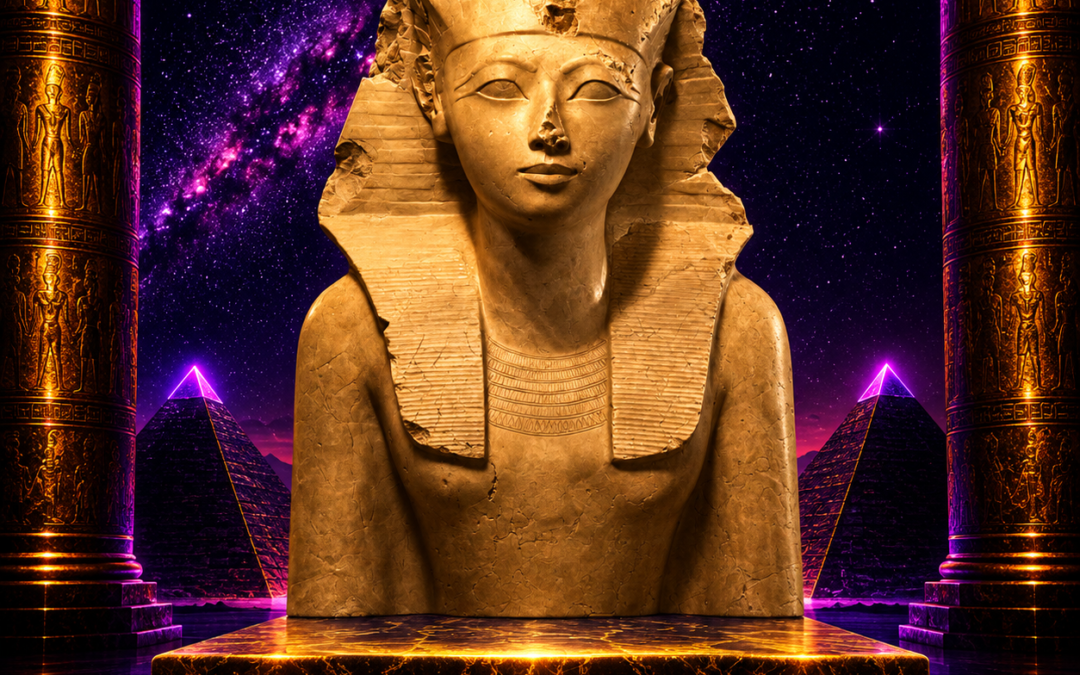
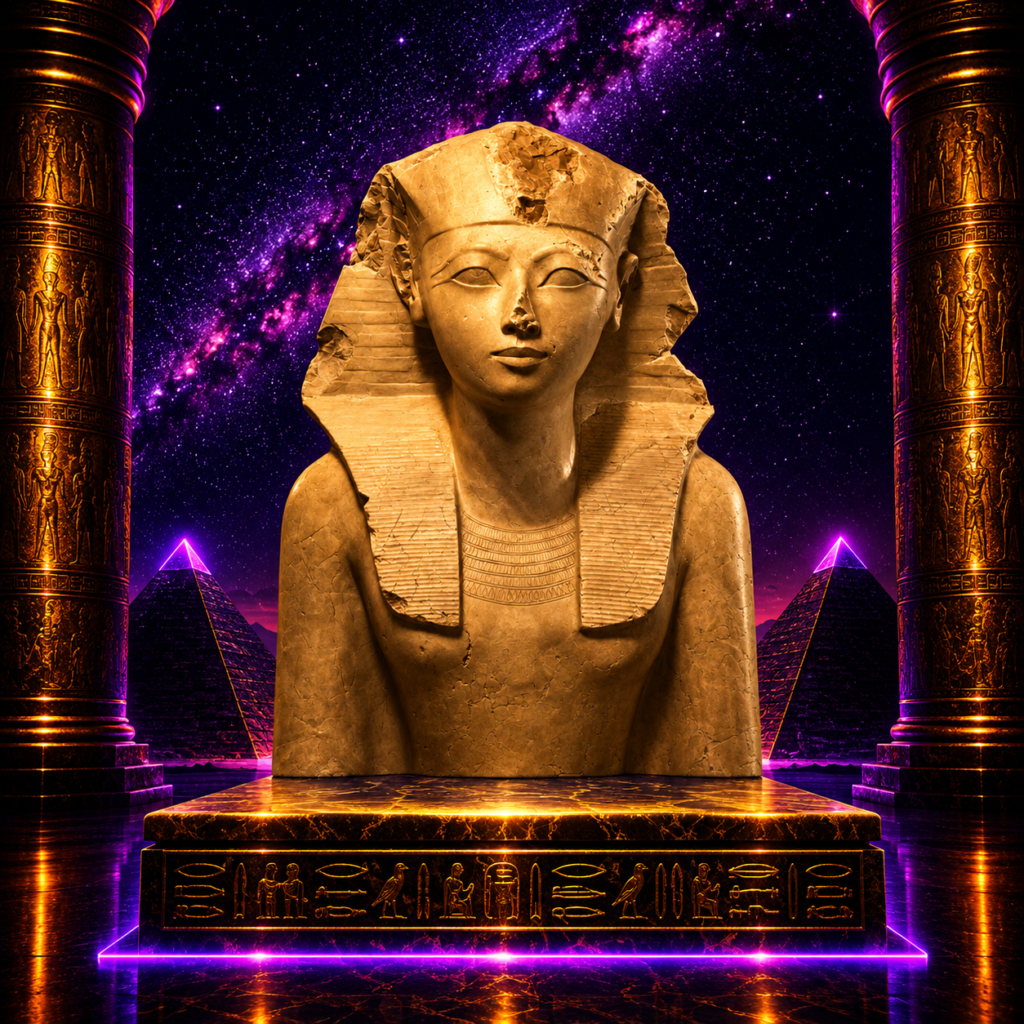
Some statues show her with the nemes headdress, royal regalia, a masculine body, and the ceremonial false beard associated with kingship.
This does not necessarily mean Hatshepsut was attempting to conceal that she was female.
Egyptian royal art was highly symbolic. Pharaohs were depicted according to conventions designed to communicate divine authority, power, legitimacy, and eternal kingship rather than simply reproduce a ruler's everyday physical appearance.
Hatshepsut's changing representation can therefore be understood as part of her adoption of the traditional role of pharaoh.
Hatshepsut's Magnificent Temple at Dear el Bahri
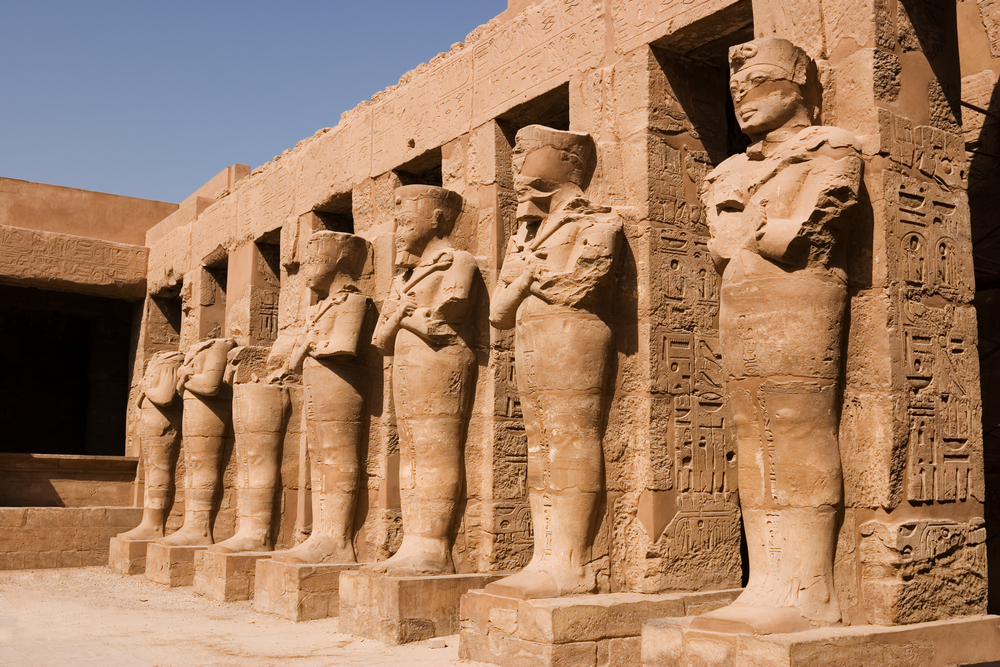
Perhaps the greatest surviving monument associated with Hatshepsut is her mortuary temple at Dear el Bahri, near modern Luxor.
Known in ancient times as Djeser Djeseru, often translated as “Holy of Holies,” the temple was constructed against the dramatic cliffs on the western side of the Nile.
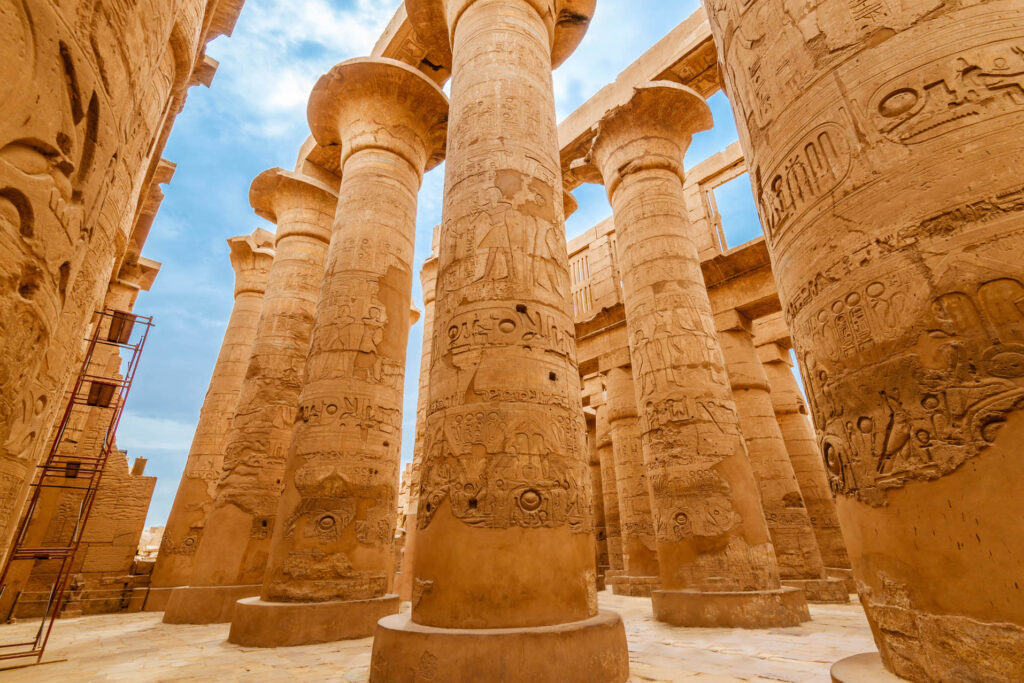
Its enormous terraces, colonnades, ramps, chapels, statues, and reliefs created one of the architectural masterpieces of the New Kingdom.
The temple was closely connected with the worship of Amun and Hatshepsut's mortuary cult. It also contained sacred spaces associated with other deities, including Hathor and Anubis.
Its walls preserve some of the most important visual records of Hatshepsut's reign.
The Famous Expedition to Punt
Among the most celebrated events depicted at Dear el Bahri is Hatshepsut's expedition to the mysterious land known to the Egyptians as Punt.
Punt had longstanding commercial connections with ancient Egypt. Scholars generally associate it with areas around the Red Sea and Horn of Africa, although its precise geographic boundaries remain debated.
Hatshepsut's reliefs depict ships traveling to Punt and returning with valuable commodities.
These included incense, myrrh, ebony, ivory, exotic animals, and other luxury goods.
Particularly remarkable are representations of living myrrh trees being transported back to Egypt.
The expedition was more than a commercial achievement. Its depiction on a royal monument communicated Hatshepsut's ability to obtain valuable resources from distant lands and maintain Egypt's international connections.
For modern historians, the Punt reliefs also provide extraordinary evidence of ancient Egyptian ships, commerce, geography, diplomacy, and interactions with neighboring African regions.
Hatshepsut's Massive Building Program
Hatshepsut was one of the New Kingdom's great builders.
Her construction projects appeared throughout Egypt, but Karnak Temple became an especially important center of her royal activity.
She commissioned enormous obelisks dedicated to Amun. One of her obelisks at Karnak remains standing today and is among the most recognizable monuments associated with her reign.
Hatshepsut proudly commemorated these projects in inscriptions.
Building temples was not simply an act of personal ambition. Egyptian kings used construction to honor the gods, demonstrate royal legitimacy, celebrate political achievements, preserve their names, and participate symbolically in maintaining cosmic order.
Hatshepsut understood the extraordinary power of monumental architecture.
Thousands of years later, her monuments are still accomplishing what Egyptian royal architecture was designed to do.
They preserve the memory of the king.
Hatshepsut and the God Amun
Religion played a central role in Hatshepsut's kingship.
The cult of Amun, particularly Amun Ra, had become increasingly influential during the New Kingdom. Hatshepsut strongly associated herself with the deity and invested heavily in his religious institutions.
Her monuments described divine support for her rule and emphasized her special relationship with Amun.
This connection helped reinforce her legitimacy.
The relationship between Egyptian religion and political authority was deeply intertwined. Pharaoh was not simply a political leader in the modern sense. Egyptian kingship carried sacred responsibilities involving the gods, temples, offerings, Maat, and the preservation of cosmic order.
Hatshepsut presented herself as fully capable of performing these responsibilities.
Hatshepsut's relationship with Thutmose III is sometimes portrayed as a dramatic struggle for the throne, but the surviving evidence presents a more complicated picture.
Thutmose III remained king during Hatshepsut's reign and appeared with her on monuments. He was not simply removed from royal life.
After Hatshepsut's death, Thutmose III became the sole ruler and eventually developed a reputation as one of ancient Egypt's most successful military pharaohs.
Years later, however, something unusual happened.
Images and names of Hatshepsut began to disappear.
Why Was Hatshepsut Erased From History?
One of the greatest mysteries surrounding Hatshepsut concerns the destruction of her memory.
Her names were removed from certain monuments. Statues were damaged, altered, buried, or destroyed. Images of Hatshepsut were chiseled away in selected locations.
For many years, this destruction encouraged a dramatic interpretation: Thutmose III hated his stepmother and sought revenge after finally gaining control.
Modern scholarship has made that explanation considerably less certain.
Importantly, much of the campaign against Hatshepsut appears to have occurred years after her death, rather than immediately afterward.
This delayed timing has encouraged historians to consider political and dynastic explanations.
One possibility is that removing Hatshepsut from the official sequence of kings helped reinforce a conventional male line of succession, particularly as Thutmose III prepared the future succession of his son Amenhotep II.
The exact motivations remain debated.
What is clear is that the destruction was selective and significant enough to obscure Hatshepsut's unusual kingship for centuries.
Rediscovering the Female Pharaoh
The attempt to diminish Hatshepsut's royal identity ultimately failed.
Archaeologists and Egyptologists gradually reconstructed her history through surviving inscriptions, statues, temples, reliefs, and archaeological discoveries.
Her monuments revealed something extraordinary.
The apparently male king represented on some monuments and the royal woman Hatshepsut were the same ruler.
Modern archaeological work at Dear el Bahri and other locations has continued to reveal information about her reign, officials, religious program, architecture, and royal identity.
Today, Hatshepsut has reclaimed her place among the most important rulers of ancient Egypt.
The Mystery of Hatshepsut's Mummy
The identification of Hatshepsut's mummy has generated considerable attention and debate.
In 2007, Egyptian authorities announced that a female mummy from tomb KV60 in the Valley of the Kings had been identified as Hatshepsut. The proposed identification involved archaeological evidence and comparisons involving a tooth reportedly associated with Hatshepsut.
The identification became widely publicized, but scholars have continued to discuss the strength of the evidence.
Because ancient remains present difficult archaeological and scientific challenges, conclusions surrounding royal mummy identification should be treated carefully when evidence remains disputed.
The continuing investigation illustrates how archaeology can transform our understanding of individuals who lived more than three thousand years ago.
What Did Hatshepsut Accomplish?
Hatshepsut's reign demonstrates that political power in ancient Egypt could sometimes operate beyond the expectations we might assume existed in the ancient world.
Her accomplishments included extensive monumental construction, temple restoration and expansion, international commerce, religious patronage, and the strengthening of royal institutions.
She also created one of the most distinctive presentations of kingship in Egyptian history.
Rather than abandoning the institution because its imagery had traditionally been masculine, Hatshepsut adapted herself to its symbols while simultaneously preserving references to her identity as a woman.
That makes her reign especially valuable for understanding how ancient Egyptians conceptualized gender, political authority, religion, and kingship.
Hatshepsut's Powerful Legacy
Hatshepsut ruled more than three thousand years ago, yet her story remains remarkably compelling.
She inherited a political situation in which she was expected to serve as regent for a young king. She ultimately transformed that position into full pharaonic authority.
She constructed monumental temples.
She raised enormous obelisks.
She celebrated expeditions to distant lands.
She presented herself as chosen by the gods.
And when later generations attempted to remove portions of her royal identity from Egypt's monuments, enough evidence survived for history to reconstruct her remarkable reign.
Hatshepsut's story is therefore not simply the story of a female ruler.
It is the story of power, legitimacy, transformation, memory, and survival in one of the world's most influential ancient civilizations.
Her monuments still rise above the Egyptian landscape, reminding the world that even an attempted erasure could not completely silence one of ancient Egypt's most extraordinary pharaohs.
Frequently Asked Questions About Hatshepsut
Was Hatshepsut really a pharaoh?
Yes. Hatshepsut adopted the full titles, regalia, and political and religious responsibilities associated with Egyptian kingship. She ruled as pharaoh during Egypt's 18th Dynasty.
Was Hatshepsut the first female pharaoh?
No. Women ruled Egypt before Hatshepsut. Earlier female rulers included Sobekneferu of the 12th Dynasty. Hatshepsut is significant because of the length, prosperity, monumental scale, and documentation of her reign.
Why did Hatshepsut wear a false beard?
The ceremonial beard was part of traditional Egyptian royal iconography. Hatshepsut's use of masculine royal symbols represented her status as pharaoh rather than necessarily an attempt to disguise her sex.
What is Hatshepsut most famous for?
Hatshepsut is especially famous for becoming pharaoh, her monumental building projects, her mortuary temple at Dear el Bahri, her obelisks at Karnak, and the celebrated trading expedition to Punt.
Who ruled after Hatshepsut?
Thutmose III, who had technically ruled alongside Hatshepsut, became the sole pharaoh following her death.
Why was Hatshepsut's name erased?
Parts of Hatshepsut's royal imagery and names were deliberately removed after her death. Scholars continue to debate the precise motivation, although dynastic succession and the desire to reshape the official royal lineage are important explanations.
Final Thoughts
Hatshepsut remains one of the most fascinating figures in the history of ancient Kemet.
Her reign reveals a civilization in which political authority, divine legitimacy, architecture, trade, symbolism, and remembrance were deeply interconnected.
Attempts to erase her could damage stone, remove names, and destroy statues.
They could not erase her completely.
More than three millennia later, Hatshepsut stands again among the great pharaohs of ancient Egypt, her temple beneath the cliffs of Dear el Bahri serving as one of the most spectacular surviving monuments to her reign.
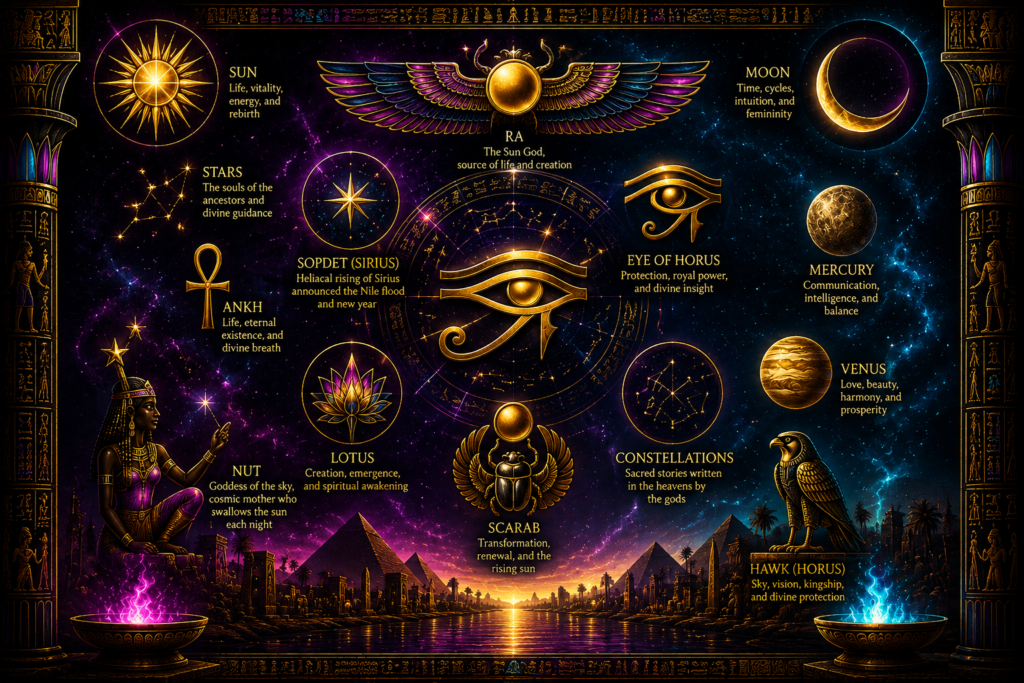
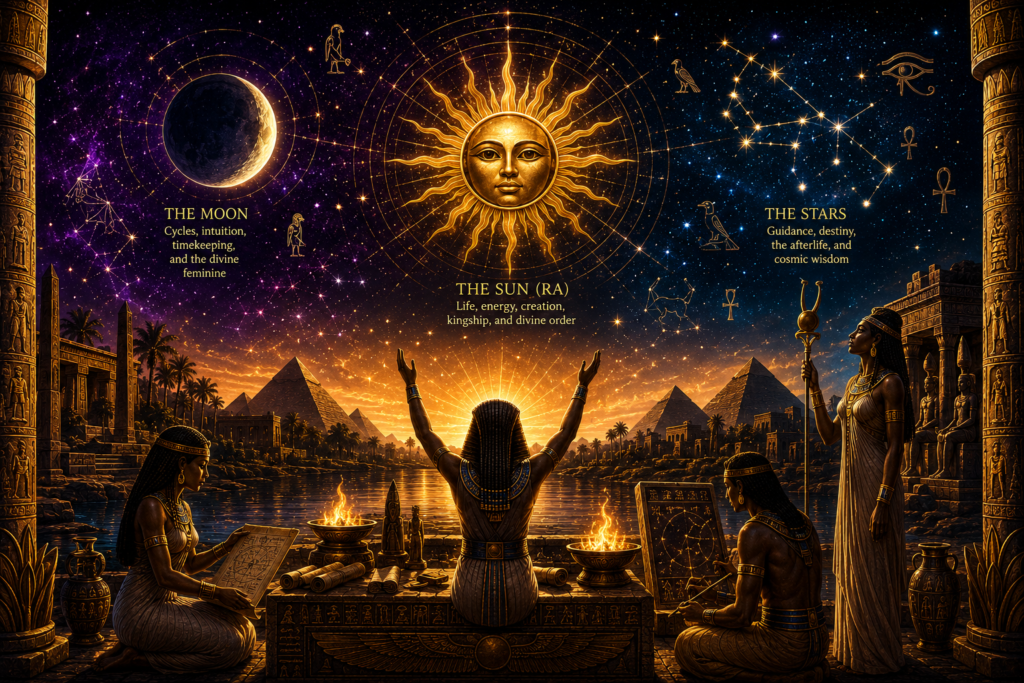
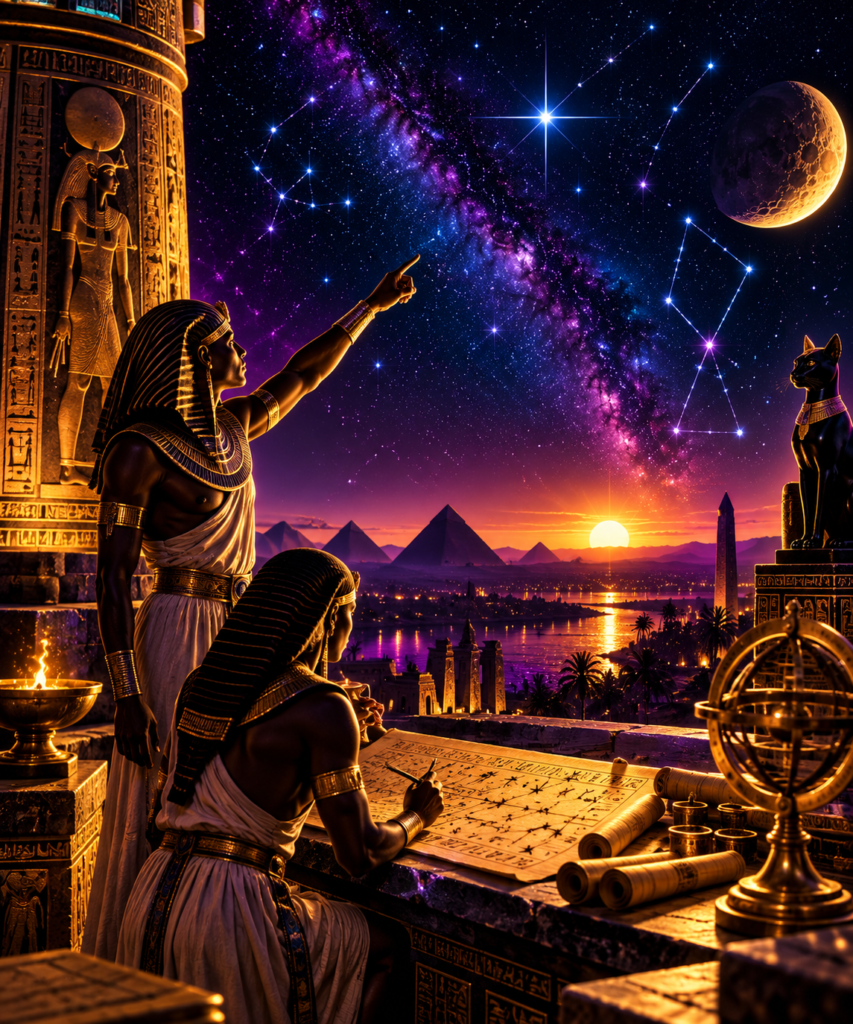
For thousands of years, the people of ancient Egypt carefully observed the Sun, Moon, stars, planets, and recurring movements of the night sky. These observations were connected to far more than curiosity about the heavens. Celestial cycles helped ancient Egyptians measure time, organize calendars, express religious ideas, understand cycles of renewal, and represent the structure of the cosmos.
Ancient Egyptian celestial symbols therefore carried layers of meaning. The Sun could represent divine power and regeneration. Stars could be associated with eternity and the afterlife. Sopdet, identified with Sirius, became connected with an important seasonal transition. Nut embodied the sky itself, while groups of stars now called decans were incorporated into systems for measuring the passage of the night.
These traditions belonged to an ancient African civilization whose astronomical knowledge developed over many centuries.
It is important, however, to distinguish this Egyptian celestial tradition from the popular idea of modern astrology. The evidence from ancient Egypt is strongest for astronomical observation, calendars, timekeeping, religious symbolism, funerary traditions, and cosmology. The familiar twelve-sign zodiac became prominent in Egypt much later.
To understand ancient Egyptian celestial symbols accurately, we must begin with the Egyptians' own sky.
The Sun: Divine Power, Life, and Renewal
Few celestial objects were as important to ancient Egyptian culture as the Sun.
Its daily journey across the sky provided a visible cycle of appearance, disappearance, and return. Egyptian religious traditions transformed this recurring natural phenomenon into a powerful expression of cosmic regeneration.
Ra, one of ancient Egypt's major solar deities, became closely associated with the Sun, creation, kingship, life, and the maintenance of cosmic order.
Egyptian religious compositions described the solar deity traveling through the visible sky during the day and through the hidden regions of the cosmos during the night. Dawn represented the successful renewal of this journey.
The Sun therefore carried meanings extending far beyond light itself. It could symbolize:
Life
Divine authority
Kingship
Creation
Regeneration
Cosmic continuity
Solar disks appear throughout Egyptian religious imagery and could be associated with several deities.
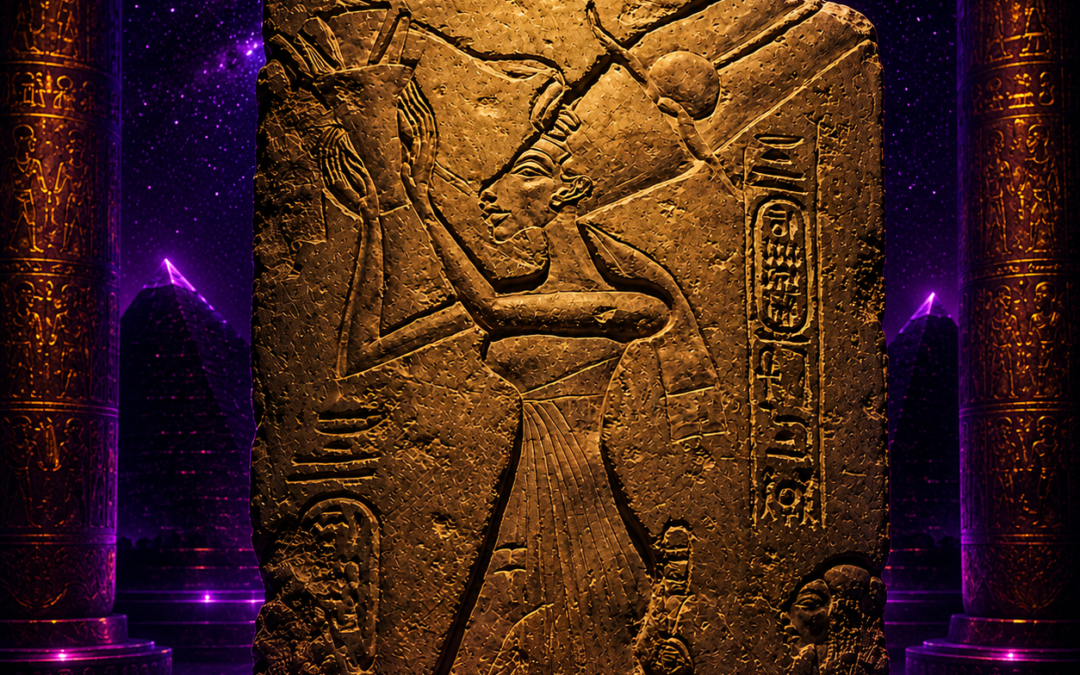
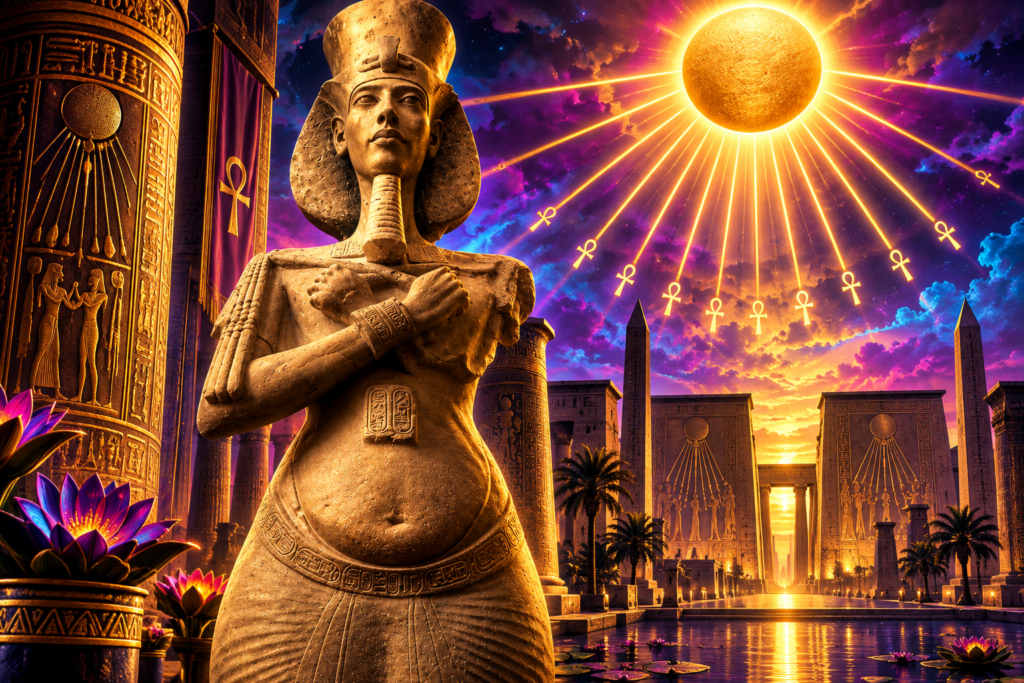
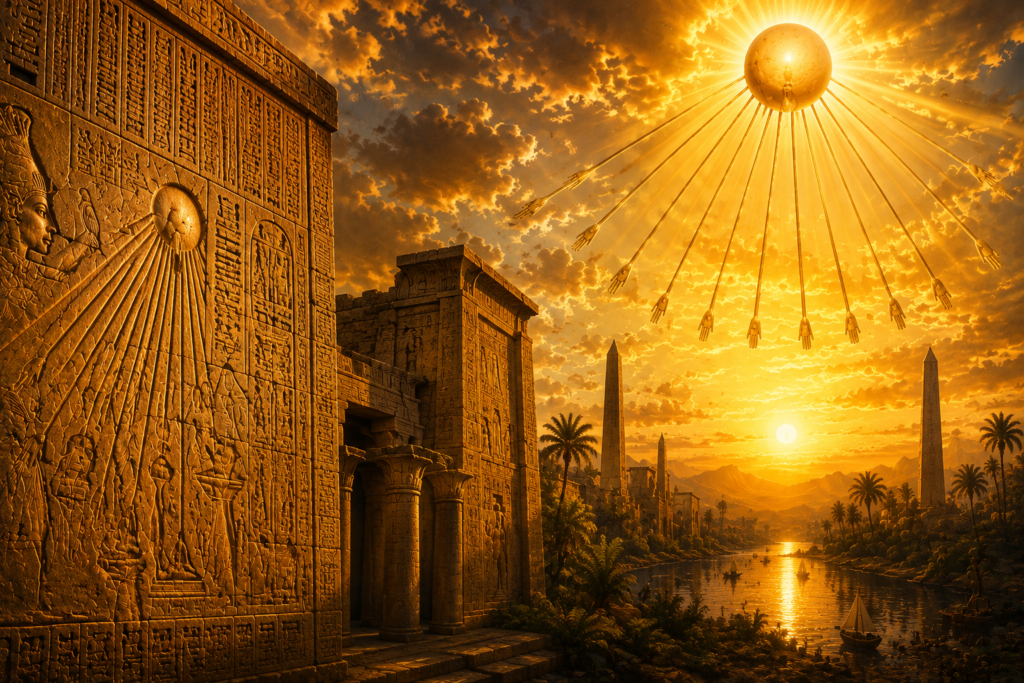
During the reign of Akhenaten, the Aten—the visible solar disk—became the center of an extraordinary transformation of royal religion. Artistic representations famously show rays descending from the disk, some terminating in hands offering life to members of the royal family.
Although Akhenaten's religious program was exceptional, reverence for solar power was deeply rooted in Egyptian culture long before his reign.
The Moon: Time, Cycles, and Renewal
The Moon also occupied an important place within ancient Egyptian understandings of the sky.
Unlike the Sun's daily rhythm, the Moon visibly changes throughout its monthly cycle. Its recurring phases provided ancient observers with another celestial means of recognizing the passage of time.
Several Egyptian deities possessed lunar associations.
Khonsu, whose major cult became especially important at Waset, modern Luxor, was strongly associated with the Moon. Thoth, the deity of writing, knowledge, reckoning, and wisdom, also acquired significant lunar connections.
Within Egyptian religious thought, the Moon could consequently become associated with ideas involving:
Time
Measurement
Cycles
Restoration
Renewal
The Egyptian Moon was therefore part of a much larger system in which observation of the natural world and religious meaning could intersect.
Stars and the Promise of Eternity
Stars possessed profound significance in ancient Egyptian religion, particularly in ideas concerning death and continued existence.
Some of Egypt's earliest surviving royal funerary writings, the Pyramid Texts, contain passages describing the deceased king ascending into the heavens and becoming associated with celestial beings and stars.
Of particular importance were stars in the northern sky that appeared never to set.
From the Egyptian observer's perspective, these stars possessed an enduring quality. Because they continually circled the northern celestial region rather than disappearing for long periods below the horizon, they became powerful images of permanence.
This made the stars particularly appropriate symbols for concepts involving:
Eternity
Immortality
Royal transformation
The celestial afterlife
Continuity beyond death
For ancient Egyptians looking upward at night, the sky could therefore represent both a physical environment and a sacred landscape.
Sopdet: Sirius and the Egyptian Year
Among all the stars known to ancient Egyptians, Sopdet held exceptional importance.
Sopdet is identified with the star we now call Sirius, the brightest star in Earth's night sky.
Ancient Egyptian observers paid particular attention to its heliacal rising—its reappearance in the eastern sky shortly before sunrise after a period during which it had not been visible.
This appearance became associated with an important seasonal transition and the beginning of the Egyptian year.
The annual inundation of the Nile was essential to Egypt's agricultural system. It replenished agricultural lands with water and fertile sediment and profoundly shaped the rhythm of life along the Nile Valley.
Sopdet's reappearance became culturally associated with this season of renewal.
However, an important distinction is necessary: Sirius and the Nile flood should not be described as remaining perfectly synchronized throughout all periods of Egyptian history.
Egypt's 365-day civil calendar lacked the extra quarter-day of the solar year, causing calendar dates to gradually shift in relation to the seasons.
The importance of Sopdet therefore demonstrates not fortune-telling, but something historically more significant: Egyptian observers recognized recurring celestial phenomena and incorporated them into systems of time, religion, and seasonal understanding.
Sah: The Celestial Figure Associated With Orion
Another prominent celestial figure was Sah.
Sah is commonly associated with the region of the sky we identify today with Orion, although ancient Egyptian constellations should not automatically be assumed to correspond perfectly to modern constellation boundaries.
Sah became closely connected with Osiris, one of the most important deities associated with death, regeneration, kingship, and the afterlife.
Egyptian astronomical representations sometimes place Sah and Sopdet within the same broader celestial environment.
Their importance illustrates how Egyptians mapped religious meaning onto the observable sky without separating astronomy, religion, and cosmology into the strict modern categories familiar today.
The stars were observable celestial bodies, but they could simultaneously participate in a sacred understanding of existence.
The Decans: Egypt's Celestial Timekeepers
Among the strongest evidence for ancient Egyptian astronomical knowledge are the star groups conventionally known today as decans.
Egyptian astronomical traditions organized decanal stars or star groups into systems connected with ten-day periods and the measurement of nighttime.
One of the most remarkable surviving forms of this knowledge appears in diagonal star tables, particularly those preserved on Middle Kingdom coffins.
These tables arranged sequences of stars across grids. Their successive appearances were used to represent the passage of the hours of the night.
A traditional Egyptian system ultimately involved 36 ten-day divisions within the 360-day portion of the year, followed by five additional days completing the 365-day civil calendar.
The decanal system should not be imagined as completely unchanged throughout Egyptian history. Star lists, astronomical representations, and methods evolved over time.
What remains clear is that ancient Egyptians developed sophisticated systems connecting observation of stars with the measurement and organization of time.
This is one of the clearest examples of practical astronomy preserved from ancient Egypt.
Star Clocks and Astronomical Ceilings
Egyptian celestial knowledge survives not only in written texts but also in spectacular visual representations.
Astronomical ceilings have been discovered in tombs and temples, where stars, planets, deities, calendars, and constellations could be represented together.
A famous example comes from the tomb of Senenmut, an important official during the reign of Hatshepsut.
Its astronomical ceiling contains representations of celestial figures alongside stars, planets, decans, and calendrical information.
Such monuments demonstrate that Egyptians did not simply observe individual stars in isolation. They developed organized ways of representing the structure and movement of the sky.
Other Egyptian astronomical sources include:
Diagonal star tables
Astronomical ceilings
Water clocks
Shadow clocks and sundials
Calendrical texts
Religious compositions concerning the heavens
Together, these surviving sources provide direct archaeological and textual evidence for Egyptian celestial knowledge.
Nut: The Sky Embodied
Few images capture ancient Egyptian cosmology more dramatically than Nut, the goddess of the sky.
Nut was often depicted as a woman arching over the Earth, sometimes with stars covering her elongated body.
Rather than simply living somewhere in the heavens, Nut could embody the sky itself.
Her body created a visual representation of the celestial realm stretching over the world below.
Egyptian religious traditions also connected Nut with the solar cycle. The Sun could be described as entering her body in the evening and emerging again with the dawn.
Nut consequently became associated with:
The sky
Stars
The solar cycle
Birth and rebirth
Protection
Regeneration
The afterlife
One of the most important Egyptian astronomical compositions known today as the Book of Nut describes aspects of the behavior of the Sun and stars within this cosmological framework.
Nut demonstrates how ancient Egyptians could transform careful observation of celestial cycles into a powerful visual and religious understanding of the universe.
The Wedjat Eye: Restoration and Celestial Meaning
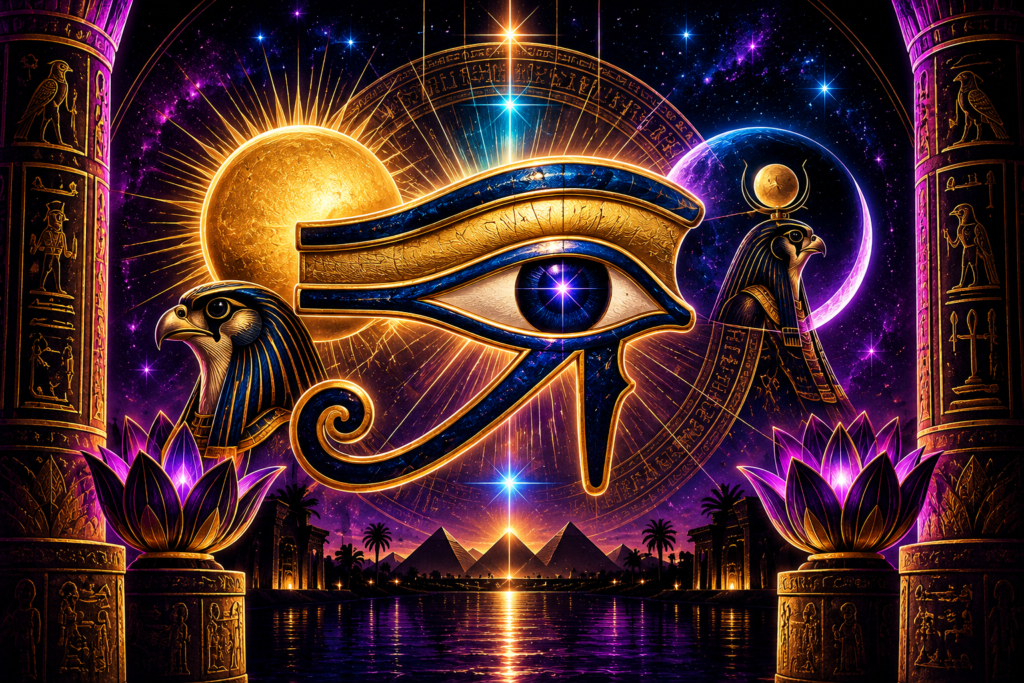
The Wedjat Eye, commonly called the Eye of Horus, is one of ancient Egypt's most recognizable symbols.
Its principal meanings concerned protection, healing, restoration, and wholeness.
Egyptian religious traditions describe the eye of Horus being damaged during conflict with Seth and subsequently restored. This restoration made the Wedjat a potent symbol of completeness and recovery.
The eyes of divine figures could also acquire solar and lunar associations in Egyptian religious thought.
However, the Wedjat should not simply be labeled an "astrology symbol."
Its historical meaning was considerably broader.
The Wedjat belonged to Egyptian religious and protective symbolism and appears extensively in amulets and funerary contexts. Any celestial interpretation should therefore remain part of that larger Egyptian religious framework.
The Ankh: The Symbol of Life
The ankh is among the most recognizable symbols surviving from ancient Egypt.
Its fundamental meaning was life.
Egyptian artworks frequently depict deities holding an ankh or extending it toward the king. In these scenes, the symbol communicates the divine granting or sustaining of life.
The ankh was not an astrological sign.
Its relevance to Egyptian celestial symbolism comes from the wider Egyptian understanding of the cosmos as a divinely ordered environment in which life, nature, kingship, and divine forces were interconnected.
Understanding this distinction prevents modern spiritual interpretations from replacing the meanings supported by ancient Egyptian evidence.
Ma'at: Cosmic Order and Balance
To understand how Egyptians viewed the heavens, we must also understand Ma'at.
Ma'at encompassed interconnected concepts of truth, justice, balance, right order, and cosmic stability.
The Egyptians experienced a world filled with recurring patterns.
Day followed night.
The Sun disappeared and returned.
Stars moved across the heavens.
Seasons changed.
The Nile followed recurring environmental rhythms.
Against this background, the predictable behavior of the heavens could be understood as part of a larger ordered cosmos.
Egyptian kingship itself was deeply connected with maintaining Ma'at. The king was expected to preserve proper order against destructive disorder.
Celestial cycles therefore belonged to something larger than astronomy. They existed within an Egyptian worldview concerned with maintaining the balance necessary for life and society.
Egyptian Cosmology in Its African Setting
Ancient Egypt developed in northeastern Africa, with the Nile connecting communities across Egypt and regions farther south.
Understanding Egyptian celestial traditions within this African geography is essential.
African scholars have long argued that ancient Egypt should be studied within African history rather than isolated from the continent. Senegalese scholar Cheikh Anta Diop, in particular, challenged approaches that separated Egyptian civilization from its African setting and emphasized the importance of examining Egyptian religion, philosophy, language, and culture within African historical study.
Modern scholarship continues to debate many questions concerning cultural relationships across ancient Africa, and individual historical claims must be evaluated according to archaeological, linguistic, textual, and biological evidence.
Yet the geographical foundation is unmistakable: ancient Egyptian civilization developed on the African continent, within a Nile Valley environment that connected Egypt with neighboring African regions.
Celestial observation was therefore one expression of an African civilization's sustained effort to understand nature, time, life, death, and the structure of the universe.
Did Ancient Egyptians Practice Astrology?
This question requires careful terminology.
Ancient Egyptians unquestionably observed the heavens.
They tracked celestial cycles, created calendars, developed stellar timekeeping systems, represented constellations and planets, incorporated celestial phenomena into religious traditions, and produced astronomical diagrams.
That does not mean that the familiar modern system of twelve zodiac personality signs existed throughout pharaonic Egyptian history.
It did not.
The twelve-sign zodiac familiar from later astrology entered Egyptian visual and intellectual culture much later, after zodiac traditions developed elsewhere and circulated throughout the ancient Mediterranean and Near Eastern worlds.
Late Egyptian monuments such as the famous zodiac at Dendera demonstrate this later interaction.
For an article focused on ancient Egyptian celestial symbolism, however, this later development should not overshadow Egypt's much older indigenous traditions.
Long before zodiac imagery appeared in Egypt, Egyptians were observing Sopdet, Sah, decanal stars, the Sun, Moon, planets, and northern stars and integrating celestial cycles into their understanding of time and the cosmos.
Did Celestial Symbols Predict Individual Fate?
Claims that ancient Egyptians routinely used celestial symbols to determine everyone's personality or individual destiny should be approached cautiously.
Evidence from pharaonic Egypt strongly supports the use of celestial observation in:
Calendars
Nighttime measurement
Religious ritual
Temple and funerary symbolism
Seasonal organization
Royal ideology
Cosmology
Concepts of death and regeneration
That evidence does not justify transforming every Egyptian deity or sacred symbol into a zodiac personality sign.
Modern systems sometimes assign Egyptian gods to birthdays, personality traits, or zodiac signs, but these should not automatically be presented as traditions originating in the earliest periods of ancient Egypt.
The historically documented Egyptian relationship with the heavens is compelling without adding unsupported claims.
What Ancient Egyptian Celestial Symbols Really Tell Us
Ancient Egyptian celestial symbols reveal a civilization paying extraordinarily close attention to recurring patterns in nature.
The Sun demonstrated renewal and divine power.
The Moon provided visible cycles connected with time and restoration.
Sopdet marked an important celestial and seasonal transition.
Sah linked a recognizable region of the night sky with Egyptian religious traditions concerning Osiris.
The decanal stars helped organize nighttime.
Nut transformed the entire sky into divine imagery.
The Wedjat represented restoration and protection while acquiring celestial associations.
The ankh expressed life.
And Ma'at provided a broader concept through which cosmic stability, social order, and proper balance could be understood.
These symbols were not isolated mystical icons.
Together, they belonged to a sophisticated Egyptian way of observing and representing the universe.
The Enduring Legacy of Ancient Egypt's Celestial Symbols
Ancient Egyptians left behind one of Africa's most extraordinary records of sustained engagement with the heavens.
Coffins preserve star tables. Tombs contain astronomical ceilings. Religious texts describe celestial journeys. Temples preserve images of sky deities, solar cycles, stars, and planets. Surviving timekeeping instruments demonstrate attempts to measure the passage of hours.
The evidence reveals a civilization in which the observable sky, sacred tradition, time, kingship, death, regeneration, and cosmic order could exist within an interconnected worldview.
Ancient Egyptian celestial symbols should therefore be understood first within the civilization that created them.
Doing so moves us beyond the popular image of a mysterious "Egyptian zodiac" and toward something supported far more strongly by the surviving evidence: an ancient African civilization that carefully observed the heavens and transformed those observations into systems of timekeeping, religious expression, and powerful ideas about humanity's place within an ordered cosmos.
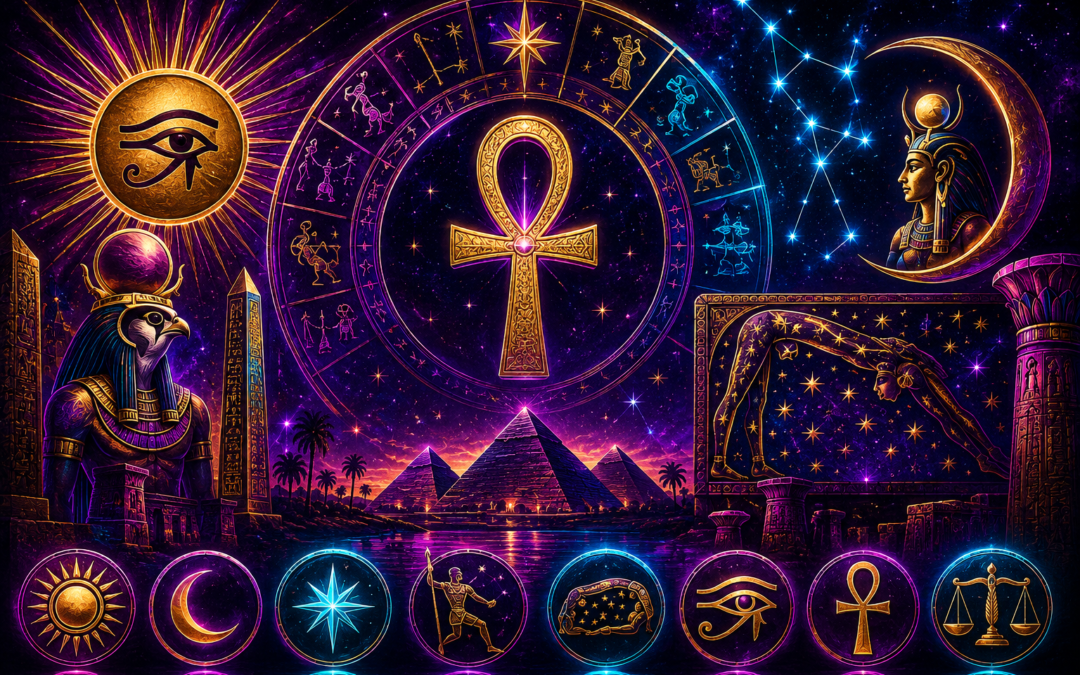
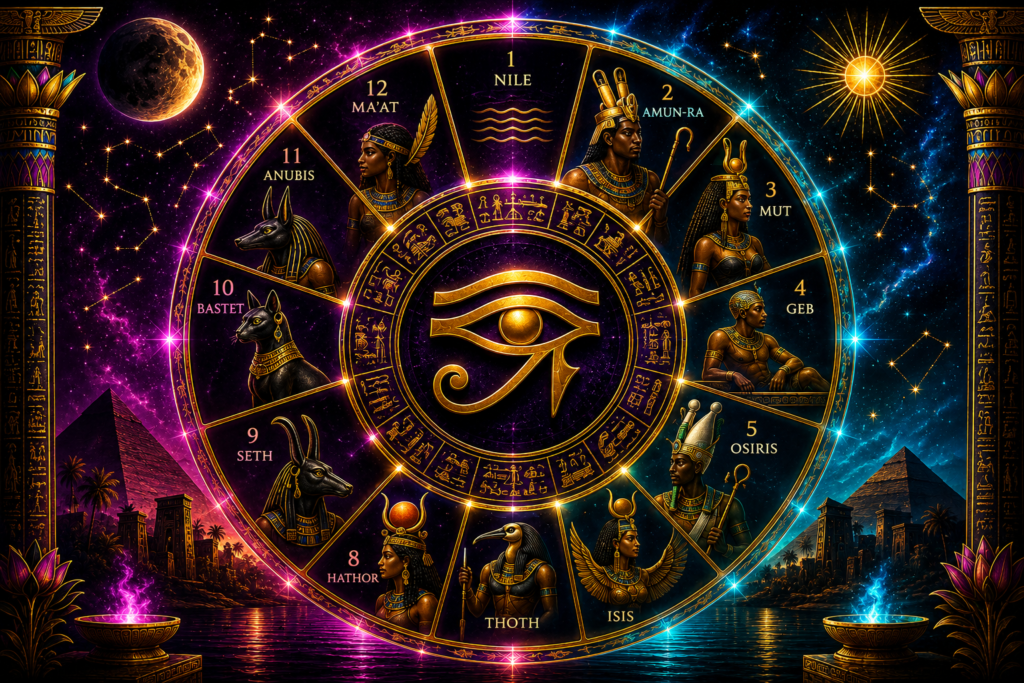
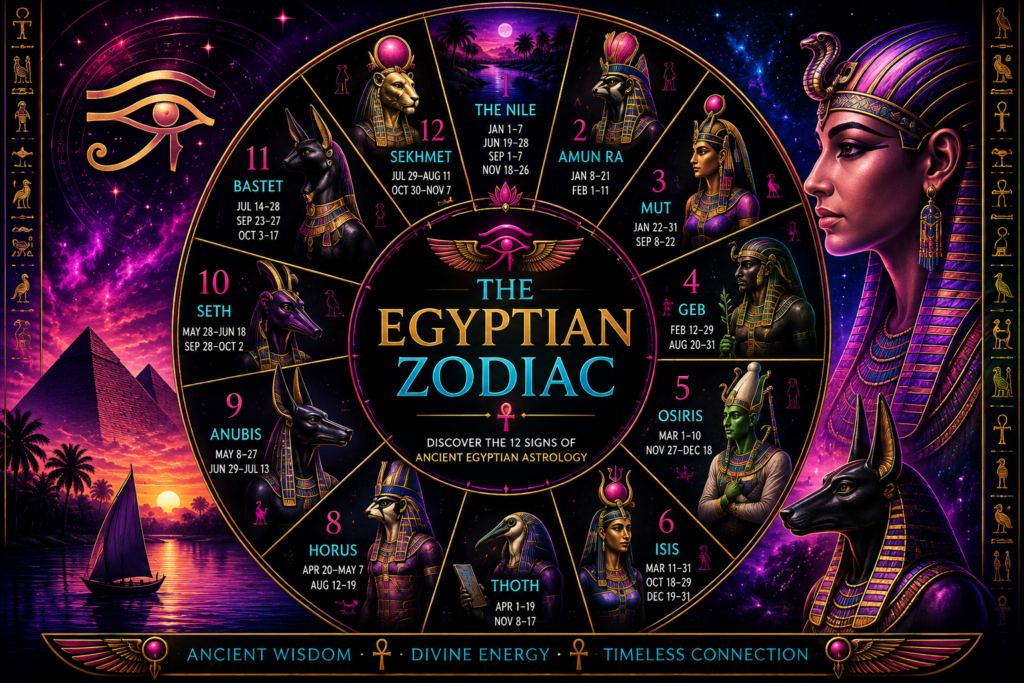
Search for the Egyptian zodiac today and you will often encounter twelve signs associated with Egyptian deities and sacred figures such as Amun-Ra, Mut, Geb, Osiris, Aset (Isis), Djehuty (Thoth), Horus, Anpu (Anubis), Set, Bastet, and Sekhmet.
These signs are commonly assigned birth dates and personality traits, creating what is often called the 12 signs of the Egyptian zodiac.
There is one important historical distinction, however: this popular twelve-deity birth-sign system is not known from surviving ancient Egyptian texts as an original pharaonic zodiac.
Ancient Egyptians absolutely possessed sophisticated traditions for observing the sky, measuring time, organizing calendars, tracking stars, and connecting celestial phenomena with religion. But the evidence they left behind reveals something considerably more complex than the modern Egyptian zodiac found online.
To understand the Egyptian zodiac accurately, we therefore need to separate two subjects:
the popular modern Egyptian zodiac inspired by Egyptian deities, and the documented astronomical and celestial traditions of ancient Kemet.
Let's explore both.
What Is the Egyptian Zodiac?
The term Egyptian zodiac is commonly used today for a twelve-sign astrological system in which different periods of the year are assigned to Egyptian gods, goddesses, or sacred concepts.
The twelve commonly presented signs are:
The Nile
Amun-Ra
Mut
Geb
Osiris
Aset (Isis)
Djehuty (Thoth)
Horus
Anpu (Anubis)
Set
Bastet
Sekhmet
You'll frequently find these signs accompanied by birth dates and descriptions of supposed personality characteristics.
These associations can provide an interesting modern spiritual or astrological way of exploring Egyptian deities, but they should not be confused with a documented system used by Egyptians during the pharaonic periods.
No surviving ancient Egyptian source currently establishes this exact collection of twelve deities as birth signs with the modern date ranges and personality profiles commonly reproduced today.
Ancient Egyptian astronomical traditions were extensive, and the surviving evidence allows us to explore what Egyptians actually recorded about the heavens.
The 12 Popular Egyptian Zodiac Signs
The following are the twelve signs most commonly encountered in the modern Egyptian zodiac.
The personality descriptions associated with them belong to modern astrological interpretation rather than documented ancient Egyptian teachings.
1. The Nile
The Nile is commonly presented as the first Egyptian zodiac sign.
Modern interpretations associate this sign with peacefulness, adaptability, intuition, and wisdom.
Historically, however, the Nile was far more than an astrological symbol. Its cycles shaped agriculture, settlement, transportation, religious practice, and the economic foundations of Egyptian civilization.
Modern associations: Adaptability, intuition, peacefulness and awareness.
2. Amun-Ra
Amun-Ra combines Amun, an enormously important deity whose prominence increased dramatically during the New Kingdom, with Ra, one of Egypt's major solar deities.
Modern Egyptian zodiac traditions associate Amun-Ra with leadership, confidence, ambition, and optimism.
These personality characteristics should be understood as modern zodiac interpretations, not personality descriptions assigned to people born under Amun-Ra in surviving pharaonic texts.
Modern associations: Leadership, confidence, ambition and determination.
3. Mut
Mut was an important Egyptian goddess whose name is closely connected with the concept of mother.
She became particularly prominent at Waset, modern Luxor, where she was associated with Amun and Khonsu.
In modern Egyptian zodiac systems, Mut is associated with loyalty, protection, patience, and nurturing qualities.
Modern associations: Protection, loyalty, patience and compassion.
4. Geb
Geb was an Egyptian deity associated with the earth and an important figure within Egyptian creation traditions.
He was connected genealogically with Shu and Tefnut and with the sky goddess Nut.
Modern Egyptian zodiac interpretations describe people associated with Geb as dependable, sensitive, practical, and grounded.
Modern associations: Stability, sensitivity, reliability and connection with nature.
5. Osiris
Osiris, whose Egyptian name is conventionally rendered Wesir or Wsir, became one of the most important deities in Egyptian religious history.
He was profoundly associated with death, regeneration, legitimate kingship and the afterlife.
Modern zodiac traditions associate the Osiris sign with independence, resilience, passion, and personal transformation.
Modern associations: Resilience, independence, determination and transformation.
6. Aset (Isis)
Aset, better known internationally by the later name Isis, was among the most influential goddesses of ancient Egypt.
Her roles encompassed motherhood, protection, kingship, healing and powerful divine magic. She was the wife of Osiris and mother of Horus within one of Egypt's most enduring religious traditions.
Modern Egyptian zodiac systems associate Aset with compassion, loyalty, protection, confidence, and devotion.
Modern associations: Compassion, protection, loyalty and determination.
7. Djehuty (Thoth)
Djehuty, commonly known by the later name Thoth, was closely associated with writing, knowledge, calculation, wisdom and the moon.
He occupied an extraordinary intellectual role within Egyptian religion and appears repeatedly in religious and funerary texts.
Modern zodiac interpretations associate Djehuty with intelligence, curiosity, communication, creativity, and analytical thinking.
Modern associations: Intelligence, curiosity, communication and creativity.
8. Horus
Horus was one of ancient Egypt's most enduring divine figures.
Usually represented as a falcon or falcon-headed deity, Horus was intimately connected with kingship, royal legitimacy, protection and the sky.
Living Egyptian kings could be identified with Horus through royal ideology.
Modern Egyptian zodiac systems consequently associate Horus with leadership, courage, ambition and confidence.
Modern associations: Courage, leadership, protection and ambition.
9. Anpu (Anubis)
Anpu, commonly known today as Anubis, was closely associated with cemeteries, embalming, funerary rituals and protection of the deceased.
His recognizable jackal or jackal-headed imagery became one of the most famous visual traditions of ancient Egypt.
Modern Egyptian zodiac interpretations associate Anpu with independence, introspection, observation, mystery and emotional depth.
Modern associations: Independence, observation, introspection and determination.
10. Set
Set was a complicated and powerful Egyptian deity.
His roles changed considerably across Egyptian history. He could be associated with the desert, storms, strength, disorder and conflict, yet Egyptian religious tradition cannot accurately be reduced to the idea that Set was simply an embodiment of “evil.”
Modern zodiac systems associate Set with boldness, independence, competitiveness and adventurousness.
Modern associations: Boldness, independence, strength and determination.
11. Bastet
Bastet was an important Egyptian goddess whose character and iconography developed significantly over Egypt's long history.
She became particularly associated with protection, domestic life, fertility, women, music and feline imagery.
Modern Egyptian zodiac interpretations associate Bastet with intuition, independence, charm and protection.
Modern associations: Intuition, independence, protection and harmony.
12. Sekhmet
Sekhmet was the formidable lioness goddess whose powers could encompass destruction, warfare, royal protection, disease and healing.
This combination of destructive and restorative power illustrates how Egyptian deities could embody forces that modern categories sometimes struggle to capture.
Modern Egyptian zodiac traditions associate Sekhmet with discipline, strength, courage and intensity.
Modern associations: Strength, discipline, courage and passion.
Did Ancient Egyptians Actually Have a Zodiac?
This question requires a careful answer.
Ancient Egyptians developed extensive astronomical, calendrical and celestial traditions, but the popular twelve-deity Egyptian zodiac described above is not currently documented as a pharaonic birth-sign system.
The evidence instead reveals Egyptians observing the movement of stars, organizing time through celestial phenomena and incorporating the sky into religious understandings of the cosmos.
One of the most important components of this tradition involved star groups now commonly called decans.
The Decans: A Genuine Ancient Egyptian Celestial System
Long before the famous circular zodiac at Dendera was created, Egyptians were recording groups of stars used in systems for tracking the night.
Modern Egyptology commonly refers to these star groups as decans.
Sequences of these celestial groups appear in some of ancient Egypt's remarkable diagonal star tables, including examples preserved on Middle Kingdom coffins.
The star groups appeared at regular intervals through the year and could be used to mark portions of the night.
This is an essential distinction for anyone researching ancient Egyptian astrology and astronomy.
The decans are supported by actual Egyptian archaeological and textual evidence. The popular twelve deity-based personality signs are not documented in the same way.
Egyptian Star Clocks and the Measurement of Night
Ancient Egyptian interest in the sky was practical, religious and intellectual.
Diagonal star tables arranged celestial information in a systematic fashion. Sequences of stars could help identify the progression of nighttime hours.
Later astronomical ceilings provide additional evidence.
One particularly important example survives from the tomb of Senenmut, a high official during the reign of Hatshepsut in the Eighteenth Dynasty.
Its astronomical ceiling depicts celestial figures and contains information concerning stars, planets, decans, months and divisions of time.
These surviving records demonstrate something far more substantial than a generalized claim that Egyptians “believed in astrology.”
They demonstrate systematic observation and organization of celestial phenomena within an Egyptian cultural and religious framework.
Sopdet: One of Ancient Egypt's Most Important Stars
Few stars were as culturally significant in Egypt as Sopdet, the brilliant star known today as Sirius.
The reappearance of Sopdet in the predawn sky after a period of invisibility became associated with Egyptian calendrical traditions and the approach of the Nile's inundation.
The Nile flood itself ultimately depended upon seasonal rainfall far to Egypt's south in the African interior, particularly the Ethiopian highlands.
This relationship connected Egyptian civilization to a much larger African environmental system.
Sopdet also possessed religious significance and became closely associated with Aset.
Rather than simply assigning a personality type to someone born beneath a zodiac sign, Egyptian celestial traditions integrated time, environment, kingship, religion, agriculture and the cosmos.
The Ancient Egyptian Calendar and the Heavens
Egyptian civilization developed a civil calendar of 365 days.
It consisted of twelve months containing thirty days each, producing 360 days, followed by five additional days.
The year was also organized around three major seasons:
Akhet — associated with inundation
Peret — associated with emergence and growing
Shemu — associated with harvest and the dry season
The Egyptian calendar demonstrates how observations of nature and the heavens became incorporated into systems that organized society and ritual life.
Egyptian celestial knowledge was therefore not an isolated practice.
It was part of the way Egyptians understood time itself.
Nut and the Egyptian Vision of the Sky
The heavens also possessed profound religious meaning.
Nut, the Egyptian sky goddess, could be depicted arching across the world, her body filled with stars.
Egyptian religious texts describe celestial cycles involving the sun and stars moving through the cosmic realm.
This imagery illustrates an important feature of Egyptian thought: astronomy and religion were not necessarily separated into the modern categories we use today.
Observation of celestial cycles existed within a worldview in which the universe itself possessed sacred order and meaning.
What About the Dendera Zodiac?
No discussion of the Egyptian zodiac would be complete without the famous Dendera Zodiac.
The circular relief comes from the Temple of Hathor complex at Dendera in Upper Egypt and is now preserved at the Louvre.
It includes representations of zodiac figures, constellations, decans and Egyptian divine imagery.
However, its date is crucial.
The surviving circular zodiac is generally dated to approximately 50 BCE, during the Ptolemaic period, thousands of years after the beginnings of Egyptian civilization.
By this period Egypt had experienced centuries of interaction with neighboring cultures.
The Dendera Zodiac therefore provides extraordinary evidence for late Egyptian celestial traditions and the adaptation of zodiac imagery within an Egyptian religious environment.
It should not be projected backward thousands of years as evidence that Old Kingdom or Middle Kingdom Egyptians practiced the same twelve-sign zodiac system.
That distinction is essential.
Egyptian Astronomy Was Part of an African Intellectual Tradition
Ancient Egypt developed within northeastern Africa, and its astronomical achievements belong within the history of African knowledge and civilization.
This context deserves particular attention.
Senegalese scholar Cheikh Anta Diop repeatedly argued for recognizing ancient Egypt as fundamental to understanding African history and intellectual development. His work addressed Egyptian mathematics, astronomy, calendrical knowledge, cultural history and Egypt's relationship with the wider African continent.
Individual chronological reconstructions proposed by Diop, like those proposed by other scholars, remain subjects for scholarly examination rather than facts that should simply be repeated without qualification.
But his broader insistence that ancient Egyptian science be examined within African history rather than detached from Africa remains important to the way Kemet Hive approaches the subject.
Egypt's astronomical traditions should therefore be understood simultaneously as Egyptian achievements and as part of the extraordinarily deep history of intellectual activity on the African continent.
Egyptian Zodiac vs. Ancient Egyptian Astronomy
Understanding the distinction between the two actually makes ancient Egypt more interesting.
The modern Egyptian zodiac provides twelve deity-inspired signs associated with birth dates and personality characteristics.
Documented ancient Egyptian celestial traditions provide something different:
star clocks, decans, astronomical ceilings, calendars, observations of Sopdet, celestial deities, religious texts and systems for organizing the passage of time.
The latter are supported directly by surviving artifacts and inscriptions.
The former is better understood as a modern astrological tradition inspired by Egyptian religion.
Both can be discussed, but they should not be presented as the same thing.
So What Is Your Egyptian Zodiac Sign?
Readers interested in modern Egyptian astrology can still explore the twelve popular signs and discover which deity is traditionally assigned to their birth period.
But instead of stopping with a personality description, use that sign as an invitation to investigate the actual Egyptian deity behind the modern association.
If your modern sign is Aset, learn about Aset's historical role in Egyptian religion.
If it is Djehuty, explore Egyptian writing, wisdom and lunar traditions.
If it is Anpu, investigate Egyptian embalming and funerary practices.
If it is Sekhmet, examine her complex relationship with protection, healing and destructive divine power.
That approach transforms a modern zodiac curiosity into an opportunity to discover authentic Egyptian history.
The Powerful Truth Behind the Egyptian Zodiac
Ancient Egyptians did not need the modern twelve-deity zodiac to demonstrate an extraordinary understanding of the heavens.
Their surviving monuments and texts reveal generations of observation.
They watched stars rise and disappear. They organized nighttime through celestial movements. They developed calendars. They connected Sopdet with cycles of the year. They recorded star groups on coffins and astronomical information on tomb ceilings. They incorporated celestial bodies into some of their most profound ideas about existence, death, regeneration and cosmic order.
The popular 12 signs of the Egyptian zodiac can therefore serve as an accessible introduction to Egyptian symbolism, but they should never replace the documented history.
The authentic story is richer.
Ancient Kemet possessed a sophisticated celestial tradition rooted in observation, religion, timekeeping, the Nile environment and an African understanding of humanity's relationship with the cosmos.
And thousands of years later, the surviving evidence continues to reveal just how closely ancient Egyptians watched the sky.
Long before modern observatories and mechanical clocks, the people of ancient Egypt watched the sky with remarkable attention.
The rising and setting of the sun, the changing phases of the moon, and the recurring appearances of particular stars created patterns that could be observed across days, seasons, and generations. These celestial cycles became intertwined with Egyptian systems of timekeeping, calendars, religious observance, agriculture, kingship, and ideas about cosmic order.
For the ancient Egyptians, however, the sky was not simply a scientific object separate from religion. Celestial observation existed within a worldview in which the natural and divine worlds were closely connected.
The heavens could function simultaneously as a clock, a calendar, a sacred landscape, and a visible expression of order.
Why the Sky Mattered in Ancient Egypt
Ancient Egyptian civilization depended on understanding recurring cycles.
Day followed night. The moon changed through recognizable phases. Stars disappeared and returned at predictable times of the year. The Nile rose and fell seasonally. Agricultural activity likewise followed patterns of growth, harvest, and renewal.
Egyptians observed these rhythms and incorporated them into methods of organizing time.
Their 365-day civil calendar contained 12 months of 30 days, followed by five additional days. The year was divided into three seasons traditionally known as Akhet, Peret, and Shemu, broadly connected with inundation, agricultural growth, and harvest.
Celestial observation also helped Egyptians measure shorter periods of time, especially during the night.
Yet astronomy was not isolated from Egyptian religion. The recurring order visible in the heavens fit naturally within an Egyptian worldview that placed enormous importance on Ma'at—truth, balance, proper order, justice, and the maintenance of harmony in the cosmos and society.
The predictable return of celestial phenomena made the sky one of the most powerful visible examples of recurring cosmic order.
The Sun: Life, Kingship, and Daily Renewal
No celestial body was more immediately important than the sun.
Its daily appearance brought light and warmth to the Nile Valley, while its regular disappearance and return offered a powerful natural image of continuity and regeneration.
Ancient Egyptian religion developed several important solar traditions. Ra became one of Egypt's major solar deities, while other gods could acquire solar characteristics or become closely associated with the sun.
The sun's journey was understood through different divine manifestations and religious traditions rather than through one unchanging explanation across all periods of Egyptian history.
Sunrise carried particularly strong associations with renewal and emergence.
The scarab beetle, associated with Khepri, became an important symbol of the rising sun and renewed existence. Ra represented the sun in other aspects of its power and celestial journey, while Atum could be associated with the setting sun and completion.
These relationships demonstrate how Egyptians interpreted the daily solar cycle as something far more significant than the movement of a bright object across the sky.
The sun embodied continuity.
Every sunset was followed by another dawn.
The Night Journey of the Sun
Ancient Egyptian funerary texts developed elaborate descriptions of what happened after sunset.
In several traditions, the solar deity traveled through the Duat, a realm connected with the night, the gods, transformation, and the dead.
The journey was not simply a story about darkness.
It explained how the sun could disappear in the west and nevertheless emerge renewed in the east each morning. Texts and images found in royal tombs describe stages of this nocturnal journey and the divine forces encountered along the way.
The daily cycle of disappearance, transformation, and reappearance became closely connected with Egyptian ideas about death and renewed existence.
For the Egyptians, the sky therefore presented a cosmic pattern that was repeated every day.
The Moon: A Celestial Measure of Change
The moon offered a different type of cycle.
Unlike the sun's daily rhythm, the moon visibly changed its appearance over a longer period. Its phases provided an observable way of tracking time and were important within Egyptian religious calendars.
Evidence indicates that lunar reckoning continued alongside Egypt's civil calendar, particularly for determining the timing of certain religious observances and festivals.
The moon also had connections with several Egyptian deities.
Khonsu became one of the best-known lunar gods, particularly at Waset, modern Luxor. His name is commonly understood in relation to movement or traveling, making his celestial identity especially appropriate for an object that visibly moves through the night sky.
Thoth, the deity of writing, knowledge, calculation, and wisdom, also possessed important lunar associations.
The moon's repeated waxing, fullness, waning, disappearance, and return made it another powerful expression of celestial renewal.
Sopdet: One of Ancient Egypt's Most Important Stars
Among all the stars visible from Egypt, Sopdet held exceptional significance.
Today, the star is commonly called Sirius.
Sopdet is the brightest star in the night sky, and its annual heliacal rising—its reappearance shortly before sunrise after a period of invisibility—became an important event in Egyptian timekeeping and religious thought.
Its appearance occurred approximately around the period when the first signs of the Nile's annual inundation traditionally became important in Egypt.
This relationship gave Sopdet strong associations with the Egyptian New Year, renewal, and the seasonal transformation of the Nile Valley.
But an important distinction is necessary.
Sopdet should not be described simply as a magical device Egyptians used to predict the exact arrival of the Nile flood every year.
Egypt's civil calendar contained 365 days, slightly shorter than the true solar year. As a result, the civil calendar gradually shifted relative to the astronomical and agricultural seasons.
The relationship between Sopdet, New Year, and the inundation was therefore historically significant but more complex than the common claim that Sirius functioned as a perfectly fixed annual flood alarm.
That distinction gives us a more accurate understanding of Egyptian astronomical knowledge.
Sopdet as Both Star and Divine Presence
Ancient Egyptians did not necessarily separate a celestial body from religious meaning in the way modern scientific culture often does.
Sopdet could be understood astronomically while also being personified as a goddess.
She became associated with renewal and the arrival of the new year and was eventually closely linked with Isis.
This illustrates an important principle when studying Egyptian astronomy:
Observation and religion were not competing explanations of the sky.
The Egyptians could recognize recurring astronomical behavior while simultaneously understanding that celestial phenomenon within their religious worldview.
Sah and the Celestial Realm of Osiris
Another important celestial figure was Sah, traditionally associated by modern scholars with the region of the sky corresponding broadly to Orion.
Sah became closely connected with Osiris, one of ancient Egypt's most important deities of death, regeneration, and renewed existence.
The association between Sopdet and Sah also acquired religious importance through their connections with Isis and Osiris.
It is better, however, to begin with the Egyptian figures Sopdet and Sah rather than imposing modern constellation boundaries directly onto Egyptian astronomy.
The Egyptians organized and interpreted the sky according to their own celestial traditions.
Their sky was Egyptian.
Stars and Eternal Life
Stars also played an important role in Egyptian ideas about death and immortality.
This is especially evident in some of the oldest surviving Egyptian religious writings: the Pyramid Texts.
These inscriptions, first preserved inside royal pyramids during the Old Kingdom, contain passages describing the deceased king ascending into the heavens and existing among divine and celestial beings.
Particularly important were stars in the northern region of the sky that appeared not to disappear beneath the horizon.
To Egyptian observers, these seemingly enduring stars provided a compelling image of permanence.
The deceased king could therefore be imagined as joining a celestial realm that appeared eternal.
This connection between the dead and the stars became one of the most remarkable features of ancient Egyptian royal funerary religion.
Decans: Turning the Night Sky Into a Clock
One of the clearest demonstrations of Egyptian astronomical observation is the system of star groups now conventionally called decans.
Egyptians tracked groups of stars whose appearances changed systematically throughout the year.
These stellar patterns could be used to divide and measure the night.
Evidence for this practice survives in remarkable diagonal star tables, particularly from the Middle Kingdom. Some were painted inside coffin lids, where rows and columns recorded sequences of celestial groups associated with different portions of the night and year.
Thirty-six principal decanal groups corresponded with successive ten-day periods.
As particular stars appeared in sequence during the night, their positions provided a means of estimating the passage of nighttime hours.
This was an extraordinary achievement.
Instead of relying on a mechanical clock, Egyptian observers could look toward the heavens and use the changing stellar environment as a system of timekeeping.
Egyptian Astronomical Ceilings
Ancient Egyptian astronomical knowledge also survives visually.
Tombs and temples preserve elaborate representations of the heavens containing stars, celestial deities, planets, decans, constellations, and other astronomical imagery.
One important example survives in the tomb complex associated with Senenmut, a high official during the reign of Hatshepsut in the 18th Dynasty.
Its astronomical ceiling contains celestial representations that provide valuable evidence for how Egyptians organized parts of the visible sky.
Later monuments preserve increasingly elaborate celestial imagery.
These ceilings should not be viewed simply as decorative star maps in the modern sense. They combined astronomical information with Egyptian religious and cosmological ideas.
The sky was simultaneously observed, organized, represented, and made sacred.
How Egyptians Measured Day and Night
Stars were not the only way Egyptians measured time.
During daylight, Egyptians could use the movement of the sun and shadows. Archaeological evidence includes shadow clocks and sundials, while water clocks provided another method of measuring hours.
At night, stellar observations offered an additional system.
Egyptian timekeeping therefore developed through several complementary technologies and observational practices rather than through one single invention.
These systems reveal a society deeply interested in structuring time.
That was important for administration and daily life, but it also mattered greatly for temples.
Rituals had to occur at appropriate times. Festivals belonged within calendrical cycles. Priestly responsibilities could be organized according to portions of the day or night.
Measuring time could therefore serve both practical and sacred purposes.
Did Egyptians Use the Stars to Predict the Future?
This question requires careful treatment.
Ancient Egyptians clearly believed that the cosmos, divine powers, the natural world, and events in human life were interconnected. They also practiced forms of divination and consulted religious texts and signs.
But this does not mean that the astronomy of pharaonic Egypt should automatically be described as the same kind of horoscope-based astrology familiar today.
The strongest evidence from much of pharaonic Egyptian history shows celestial observation being used for purposes such as:
measuring time
organizing calendars
scheduling religious observances
understanding seasonal cycles
representing cosmic order
supporting religious and funerary traditions
orienting certain sacred and monumental structures
Systems involving zodiacal signs and personal horoscope traditions became much more prominent in Egypt during later periods when Egyptian culture interacted with other Mediterranean and Near Eastern astronomical traditions.
Those later developments should not be projected backward onto thousands of years of earlier Egyptian history.
Were Egyptian Monuments Aligned With the Heavens?
Some were.
Egyptian builders demonstrated an extraordinary ability to establish cardinal directions and orient major structures with considerable precision.
Solar and stellar phenomena appear to have played roles in the orientation of certain temples, pyramids, and sacred landscapes.
However, another distinction is important.
There was no single celestial alignment that explains every Egyptian monument.
Different structures were built in different locations, periods, and religious contexts. Local geography, the Nile, cardinal directions, solar events, particular cult traditions, and possibly selected stellar observations could all influence orientation.
Claims that every pyramid secretly points toward one particular star or that all Egyptian monuments reproduce a single celestial map go beyond what archaeological evidence can securely demonstrate.
The real Egyptian achievement is impressive enough without exaggeration.
Celestial Observation and Ma'at
The importance of the heavens becomes even clearer when considered through Ma'at.
Ma'at represented the proper order that sustained the universe and Egyptian society.
The sun returned.
Stars followed recurring paths.
The moon passed through its phases.
The Nile followed its seasonal rhythm, even though the exact scale and timing of inundation could vary.
For Egyptian religious thought, these recurring patterns existed within an ordered cosmos that had to be maintained against disorder.
The king was expected to uphold Ma'at on Earth.
The gods maintained cosmic processes.
Human religious activity participated in that relationship through temples, offerings, festivals, ritual, and proper conduct.
The heavens therefore provided more than information.
They provided a visible demonstration of continuity and cosmic order.
Astronomy, Agriculture, and the Nile
Agriculture was the foundation of Egyptian economic life, making seasonal knowledge extremely important.
The Nile's annual inundation deposited water and fertile sediment across agricultural lands. As floodwaters withdrew, fields could be prepared and planted before crops were eventually harvested.
Egyptians organized their year around this environment.
Celestial cycles contributed to the broader framework through which time and seasons were understood, particularly through the historical relationship between Sopdet and the beginning of the year.
Yet Egyptian farmers did not simply stare at the stars and receive exact instructions about what would happen next.
Their knowledge came from generations of experience with the Nile, seasons, landscape, weather, calendars, and celestial cycles together.
That distinction replaces romanticized claims with something even more significant: a civilization that accumulated and transmitted environmental knowledge over thousands of years.
The Egyptian Sky Was Both Observed and Sacred
One of the biggest mistakes we can make when studying ancient Egypt is forcing a modern division between astronomy and religion onto Egyptian civilization.
Modern astronomy is a scientific discipline concerned with the physical universe.
Ancient Egyptians did not approach the heavens through precisely the same categories.
A star could be carefully observed and simultaneously possess religious meaning.
The sun could measure the day while also manifesting divine power.
The appearance of Sopdet could provide calendrical information while also representing a goddess.
Stars could measure nighttime while simultaneously appearing in funerary traditions concerned with eternal existence.
These ideas were not contradictions within the Egyptian worldview.
They were parts of an interconnected understanding of the cosmos.
What Ancient Egyptian Astronomy Reveals Today
Ancient Egyptian celestial knowledge survives through archaeological objects, inscriptions, funerary texts, temple and tomb ceilings, calendars, water clocks, shadow clocks, and star tables.
Together, they demonstrate sustained observation of the heavens across many centuries.
The Egyptians recognized recurring celestial patterns and transformed those observations into systems for organizing time and understanding their environment.
But they also did something more.
They incorporated the heavens into their understanding of life, death, kingship, renewal, nature, and cosmic order.
The sun was not merely a source of light.
The moon was not merely an object passing through phases.
Sopdet was not merely the brightest star.
And the night sky was not simply empty darkness scattered with distant lights.
For the people of ancient Egypt, the heavens formed part of an ordered living cosmos—one whose recurring movements helped structure both earthly life and humanity's relationship with the divine.
That is the true influence of celestial bodies in ancient Egypt.
Suggested Internal Links for Kemet Hive
Where naturally relevant within the article, link to your existing Kemet Hive content on Sirius B and the Dogon tradition, The Egyptian Zodiac, Ancient Egyptian Celestial Symbols and Meanings, Atum, Nut, and other articles covering Egyptian astronomy and celestial beliefs.
For the Sirius B/Dogon article in particular, I would link it as a separate African astronomical tradition rather than suggesting that the Dogon interpretation is evidence for ancient Egyptian knowledge of Sirius B. This keeps both articles distinctive and historically responsible.
Kemet Hive SEO Package
SEO Title: Celestial Bodies in Ancient Egypt: Powerful Secrets of the Sun, Moon & Stars
Primary Focus Keyword: celestial bodies in ancient Egypt
Meta Description: Discover how celestial bodies influenced ancient Egypt as the sun, moon, Sopdet, stars, and celestial cycles shaped timekeeping, religion, calendars, seasons, and cosmic order.
Secondary Keywords: ancient Egyptian astronomy, celestial bodies ancient Egypt, stars in ancient Egypt, sun and moon ancient Egypt, Sopdet ancient Egypt, Sirius ancient Egypt, ancient Egyptian stars, Egyptian astronomy, Egyptian celestial beliefs, decans ancient Egypt, ancient Egyptian calendar, astronomy and religion ancient Egypt, Ma'at cosmic order, ancient Egyptian timekeeping
Suggested URL Slug:celestial-bodies-ancient-egypt
Excerpt: Explore how ancient Egyptians observed the sun, moon, Sopdet, and stars to measure time, organize calendars, guide religious observances, understand seasonal cycles, and express their powerful vision of cosmic order.
Primary Category: Ancient Egyptian Astronomy
Suggested Tags: Ancient Egyptian Astronomy, Celestial Bodies, Ancient Egypt, Sopdet, Sirius, Egyptian Stars, Egyptian Calendar, Decans, Ra, Khonsu, Ma'at, Egyptian Cosmology, Sun and Moon, Ancient Egyptian Religion, Egyptian Timekeeping
Featured Image File Name:celestial-bodies-ancient-egypt-sun-moon-stars.jpg
Featured Image Title: Celestial Bodies in Ancient Egypt – Sun, Moon and Stars
Featured Image Alt Text: Ancient Egyptian pyramids beneath a celestial sky filled with stars, a golden moon, and cosmic light representing astronomy in ancient Egypt.
Featured Image Caption: The sun, moon, stars, and recurring celestial cycles played important roles in ancient Egyptian timekeeping, religion, calendars, and concepts of cosmic order.
This version makes the article distinct from your Egyptian Zodiac and Sirius B articles. Its central subject is how Egyptians observed and used celestial cycles, rather than turning into another general astrology article. It also deliberately leads with Sopdet and Sah, with Sirius and Orion used for modern reader recognition rather than as the framework for Egyptian celestial thought.
For fact-checking, I relied especially on the Metropolitan Museum's treatment of Egyptian timekeeping and Sopdet, the Ancient Egyptian Astronomy Database, current Museo Egizio research into diagonal star tables, and specialist scholarship on Egyptian astronomical representations. These support the distinctions made above concerning the 365-day calendar, Sopdet's heliacal rising, decans, stellar timekeeping, and Egyptian astronomical imagery. (Museo Egizio)
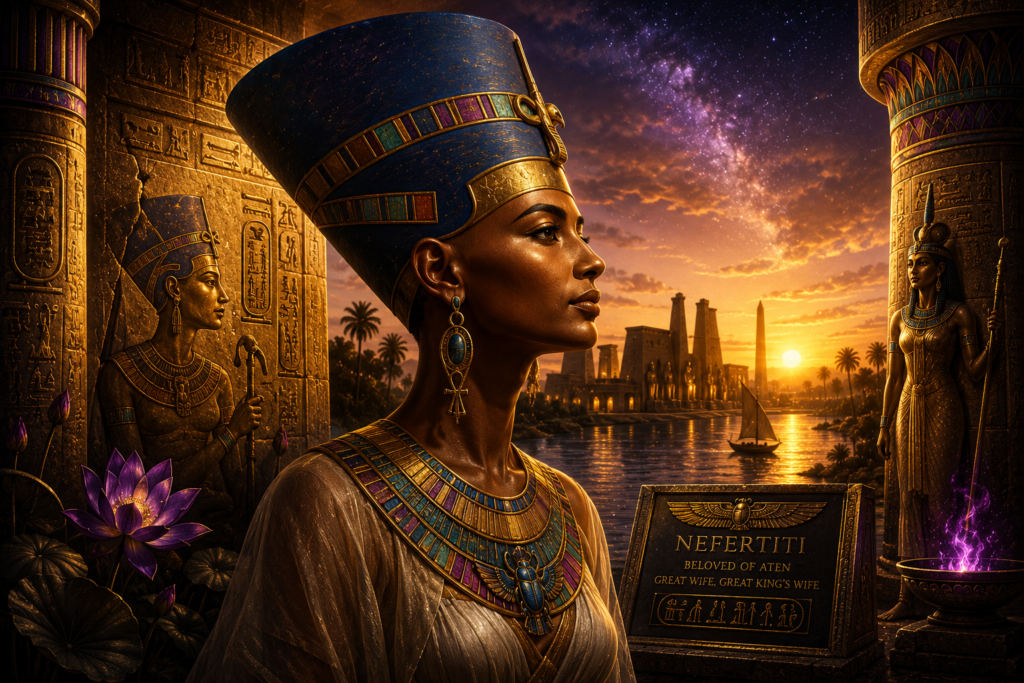
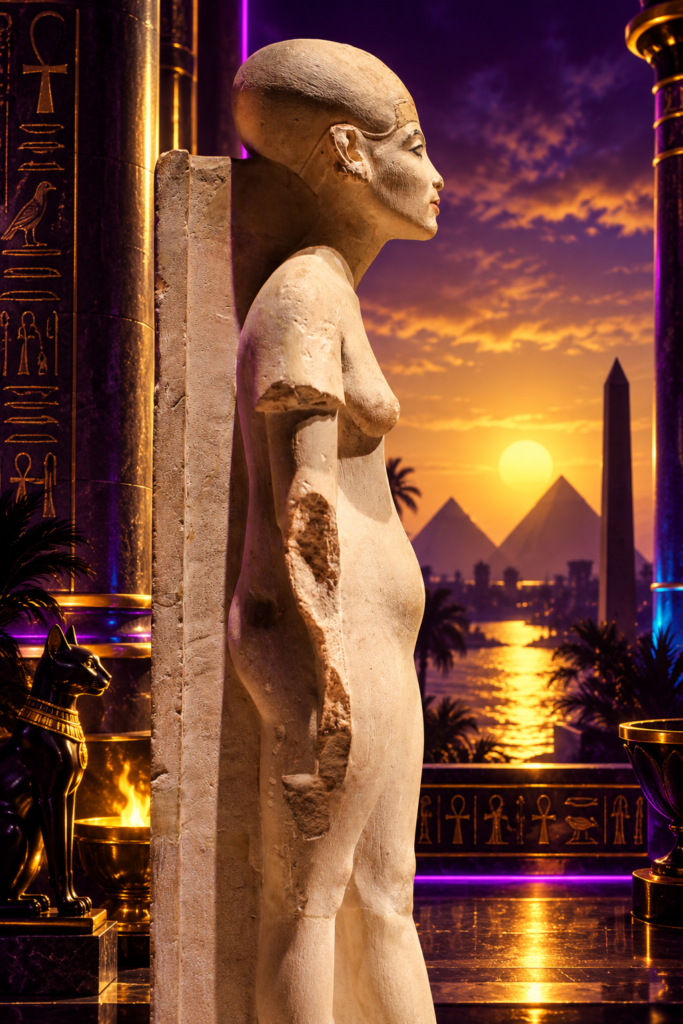
Few figures from ancient Egypt command the imagination quite like Queen Nefertiti. Her famous painted limestone bust has become one of the most recognizable images from the ancient world, yet the woman behind that celebrated face remains surrounded by unanswered questions.
Nefertiti was far more than a symbol of beauty. As the Great Royal Wife of Pharaoh Akhenaten, she occupied an extraordinary position during one of the most dramatic religious and political transformations in Egyptian history. Images from the Amarna Period portray her participating in rituals, appearing alongside the king and even striking Egypt's enemies, visual roles that reveal an exceptionally powerful queen.
Her life unfolded during the 18th Dynasty of Egypt's New Kingdom, an era associated with immense wealth, monumental building projects, international diplomacy and some of Egypt's most famous rulers.
But Nefertiti's story eventually becomes a mystery.
Her prominence in the historical record changes dramatically toward the later years of Akhenaten's reign, and scholars continue to debate what happened to her. Did she die? Did she adopt another royal name? Could she have become a co-regent—or even ruled Egypt herself?
The surviving evidence offers fascinating clues, but no universally accepted answer.
Who Was Queen Nefertiti?
Nefertiti was the Great Royal Wife of Pharaoh Akhenaten, originally known as Amenhotep IV. She lived during the 14th century BCE and became one of the most prominent royal women of ancient Egypt.
Her name is commonly translated as "The Beautiful One Has Come."
Despite her fame, Nefertiti's origins remain uncertain. Scholars have proposed several theories regarding her parentage, but no surviving evidence has conclusively identified her parents.
One frequently discussed possibility connects her with Ay, an influential court official who later became pharaoh following the reign of Tutankhamun. However, Nefertiti's precise relationship to Ay remains uncertain.
What is much clearer is that Nefertiti rose to extraordinary prominence beside Akhenaten.
Rather than appearing merely as a royal companion, she became an active participant in the revolutionary religious world created during her husband's reign.
Nefertiti and Pharaoh Akhenaten
Amenhotep IV inherited an Egypt whose religious traditions included a vast pantheon of deities and powerful temple institutions.
During his reign, however, the king increasingly elevated the Aten, represented by the radiant solar disk. He eventually changed his name from Amenhotep IV to Akhenaten, reflecting his devotion to the Aten.
Nefertiti was deeply integrated into this transformation.
Together, Akhenaten and Nefertiti became the royal faces of Aten-centered worship.
Egyptian art frequently depicts the royal couple beneath the rays of the Aten. The rays often terminate in tiny hands, some holding the ankh, the ancient Egyptian symbol of life, toward the royal family's faces.
These scenes communicate an important theological message: the king and queen occupied a privileged position between the Aten and the people of Egypt.
Nefertiti was therefore not simply standing beside Akhenaten.
She was an essential participant in the religious ideology of the Amarna court.
The Rise of Akhetaten
Akhenaten eventually established a new royal capital called Akhetaten, meaning approximately "Horizon of the Aten."
Today, the archaeological site is known as Amarna.
The city represented an extraordinary break from established royal traditions. Temples, palaces, administrative buildings, residences and workshops emerged in a landscape selected for the new religious center.
Nefertiti's presence appears throughout the surviving artistic program of this city.
She participated in ceremonies and offerings and was repeatedly represented with Akhenaten and their daughters beneath the Aten.
These images provide an unusually intimate glimpse into an ancient Egyptian royal household.
Nefertiti Was More Than a Queen Consort
One of the most fascinating aspects of Nefertiti's legacy is the exceptional power expressed through her imagery.
Ancient Egyptian royal art was highly symbolic. The size, clothing, crowns and actions of figures could communicate political and religious authority.
Nefertiti appears in contexts traditionally associated with kingship.
Most dramatically, surviving imagery depicts her smiting an enemy, a pose deeply connected with pharaonic power and the king's role in defeating disorder and preserving Ma'at, the principle of cosmic and social order.
For a queen to assume such imagery was significant.
Nefertiti was also represented performing offerings to the Aten and wearing an impressive variety of crowns and royal regalia.
Her visual presence suggests that her position within Akhenaten's new religious order exceeded the conventional image of a royal wife.
Exactly how much formal political authority she possessed remains debated, but the surviving evidence makes one conclusion difficult to ignore:
Nefertiti was one of the most visibly powerful royal women of ancient Egypt.
Nefertiti and the Aten
The religious changes of Akhenaten's reign are sometimes described as the world's first monotheistic revolution.
The historical reality is more complicated.
Akhenaten's religious program placed unprecedented emphasis on the Aten, while traditional cults—most famously that of Amun—were severely diminished. Whether Atenism should be classified as strict monotheism, monolatry or another form of exclusive royal worship continues to be debated.
What is certain is that the Aten became overwhelmingly dominant within official royal ideology.
Nefertiti played a central role in that system.
Representations of the royal family suggest that access to the Aten's divine power was closely associated with Akhenaten and Nefertiti themselves.
This gave the queen an extraordinary religious significance.
The Children of Nefertiti
Nefertiti and Akhenaten are generally understood to have had six daughters:
Meritaten
Meketaten
Ankhesenpaaten
Neferneferuaten Tasherit
Neferneferure
Setepenre
Their daughters frequently appear in Amarna artwork with their parents.
These depictions are remarkable because they often show affectionate interactions uncommon in earlier formal Egyptian royal art.
One famous scene portrays Akhenaten and Nefertiti seated with their daughters beneath the Aten. The children sit on their parents' laps while the rays of the solar disk extend toward the family.
Whether these scenes represent ordinary family life or primarily communicate religious symbolism, they give Amarna art a distinctive sense of intimacy.
One daughter, Ankhesenpaaten, would later become better known as Ankhesenamun, the wife of Pharaoh Tutankhamun.
The Famous Bust of Nefertiti
No discussion of Queen Nefertiti is complete without the extraordinary bust that transformed her into a global icon.
The painted limestone bust was discovered in 1912 at Amarna by a German archaeological expedition led by Ludwig Borchardt. It was found in the workshop associated with the sculptor Thutmose.
The sculpture presents Nefertiti wearing her distinctive tall blue crown.
Its symmetry, elegant proportions, preserved pigments and refined craftsmanship helped make it one of the world's most famous surviving works of ancient Egyptian art.
Today, the bust is housed in the Neues Museum in Berlin.
Its fame has strongly shaped modern perceptions of Nefertiti. Yet concentrating solely on her beauty risks obscuring the most compelling aspect of her story.
Nefertiti was not important because she was beautiful.
She was important because she stood near the center of one of the greatest religious and political transformations in ancient Egyptian history.
The Mystery of Nefertiti's Disappearance
One of the greatest mysteries surrounding Nefertiti concerns what happened during the final years of Akhenaten's reign and its immediate aftermath.
Older interpretations often suggested that Nefertiti suddenly disappeared from the historical record and may have died around the middle of Akhenaten's reign.
Later archaeological and inscriptional evidence complicated that picture.
An inscription dated to Year 16 of Akhenaten's reign refers to Nefertiti as the king's Great Royal Wife, demonstrating that she remained alive and retained her title considerably later than some earlier theories proposed.
But what happened afterward remains uncertain.
Her eventual fate has generated several competing theories.
Did Nefertiti Become Pharaoh?
This is one of the most intriguing questions in Egyptology.
Following Akhenaten, the succession is difficult to reconstruct. Royal figures including Smenkhkare and Neferneferuaten appear in the evidence surrounding the end of the Amarna Period.
Some scholars have proposed that Nefertiti adopted the name Neferneferuaten and ruled as a co-regent or pharaoh.
There are reasons the theory remains compelling.
Nefertiti had already been represented with unusual royal authority. She possessed enormous religious prominence, and a female ruler named Neferneferuaten appears in evidence associated with the succession.
But identifying this ruler conclusively as Nefertiti remains difficult.
Other interpretations have connected Neferneferuaten with different members of the royal family.
Therefore, statements that Nefertiti definitely became pharaoh go beyond what surviving evidence can currently establish.
A more historically responsible conclusion is:
Nefertiti may have exercised pharaonic authority late in the Amarna Period, but whether she formally ruled Egypt as pharaoh remains an unresolved scholarly debate.
That uncertainty is part of what makes her story so fascinating.
Nefertiti and King Tutankhamun
Nefertiti's story is also intertwined with that of Tutankhamun.
Tutankhamun was born during the Amarna Period and originally bore the name Tutankhaten, meaning "Living Image of Aten."
His exact maternal relationship to Nefertiti has been the subject of considerable discussion, but current genetic and archaeological interpretations generally do not identify Nefertiti securely as his mother.
Tutankhamun nevertheless became connected to Nefertiti's family through his marriage to her daughter Ankhesenpaaten.
After Akhenaten's death, Egypt gradually moved away from Aten-centered royal religion.
Tutankhaten became Tutankhamun, signaling the restoration of Amun's prominence.
The royal court eventually abandoned Akhetaten, and traditional temples and religious institutions were restored.
The revolutionary world in which Nefertiti had held such extraordinary prominence was being dismantled.
The Amarna Artistic Revolution
Nefertiti's reign also coincided with one of the most recognizable artistic periods in Egyptian history.
Amarna art frequently departed from the idealized conventions familiar from other periods.
Akhenaten could be depicted with an elongated face, narrow chest, prominent abdomen and broad hips. Members of the royal family sometimes appear with elongated skulls and highly stylized features.
Scholars have debated the meaning of these unusual representations for generations.
Some earlier interpretations attempted to diagnose Akhenaten with medical conditions based on the artwork. Such conclusions are highly uncertain because Egyptian royal art was symbolic and ideological rather than straightforward portrait photography.
The artistic changes may instead reflect the distinctive theology and ideology of Akhenaten's court.
Nefertiti herself appears in multiple artistic forms—from highly refined idealized portraits to more stylized Amarna representations.
Her famous bust demonstrates the exceptional sophistication of royal artistic workshops during this era.
What Happened to Nefertiti's Tomb?
Another major mystery remains unresolved:
Where was Queen Nefertiti buried?
No tomb universally accepted as Nefertiti's final burial place has been identified.
Because members of Akhenaten's royal family were associated with the Royal Tomb at Amarna, it is possible that plans existed for her burial there.
But the abandonment of Akhetaten and the political upheaval following Akhenaten's death make reconstructing events extremely difficult.
Researchers have also investigated theories that Nefertiti might have been buried elsewhere, including controversial proposals involving hidden spaces near Tutankhamun's tomb in the Valley of the Kings.
To date, no discovery has conclusively revealed Nefertiti's burial place or securely identified her mummy.
Her missing tomb remains one of ancient Egypt's most captivating archaeological mysteries.
The Fall of the Amarna Revolution
The religious revolution associated with Akhenaten and Nefertiti did not survive for long after their era.
Traditional Egyptian religious institutions returned to prominence, especially the cult of Amun.
Akhetaten was largely abandoned.
Later rulers also attempted to distance themselves from the Amarna kings. Akhenaten's monuments were dismantled, and his name and images were attacked or omitted from later royal records.
This deliberate suppression makes reconstructing the period particularly difficult.
Ironically, attempts to erase the Amarna royal family helped create one of archaeology's greatest historical puzzles.
Thousands of years later, Akhenaten, Nefertiti and Tutankhamun are among the most recognizable figures from ancient Egypt.
Nefertiti's Legacy
Nefertiti's legacy extends far beyond her celebrated portrait.
She represents a remarkable moment when religious authority, royal power, artistic experimentation and political transformation converged.
She was a Great Royal Wife, a prominent participant in Aten worship, the mother of royal daughters and possibly an even more powerful political figure during the final years of the Amarna Period.
Her story also reminds us of an important principle when exploring ancient history:
absence of evidence does not automatically provide evidence for a dramatic conclusion.
There are things we know about Nefertiti.
There are things scholars can reasonably infer.
And there are mysteries that ancient Egypt has not yet surrendered.
That distinction makes the real Nefertiti even more compelling than legend.
Why Queen Nefertiti Still Fascinates the World
More than three thousand years after she lived, Nefertiti remains instantly recognizable.
Part of that fascination comes from the beauty of her famous bust, but the deeper attraction lies in the unanswered questions surrounding her life.
Who were her parents?
How much political authority did she possess?
What happened after the final years of Akhenaten?
Was she the female ruler Neferneferuaten?
Where is her tomb?
And could archaeological discoveries still be waiting to rewrite her story?
Every inscription and artifact recovered from the Amarna Period has the potential to alter our understanding of one of ancient Egypt's most enigmatic royal figures.
Nefertiti stands at the intersection of power, religion, art, family and mystery.
She was not merely the beautiful queen beside Akhenaten.
She was one of the defining figures of the Amarna revolution and possibly one of the most powerful women ever to occupy Egypt's royal court.
Queen Nefertiti: Beauty, Power and an Unfinished Story
Nefertiti's famous face has survived the centuries, but much of her story remains hidden.
She witnessed, and helped represent, a radical transformation of Egyptian religion. She appeared in imagery displaying exceptional royal authority. Her daughters became part of Egypt's dynastic succession, and her family stood at the center of events that reshaped the New Kingdom.
Then the historical trail becomes frustratingly incomplete.
Perhaps future discoveries will reveal Nefertiti's tomb, identify her remains or finally establish whether she ruled Egypt after Akhenaten.
Until then, Queen Nefertiti remains one of ancient Egypt's greatest mysteries, a royal woman whose extraordinary power may have been every bit as remarkable as the beauty that made her immortal.
More than 5,000 years ago, along the fertile banks of the Nile, a ruler emerged whose reign became closely associated with one of the most important transformations in ancient Egyptian history: the political consolidation of Upper and Lower Egypt.
His name was Narmer.
King Narmer is one of the earliest rulers known from ancient Egypt and is traditionally placed near the beginning of the First Dynasty, around 3100 BCE. His name appears on some of the most significant artifacts surviving from Egypt's formative period, including the extraordinary Narmer Palette.
For generations, Narmer has been associated with the unification of Egypt and the establishment of the centralized kingship that would define ancient Egyptian civilization for thousands of years.
But who exactly was King Narmer? Did he truly unite Upper and Lower Egypt? Was Narmer the legendary Menes described by later Egyptian traditions? And what can archaeology actually tell us about this mysterious ruler?
The story of Narmer takes us back to the very beginning of dynastic Egypt.
Who Was King Narmer?
King Narmer was an early Egyptian ruler who lived around the transition between the Predynastic Period and Egypt's First Dynasty, approximately 3100 BCE.
He ruled during a period when communities throughout the Nile Valley were becoming increasingly interconnected and politically organized.
Before Egypt developed into the centralized kingdom familiar from later periods, the Nile Valley contained different settlements and regional centers of power. Over generations, increasingly powerful rulers based in southern Egypt expanded their influence northward.
Narmer appears near the culmination of this process.
His reign is therefore frequently associated with the emergence of the Egyptian state and the beginning of what historians call the Early Dynastic Period.
Narmer's name has been discovered at several archaeological sites, demonstrating that his authority or influence extended across a considerable geographic area.
Yet the most famous evidence connected to him comes from a ceremonial object discovered at Hierakonpolis, known today as the Narmer Palette.
The Narmer Palette: An Extraordinary Window Into Early Egypt
Few ancient Egyptian artifacts are as important to our understanding of early kingship as the Narmer Palette.
Discovered in the late nineteenth century at Hierakonpolis in Upper Egypt, the ceremonial stone palette dates to around 3100 BCE.
Both sides contain intricately carved scenes centered on King Narmer.
On one side, Narmer appears wearing the White Crown, traditionally associated with Upper Egypt. He raises a mace over a kneeling captive while the falcon god Horus appears nearby.
On the opposite side, Narmer is depicted wearing the Red Crown, traditionally associated with Lower Egypt.
This combination is one of the primary reasons the palette has long been interpreted as evidence of Narmer's connection with the unification of Upper and Lower Egypt.
The imagery also reveals something profound about early Egyptian kingship.
Narmer is depicted much larger than the people surrounding him, a visual convention known as hierarchical scale. His enormous size communicates his elevated political and sacred status.
This artistic convention would remain a recognizable feature of Egyptian royal art for thousands of years.
Did King Narmer Unite Upper and Lower Egypt?
Narmer is commonly described as the ruler who unified Upper and Lower Egypt, creating one of the world's earliest centralized territorial states.
The traditional interpretation is compelling.
Narmer appears wearing the crowns associated with both regions on the Narmer Palette. The artifact also contains scenes of military victory and royal authority.
However, historians today generally treat Egyptian unification as more complicated than a single dramatic conquest.
Archaeological evidence suggests that political consolidation developed over generations. Rulers preceding Narmer, including kings associated with the late Predynastic period, were already expanding political and economic networks throughout the Nile Valley.
Narmer may therefore have completed, strengthened, or symbolized a process that had already been underway.
Rather than imagining Egypt becoming unified on a single day, it may be more accurate to see Narmer as one of the pivotal rulers in a long transformation that produced the dynastic Egyptian state.
Upper Egypt and Lower Egypt Explained
Understanding Narmer requires understanding one of the distinctive features of Egyptian geography.
Ancient Egypt was traditionally divided into two regions.
Upper Egypt was located in the south, extending along the Nile Valley toward the First Cataract.
Lower Egypt was located in the north, particularly around the broad Nile Delta.
The terminology may initially seem reversed. Upper Egypt is geographically south because it lies upstream, while Lower Egypt lies downstream toward the Mediterranean coast.
These two regions became central to Egyptian royal ideology.
Later pharaohs regularly presented themselves as rulers of the Two Lands, emphasizing the unity of Upper and Lower Egypt under one monarch.
Narmer's imagery appears at the beginning of this enduring political tradition.
Narmer and the Meaning of the Two Crowns
The crowns worn by Narmer on his famous palette carried powerful political symbolism.
The White Crown, or Hedjet, became associated with Upper Egypt.
The Red Crown, or Deshret, became associated with Lower Egypt.
Eventually, the two crowns were combined into the Double Crown, symbolizing royal authority over the unified Two Lands.
The presence of Narmer wearing both regional crowns on the same ceremonial object is therefore particularly significant.
Whether the scenes represent a literal historical battle, ceremonial symbolism, or a combination of both remains debated. Nevertheless, the imagery clearly presents Narmer as a ruler whose authority encompassed, or claimed to encompass, both regions.
Was Narmer the Same Person as Menes?
One of the great historical questions surrounding Narmer concerns another mysterious figure: Menes.
Later Egyptian tradition remembered Menes as the first king of unified Egypt.
Ancient writers such as Manetho, an Egyptian priest who lived thousands of years after the beginning of the First Dynasty, placed Menes at the beginning of Egypt's dynastic history.
The difficulty is that contemporary archaeological evidence has not produced a king whose Horus name was simply "Menes."
This has led scholars to several possibilities.
Narmer may have been the historical ruler remembered later as Menes.
Alternatively, Menes may have referred to Narmer's successor, Hor-Aha.
Another possibility is that the later Menes tradition compressed memories of Egypt's complex unification process into the story of a single founding ruler.
The exact relationship remains uncertain.
For this reason, it is safer to describe Narmer as one of the strongest historical candidates behind the later tradition of Menes rather than stating definitively that the two names represented the same individual.
The Meaning of Narmer's Name
Narmer's royal name appears inside a serekh, an early rectangular royal emblem representing the façade of a palace and topped by the falcon god Horus.
The hieroglyphic signs associated with his name include a catfish and a chisel-like object.
Because of this, Narmer's name has sometimes been popularly translated using expressions connected with the catfish symbol, although the precise linguistic interpretation remains debated.
More important historically is the way his name was displayed.
The serekh became an important feature of early Egyptian kingship, associating the ruler with Horus, one of the most significant divine figures connected with royal authority.
Narmer therefore belonged to a developing ideological system in which political leadership, divine legitimacy, symbolism, and royal identity were deeply interconnected.
Horus and the Divine Authority of Narmer
The falcon god Horus occupies a prominent position on the Narmer Palette.
In one scene, a falcon representing Horus stands above a group of papyrus plants while controlling a human figure.
Papyrus was strongly associated with the marshlands of northern Egypt, causing many scholars to interpret the imagery as a symbolic representation of Narmer's domination over territories in Lower Egypt.
The scene demonstrates how religion and kingship were already becoming intertwined at the dawn of dynastic Egypt.
Egyptian kings were not simply political administrators.
Their authority existed within a sacred worldview.
The king maintained order, defended the land, honored the gods, and stood at the center of the relationship between the divine and earthly worlds.
These concepts would later become fundamental to pharaonic ideology.
Narmer and the Birth of Pharaonic Kingship
Narmer lived centuries before the Great Pyramid of Giza, Tutankhamun, Hatshepsut, Akhenaten, or Ramesses II.
Yet many features commonly associated with later Egyptian kingship were already emerging during his era.
Royal imagery emphasized enormous authority.
The king was closely connected with Horus.
Egypt was conceived as the union of two complementary lands.
Military victory could represent the triumph of order over enemies.
Royal regalia communicated political and sacred authority.
These ideas became increasingly sophisticated over subsequent dynasties, but their early development can be seen in objects associated with Narmer.
That makes his reign important not merely because of territorial politics but because it stands near the beginning of a distinctive Egyptian conception of kingship that survived for millennia.
Where Was King Narmer Buried?
Narmer's tomb is generally identified at Umm el-Qa'ab in Abydos, one of ancient Egypt's most important early royal burial grounds.
His burial consisted of relatively modest mud-brick chambers compared with the enormous pyramids constructed by later rulers.
This difference reveals how dramatically Egyptian royal architecture evolved.
Narmer lived roughly four centuries before the Great Pyramid of Khufu.
The monumental stone pyramid complexes associated with the Old Kingdom had not yet developed.
Nevertheless, Abydos was already becoming a major center of royal burial and sacred tradition.
Several of Egypt's earliest kings were buried there, and the area later became closely associated with Osiris, god of the afterlife and regeneration.
Archaeological Evidence for Narmer Beyond Egypt
One fascinating aspect of Narmer's reign is the geographic distribution of objects bearing his name.
Artifacts connected with Narmer have been discovered beyond the heartland of the Nile Valley, including areas of the southern Levant.
These discoveries demonstrate that early Egypt participated in broader systems of exchange and interaction.
Egypt was not an isolated civilization suddenly appearing along the Nile.
Its early rulers existed within networks connecting northeastern Africa and neighboring regions of western Asia.
Goods, materials, technologies, and cultural influences traveled through these networks long before Egypt's famous pyramids were constructed.
Narmer's era therefore provides evidence not only for the formation of the Egyptian state but also for Egypt's participation in an interconnected ancient world.
Was Narmer Really the First Pharaoh?
Calling Narmer the "first pharaoh" is common, but it requires some clarification.
Egypt had rulers before Narmer.
Archaeological evidence from Predynastic Egypt identifies earlier kings, particularly those associated with powerful centers in Upper Egypt.
Furthermore, the Egyptian royal title translated today as pharaoh developed much later. The ancient Egyptian term per-aa, meaning "Great House," originally referred to the royal palace before eventually becoming a designation for the king.
So Narmer would not have called himself "Pharaoh Narmer" in the way the expression is commonly used today.
Nevertheless, in popular historical language, he is frequently described as one of Egypt's earliest pharaohs because he stood near the beginning of the dynastic monarchy that later produced Egypt's famous royal tradition.
What Egypt Was Like During Narmer's Lifetime
Narmer's Egypt looked dramatically different from the Egypt of the pyramid builders.
There were no massive pyramids dominating the horizon at Giza.
The temples of Karnak had not yet been constructed.
The Valley of the Kings did not exist.
Instead, settlements stretched along the Nile, surrounded by agricultural land supported by the river's annual cycles.
Communities produced pottery, stone vessels, tools, textiles, jewelry, and increasingly sophisticated works of art.
Trade networks connected different regions, while political authority became more centralized.
Writing was also developing.
Some of Egypt's earliest hieroglyphic inscriptions date to the centuries surrounding Narmer's reign, reflecting the growth of administrative systems and royal institutions.
Narmer therefore lived during one of the most transformative periods in Egyptian history.
The Nile and the Rise of the Egyptian State
No discussion of early Egypt is complete without the Nile River.
The Nile provided water, fertile agricultural land, transportation, fish, reeds, and a natural corridor connecting communities across northeastern Africa.
Its geography also helped make political integration possible.
Instead of being separated by enormous mountain ranges, communities along much of the Egyptian Nile Valley were connected by the river.
Boats could transport people, goods, officials, and military forces over considerable distances.
As powerful rulers expanded their influence, the Nile became the central artery of the emerging Egyptian state.
Narmer inherited, and helped shape, a civilization whose political organization was inseparable from this extraordinary African river.
Why King Narmer Matters
Narmer's importance extends far beyond the details of his individual reign.
He represents a turning point between Predynastic Egypt and dynastic Egyptian civilization.
During this transformation, increasingly complex communities became incorporated into a centralized kingdom capable of administering territory stretching along hundreds of miles of the Nile.
The state that emerged would eventually build enormous monuments, develop sophisticated religious traditions, produce remarkable art and literature, and influence surrounding regions for thousands of years.
Narmer stands remarkably close to the beginning of that story.
The surviving evidence from his reign provides a rare glimpse into the moment when many of the symbols later associated with ancient Egyptian civilization were still taking shape.
The Enduring Legacy of King Narmer
More than five millennia after Narmer lived, his image remains immediately recognizable.
A king wearing an ancient crown raises his mace above a defeated enemy.
Horus watches over the scene.
Royal standards move through ceremonial processions.
The imagery communicates power, sacred authority, victory, and political order without requiring a lengthy written explanation.
That visual language would become one of ancient Egypt's greatest cultural achievements.
Narmer's historical importance therefore lies not only in the question of whether he personally "unified Egypt."
His reign represents the emergence of an extraordinary political and cultural system.
From the early rulers of Abydos to the pyramid builders of the Old Kingdom and the powerful monarchs of the New Kingdom, the institution of Egyptian kingship continued to evolve while preserving ideas whose roots stretched back to Narmer's world.
King Narmer and the Dawn of Ancient Egypt
King Narmer remains one of the most fascinating figures in ancient Egyptian history precisely because so much about him exists at the boundary between archaeology, royal symbolism, and later tradition.
The evidence strongly establishes him as a major ruler at the beginning of Egypt's First Dynasty and connects his reign with the political consolidation of Upper and Lower Egypt.
Whether Narmer alone united the Two Lands, completed a process begun by earlier rulers, or later became remembered through the legendary figure Menes remains debated.
What is clear is his extraordinary historical position.
Narmer stood at the threshold of dynastic Egypt.
The kingdom that emerged from this formative era would endure, transform, and influence the ancient world for approximately three thousand years.
More than 5,000 years later, the Narmer Palette still preserves the image of a ruler standing at the dawn of one of Africa's most extraordinary civilizations.
Frequently Asked Questions About King Narmer
Who was King Narmer?
King Narmer was an early Egyptian ruler who reigned around 3100 BCE and is generally associated with the beginning of Egypt's First Dynasty and the political consolidation of Upper and Lower Egypt.
What is King Narmer famous for?
Narmer is best known for his association with the unification of ancient Egypt and for the Narmer Palette, one of the most important surviving artifacts from early dynastic Egypt.
Did Narmer unite Upper and Lower Egypt?
Narmer has traditionally been credited with unifying Upper and Lower Egypt. Modern archaeology suggests unification was probably a gradual process involving several rulers, with Narmer playing a major role near its culmination.
Was Narmer the first pharaoh of Egypt?
Narmer is frequently called Egypt's first pharaoh in popular history, although rulers existed before him and the actual title translated as "pharaoh" came into use much later.
Are Narmer and Menes the same person?
Possibly, but the identification remains debated. Some scholars have associated Menes with Narmer, while others have proposed Narmer's successor Hor-Aha or interpret Menes as a later traditional representation of Egypt's founding ruler.
Where is the Narmer Palette today?
The Narmer Palette is preserved in the Egyptian Museum in Cairo and remains one of the most important artifacts from the formative period of the Egyptian state.
Where was King Narmer buried?
Narmer's tomb is generally identified at Umm el-Qa'ab in Abydos, an important royal cemetery used by Egypt's earliest dynastic rulers.
Thousands of years before the rise of many celebrated physicians, architects, and scholars of the classical world, Imhotep of ancient Egypt emerged as one of history’s most extraordinary intellectual figures.
Living during Egypt’s Third Dynasty, around the 27th century BCE, Imhotep served under Pharaoh Djoser and became associated with architecture, royal administration, scholarship, and healing. His reputation became so great that generations of Egyptians continued to honor him long after his death. Eventually, he was revered as a divine patron connected with medicine and healing.
Today, Imhotep is widely remembered as the brilliant mind associated with the Step Pyramid of Djoser at Saqqara, one of the earliest monumental stone structures in the world.
But Imhotep’s story extends far beyond a single pyramid.
His legacy provides a remarkable window into the intellectual achievements of ancient Kemet, demonstrating the sophisticated knowledge that flourished along the Nile thousands of years ago.
Who Was Imhotep?
Imhotep was an ancient Egyptian official who lived during the reign of Pharaoh Djoser, traditionally dated to approximately 2630–2611 BCE.
His Egyptian name is commonly interpreted as meaning “He Who Comes in Peace.”
Unlike Egypt's kings and queens, Imhotep was not born into the royal line, at least according to surviving evidence. Yet he rose to an extraordinarily influential position within Djoser’s administration.
One of the most important pieces of evidence for the historical Imhotep comes from the base of a statue of Djoser discovered at Saqqara. The inscription identifies Imhotep with several prestigious titles, including roles associated with royal authority and craftsmanship.
This inscription is particularly important because it demonstrates that Imhotep was a historical person rather than merely a legendary figure.
His extraordinary reputation, however, would grow dramatically over the centuries.
Imhotep and Pharaoh Djoser
Imhotep's name is inseparable from Pharaoh Djoser, one of the most important rulers of Egypt's Third Dynasty.
Djoser's reign represented an important period in the development of Egyptian royal architecture. During this era, Egypt possessed an organized central government capable of mobilizing skilled craftspeople, administrators, laborers, engineers, and enormous quantities of resources.
Imhotep occupied a high position within this system.
He is traditionally credited with overseeing the revolutionary funerary complex constructed for Djoser at Saqqara.
At the heart of this complex stood a monument that would transform architecture forever:
the Step Pyramid.
Imhotep and the Step Pyramid of Djoser
The Step Pyramid of Djoser is one of the great landmarks of world architecture.
Before the Step Pyramid, elite Egyptian tombs were commonly constructed in a rectangular form known today as a mastaba.
Djoser's monument dramatically expanded this concept.
The pyramid ultimately consisted of six progressively smaller levels, creating the distinctive stepped structure that still dominates the Saqqara landscape.
Rising roughly 60 meters (197 feet), the monument became the centerpiece of an enormous ceremonial complex.
What made the project especially revolutionary was its extensive use of cut stone on a monumental scale.
The surrounding complex contained courtyards, ceremonial structures, shrines, passages, columns, walls, and underground chambers. Together they demonstrated a remarkable level of architectural planning and craftsmanship.
Imhotep's association with this project helped establish his enduring reputation as one of history's earliest named architectural figures.
The Step Pyramid also became an important predecessor to the later pyramid-building traditions that produced the monumental pyramids of Egypt's Old Kingdom.
Was Imhotep Really the World's First Architect?
Imhotep is frequently described as the world's first recorded architect.
That description requires some nuance.
People had obviously designed and constructed sophisticated buildings long before Imhotep. What makes him exceptional is that his name survived in association with a monumental architectural project from an extraordinarily early period of recorded history.
For this reason, he occupies a unique position in architectural history.
His legacy reminds us that architecture in ancient Egypt involved far more than physical labor. Monumental projects required geometry, organization, material knowledge, logistics, surveying, craftsmanship, administration, and long-term planning.
The Step Pyramid complex stands as enduring evidence of this sophisticated intellectual and technical environment.
Dr. Imhotep: Was Imhotep the First Doctor?
Imhotep is also popularly called “Dr. Imhotep” and is frequently described as the first physician in recorded history.
The historical reality is more complicated, and even more interesting.
There is strong evidence that Imhotep became closely associated with medicine and healing in later Egyptian tradition. However, surviving contemporary evidence from Djoser's reign does not directly document him practicing medicine.
His reputation as a healer developed particularly strongly centuries after his lifetime.
Eventually, Egyptians revered Imhotep as a divine patron of healing, and people sought his assistance in matters of illness and health.
Therefore, it is more historically accurate to say that Imhotep became one of the earliest named historical figures strongly associated with medicine, rather than claiming with certainty that surviving evidence proves he personally practiced medicine as a physician during Djoser's reign.
That distinction does not diminish his importance.
In fact, the transformation of a historical official into a revered figure of healing demonstrates just how extraordinary his reputation became.
Medicine in Ancient Egypt
The civilization in which Imhotep lived developed a sophisticated tradition of medicine.
Ancient Egyptian medical practitioners observed injuries, diagnosed illnesses, prepared medicines, performed treatments, and recorded medical knowledge.
Several surviving Egyptian medical papyri reveal this advanced tradition.
Among the most famous is the Edwin Smith Papyrus, a medical document containing descriptions of injuries and methods of examination, diagnosis, treatment, and prognosis.
Although the surviving manuscript dates much later than Imhotep's lifetime, portions of its medical knowledge may derive from considerably older traditions.
The text is especially notable because many of its cases demonstrate careful physical observation.
Another important document, the Ebers Papyrus, preserves hundreds of remedies and discussions concerning illnesses and treatments.
These documents reveal a medical tradition that could combine empirical observation with religious and magical understandings of illness, approaches that were not considered mutually exclusive within ancient Egyptian culture.
Did Imhotep Write the Edwin Smith Papyrus?
A popular claim sometimes attributes the Edwin Smith Papyrus directly to Imhotep.
There is currently no conclusive evidence proving that he wrote it.
The surviving manuscript dates to approximately the 17th century BCE, more than a thousand years after Imhotep lived.
Scholars believe parts of the material may preserve traditions originating much earlier, but identifying Imhotep as the original author goes beyond what the surviving evidence can establish.
This is an important distinction because Imhotep's documented achievements and later reputation are remarkable enough without turning uncertain traditions into historical facts.
Understanding ancient Kemet requires separating evidence from later legend while appreciating both.
Imhotep as a Scholar and Royal Official
Imhotep was much more than an architect in later Egyptian memory.
He became associated with wisdom, writing, scholarship, and learning.
As a high-ranking official serving Djoser, he would have operated within Egypt's educated administrative elite.
Ancient Egyptian government depended heavily upon scribes.
Writing allowed officials to manage taxation, agricultural production, construction projects, religious institutions, royal decrees, inventories, and the distribution of resources.
Literacy was therefore closely connected with administrative power and intellectual prestige.
Later generations remembered Imhotep as an idealized sage, a person whose wisdom represented the highest traditions of Egyptian learning.
Imhotep's Connection to Ptah
Imhotep's later religious importance was closely associated with Ptah, the great creator deity and patron of craftspeople centered at Memphis.
In later tradition, Imhotep was regarded as the son of Ptah, strengthening his connections with craftsmanship, creation, knowledge, and intellectual ability.
This association was particularly meaningful because Memphis was an enormously important political and religious center.
Ptah was closely connected with craftspeople and creative power. Linking Imhotep with Ptah therefore elevated the famous architect and sage into a sacred intellectual lineage.
Imhotep was no longer remembered merely as a government official.
He became a symbol of divinely inspired wisdom.
How Imhotep Became a God
One of the most fascinating aspects of Imhotep's story is what happened after his death.
Most officials of ancient Egypt disappeared from popular memory over the centuries.
Imhotep did not.
His reputation continued to grow.
Approximately two thousand years after his lifetime, he received full divine worship and was increasingly revered as a god of medicine and healing.
People appealed to him for cures and divine assistance.
Temples and sacred spaces associated with his worship attracted individuals seeking healing, and offerings were dedicated in his honor.
Small bronze statuettes frequently depicted Imhotep seated with a papyrus scroll across his lap—an image emphasizing his identity as a scholar and source of wisdom.
Few individuals in Egyptian history experienced such an extraordinary transformation from historical person to deity.
Imhotep and Asclepius
When Greek culture became increasingly influential in Egypt, particularly during the Ptolemaic period, Greeks identified Imhotep with their healing deity Asclepius.
Both figures were strongly associated with medicine and healing.
This comparison demonstrates how far Imhotep's reputation had spread.
A man who had served an Egyptian king during the third millennium BCE remained culturally significant more than two thousand years later.
His identity had evolved from royal official and architect to legendary sage, healer, and ultimately divine figure.
Was Imhotep African?
Yes.
Imhotep lived in ancient Egypt, in northeastern Africa, and was a product of the civilization that developed along the African Nile Valley.
This geographic reality matters when discussing the history of ancient Egypt.
Egypt was deeply connected with neighboring African regions through migration, trade, diplomacy, cultural exchange, warfare, religion, and movement along the Nile.
Imhotep therefore belongs within the history of ancient Africa as well as the broader history of world civilization.
Recognizing ancient Egypt's African geography does not require simplifying the complex identities of people who lived there thousands of years ago. Instead, it places Egyptian civilization within its proper geographic and historical environment.
What Did Imhotep Look Like?
No securely identified portrait created during Imhotep's lifetime is known to survive.
Most familiar representations of him were produced many centuries after his death.
Later Egyptian statues commonly depict Imhotep as a seated man wearing a close-fitting cap and holding an open papyrus scroll.
These images were religious representations rather than verified portraits of his physical appearance.
Therefore, modern artistic reconstructions of Imhotep, including paintings, sculptures, films, and digital artwork—should be understood as interpretations rather than confirmed likenesses.
Where Is Imhotep Buried?
One of ancient Egypt's great archaeological mysteries is the location of Imhotep's tomb.
Despite his enormous historical importance, his burial place has never been conclusively identified.
Because of his association with Djoser and Saqqara, archaeologists have long suspected that Imhotep may have been buried somewhere within the wider Saqqara necropolis.
Numerous archaeological investigations have attempted to uncover evidence connected with his burial.
Yet no tomb has been definitively proven to belong to him.
Finding Imhotep's burial place would be an extraordinary archaeological discovery and could potentially reveal new information about one of ancient Egypt's most celebrated individuals.
Imhotep: A Genius of Ancient Kemet
More than 4,500 years after his lifetime, Imhotep remains one of the most fascinating figures of ancient Egypt.
He began as a royal official serving Pharaoh Djoser, became forever associated with one of history's most revolutionary architectural monuments, and ultimately entered Egyptian religious tradition as a divine patron of wisdom and healing.
His story occupies the fascinating boundary between history, archaeology, medicine, architecture, religion, and legend.
The Step Pyramid still rises above Saqqara.
Statues created centuries after his death still portray him studying a papyrus.
His name is still spoken around the world.
That extraordinary survival may be Imhotep's greatest monument of all.
More than four thousand years later, the genius of Imhotep continues to echo from ancient Kemet into the modern world.
Few rulers in the history of ancient Egypt have inspired as much fascination, controversy, and debate as Pharaoh Akhenaten. During the 18th Dynasty of Egypt’s New Kingdom, Akhenaten launched sweeping changes that challenged long-established religious traditions, transformed Egyptian art, and created an entirely new royal capital.
Originally known as Amenhotep IV, the pharaoh elevated the solar deity Aten to an extraordinary position within Egyptian religion. He changed his own name, abandoned the traditional royal center at Thebes, established the city of Akhetaten, modern-day Amarna, and promoted a radically different vision of kingship and divine worship.
His revolution did not survive him.
After Akhenaten's death, Egypt's traditional religious institutions returned, his new capital was largely abandoned, and later rulers attempted to erase his legacy. Yet more than 3,000 years later, Akhenaten remains one of the most recognizable and mysterious pharaohs of ancient Egypt.
Who was Akhenaten, and why did his reign change Egypt so dramatically?
Who Was Pharaoh Akhenaten?
Akhenaten was an ancient Egyptian pharaoh of the 18th Dynasty, ruling during the New Kingdom in the 14th century BCE. He was the son of Pharaoh Amenhotep III and Queen Tiye, one of the most influential royal women of her era.
Akhenaten came to the throne as Amenhotep IV.
The name Amenhotep can be understood as meaning “Amun is satisfied” or “Amun is content,” connecting the king directly with Amun, whose cult had become immensely powerful during the New Kingdom.
But Amenhotep IV would eventually break dramatically with that religious tradition.
Around the fifth year of his reign, the king changed his name to Akhenaten, generally translated along the lines of “Effective for the Aten” or “Beneficial to the Aten.”
The change represented far more than a new royal name. It symbolized the extraordinary religious transformation taking place throughout Egypt.
Akhenaten and the Rise of Aten
The Aten was represented as the visible disk of the sun. Depictions from Akhenaten's reign commonly show rays extending downward from the solar disk, with small hands at their ends.
Some of these hands present the ankh, the ancient Egyptian symbol of life, toward Akhenaten and members of the royal family.
Solar worship was not invented by Akhenaten. The sun had occupied a central place in Egyptian religion for centuries, and Aten itself existed before his reign.
What changed under Akhenaten was the Aten's position.
As his reign progressed, Akhenaten increasingly elevated Aten while restricting or suppressing the worship of other traditional gods, particularly Amun.
Names and images of Amun were removed or damaged in various places, while the Aten became the overwhelming focus of the state religion.
This was one of the most dramatic religious transformations ever attempted by an Egyptian pharaoh.
Did Akhenaten Invent Monotheism?
Akhenaten is frequently described as the world's first monotheist, but the reality is more complicated.
His religious reforms unquestionably concentrated royal and state worship around Aten to an extraordinary degree. Other gods were marginalized, and traditional cults suffered under his reforms.
However, scholars continue to debate whether Akhenaten's religion should be classified as true monotheism belief that only one god exists, or something closer to monolatry, in which one deity receives exclusive or supreme worship without necessarily denying every other divine being.
This distinction is important.
Akhenaten's religious system also placed the pharaoh and his family between Aten and the Egyptian population. Rather than simply creating a religion in which everyone independently worshipped a universal god, Akhenaten remained central to the relationship between humanity and Aten.
For this reason, calling him the “first monotheist” can oversimplify a complex religious revolution.
What can be said with confidence is that Akhenaten attempted one of the most radical reorganizations of religion known from ancient Egypt.
Akhetaten: The New City of the Aten
Akhenaten's revolution required more than temples and theology.
It required a new city.
The pharaoh established a royal capital called Akhetaten, meaning approximately “Horizon of the Aten.” Today, its archaeological remains are known as Amarna.
The location was significant because Akhenaten presented the site as territory belonging specifically to Aten rather than one already dominated by Egypt's established religious institutions.
Boundary stelae carved into cliffs surrounding the region recorded the king's dedication of the city.
Akhetaten became the center of Akhenaten's new religious order.
Palaces, administrative buildings, residences, temples, workshops, and other structures were constructed there, creating a functioning royal city within a relatively short period.
The city's temples were also suited to Aten worship. Because Aten was represented through the sun's disk and rays, worship emphasized open spaces where sunlight could reach offerings directly.
The city became the physical embodiment of Akhenaten's revolution.
Akhenaten and Queen Nefertiti
No discussion of Akhenaten is complete without Queen Nefertiti.
Nefertiti was Akhenaten's Great Royal Wife and one of the most famous women of ancient Egypt. During the Amarna Period, she appears prominently in religious and royal imagery.
Her visibility is remarkable.
Nefertiti is shown participating alongside Akhenaten in ceremonies, presenting offerings to Aten, and appearing with their children beneath the life-giving rays of the solar disk.
In some scenes, she assumes positions and gestures associated with royal power.
This prominence has led to extensive debate about her political and religious authority.
Some scholars have proposed that Nefertiti eventually served as Akhenaten's co-regent or even ruled independently after his death under another royal name. The exact sequence of rulers at the end of the Amarna Period remains one of Egyptology's most complicated questions.
What is clear is that Nefertiti occupied an unusually visible position in Akhenaten's new royal and religious order.
The Famous Amarna Art Revolution
Akhenaten's reign transformed more than religion.
Egyptian royal art changed dramatically.
Earlier representations of pharaohs generally emphasized idealized strength, symmetry, youth, and divine perfection. During the Amarna Period, royal figures were portrayed with strikingly different characteristics.
Akhenaten was depicted with:
An elongated face and skull
Narrow eyes
Full lips
A long neck
A prominent abdomen
Broad hips and thighs
Slender arms and legs
These images are among the most recognizable works of ancient Egyptian art.
The reasons for Akhenaten's unusual appearance remain debated.
Older theories attempted to diagnose the pharaoh with various medical or genetic conditions based primarily on artistic representations. Such interpretations are speculative and should be treated cautiously. Art created during Akhenaten's reign was highly stylized, and the unusual body proportions may have communicated religious or ideological concepts rather than recording his literal physical appearance.
Amarna art also introduced unusually intimate royal scenes.
Akhenaten and Nefertiti can be seen interacting affectionately with their daughters beneath Aten's rays. These images provide a striking contrast to the more formal royal imagery associated with many other periods of Egyptian history.
The Great Hymn to the Aten
One of the most famous religious texts associated with the Amarna Period is the Great Hymn to the Aten.
The hymn survives in the tomb of Ay at Amarna and praises Aten as a life-giving solar power whose light sustains creation.
It describes the world awakening when the sun rises and becoming dark and inactive when the sun disappears. People, animals, plants, and distant lands all depend upon the Aten's light.
The text is important because it provides insight into the theology promoted during Akhenaten's reign.
The Aten was not presented merely as a local deity. The solar power was portrayed as sustaining life across different peoples and lands.
This universal quality has contributed greatly to modern fascination with Akhenaten's religion.
Is the Hymn to Aten Connected to Psalm 104?
A particularly fascinating debate involves similarities between the Great Hymn to the Aten and Psalm 104 in the Hebrew Bible.
Both compositions contain imagery involving sunlight, darkness, animals, creation, ships, and the ordering or sustaining of life.
These parallels have prompted some writers to suggest that the Aten hymn may have influenced later Hebrew religious literature.
However, similarity does not establish direct borrowing.
The chronology, transmission mechanisms, and broader traditions of ancient Near Eastern religious poetry make the relationship difficult to prove. Scholars therefore debate how much significance should be attached to the parallels.
It is more accurate to say that the two texts contain noteworthy thematic similarities than to claim as established fact that one was copied from the other.
Akhenaten, Moses, and the Monotheism Theory
Akhenaten's religious revolution has also inspired theories connecting him with Moses and the development of biblical monotheism.
Perhaps the most famous modern thinker to explore this connection was Sigmund Freud, who proposed in Moses and Monotheism that Moses may have been influenced by Akhenaten's Aten religion.
Other writers have gone much further, sometimes arguing that Akhenaten and Moses were actually the same person.
There is no accepted historical or archaeological evidence establishing that Akhenaten was Moses.
These ideas remain speculative.
Nevertheless, the comparison persists because Akhenaten's reign raises an extraordinary historical question: how did such a radical concentration of worship around a single deity emerge in Egypt during the second millennium BCE?
The question is legitimate even when sensational conclusions are not.
What Happened to Egypt During Akhenaten's Reign?
While Akhenaten concentrated enormous attention on religious transformation, Egypt still faced the political realities of an international empire.
One of the most valuable sources for this period is the collection known as the Amarna Letters.
These clay tablets preserve diplomatic correspondence involving Egypt and rulers or officials throughout the ancient Near East.
They reveal a complicated international world of alliances, marriages, gifts, disputes, territorial competition, and requests for Egyptian assistance.
Some of Egypt's vassals appealed to the pharaoh for military support as political conditions changed in the region.
Akhenaten has consequently been portrayed by some accounts as a ruler so consumed with religion that he neglected Egypt's empire.
That interpretation should be approached cautiously.
The Amarna Letters demonstrate serious geopolitical pressures, but reconstructing precisely how Akhenaten responded, and how much territory was actually lost because of his policies, is more difficult than the popular image of a completely disengaged pharaoh suggests.
Akhenaten's Family
Akhenaten and Nefertiti are shown with several daughters in Amarna-period inscriptions and artwork.
Among them were:
Meritaten, Meketaten, Ankhesenpaaten, Neferneferuaten Tasherit, Neferneferure, and Setepenre.
Ankhesenpaaten would later become particularly important.
Following the restoration of Egypt's traditional religion, her name was changed to Ankhesenamun, reflecting the renewed importance of Amun.
She became the wife of one of the most famous pharaohs in history:
Tutankhamun.
Was Tutankhamun Akhenaten's Son?
Evidence strongly supports a close family relationship between Tutankhamun and Akhenaten, and genetic research on royal mummies has been interpreted as identifying Tutankhamun's father with the male buried in tomb KV55.
Many Egyptologists identify the KV55 individual as Akhenaten, although aspects of the identification and reconstruction of the Amarna royal family have generated scholarly debate.
Tutankhamun's original name was Tutankhaten, meaning approximately “Living Image of Aten.”
That name alone demonstrates how closely his early life was connected to the religious world created by Akhenaten.
But that world was about to disappear.
The Death of Akhenaten and the Collapse of His Revolution
Akhenaten died after approximately 17 years of rule.
What happened immediately afterward remains complicated because the succession at the end of the Amarna Period is not completely understood.
Names such as Smenkhkare and Neferneferuaten appear in the surviving evidence, and historians continue to debate their identities, relationships, and precise order of rule.
Eventually, the young Tutankhaten came to the throne.
During his reign, the religious revolution of Akhenaten was reversed.
Traditional gods and temples were restored. Amun regained prominence. Tutankhaten changed his name to Tutankhamun, publicly signaling the restoration.
The royal court also abandoned Akhetaten.
Akhenaten's dream city began to empty.
The Attempt to Erase Akhenaten From History
The backlash did not end with the abandonment of Amarna.
Later rulers worked to dismantle Akhenaten's legacy.
His monuments were taken apart. Blocks from his buildings were reused in later construction. His name and images were attacked, and he was excluded from some later king lists.
In later records, Akhenaten could be referred to indirectly as the “enemy” or “criminal” of Akhetaten.
This was effectively a form of damnatio memoriae, the destruction or suppression of a person's public memory, although that term itself comes from Roman historical practice.
For ancient Egyptians, the consequences had profound religious significance.
A person's continued existence after death was closely associated with the preservation and remembrance of the name. Destroying a ruler's name and image therefore carried implications far beyond ordinary political criticism.
Akhenaten was not simply being rejected.
His revolution was being systematically dismantled.
Why Did Akhenaten's Revolution Fail?
Several factors probably contributed.
His religious reforms were deeply connected to the authority and personality of the king himself. They disrupted institutions that had existed for centuries and challenged powerful temple establishments.
Amun's priesthood and traditional cults were deeply embedded within Egyptian society.
Akhenaten's new system also concentrated religious access around the king and royal family.
Once Akhenaten was gone, there may have been little institutional foundation capable of preserving the revolution against supporters of Egypt's traditional religious order.
Within a relatively short period, the old gods returned.
Akhetaten was abandoned.
And Aten ceased to dominate Egyptian state religion.
Was Akhenaten a Visionary or a Heretic?
That depends greatly on perspective.
To modern observers, Akhenaten can appear remarkably innovative, a ruler willing to challenge centuries of tradition and reconstruct Egyptian religion, art, architecture, and royal ideology.
From the perspective of those committed to traditional Egyptian religion, however, his policies may have represented a dangerous disruption of Ma'at, the principle of cosmic and social order.
The Egyptians depended upon the gods, and the pharaoh was responsible for maintaining proper relations between the divine and earthly worlds.
Suppressing established gods and their temples could therefore be understood not simply as religious reform but as a threat to the order sustaining Egypt itself.
That helps explain the intensity of the reaction after his death.
The Enduring Mystery of Pharaoh Akhenaten
Akhenaten's experiment lasted less than two decades.
Yet few pharaohs have generated more discussion.
He challenged one of the world's oldest religious systems.
He elevated Aten above Egypt's traditional gods.
He created a new capital.
He transformed royal art.
He placed Nefertiti and the royal family at the center of a new visual and religious ideology.
And after his death, much of what he created was deliberately dismantled.
Ironically, the attempt to erase Akhenaten helped make his rediscovery even more compelling.
Modern archaeology at Amarna, surviving sculptures, inscriptions, diplomatic tablets, and reconstructed monuments have allowed researchers to piece together the extraordinary story of a pharaoh whom later Egyptian rulers wanted history to forget.
Akhenaten's Legacy in Ancient Egypt
Akhenaten's greatest historical significance may not be that his revolution succeeded.
It is that he attempted it at all.
Ancient Egyptian civilization was remarkably capable of absorbing political changes while preserving religious traditions stretching across centuries. Akhenaten interrupted that continuity in a dramatic way.
His reign forces us to reconsider the idea that ancient Egypt was culturally static.
It wasn't.
Egyptian civilization contained periods of innovation, conflict, experimentation, restoration, and transformation.
Akhenaten represents one of the most dramatic examples.
He remains simultaneously a pharaoh, religious reformer, political ruler, husband of Nefertiti, father within the Amarna royal family, patron of revolutionary art, and one of ancient Egypt's greatest historical mysteries.
More than three millennia after his death, the questions surrounding him remain powerful:
Did Akhenaten believe he was restoring a forgotten divine truth? Was his revolution driven by faith, politics, royal authority, or all three?
The surviving evidence cannot answer every question.
But one thing is certain:
Akhenaten changed ancient Egypt, and Egypt spent generations trying to undo what he had begun.