For thousands of years, the people of ancient Egypt carefully observed the Sun, Moon, stars, planets, and recurring movements of the night sky. These observations were connected to far more than curiosity about the heavens. Celestial cycles helped ancient Egyptians measure time, organize calendars, express religious ideas, understand cycles of renewal, and represent the structure of the cosmos.
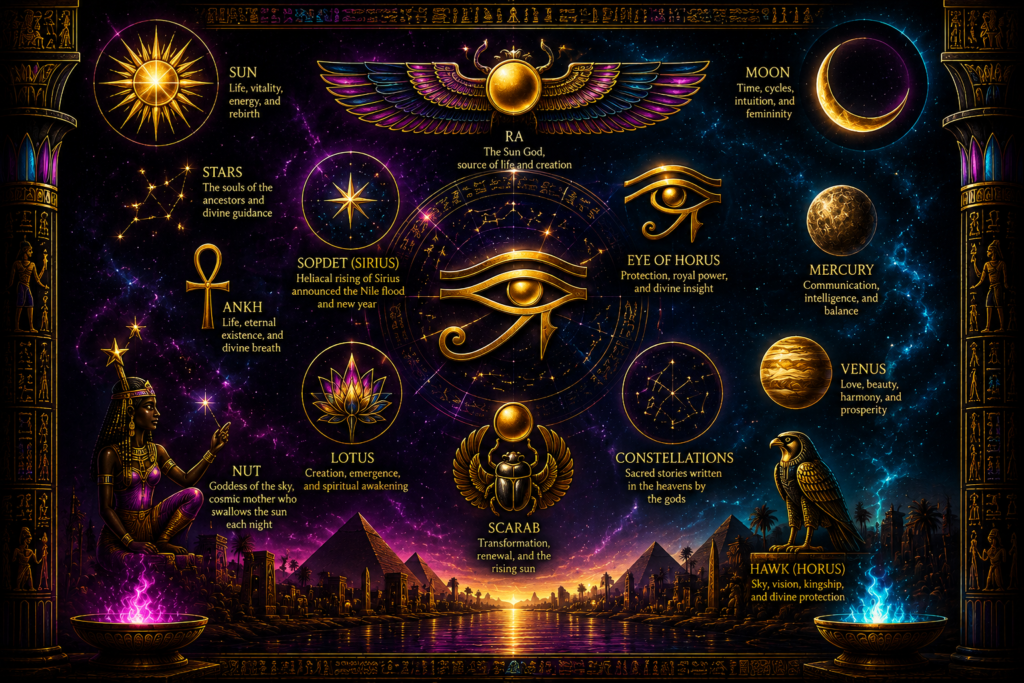
Ancient Egyptian celestial symbols therefore carried layers of meaning. The Sun could represent divine power and regeneration. Stars could be associated with eternity and the afterlife. Sopdet, identified with Sirius, became connected with an important seasonal transition. Nut embodied the sky itself, while groups of stars now called decans were incorporated into systems for measuring the passage of the night.
These traditions belonged to an ancient African civilization whose astronomical knowledge developed over many centuries.
It is important, however, to distinguish this Egyptian celestial tradition from the popular idea of modern astrology. The evidence from ancient Egypt is strongest for astronomical observation, calendars, timekeeping, religious symbolism, funerary traditions, and cosmology. The familiar twelve-sign zodiac became prominent in Egypt much later.
To understand ancient Egyptian celestial symbols accurately, we must begin with the Egyptians' own sky.
The Sun: Divine Power, Life, and Renewal
Few celestial objects were as important to ancient Egyptian culture as the Sun.
Its daily journey across the sky provided a visible cycle of appearance, disappearance, and return. Egyptian religious traditions transformed this recurring natural phenomenon into a powerful expression of cosmic regeneration.
Ra, one of ancient Egypt's major solar deities, became closely associated with the Sun, creation, kingship, life, and the maintenance of cosmic order.
Egyptian religious compositions described the solar deity traveling through the visible sky during the day and through the hidden regions of the cosmos during the night. Dawn represented the successful renewal of this journey.
The Sun therefore carried meanings extending far beyond light itself. It could symbolize:
- Life
- Divine authority
- Kingship
- Creation
- Regeneration
- Cosmic continuity
Solar disks appear throughout Egyptian religious imagery and could be associated with several deities.
During the reign of Akhenaten, the Aten—the visible solar disk—became the center of an extraordinary transformation of royal religion. Artistic representations famously show rays descending from the disk, some terminating in hands offering life to members of the royal family.
Although Akhenaten's religious program was exceptional, reverence for solar power was deeply rooted in Egyptian culture long before his reign.
The Moon: Time, Cycles, and Renewal
The Moon also occupied an important place within ancient Egyptian understandings of the sky.
Unlike the Sun's daily rhythm, the Moon visibly changes throughout its monthly cycle. Its recurring phases provided ancient observers with another celestial means of recognizing the passage of time.
Several Egyptian deities possessed lunar associations.
Khonsu, whose major cult became especially important at Waset, modern Luxor, was strongly associated with the Moon. Thoth, the deity of writing, knowledge, reckoning, and wisdom, also acquired significant lunar connections.
Within Egyptian religious thought, the Moon could consequently become associated with ideas involving:
- Time
- Measurement
- Cycles
- Restoration
- Renewal
The Egyptian Moon was therefore part of a much larger system in which observation of the natural world and religious meaning could intersect.
Stars and the Promise of Eternity
Stars possessed profound significance in ancient Egyptian religion, particularly in ideas concerning death and continued existence.
Some of Egypt's earliest surviving royal funerary writings, the Pyramid Texts, contain passages describing the deceased king ascending into the heavens and becoming associated with celestial beings and stars.
Of particular importance were stars in the northern sky that appeared never to set.
From the Egyptian observer's perspective, these stars possessed an enduring quality. Because they continually circled the northern celestial region rather than disappearing for long periods below the horizon, they became powerful images of permanence.
This made the stars particularly appropriate symbols for concepts involving:
- Eternity
- Immortality
- Royal transformation
- The celestial afterlife
- Continuity beyond death
For ancient Egyptians looking upward at night, the sky could therefore represent both a physical environment and a sacred landscape.
Sopdet: Sirius and the Egyptian Year
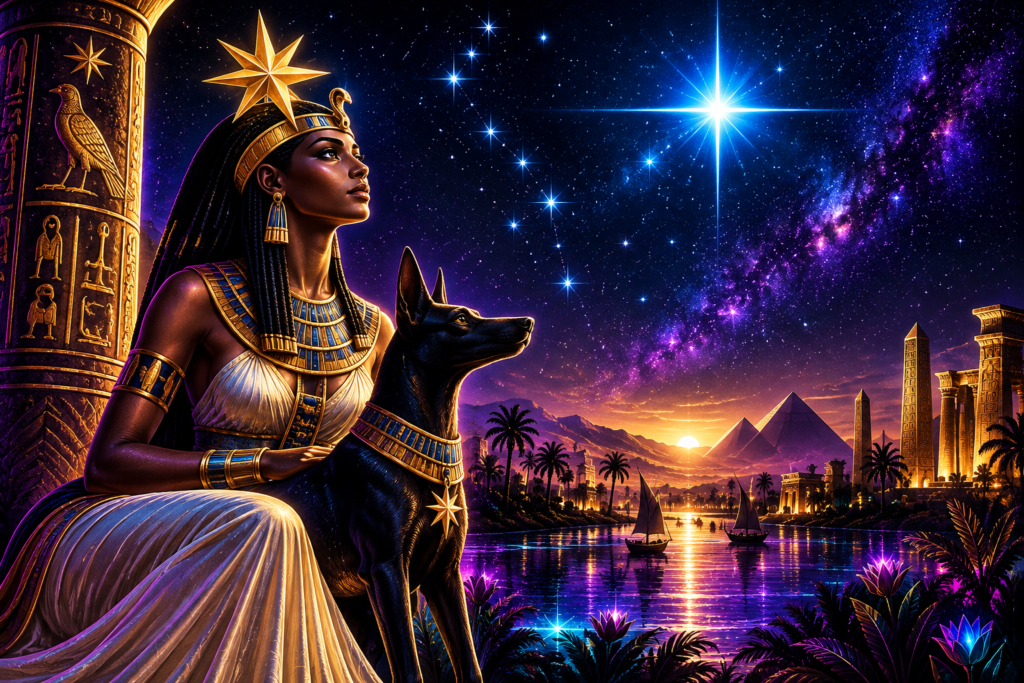
Among all the stars known to ancient Egyptians, Sopdet held exceptional importance.
Sopdet is identified with the star we now call Sirius, the brightest star in Earth's night sky.
Ancient Egyptian observers paid particular attention to its heliacal rising—its reappearance in the eastern sky shortly before sunrise after a period during which it had not been visible.
This appearance became associated with an important seasonal transition and the beginning of the Egyptian year.
The annual inundation of the Nile was essential to Egypt's agricultural system. It replenished agricultural lands with water and fertile sediment and profoundly shaped the rhythm of life along the Nile Valley.
Sopdet's reappearance became culturally associated with this season of renewal.
However, an important distinction is necessary: Sirius and the Nile flood should not be described as remaining perfectly synchronized throughout all periods of Egyptian history.
Egypt's 365-day civil calendar lacked the extra quarter-day of the solar year, causing calendar dates to gradually shift in relation to the seasons.
The importance of Sopdet therefore demonstrates not fortune-telling, but something historically more significant: Egyptian observers recognized recurring celestial phenomena and incorporated them into systems of time, religion, and seasonal understanding.
Sah: The Celestial Figure Associated With Orion
Another prominent celestial figure was Sah.
Sah is commonly associated with the region of the sky we identify today with Orion, although ancient Egyptian constellations should not automatically be assumed to correspond perfectly to modern constellation boundaries.
Sah became closely connected with Osiris, one of the most important deities associated with death, regeneration, kingship, and the afterlife.
Egyptian astronomical representations sometimes place Sah and Sopdet within the same broader celestial environment.
Their importance illustrates how Egyptians mapped religious meaning onto the observable sky without separating astronomy, religion, and cosmology into the strict modern categories familiar today.
The stars were observable celestial bodies, but they could simultaneously participate in a sacred understanding of existence.
The Decans: Egypt's Celestial Timekeepers
Among the strongest evidence for ancient Egyptian astronomical knowledge are the star groups conventionally known today as decans.
Egyptian astronomical traditions organized decanal stars or star groups into systems connected with ten-day periods and the measurement of nighttime.
One of the most remarkable surviving forms of this knowledge appears in diagonal star tables, particularly those preserved on Middle Kingdom coffins.
These tables arranged sequences of stars across grids. Their successive appearances were used to represent the passage of the hours of the night.
A traditional Egyptian system ultimately involved 36 ten-day divisions within the 360-day portion of the year, followed by five additional days completing the 365-day civil calendar.
The decanal system should not be imagined as completely unchanged throughout Egyptian history. Star lists, astronomical representations, and methods evolved over time.
What remains clear is that ancient Egyptians developed sophisticated systems connecting observation of stars with the measurement and organization of time.
This is one of the clearest examples of practical astronomy preserved from ancient Egypt.
Star Clocks and Astronomical Ceilings
Egyptian celestial knowledge survives not only in written texts but also in spectacular visual representations.
Astronomical ceilings have been discovered in tombs and temples, where stars, planets, deities, calendars, and constellations could be represented together.
A famous example comes from the tomb of Senenmut, an important official during the reign of Hatshepsut.
Its astronomical ceiling contains representations of celestial figures alongside stars, planets, decans, and calendrical information.
Such monuments demonstrate that Egyptians did not simply observe individual stars in isolation. They developed organized ways of representing the structure and movement of the sky.
Other Egyptian astronomical sources include:
- Diagonal star tables
- Astronomical ceilings
- Water clocks
- Shadow clocks and sundials
- Calendrical texts
- Religious compositions concerning the heavens
Together, these surviving sources provide direct archaeological and textual evidence for Egyptian celestial knowledge.
Nut: The Sky Embodied
Few images capture ancient Egyptian cosmology more dramatically than Nut, the goddess of the sky.
Nut was often depicted as a woman arching over the Earth, sometimes with stars covering her elongated body.
Rather than simply living somewhere in the heavens, Nut could embody the sky itself.
Her body created a visual representation of the celestial realm stretching over the world below.
Egyptian religious traditions also connected Nut with the solar cycle. The Sun could be described as entering her body in the evening and emerging again with the dawn.
Nut consequently became associated with:
- The sky
- Stars
- The solar cycle
- Birth and rebirth
- Protection
- Regeneration
- The afterlife
One of the most important Egyptian astronomical compositions known today as the Book of Nut describes aspects of the behavior of the Sun and stars within this cosmological framework.
Nut demonstrates how ancient Egyptians could transform careful observation of celestial cycles into a powerful visual and religious understanding of the universe.
The Wedjat Eye: Restoration and Celestial Meaning
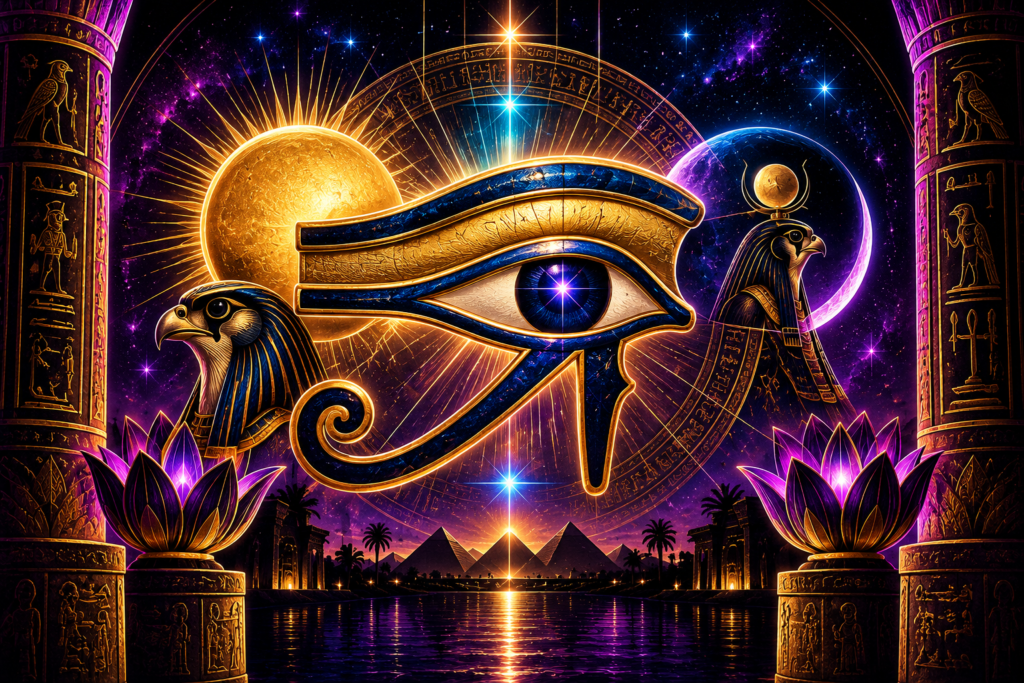
The Wedjat Eye, commonly called the Eye of Horus, is one of ancient Egypt's most recognizable symbols.
Its principal meanings concerned protection, healing, restoration, and wholeness.
Egyptian religious traditions describe the eye of Horus being damaged during conflict with Seth and subsequently restored. This restoration made the Wedjat a potent symbol of completeness and recovery.
The eyes of divine figures could also acquire solar and lunar associations in Egyptian religious thought.
However, the Wedjat should not simply be labeled an "astrology symbol."
Its historical meaning was considerably broader.
The Wedjat belonged to Egyptian religious and protective symbolism and appears extensively in amulets and funerary contexts. Any celestial interpretation should therefore remain part of that larger Egyptian religious framework.
The Ankh: The Symbol of Life
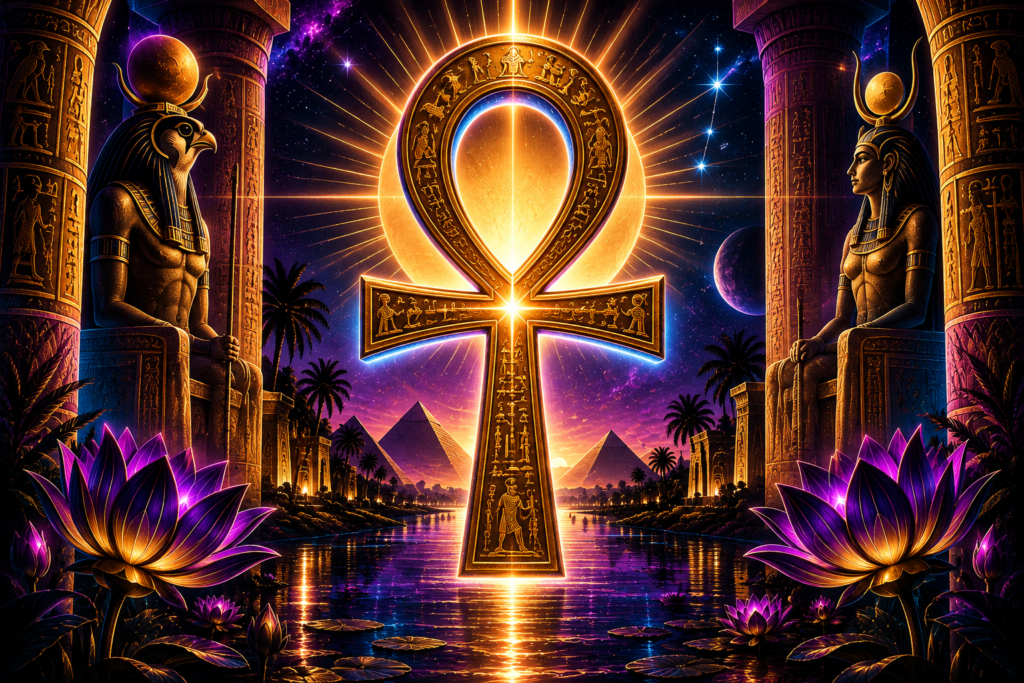
The ankh is among the most recognizable symbols surviving from ancient Egypt.
Its fundamental meaning was life.
Egyptian artworks frequently depict deities holding an ankh or extending it toward the king. In these scenes, the symbol communicates the divine granting or sustaining of life.
The ankh was not an astrological sign.
Its relevance to Egyptian celestial symbolism comes from the wider Egyptian understanding of the cosmos as a divinely ordered environment in which life, nature, kingship, and divine forces were interconnected.
Understanding this distinction prevents modern spiritual interpretations from replacing the meanings supported by ancient Egyptian evidence.
Ma'at: Cosmic Order and Balance
To understand how Egyptians viewed the heavens, we must also understand Ma'at.
Ma'at encompassed interconnected concepts of truth, justice, balance, right order, and cosmic stability.
The Egyptians experienced a world filled with recurring patterns.
Day followed night.
The Sun disappeared and returned.
Stars moved across the heavens.
Seasons changed.
The Nile followed recurring environmental rhythms.
Against this background, the predictable behavior of the heavens could be understood as part of a larger ordered cosmos.
Egyptian kingship itself was deeply connected with maintaining Ma'at. The king was expected to preserve proper order against destructive disorder.
Celestial cycles therefore belonged to something larger than astronomy. They existed within an Egyptian worldview concerned with maintaining the balance necessary for life and society.
Egyptian Cosmology in Its African Setting
Ancient Egypt developed in northeastern Africa, with the Nile connecting communities across Egypt and regions farther south.
Understanding Egyptian celestial traditions within this African geography is essential.
African scholars have long argued that ancient Egypt should be studied within African history rather than isolated from the continent. Senegalese scholar Cheikh Anta Diop, in particular, challenged approaches that separated Egyptian civilization from its African setting and emphasized the importance of examining Egyptian religion, philosophy, language, and culture within African historical study.
Modern scholarship continues to debate many questions concerning cultural relationships across ancient Africa, and individual historical claims must be evaluated according to archaeological, linguistic, textual, and biological evidence.
Yet the geographical foundation is unmistakable: ancient Egyptian civilization developed on the African continent, within a Nile Valley environment that connected Egypt with neighboring African regions.
Celestial observation was therefore one expression of an African civilization's sustained effort to understand nature, time, life, death, and the structure of the universe.
Did Ancient Egyptians Practice Astrology?
This question requires careful terminology.
Ancient Egyptians unquestionably observed the heavens.
They tracked celestial cycles, created calendars, developed stellar timekeeping systems, represented constellations and planets, incorporated celestial phenomena into religious traditions, and produced astronomical diagrams.
That does not mean that the familiar modern system of twelve zodiac personality signs existed throughout pharaonic Egyptian history.
It did not.
The twelve-sign zodiac familiar from later astrology entered Egyptian visual and intellectual culture much later, after zodiac traditions developed elsewhere and circulated throughout the ancient Mediterranean and Near Eastern worlds.
Late Egyptian monuments such as the famous zodiac at Dendera demonstrate this later interaction.
For an article focused on ancient Egyptian celestial symbolism, however, this later development should not overshadow Egypt's much older indigenous traditions.
Long before zodiac imagery appeared in Egypt, Egyptians were observing Sopdet, Sah, decanal stars, the Sun, Moon, planets, and northern stars and integrating celestial cycles into their understanding of time and the cosmos.
Did Celestial Symbols Predict Individual Fate?
Claims that ancient Egyptians routinely used celestial symbols to determine everyone's personality or individual destiny should be approached cautiously.
Evidence from pharaonic Egypt strongly supports the use of celestial observation in:
- Calendars
- Nighttime measurement
- Religious ritual
- Temple and funerary symbolism
- Seasonal organization
- Royal ideology
- Cosmology
- Concepts of death and regeneration
That evidence does not justify transforming every Egyptian deity or sacred symbol into a zodiac personality sign.
Modern systems sometimes assign Egyptian gods to birthdays, personality traits, or zodiac signs, but these should not automatically be presented as traditions originating in the earliest periods of ancient Egypt.
The historically documented Egyptian relationship with the heavens is compelling without adding unsupported claims.
What Ancient Egyptian Celestial Symbols Really Tell Us
Ancient Egyptian celestial symbols reveal a civilization paying extraordinarily close attention to recurring patterns in nature.
The Sun demonstrated renewal and divine power.
The Moon provided visible cycles connected with time and restoration.
Sopdet marked an important celestial and seasonal transition.
Sah linked a recognizable region of the night sky with Egyptian religious traditions concerning Osiris.
The decanal stars helped organize nighttime.
Nut transformed the entire sky into divine imagery.
The Wedjat represented restoration and protection while acquiring celestial associations.
The ankh expressed life.
And Ma'at provided a broader concept through which cosmic stability, social order, and proper balance could be understood.
These symbols were not isolated mystical icons.
Together, they belonged to a sophisticated Egyptian way of observing and representing the universe.
The Enduring Legacy of Ancient Egypt's Celestial Symbols
Ancient Egyptians left behind one of Africa's most extraordinary records of sustained engagement with the heavens.
Coffins preserve star tables. Tombs contain astronomical ceilings. Religious texts describe celestial journeys. Temples preserve images of sky deities, solar cycles, stars, and planets. Surviving timekeeping instruments demonstrate attempts to measure the passage of hours.
The evidence reveals a civilization in which the observable sky, sacred tradition, time, kingship, death, regeneration, and cosmic order could exist within an interconnected worldview.
Ancient Egyptian celestial symbols should therefore be understood first within the civilization that created them.
Doing so moves us beyond the popular image of a mysterious "Egyptian zodiac" and toward something supported far more strongly by the surviving evidence: an ancient African civilization that carefully observed the heavens and transformed those observations into systems of timekeeping, religious expression, and powerful ideas about humanity's place within an ordered cosmos.