High above Earth shines Sirius, the brilliant star that has fascinated civilizations for thousands of years. Known today as the brightest star visible in Earth’s night sky, Sirius held particular importance across parts of Africa, including ancient Egypt.
Yet one of the most intriguing stories connected with Sirius comes not from a modern observatory, but from West Africa.
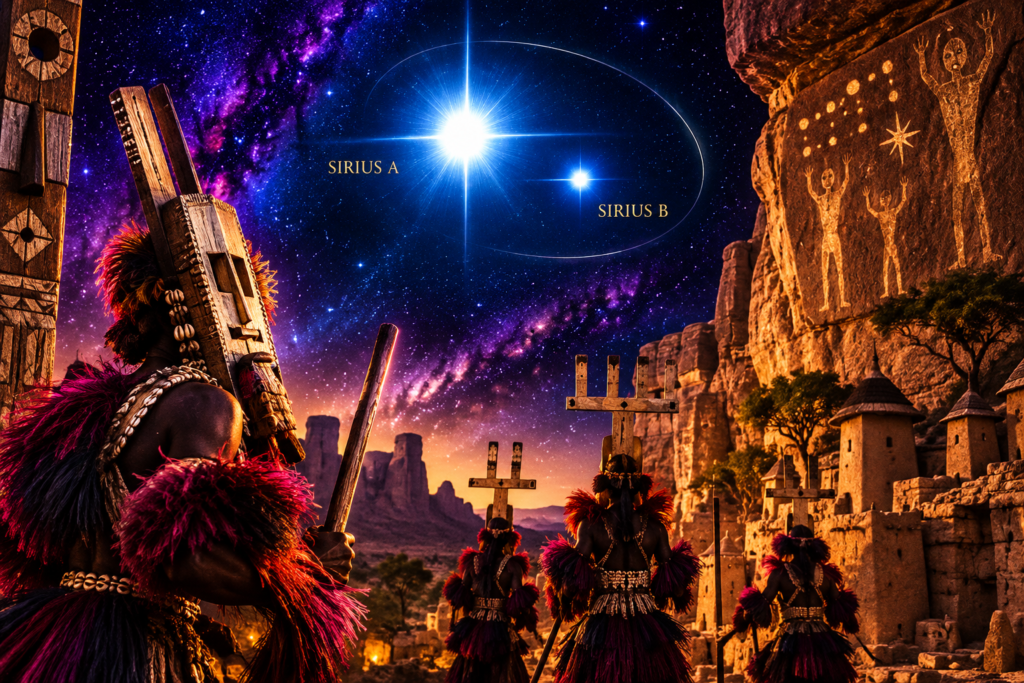
Among the Dogon people of Mali, researchers in the twentieth century recorded traditions that they interpreted as describing an extraordinarily small, heavy, and invisible companion associated with Sirius. The star described in these accounts became popularly identified with Sirius B, a white dwarf that cannot be seen with the naked eye.
The resulting question has fascinated historians, astronomers, anthropologists, and alternative-history researchers for decades:
Did the Dogon possess sophisticated knowledge of the Sirius star system, and if so, where did that knowledge come from?
The answer remains controversial.
Sirius: The Brilliant Star of the Night Sky
Sirius lies approximately 8.6 light-years from Earth and appears in the constellation Canis Major. Although it looks like a single brilliant point of light to the unaided eye, Sirius is actually a binary star system.
The dominant star is Sirius A, the luminous object we see in the night sky.
Its companion is Sirius B, an extraordinarily dense stellar remnant known as a white dwarf.
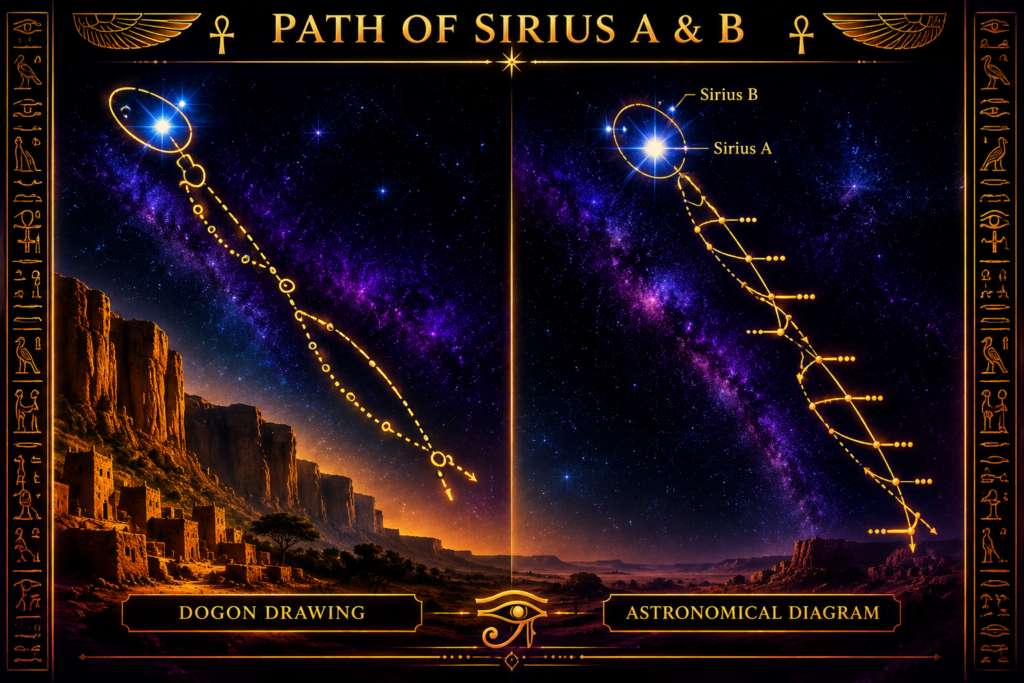
Sirius B is only about 7,500 miles (12,000 kilometers) in diameter and roughly 10,000 times fainter than Sirius A. Sirius A and Sirius B orbit their common center of mass over a period of approximately 50 years.
Sirius B was first observed telescopically in 1862 by American astronomer Alvan Graham Clark, after mathematician and astronomer Friedrich Bessel had earlier inferred the existence of an unseen companion from irregularities in Sirius A's motion.
None of this would be particularly mysterious on its own.
The mystery begins when we travel to Mali.
The Dogon and the Mystery of Sirius
The Dogon are an Indigenous West African people whose traditional homeland is centered around the Bandiagara region of Mali.
Their cultural traditions include complex systems of symbolism, ritual, agriculture, ancestry, creation, and cosmology.
Beginning in the 1930s, French ethnographer Marcel Griaule conducted extensive research among the Dogon. He was later joined in this work by ethnologist Germaine Dieterlen.
In 1950, Griaule and Dieterlen published a paper titled Un système soudanais de Sirius, roughly, “A Sudanese System of Sirius.”
Their account would eventually ignite one of the most famous astronomical controversies associated with African traditional knowledge.
The researchers reported information from several Dogon informants concerning a cosmological system centered partly on Sirius.
Within their interpretation of those traditions appeared something extraordinary.
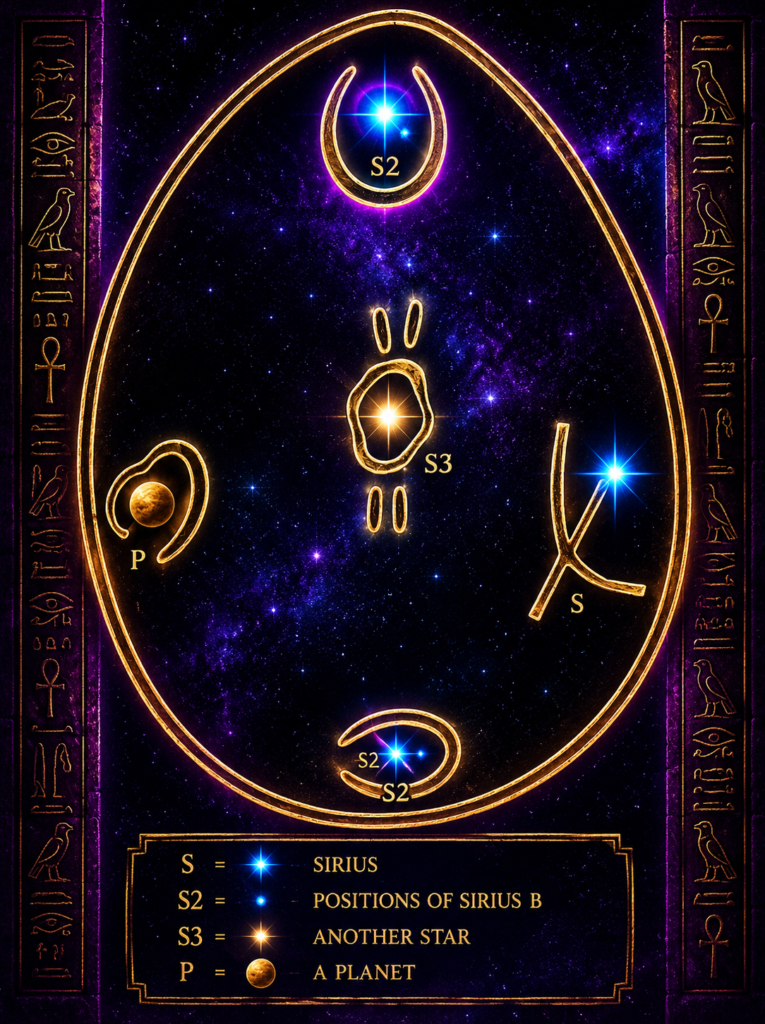
A star known as Po Tolo was described as extremely small yet extraordinarily heavy.
Griaule and Dieterlen associated this mysterious object with the invisible companion of Sirius.
Today, that companion is known as Sirius B.
Po Tolo: The Mysterious “Seed Star”
The name Po Tolo has commonly been translated in discussions of Dogon cosmology as the “fonio star” or “seed star.”
Fonio is an extremely small West African grain.
This imagery is important because the star was represented as something incredibly small while simultaneously possessing tremendous weight or density.
That description immediately attracted attention because Sirius B is exactly the kind of astronomical object that combines small physical size with extraordinary density.
A white dwarf contains an enormous amount of mass compressed into a sphere roughly comparable in size to Earth.
Popular accounts of the Dogon mystery therefore ask an obvious question:
How could people without modern astronomical instruments have known that an invisible companion of Sirius was both small and extraordinarily dense?
That question became the heart of the Sirius mystery.
The 50-Year Orbit
The mystery became even more fascinating because Griaule and Dieterlen's account was interpreted as connecting Po Tolo with a cycle of approximately 50 years.
Modern astronomy shows that Sirius B takes roughly 50 years to orbit Sirius A.
The similarity is striking.
The Dogon also traditionally perform an important ceremonial cycle known as the Sigui, although interpretations of its astronomical significance and exact relationship to Sirius are disputed.
Supporters of the Sirius B interpretation have argued that the combination of an invisible companion, extreme density, and a roughly 50-year cycle is too specific to dismiss easily.
Critics strongly disagree.
And that disagreement is where the story becomes even more interesting.
Nommo and the Dogon Creation Tradition
Another element frequently connected with the Sirius mystery is Nommo.
In accounts recorded by Griaule and Dieterlen, Nommo occupies an important place within Dogon cosmological traditions and is associated with creation, order, water, regeneration, and ancestral or spiritual beings.
Later popular writers dramatically expanded this part of the story.
The best-known example was Robert Temple, whose 1976 book The Sirius Mystery proposed that the Dogon's astronomical knowledge might preserve memories of contact with intelligent beings associated with the Sirius system.
Temple connected the Nommo traditions with this hypothesis.
This is where an important distinction must be made.
The claim that extraterrestrial beings from Sirius taught astronomy to the Dogon is an interpretation—not an established conclusion of archaeology, anthropology, or astronomy.
It nevertheless transformed the Dogon story into an international mystery.
Did the Dogon Really Know About Sirius B?
This is the central controversy.
Griaule and Dieterlen did indeed publish an ethnographic account in 1950 describing a Dogon Sirius system. Their paper identifies multiple principal informants and presents traditions that the researchers interpreted in astronomical terms.
But later researchers questioned whether these traditions actually demonstrated independent, ancient knowledge of Sirius B.
Anthropologist Walter E. A. van Beek returned to Dogon communities decades later and attempted to investigate Griaule's findings.
His conclusions were dramatically different.
Van Beek reported that he could not independently reproduce much of the elaborate cosmological system Griaule had described. In particular, he found that Sirius did not hold the extraordinary central importance among his Dogon informants that Griaule's work seemed to suggest.
This created several competing explanations.
Perhaps Griaule accurately recorded specialized knowledge possessed only by certain initiated individuals.
Perhaps elements of European astronomical knowledge had reached Dogon communities before or during the period of ethnographic research.
Perhaps researchers and informants influenced one another during lengthy interviews.
Or perhaps later fieldwork simply failed to recover traditions that had changed, disappeared, or were restricted.
The available evidence has not established the sensational version of the story as historical fact.
What Astronomy Actually Tells Us About Sirius B
Whatever one concludes about the Dogon story, Sirius B itself is extraordinary.
NASA describes Sirius B as a faint white dwarf orbiting Sirius A. The two stars revolve around one another approximately every 50 years, while Sirius B is around 10,000 times fainter than its brilliant companion.
White dwarfs are stellar remnants.
When certain stars exhaust their nuclear fuel, their outer material is eventually expelled and the remaining core collapses into an incredibly compact object.
This means Sirius B represents the remains of a star that underwent a profound transformation long before recorded human history.
To someone standing beneath the African night sky, none of this is visible.
There appears to be only one brilliant Sirius.
The hidden companion requires astronomy to reveal itself.
That is precisely why the Dogon story became so famous.
Sirius and Ancient Egypt
The mystery becomes especially fascinating when Sirius is placed within the broader history of African astronomy.
Thousands of years before modern astrophysics, ancient Egyptians carefully observed Sirius.
The Egyptians called the star Sopdet, later associated by the Greeks with Sothis. Its heliacal rising—its seasonal reappearance shortly before sunrise after a period of invisibility—became closely associated with the annual rhythm of the Nile and Egyptian calendrical traditions.
Sirius therefore occupied an important place within Egyptian religious and astronomical culture.
Sopdet became closely associated with Isis, while nearby Orion was associated with Osiris.
This does not prove that ancient Egyptians knew about Sirius B.
Nor does it demonstrate that Egyptian astronomical knowledge was transmitted to the Dogon.
But it reveals something historically important that can sometimes disappear from popular retellings of the Sirius mystery:
African civilizations and cultures possessed significant traditions of observing, interpreting, and preserving knowledge about the sky.
The history of astronomy is not exclusively European.
An African Astronomy Mystery Worth Exploring Carefully
The most compelling version of the Dogon story does not require us to declare the mystery solved.
There are really two extraordinary stories here.
The first is astronomical.
Sirius, apparently a solitary blazing star to the human eye, possesses a tiny, incredibly dense stellar companion orbiting beside it in darkness.
The second is cultural.
Twentieth-century ethnographers reported Dogon traditions that they interpreted as containing remarkably similar characteristics: a tiny, heavy star associated with Sirius and a long orbital cycle.
Whether those similarities represent ancient astronomical knowledge, cultural transmission, ethnographic misunderstanding, specialized religious symbolism, or some combination remains debated.
Treating the story responsibly means acknowledging both sides.
We should not automatically transform oral traditions into proof of extraterrestrial contact.
But neither should African cosmological traditions be dismissed merely because they do not resemble modern scientific textbooks.
They deserve to be studied within their own cultural, historical, linguistic, and spiritual contexts.

Sirius B: Mystery, Memory, or Misinterpretation?
The Dogon Sirius story ultimately raises a larger question about how knowledge survives.
Human societies have preserved information through monuments, writing, mathematics, songs, ceremonies, myths, priesthoods, storytelling, symbols, and oral traditions.
Some traditions encode observations of the natural world.
Others express spiritual or philosophical ideas.
And sometimes the boundary between the two is difficult for modern researchers to reconstruct.
That makes Sirius B one of the most fascinating intersections of African cosmology and modern astronomy.
A tiny star invisible to ordinary human sight circles the brightest star in our night sky.
More than seventy years after Griaule and Dieterlen published their account, people are still asking the same question:
What exactly did the Dogon know about Sirius and how did they know it?
Perhaps the enduring importance of the Sirius mystery lies not in forcing a spectacular answer, but in continuing to investigate the history of African astronomy with curiosity, evidence, and respect.