Discover the fascinating history of the Eye of Horus, its connection to Heru, its role in ancient Egyptian protection and restoration, and what the archaeological evidence reveals about one of Kemet's most recognizable sacred symbols.
What Is the Eye of Horus?
The Eye of Horus, known in ancient Egyptian tradition as the Wedjat Eye, is one of the most enduring religious symbols of ancient Kemet (Egypt). Associated with the falcon god Heru (Horus), the eye represented protection, restoration, wholeness, and the renewal of life.
For thousands of years, ancient Egyptians incorporated the Wedjat Eye into jewelry, amulets, funerary objects, religious imagery, and ritual practices. Its significance extended beyond decoration. It expressed an important religious idea: that what had been damaged or disrupted could be restored to completeness.
The ancient Egyptian term wḏꜣt, commonly rendered as wedjat or udjat, is associated with being sound, intact, or whole. This meaning reflects the mythology of the injured eye of Heru, which was healed and restored.
Although the symbol is frequently described today as the Eye of Horus, understanding its original Egyptian name and religious context provides a deeper appreciation of its place in ancient African civilization.
The Ancient Egyptian Name and Meaning of the Wedjat Eye
The word Wedjat comes from the ancient Egyptian language and expresses the condition of being restored, healthy, or intact.
This meaning was central to the symbol's religious importance.
In ancient Egyptian thought, wholeness was not simply a physical condition. Restoration could also carry religious significance, particularly in relation to divine order, healing, kingship, and the continuation of life after death.
The Wedjat Eye therefore represented several interconnected concepts:
Protection: Safeguarding the living and deceased against harmful forces.
Restoration: The recovery of something damaged or lost.
Wholeness: The return to an intact and complete condition.
Regeneration: The renewal of life and vitality.
Divine well-being: The preservation of health and sacred order.
These meanings emerged from Egyptian religious traditions and were reinforced through centuries of ritual practice.
The Myth of Heru and the Restoration of the Sacred Eye
The mythology of the Eye of Horus is closely connected to Heru, the falcon deity associated with kingship, the sky, and divine authority.
In Egyptian religious traditions, Heru became involved in a struggle with Set (Seth), a powerful deity associated with conflict, storms, and disruptive forces.
The conflict was connected to the murder of Wesir (Osiris), the father of Heru, and the struggle over rightful kingship.
During the contest, Heru suffered an injury to his eye.
Different Egyptian texts preserve variations of this episode. Some describe the eye being damaged, removed, or otherwise harmed. Its restoration became a major religious theme.
The god Djehuty (Thoth), associated with wisdom, writing, and sacred knowledge, plays an important role in healing or restoring the eye in several traditions.
Once restored, the eye became the Wedjat: the sound or complete eye.
Why the restoration mattered
The recovered eye was not simply a sign that Heru had survived an injury.
It became a powerful expression of the restoration of divine order after conflict.
In Egyptian funerary traditions, the restored eye could also be offered to Wesir, helping express his renewed vitality and the continuation of existence beyond death.
This connection explains why the Wedjat Eye became especially important in mortuary rituals.
The myth carried a message that resonated throughout Egyptian religion: damage, disorder, and loss could be overcome through restoration and renewal.
Eye of Horus vs. Eye of Ra: What Is the Difference?
The Eye of Horus and the Eye of Ra are frequently confused because both appear in Egyptian religious imagery and can share similar visual forms.
However, their mythological associations are not identical.
Eye of Horus (Wedjat)
Eye of Ra
Associated particularly with Heru
Associated with the solar deity Ra
Famous for its injury and restoration
Often expresses solar power and divine authority
Represents protection, wholeness, and renewal
Frequently represents protective and potentially destructive divine force
Prominent in healing and funerary symbolism
Prominent in solar mythology and protective goddess traditions
The distinction should not be treated as absolute. Ancient Egyptian religious symbolism was flexible, and the meanings of divine eyes sometimes overlapped.
In some traditions, the eyes of Heru were associated with the sun and moon, while the Eye of Ra could be personified through goddesses such as Sekhmet, Hathor, or Tefnut.
Both traditions demonstrate the importance of divine sight and protective power in Egyptian religion.
The Wedjat Eye has a distinctive appearance that makes it recognizable even when separated from other Egyptian religious imagery.
Its design generally includes a prominent eye, an eyebrow, a curved marking beneath the eye, and an extended line descending from its outer region.
These features are often interpreted in relation to the markings around the eyes of falcons, particularly birds associated with Heru.
The falcon was an important symbol of royal and divine authority in ancient Egypt.
The eye's design combined recognizable visual elements with religious symbolism, creating an image that could be reproduced across many materials and scales.
Ancient artisans fashioned Wedjat Eyes from faience, stone, precious metals, and other materials. The symbol also appeared in painted decoration and carved reliefs.
Its widespread use demonstrates that the Wedjat Eye was not restricted to royal settings. It became a recognizable protective emblem throughout different levels of Egyptian society.
How Ancient Egyptians Used the Eye of Horus for Protection
The Wedjat Eye was among the most common protective amulet designs in ancient Egypt.
Amulets were objects believed to provide benefits through their religious symbolism, materials, inscriptions, or ritual associations.
Wedjat amulets could be worn by the living and placed with the deceased.
Protection during everyday life
Ancient Egyptians wore protective amulets to seek divine safeguarding and well-being.
A Wedjat Eye pendant or small amulet could symbolize the protection associated with the restored eye of Heru.
The choice of materials and colors could add further religious significance.
Blue and green Egyptian faience, for example, were widely used in amulet production and could evoke renewal, fertility, and life.
Protection in the afterlife
The Wedjat Eye was also important in funerary contexts.
Examples have been recovered from burials, mummy wrappings, coffins, and other mortuary objects.
Within Egyptian funerary belief, the symbol was associated with the restoration and protection of the deceased.
Its connection to the renewed eye of Heru made it especially appropriate for religious practices concerned with overcoming death and achieving renewed existence.
The Eye of Horus in Ancient Egyptian Religious Texts
The Wedjat Eye appears in important ancient Egyptian religious compositions, including the Pyramid Texts, Coffin Texts, and Book of the Dead traditions.
These texts developed across different historical periods and preserve variations in Egyptian religious thought.
The Pyramid Texts
The Pyramid Texts, first preserved extensively in royal pyramids of the late Fifth and Sixth Dynasties, contain some of the earliest surviving substantial collections of Egyptian funerary spells.
They include references to the Eye of Horus as an offering and as a means of restoring vitality.
In several passages, the eye is presented to the deceased king, expressing the renewal of strength and the continuation of divine existence.
The Coffin Texts
The Coffin Texts expanded the surviving written record of funerary religious practices, particularly during the Middle Kingdom.
References to the Eye of Horus continued to express protection, renewal, and ritual restoration.
The eye could function symbolically as a divine offering or as a source of restored well-being.
The Book of the Dead
During the New Kingdom and later periods, compositions now commonly grouped under the Book of the Dead continued to incorporate the protective and regenerative symbolism of divine eyes.
The Wedjat Eye also appeared independently on funerary objects associated with the deceased person's journey into the afterlife.
Together, these sources demonstrate that the symbol's religious importance was not based on a single myth or one historical period.
Its meanings developed within a long and varied Egyptian religious tradition.
The Eye of Horus and Ancient Egyptian Fractions
One of the most interesting associations of the Eye of Horus concerns a system of fractional values.
In modern discussions of Egyptian mathematics, individual elements of the Wedjat Eye are frequently connected with fractions used in measuring grain and other commodities.
The familiar sequence is:
Fraction
Decimal value
1/2
0.5
1/4
0.25
1/8
0.125
1/16
0.0625
1/32
0.03125
1/64
0.015625
These six fractions add up to 63/64.
Egyptian mathematical sources establish the use of these fractional values in systems of measurement, particularly the heqat, a unit of capacity.
However, the popular diagram assigning each fraction to a particular anatomical feature of the Wedjat Eye should be treated carefully.
Although it is commonly repeated as an ancient Egyptian teaching, the full correspondence between the six drawn parts of the eye and the six fractions is not securely established by surviving ancient mathematical documents.
The historical use of the fractions is better documented than the familiar modern illustration.
This distinction matters because ancient Egyptian mathematics deserves recognition for its actual achievements rather than interpretations that cannot be fully verified.
The Eye of Horus, the Pineal Gland, and the Third Eye
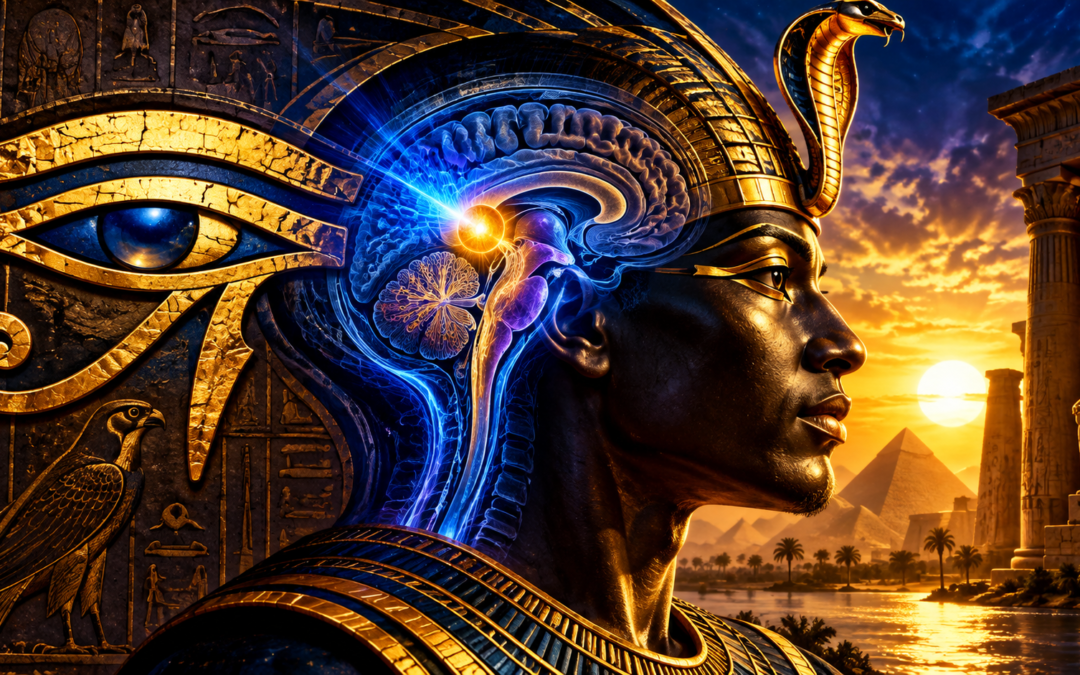
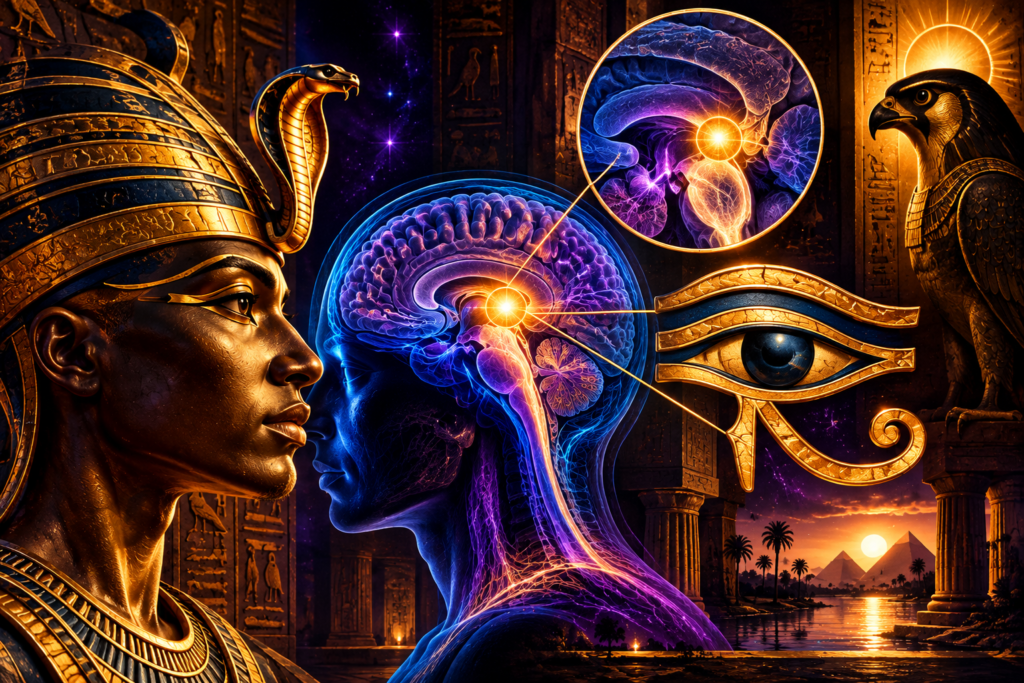
In contemporary spiritual discussions, the Eye of Horus is sometimes associated with the pineal gland, the human brain, and the concept of a third eye.
The pineal gland is a small endocrine structure located within the brain. Its established biological functions include producing melatonin, a hormone involved in regulating sleep and circadian rhythms.
Modern illustrations sometimes compare the appearance of the Wedjat Eye with structures visible in a sagittal section of the human brain.
These comparisons have encouraged claims that the Eye of Horus was deliberately designed as an anatomical representation of the pineal gland or that ancient Egyptians used the symbol to encode knowledge of a spiritual third eye.
What does the historical evidence actually show?
Ancient Egyptians possessed meaningful anatomical knowledge, particularly through medical observation, injury treatment, and embalming practices.
The Edwin Smith Surgical Papyrus, for example, contains descriptions of head injuries and observations relating to the brain.
However, surviving Egyptian religious and medical texts do not establish that the Wedjat Eye was intended to represent the pineal gland.
Nor do they demonstrate that Egyptian priests understood the pineal gland as the biological location of spiritual enlightenment.
The familiar connection between the Eye of Horus and the third eye belongs primarily to modern symbolic and esoteric interpretation.
It should not be presented as a verified ancient Egyptian doctrine.
Can the Eye of Horus still carry a modern spiritual meaning?
Yes. People today may interpret the Wedjat Eye as a symbol of awareness, insight, balance, or spiritual reflection.
Such interpretations can hold personal or cultural significance.
The important distinction is between modern spiritual meaning and what ancient Egyptian evidence actually documents.
For Kemet Hive, recognizing that difference helps preserve the original African historical context while allowing readers to understand why the symbol continues to inspire contemporary spiritual thought.
Archaeological Evidence of the Wedjat Eye
The archaeological record provides substantial evidence of the Wedjat Eye's importance across ancient Egyptian history.
Objects bearing the symbol have been recovered from temples, settlements, tombs, and burial assemblages.
These include small faience amulets, jewelry, decorated coffins, funerary equipment, and religious offerings.
Wedjat Eye amulets
Small Wedjat Eye amulets are among the most recognizable surviving Egyptian protective objects.
Many were produced in Egyptian faience, a glazed material commonly associated with blue and green coloring.
Others were fashioned from stones, metals, and other materials.
Their sizes and forms varied considerably, indicating different practical and ritual uses.
Coffins and funerary equipment
Eye motifs were also incorporated into Egyptian coffin decoration.
On some coffins, painted eyes symbolically allowed the deceased to look outward toward the world of the living and receive offerings.
Not every coffin-eye motif is identical to a freestanding Wedjat amulet, but these traditions share the broader Egyptian religious importance of sight, protection, and continued existence.
Museum collections and surviving artifacts
Today, major Egyptian and international museum collections preserve numerous examples of Wedjat Eye objects.
The Egyptian Museum in Cairo, the National Museum of Egyptian Civilization, and other Egyptian institutions provide important contexts for studying Egyptian religious material culture.
International collections, including those of the Metropolitan Museum of Art and British Museum, also preserve documented examples.
Together, surviving artifacts demonstrate the symbol's extensive history and changing artistic forms.
The Eye of Horus and Ma'at: Restoration of Divine Order
The Eye of Horus can also be understood in relation to the broader Egyptian concept of Ma'at.
Ma'at represented truth, justice, proper order, and the balanced functioning of the cosmos and society.
The restoration of Heru's damaged eye expresses a religious concern closely related to these ideas: the overcoming of disruption and the return to a sound condition.
However, the Wedjat Eye and Ma'at were not interchangeable symbols.
The Wedjat specifically developed from traditions involving divine eyes, protection, offerings, and restoration.
Ma'at represented a much broader principle of cosmic and social order.
Their relationship is therefore best understood as a thematic connection within Egyptian religious thought rather than as two names for the same religious concept.
Why the Eye of Horus Still Matters Today
The Eye of Horus remains one of the most internationally recognized symbols associated with ancient Egypt.
Its enduring popularity reflects both its distinctive design and the powerful religious ideas attached to it.
For the people of ancient Kemet, the Wedjat Eye was not merely a decorative emblem or a mysterious illustration.
It represented a meaningful relationship between divine protection, injury, restoration, and renewed life.
The symbol also reveals the sophistication of Egyptian religious thought.
Its meanings were expressed through mythology, ritual, language, artistic production, and funerary practices, demonstrating how closely these aspects of Egyptian civilization were connected.
Modern interpretations continue to evolve, but the historical Wedjat Eye deserves to be understood first within the African civilization that created and sustained its traditions.
Frequently Asked Questions About the Eye of Horus
What does the Eye of Horus symbolize?
The Eye of Horus primarily symbolizes protection, restoration, wholeness, and renewal. Its meaning is closely connected to the mythological injury and healing of the eye of Heru.
What is the original Egyptian name for the Eye of Horus?
The ancient Egyptian name is Wedjat, also written Udjat, derived from terminology associated with being sound, healthy, or whole.
Is the Eye of Horus the same as the Eye of Ra?
No. They have overlapping protective meanings but different mythological associations. The Wedjat Eye is especially associated with the restoration of Heru's injured eye, while the Eye of Ra is closely connected with solar power and divine authority.
Did ancient Egyptians believe the Eye of Horus was the pineal gland?
There is no established historical evidence that ancient Egyptians designed the Wedjat Eye as a representation of the pineal gland. This association is primarily a modern interpretation.
Was the Eye of Horus used for protection?
Yes. Archaeological evidence demonstrates that Wedjat Eye amulets were used in ancient Egypt, including in personal adornment and funerary contexts, where they carried protective religious significance.
Is the Eye of Horus connected to mathematics?
The symbol is frequently associated with a series of Egyptian fractions, but the popular diagram connecting individual eye markings with specific fractional values is not securely documented in surviving ancient mathematical texts.
Conclusion: The Enduring Power of the Wedjat Eye
The Eye of Horus is one of ancient Kemet's most significant and enduring sacred symbols.
Its history reveals a religious tradition deeply concerned with protection, wholeness, restoration, and the renewal of life.
From the mythology of Heru and Set to the protective amulets recovered from Egyptian archaeological sites, the Wedjat Eye occupied an important place in Egyptian spiritual and cultural life.
Although modern interpretations sometimes associate it with the pineal gland, hidden consciousness, or the third eye, its original meanings are firmly rooted in ancient Egyptian mythology, religious texts, and material culture.
Understanding the Wedjat Eye within its historical African context allows us to appreciate the extraordinary intellectual, artistic, and religious heritage of ancient Kemet.
For Kemet Hive, preserving that historical foundation is essential to exploring the meaning and enduring legacy of Egyptian civilization.
For thousands of years, one of ancient Egypt’s most recognizable symbols has stared back at us: the sacred eye associated with Horus.
Another powerful symbol appeared directly above the brow of Egyptian kings and queens: the raised cobra associated with divine protection, royal authority, and the goddess Wadjet.
Today, both symbols are sometimes connected with one of the smallest and most mysterious structures in the human brain: the pineal gland.
The resemblance between the Wedjat Eye, commonly called the Eye of Horus, and structures within the human brain has inspired striking anatomical comparisons. The placement of the royal cobra on the forehead has produced another provocative question: did the ancient Egyptians associate the forehead, sight, divine perception, or the serpent with knowledge of an internal organ related to light?
In the twentieth century, esoteric philosopher Manly P. Hall took the idea even further. In Man: The Grand Symbol of the Mysteries, he proposed a relationship between the pineal gland, the Egyptian royal cobra, reptiles, Horus, and what he called the “Eye of the Gods.”
Some aspects of this discussion rest on fascinating biological and ancient Egyptian evidence. Others belong to modern interpretation.
Understanding the difference makes the mystery even more interesting.
What Is the Pineal Gland?
The pineal gland is a small neuroendocrine organ located near the center of the human brain, attached near the roof of the third ventricle.
Its established biological function is closely connected with light, darkness, and the body’s internal clock.
The pineal gland produces the hormone melatonin, with production normally increasing during darkness. Through this system, the pineal gland participates in regulating circadian rhythms and sleep timing.
Humans do not possess a functioning external “third eye” connected directly to the pineal gland.
However, the evolutionary story becomes considerably more interesting when other vertebrates are considered.
The Reptilian “Third Eye”
Some reptiles possess a specialized photosensitive structure called the parietal eye, popularly described as a “third eye.”
The parietal eye and pineal organ belong to a related group of light-sensitive structures derived from the developing diencephalon. In certain lizards and the tuatara, the parietal eye can detect environmental light and participate in biological processes associated with daily and seasonal rhythms.
It is not simply another ordinary eye like the two lateral eyes. Nevertheless, it contains genuine photoreceptor structures.
Modern research also shows that reptilian pineal systems vary considerably between species. Some reptiles possess well-developed parietal eyes, while others do not.
This biological connection between light-sensitive organs and the pineal complex helps explain why the pineal gland acquired such a powerful reputation as a “third eye” in later philosophical and esoteric traditions.
It also brings us to Manly P. Hall.
Manly P. Hall and the “Eye of the Gods”
In 1932, Manly P. Hall published Man: The Grand Symbol of the Mysteries, a study combining anatomy with comparative religion, symbolism, philosophy, and occult interpretation.
Chapter XVI was titled “The Pineal Gland, the Eye of the Gods.”
Hall discussed the evolutionary history of pineal and parietal structures before turning his attention toward ancient Egypt.
He asked whether the Egyptians knew about the unusual development of the pineal complex among reptiles and whether this could explain the placement of the serpent upon the forehead of Egyptian royalty.
This is an important distinction.
Hall was posing an interpretive question, not presenting an ancient Egyptian inscription stating that the royal cobra represented the pineal gland.
Hall then developed the idea further.
Because Egyptian kingship was closely connected with the divine world, he reasoned that an organ interpreted esoterically as representing higher perception or divinity might naturally become associated with royalty.
From there he connected the royal serpent, the forehead, Horus, and the pineal gland within a larger system of occult anatomy.
It is an intriguing theory.
But what do ancient Egyptian sources actually tell us?
The Uraeus: The Serpent on the Royal Forehead
The rearing cobra seen on Egyptian crowns is commonly known today by the Greek-derived term uraeus. The ancient Egyptian term was iaret.
Its Egyptian meaning is well documented.
The cobra was intimately connected with Wadjet, an ancient Egyptian goddess associated with Lower Egypt, royal authority, and divine protection.
When represented on the brow of the king, the cobra stood ready to defend the ruler against his enemies.
Ancient Egyptian imagery could portray the royal cobra as projecting destructive fire against hostile forces. The serpent therefore communicated far more than royal status. It embodied supernatural protection and the dangerous power surrounding legitimate kingship.
Archaeological evidence confirms its importance across Egyptian history.
A relief of King Mentuhotep II dating to approximately 2020–2000 BCE, for example, preserves the protective cobra directly above the king’s forehead.
Gold and electrum examples of royal cobras also survive.
Its placement on the forehead is therefore unquestionably ancient.
What remains unproven is whether that placement was intended to identify the pineal gland.
No known Egyptian inscription has yet been demonstrated to say that the iaret represented the pineal gland or an anatomical “third eye.”
Wadjet, the Cobra, and the Divine Eye
The story becomes even more interesting because Egyptian serpent and eye symbolism were not entirely separate religious worlds.
Wadjet herself could participate in traditions surrounding the Eye of Re.
The Eye of Re was not simply a physical eye. In Egyptian religious thought, the divine Eye could become an active manifestation of the sun god’s power, sometimes personified as a goddess capable of protecting the divine order and destroying enemies.
Wadjet could occupy this role.
This creates a genuine ancient Egyptian relationship among the cobra, divine power, protection, kingship, and the concept of the divine Eye.
That relationship does not prove a pineal connection.
But it demonstrates why Egyptian eye and serpent symbolism should be understood through Egyptian religion before modern anatomical interpretations are added.
The Wedjat: The Eye of Horus
The symbol commonly called the Eye of Horus was known in ancient Egyptian as the Wedjat.
The term carries the sense of being whole, sound, restored, or made complete.
According to Egyptian religious traditions, the eye of Horus was damaged or lost during his conflict with Seth. The eye was subsequently restored, commonly through the intervention of Thoth.
The restored eye therefore became a powerful symbol of:
wholeness, restoration, regeneration, protection, and renewed life.
Wedjat amulets became extraordinarily popular throughout ancient Egyptian history. They were worn by the living and placed with the dead.
Its visual appearance also reflects Horus himself.
Horus was strongly associated with the falcon, and the Wedjat combines characteristics of a human eye with stylized falcon markings.
This detail becomes particularly important when evaluating modern claims about its resemblance to the brain.
Does the Eye of Horus Depict the Human Brain?
One of the most widely circulated modern theories proposes that the Wedjat Eye is actually a diagram of the human brain.
When a stylized Eye of Horus is placed over a sagittal section of the brain, certain lines and curves can appear to correspond with anatomical structures.
Modern authors have proposed similarities involving structures in and around the thalamus, corpus callosum, brainstem and other regions.
Some researchers have even suggested that different components of the symbol might correspond to sensory functions.
The visual comparison is undeniably intriguing.
A published medical paper examining the Eye of Horus and neuroanatomy described these similarities and proposed that they could reflect ancient Egyptian anatomical knowledge.
But even that study characterized the idea as scientific speculation.
There is currently no surviving Egyptian text explaining the Wedjat as a diagram of the brain.
Nor is there an Egyptian inscription identifying its components with the pineal gland, thalamus, corpus callosum, or modern neurological structures.
Therefore, the responsible conclusion is not that the resemblance is meaningless, nor that it proves secret neurological knowledge.
It is that the resemblance represents an interesting hypothesis that has not been archaeologically demonstrated.
But Did Ancient Egyptians Understand the Brain?
Here the evidence becomes extremely important.
Ancient Egyptians did possess genuine knowledge of the brain.
One of the strongest pieces of evidence comes from the ancient Egyptian surgical text now called the Edwin Smith Papyrus.
The surviving manuscript dates to approximately the seventeenth century BCE, although its contents are generally understood to preserve material originating from an older medical tradition.
The document presents dozens of trauma cases in a remarkably systematic fashion.
Among its observations are descriptions involving the brain, membranes surrounding the brain, cerebrospinal fluid, cranial injuries, neurological symptoms, and pulsations associated with exposed brain tissue.
It contains the earliest surviving written use of a term referring to the brain known to scholarship.
Egyptian physicians could also observe relationships between injuries to the head and resulting physical symptoms.
This is significant.
It establishes that ancient Egyptian physicians were not anatomically ignorant. They observed the consequences of cranial trauma carefully and developed sophisticated clinical knowledge within the limitations of their period.
But recognizing the brain is different from identifying the pineal gland.
No surviving Egyptian medical document presently provides clear evidence that Egyptian physicians isolated the pineal gland as a distinct organ or assigned it the functions recognized by modern endocrinology.
That distinction must remain central to any discussion of the Egyptian “third eye.”
Did Mummification Give Egyptians Anatomical Knowledge?
Mummification provided Egyptian specialists with extensive practical contact with the human body.
During many forms of elite mummification, organs were removed and the body underwent complex preparation for burial.
The brain itself could be removed during embalming, particularly in later periods, frequently through the nasal region.
It might therefore seem logical to assume that embalmers possessed detailed neurological knowledge.
However, practical familiarity with internal anatomy does not automatically mean that every internal structure was scientifically isolated, named, and understood.
The surviving medical evidence demonstrates real Egyptian anatomical observation.
It does not, at present, demonstrate an Egyptian doctrine identifying the pineal gland as the seat of spiritual perception.
The Eye, Light, and the Pineal Gland
There is nevertheless a fascinating modern biological relationship among the eye, environmental light, and pineal function.
In humans, information about environmental light reaches the brain through the eyes and contributes to regulation of the circadian system. That system ultimately influences melatonin production by the pineal gland.
In some non-mammalian vertebrates, pineal and related structures can themselves possess photoreceptive properties.
The connection between light and the pineal system is therefore biological reality.
What cannot currently be demonstrated is that ancient Egyptians understood that physiology and encoded it into the Wedjat or royal cobra.
This is precisely where established science, Egyptian religious symbolism, and later esoteric interpretation meet without necessarily being identical.
Why Hall Connected Reptiles With the Egyptian Cobra
Hall's argument becomes easier to understand when viewed in this context.
He knew of scientific discussions concerning pineal and parietal structures in reptiles. He also knew that Egyptian rulers displayed a conspicuous serpent directly upon the forehead.
He therefore asked whether the two could be connected.
Visually and symbolically, the idea is powerful:
a reptile, a forehead, an eye-like light-sensitive structure, divine kingship, and hidden perception.
But the sequence of reasoning moves from biological observation to symbolic interpretation.
The first part can be examined scientifically.
The second requires Egyptian textual and archaeological evidence.
So far, that final bridge has not been established.
Hall's theory should therefore be understood as an influential esoteric interpretation of Egyptian symbolism, rather than a translation of documented Egyptian teachings about the pineal gland.
Horus and the Pineal Gland in Hall's Interpretation
Hall went further still.
He associated the eye of Horus with the pineal gland and interpreted Horus through his system of occult anatomy.
This idea helped contribute to a broader modern tradition in which the Eye of Horus became associated with the third eye, inner vision, expanded consciousness, and the pineal gland.
Ancient Egyptian sources unquestionably establish Horus and his restored eye as major religious concepts.
They establish the Wedjat as a symbol of restoration and protection.
They establish the royal cobra as a manifestation of divine and royal protective power.
They do not currently establish Hall's additional identification of the Eye of Horus with the pineal gland.
That distinction does not diminish ancient Egyptian spirituality.
In fact, it allows the Egyptian concepts to speak on their own terms.
The Pineal Gland Was Not the Egyptian “Seat of the Soul”
Another misconception deserves clarification.
The pineal gland is frequently called the “seat of the soul.”
That famous formulation is associated particularly with the seventeenth-century French philosopher René Descartes, who gave the pineal gland a unique role in his philosophical explanation of interactions between mind and body.
This should not automatically be projected backward into ancient Egypt.
Ancient Egyptian ideas concerning the human person were much more complex.
Egyptian religious thought recognized interconnected aspects of existence including the ka, ba, akh, ib, ren, and physical body.
Of particular importance was the ib, the heart, which carried profound associations with identity, thought, character, memory, and moral judgment.
The heart, rather than the brain or pineal gland, occupied a central position in Egyptian conceptions of the individual and the afterlife.
This is vividly expressed in traditions surrounding the weighing of the heart.
So while later Western esoteric traditions often elevated the pineal gland as the seat of spiritual consciousness, we should not substitute that later idea for documented Egyptian concepts of personhood.
Ancient Egyptian Symbolism Was Layered
One reason theories surrounding the Eye of Horus remain so compelling is that Egyptian symbols frequently carried several interconnected meanings.
The Wedjat could signify restoration, protection, regeneration, divine power, and completeness.
The cobra could represent Wadjet, protection, royal authority, and the destructive power directed against the enemies of divine order.
Horus could embody kingship while participating in solar, celestial, royal, and mythological traditions that changed and developed over thousands of years.
Ancient Egyptian symbolism was therefore sophisticated enough without requiring every image to conceal a modern anatomical diagram.
At the same time, ancient Egyptian physicians possessed genuine observational knowledge of the brain.
Both facts can coexist.
So Did Ancient Egyptians Know About the Pineal Gland?
Based on currently available textual and archaeological evidence, we cannot demonstrate that ancient Egyptians identified the pineal gland as a distinct spiritual organ or deliberately represented it through the Wedjat Eye or royal cobra.
That is the most historically responsible answer.
But it is not the end of the story.
Ancient Egyptians demonstrably possessed medical knowledge of the brain.
They developed one of history's most sophisticated symbolic traditions surrounding eyes, vision, restoration, solar power, serpents, protection, and divine kingship.
The cobra really was positioned prominently on the royal forehead.
The Wedjat really did represent a sacred restored eye connected with Horus.
Some reptiles really do possess light-sensitive parietal structures associated developmentally and evolutionarily with the pineal complex.
And the human pineal gland really does participate in biological responses to the cycle of light and darkness.
Those facts are remarkable on their own.
What remains unproven is the connecting proposition: that ancient Egyptians consciously understood these biological relationships and encoded them into their religious symbols.
The Mystery of the “Eye of the Gods”
Perhaps the greatest value of Manly P. Hall's theory is not that it solves the mystery, but that it raises a question worth examining.
Why does the serpent occupy such a prominent position on the Egyptian royal forehead?
Ancient Egyptian evidence already supplies a powerful answer: the cobra represented divine protection, royal authority, Wadjet, and the fiery force capable of destroying the king's enemies.
Could Egyptian symbolism have contained additional meanings that have not survived clearly in written form?
Possibly.
Ancient Egypt existed for more than three thousand years, and much of its intellectual and religious world has been lost.
But possibility must remain distinct from evidence.
The pineal interpretation is therefore best understood as a fascinating modern hypothesis situated at the intersection of Egyptian religion, anatomy, comparative biology, and esoteric philosophy.
The Wedjat does not need to be a hidden anatomical drawing to be extraordinary.
Nor does the iaret need to represent a pineal gland to possess profound meaning.
Both emerged from an African civilization whose physicians studied the injured brain, whose theologians developed complex concepts of divine sight and cosmic order, and whose artists transformed the eye and cobra into some of the most enduring sacred symbols in human history.
The mystery becomes more meaningful when we distinguish what the ancient Egyptians actually left behind from what later generations have seen within their symbols.
And for now, the question remains open:
Did the ancient Egyptians encode knowledge of the pineal gland into the sacred eye and royal serpent—or are we looking at an extraordinary convergence of ancient symbolism, human anatomy, and modern interpretation?
The surviving evidence has not yet given us a definitive answer.
That is precisely what makes the question so fascinating.
Atum was one of the most important creator deities of ancient Egypt. Appearing prominently in some of the oldest surviving Egyptian religious writings, he represented the creative power through which an ordered universe could emerge from the primordial state that existed before creation.
Ancient Egyptian traditions described Atum as self-generated. Before the familiar world of earth, sky, people, and living beings had taken form, Atum existed within or emerged from the primordial waters known as Nun.
From Atum came the first divine pair, Shu and Tefnut. Their descendants included Geb and Nut, followed by Osiris, Isis, Seth, and Nephthys. Through this divine genealogy, Egyptian religious thought connected Atum with the development of the natural world and some of ancient Egypt's most important deities.
Atum was also associated with the sun, especially its evening phase, and became closely linked with Ra. His influence extended into Egyptian ideas about kingship, creation, death, regeneration, and the continuing cycles of existence.
But who exactly was Atum, and what did this ancient Egyptian creator represent?
Who Was Atum in Ancient Egypt?
Atum was an ancient Egyptian creator and solar deity associated with the origin and completion of creation.
His name is commonly written Atum in English and transliterated from ancient Egyptian as jtm or jtmw. Scholars connect the name with the Egyptian verb tm, which carries meanings associated with completion or finishing.
This concept is central to understanding Atum.
He was not simply imagined as a craftsman constructing a universe from materials already around him. In an important Egyptian conception of creation, Atum contained within himself the potential from which other parts of existence could emerge.
The creator was initially one.
Creation transformed that unity into multiplicity.
This concept gave Atum an extraordinary position in ancient Egyptian religion: he could represent both the source of creation and its completeness.
The Ancient Origins of Atum
Determining exactly when Egyptians first conceived of Atum is difficult because Egypt's religious traditions developed long before many surviving texts were written.
What can be stated with confidence is that Atum was already an important deity by the Old Kingdom.
His prominence is demonstrated by the Pyramid Texts, the great collection of religious utterances first preserved extensively in royal pyramids beginning late in the Fifth Dynasty.
These inscriptions contain some of the oldest surviving written evidence concerning Egyptian religious beliefs.
Atum appears repeatedly within them.
This matters because much of what is popularly called "Egyptian mythology" today was written down or reconstructed from sources separated by enormous spans of time. The Pyramid Texts bring us much closer to early Egyptian religious thought.
They show that Atum's roles as creator, divine ancestor, and powerful figure connected with Egyptian kingship were already well established thousands of years ago.
Atum Before Creation: The Primordial Waters of Nun
Ancient Egyptians developed sophisticated ideas about what existed before the ordered world.
One important concept was Nun, the primordial watery state associated with existence before the familiar structure of the cosmos had emerged.
Nun was not simply the Nile or an ordinary body of water.
It represented a primordial condition from which creation could develop.
Atum was associated with emerging from this state at the beginning of creation.
The image of life and land emerging from water would have carried particular meaning in the Nile Valley. Egyptian civilization depended upon the Nile and its agricultural cycles, and Egyptians repeatedly witnessed the relationship between water, fertile earth, vegetation, and life.
Their religious ideas transformed such observations into cosmic concepts.
Creation was an emergence.
Atum represented the divine creative force at the heart of that transformation.
Atum and the First Land of Creation
Atum was also connected with the appearance of the primeval mound, representing the first stable land to emerge from the primordial waters.
This concept became important in ancient Egyptian creation symbolism.
For people living within the Nile Valley, the imagery would have been immediately understandable. Floodwaters could cover the landscape, followed by the reappearance of land as waters withdrew.
At the cosmic level, the first emerging land represented the beginning of an ordered and inhabitable world.
Atum's association with this moment placed him at the threshold between the primordial state and creation.
The first land also became associated with Egyptian solar symbolism and the Benben, a sacred symbol of emergence and creation.
Atum therefore represented not merely existence, but the beginning of ordered existence.
How Did Atum Create Shu and Tefnut?
Atum's creation of Shu and Tefnut is among the most distinctive episodes preserved in ancient Egyptian religious literature.
Because Atum initially existed alone, the first divine generation had to emerge from the creator himself.
The Pyramid Texts preserve bodily and sexual imagery describing this act of creation. Certain passages associate Atum's hand with the generative act, while other Egyptian traditions describe Shu and Tefnut as being brought forth through actions involving the mouth.
These descriptions should be understood within their ancient Egyptian religious context rather than through modern assumptions.
The underlying theological concept is more important than the physical imagery:
Atum possessed within himself the power required to generate life.
There was no preexisting divine couple necessary for the first act of generation.
Atum himself contained the creative potential.
Recent Egyptian scholarship examining the Pyramid Texts and archaeological evidence has drawn particular attention to the symbolism of Atum's hand as a life-bestowing instrument in this act of creation.
From the original creator came the first divine pair.
Shu and Tefnut: The First Divine Generation
From Atum came Shu and Tefnut.
Shu was strongly associated with air and atmospheric space.
Tefnut was associated particularly with moisture and related aspects of the natural world.
Their appearance represented a crucial development in creation.
Where Atum had initially existed as one, creation was now becoming differentiated.
Shu and Tefnut subsequently became the parents of:
Through these divine generations, Egyptian religious thought described the development of an increasingly structured cosmos.
Earth and sky became distinct.
Space existed between them.
The ordered world was taking shape.
Atum as Ancestor of a Powerful Divine Family
Atum's role as creator also made him the ancestor of one of ancient Egypt's most influential divine families.
The genealogy traditionally included:
Atum → Shu and Tefnut → Geb and Nut → Osiris, Isis, Seth, and Nephthys.
These nine deities are often collectively called the Ennead, from a modern term derived through Greek. More importantly for understanding the Egyptian concept, they represented an interconnected divine family beginning with Atum.
This genealogy connected the creation of the natural world with deities who later became central to Egyptian beliefs about kingship, protection, death, inheritance, regeneration, and the afterlife.
Atum therefore stood at the beginning of far more than a family tree.
Through his descendants, he became an ancestral source within a religious system that connected the structure of the universe with divine and royal order.
Atum in the Pyramid Texts
The Pyramid Texts provide some of the most important surviving evidence concerning Atum.
The earliest known substantial collection appears inside the pyramid of King Unas near the end of the Fifth Dynasty, with the tradition continuing in subsequent royal pyramids.
Atum appears throughout these texts in different religious contexts.
Some passages concern creation.
Others connect Atum with the deceased Egyptian king.
This relationship between Atum and kingship is significant.
The king's death was not understood simply as an ending. Egyptian royal funerary religion concerned transformation, continued existence, ascent, and association with divine powers.
Atum—the god connected with the beginning of creation—could therefore also participate in religious ideas concerning renewed existence after death.
Creation and regeneration were not entirely separate concepts.
Both involved the emergence or continuation of life and order.
Atum's Powers and Divine Roles
Atum's identity developed over ancient Egypt's long history, but several major roles remained especially important.
Creator
Atum represented the creative source from which the first divine generation emerged.
Divine Ancestor
Through Shu and Tefnut and their descendants, Atum became the ancestral head of an important Egyptian divine genealogy.
Solar Deity
Atum developed strong connections with the sun and particularly its evening phase.
Symbol of Completion
His name and theological character connected him with completeness and the completion of cycles.
Royal Deity
His imagery and appearances in royal religious literature associated him with divine authority and kingship.
Deity of Regeneration
His involvement in funerary religion and the recurring solar cycle connected him with transformation and continued existence.
These overlapping roles explain why Atum remained important across different periods of Egyptian history.
Atum and the Setting Sun
Atum became particularly associated with the setting sun.
Ancient Egyptians did not understand sunset merely as the disappearance of the sun.
The sun followed a recurring cosmic cycle.
It appeared in the east, traveled across the visible sky, descended in the west, passed through the night, and returned again.
Different Egyptian deities and divine manifestations could express different aspects of this solar journey.
Atum was strongly associated with its evening stage.
This made theological sense.
The setting sun had completed its daytime journey, echoing the concept of completion embedded in Atum's identity.
Yet completion did not necessarily mean permanent destruction.
The sun would return.
Atum's solar character therefore joined two important Egyptian ideas:
completion and renewal.
Atum and Ra
Atum became closely associated with the great Egyptian solar deity Ra.
The two could appear together as Ra-Atum or Atum-Ra, an association already found in Old Kingdom religious texts.
Ancient Egyptian religion frequently allowed deities to be joined in combined forms without permanently eliminating their individual identities.
This is important when understanding Atum.
Atum did not simply "turn into" Ra and disappear.
Instead, their creative and solar qualities allowed Egyptian religious thought to connect them.
Ra's immense importance as a solar deity complemented Atum's identity as a primordial creator and his association with the evening sun.
Together, these ideas strengthened Atum's connection with both creation and the recurring solar cycle.
What Did Atum Look Like?
Ancient Egyptian artists could represent Atum in several forms.
His most recognizable human representation depicts him as a male deity wearing the Double Crown of Upper and Lower Egypt.
He may hold divine symbols such as the was-scepter, associated with power and dominion, and the ankh, associated with life.
The Double Crown was especially significant.
By depicting Atum with royal regalia, Egyptian artists visually connected the creator with sovereignty and universal authority.
Atum was therefore not portrayed simply as an abstract cosmic force.
He could appear as a divine ruler.
Atum's Animal Forms and Symbols
Ancient Egyptian deities were not restricted to a single appearance.
Different forms could communicate different qualities of the same divine being.
Atum could be represented or symbolically associated with several animals, including the serpent.
Surviving Egyptian objects also preserve unusual manifestations connected with Atum, demonstrating how complex his visual identity could become.
These representations should not be interpreted as evidence that Egyptians believed Atum physically "looked" like only one creature.
Egyptian religious imagery operated symbolically.
Human, animal, and composite forms allowed artists and priests to communicate different characteristics of divine power.
Atum in Serpent Form
Atum's serpent form has particular importance because it appears in Egyptian ideas concerning the distant end of the ordered world.
Ancient Egyptian religious literature could imagine creation eventually returning toward a primordial watery state.
In one remarkable funerary tradition, Atum declares that what he created will ultimately return to the condition of Nun, while he assumes the form of a serpent.
This produces a striking theological symmetry.
Atum is associated with the beginning.
Atum is associated with completion.
And Atum remains connected with existence when the structured cosmos returns toward its primordial condition.
The creator therefore stands conceptually at both ends of the cosmic cycle.
Atum, Kingship, and the Double Crown
Atum's connection with Egyptian kingship deserves particular attention.
When depicted in human form, he commonly wears the Double Crown, combining symbols of Upper and Lower Egypt.
The imagery communicated authority over the unified Egyptian state.
Ancient Egyptian kingship was deeply connected with religious concepts of cosmic order.
The ruler was expected to uphold maat—a fundamental Egyptian principle encompassing truth, justice, balance, proper order, and rightness.
Creation itself involved the establishment of order.
Atum's position as creator and his royal appearance therefore made him especially appropriate within Egyptian ideas connecting divine authority, cosmic stability, and kingship.
Where Was Atum Worshipped?
Atum's most important cult center was Iunu, an ancient Egyptian city in the area of modern Cairo.
The city became one of Egypt's major centers of solar religion and religious learning.
It was only much later called Heliopolis by the Greeks.
Atum's importance, however, extended beyond a single location.
Evidence from Egyptian religious texts, funerary objects, and monuments demonstrates that knowledge and worship of Atum spread across different regions and periods.
His presence in royal Pyramid Texts, later funerary traditions, temple contexts, and surviving stelae demonstrates the longevity of his religious importance.
Atum Across Ancient Egyptian History
Atum's significance did not remain frozen in the Old Kingdom.
Egyptian religion continually developed.
Deities gained new associations, interacted with other gods, acquired additional titles, and could become more or less prominent depending upon historical circumstances.
Atum's connection with Ra became particularly important.
His creator role remained embedded within Egyptian religious tradition, while his solar identity allowed him to participate in broader ideas concerning the sun's daily transformation.
Later Egyptian funerary evidence continued to depict and invoke Atum.
Surviving stelae, for example, show worshippers adoring Atum and solar forms associated with him centuries after the Pyramid Texts were first inscribed.
Atum therefore remained part of Egyptian religious life across an extraordinary span of time.
Was Atum the Only Creator God in Ancient Egypt?
No.
This is one of the most important points for understanding ancient Egyptian religion accurately.
Egypt existed for thousands of years and developed multiple traditions concerning creation.
Atum was one of ancient Egypt's great creator deities, but he was not the only Egyptian god credited with creative power.
Other traditions emphasized deities such as Ptah, Khnum, Amun, Ra, and primordial divine forces.
These traditions did not always function as competing religions in the modern sense.
Egyptian theology could combine divine identities and accommodate different explanations of creation.
Atum's importance should therefore not be exaggerated into the claim that every ancient Egyptian everywhere believed Atum alone created the universe.
His documented significance is impressive without making that claim.
Atum and Khnum: Different Egyptian Ideas About Creation
Atum provides an especially interesting comparison with Khnum, another major Egyptian creator deity.
Their creative roles were not identical.
Atum's creation traditions emphasize self-generation and the emergence of the first divine beings from himself.
Khnum became famous for a different form of creative imagery: fashioning life on a potter's wheel.
These differences demonstrate the richness of ancient Egyptian religious thought.
Egyptians could express creation through several concepts—generation, emergence, divine speech, craftsmanship, solar power, and other forms of creative action.
Rather than forcing these traditions into a single uniform story, examining their differences helps us better understand the complexity of ancient Egyptian religion.
What Atum Reveals About Ancient Egyptian Thought
Atum's significance reaches beyond the question of who Egyptians believed created the universe.
His traditions preserve profound Egyptian ideas concerning the relationship between unity and multiplicity.
At the beginning, Atum exists as one.
From Atum emerge Shu and Tefnut.
From them come Geb and Nut.
Additional divine generations follow.
The original unity has unfolded into a complex cosmos.
Atum's story therefore provided ancient Egyptians with a way of explaining how the many components of existence could emerge from an original creative source.
Air, moisture, earth, sky, divine beings, kingship, solar cycles, death, and regeneration could all become interconnected within an ordered universe.
Atum Within the African History of Ancient Egypt
Atum belonged to the religious world developed within ancient Egypt in northeastern Africa.
That geographic and cultural reality matters.
Egyptian religion developed within the environmental, political, linguistic, and cultural history of the Nile Valley and interacted across long periods with other African regions, particularly to Egypt's south and west.
African scholars such as Cheikh Anta Diop challenged older approaches that isolated ancient Egypt from the rest of Africa and encouraged generations of researchers to examine Egypt within a broader African historical framework.
At the same time, understanding Atum accurately requires beginning with the surviving Egyptian evidence itself: Egyptian religious texts, inscriptions, archaeological remains, artistic representations, and the historical development of Egyptian religion.
The strongest picture emerges when ancient Egypt is neither detached from Africa nor reduced to assumptions that the surviving Egyptian evidence cannot support.
Atum is an important example of the intellectual and religious complexity that developed in the ancient Nile Valley.
Why Atum Remains Important Today
Atum provides an extraordinary window into how ancient Egyptians thought about existence.
His religious traditions addressed fundamental questions:
How did an ordered world emerge?
How could many forms of existence develop from a single source?
What connected creation with the sun?
How were divine authority and kingship related?
Why did cycles of disappearance and renewal matter?
What happened when the created world reached its completion?
Ancient Egyptians developed sophisticated theological answers to these questions over many centuries.
Atum stood at the center of some of those answers.
The Enduring Legacy of Atum
Atum was one of ancient Egypt's most significant creator gods.
The Pyramid Texts preserve his importance deep within the Old Kingdom, while later Egyptian texts, objects, and religious traditions demonstrate that his influence endured for centuries.
He was the self-generated creator from whom Shu and Tefnut emerged.
He was an ancestral deity connected with a powerful divine family.
He was associated with the primordial waters of Nun and the emergence of creation.
He was linked with Ra and the sun.
He represented the completion of the solar journey.
He appeared with the royal Double Crown and became associated with divine authority.
And in remarkable Egyptian traditions concerning the distant end of the cosmos, Atum remained connected with the return of creation toward its primordial state.
Atum therefore represents much more than a character from an ancient "myth."
He provides surviving evidence of how people in ancient Egypt contemplated creation, nature, divine power, kingship, life, death, regeneration, and the structure of the universe.
More than four thousand years after his name was inscribed within Egyptian royal pyramids, Atum remains one of the most powerful surviving examples of the intellectual and religious traditions created in the ancient African Nile Valley.
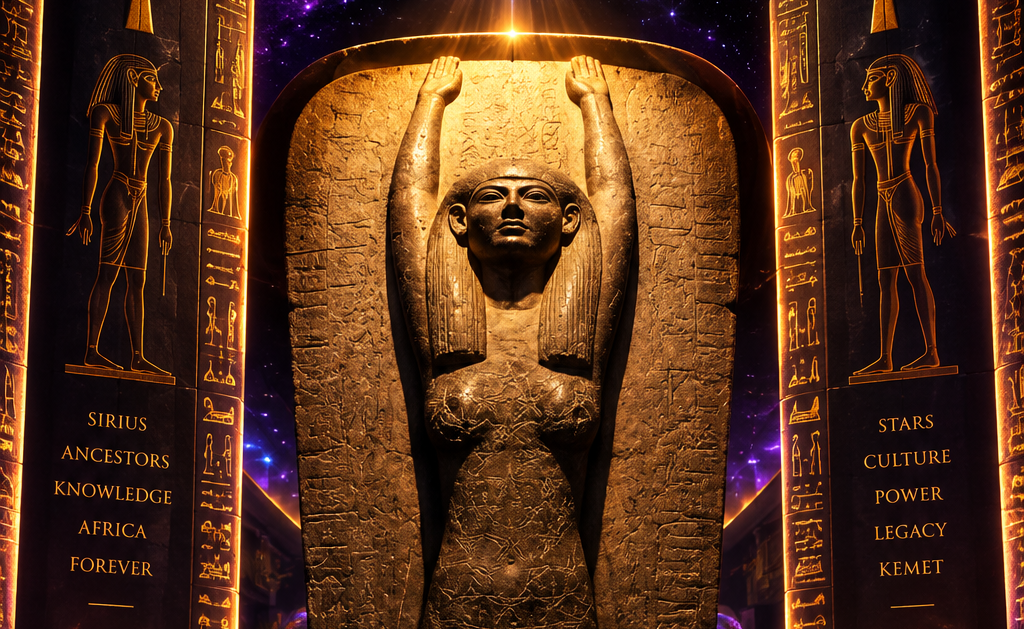
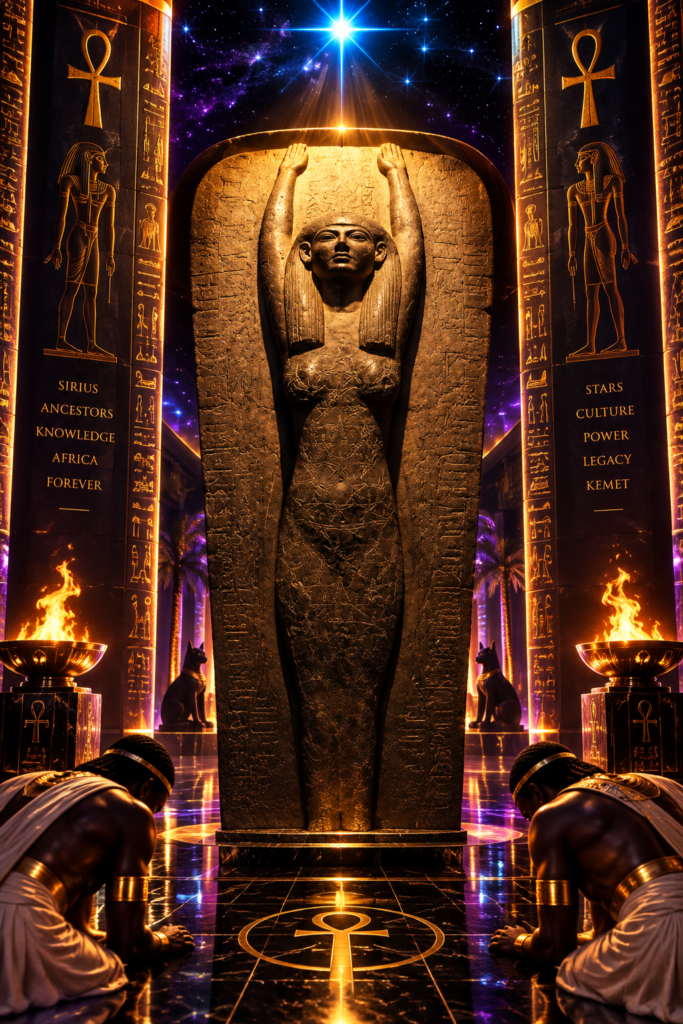
Across the sacred landscape of ancient Egypt, few divine images are as breathtaking as Nut, the great Egyptian goddess of the sky. Her enormous, star-covered body was imagined stretching across the heavens, her hands and feet touching the horizons while the world existed beneath her celestial embrace.
To the ancient Egyptians, the sky was not simply empty space overhead. It was part of a living, sacred cosmos filled with divine forces. Nut embodied that celestial realm.
She was associated with the sky, stars, cosmic renewal, the dead, and rebirth. Ancient Egyptian religious texts and funerary art also connected her to one of nature's most powerful cycles: the disappearance of the sun in the west and its return in the east.
This made Nut far more than a goddess looking down from heaven. She became a divine expression of the eternal cycle between life, death, and renewal.
Who Was Nut in Ancient Egypt?
Nut, whose name is commonly rendered as Nwt in modern Egyptological transliteration, was the ancient Egyptian personification and goddess of the sky.
She belonged to one of the most important divine families in Egyptian religion.
According to the theological traditions associated with Heliopolis, Nut was the daughter of Shu, the god associated with air, and Tefnut, associated with moisture. She was also the sister and consort of Geb, the earth god.
Nut and Geb became parents of several of ancient Egypt's most significant deities:
Osiris
Isis
Seth
Nephthys
Some traditions also connect Horus the Elder with this divine family.
Together, these gods formed part of the Great Ennead of Heliopolis, a divine grouping used by ancient Egyptians to explain aspects of creation and the structure of the cosmos.
Nut therefore occupied an extraordinary position: she was both the heavens themselves and an ancestor of gods who became central to Egyptian beliefs about kingship, death, resurrection, and the afterlife.
What Did the Goddess Nut Look Like?
Nut has one of the most recognizable forms in all of ancient Egyptian art.
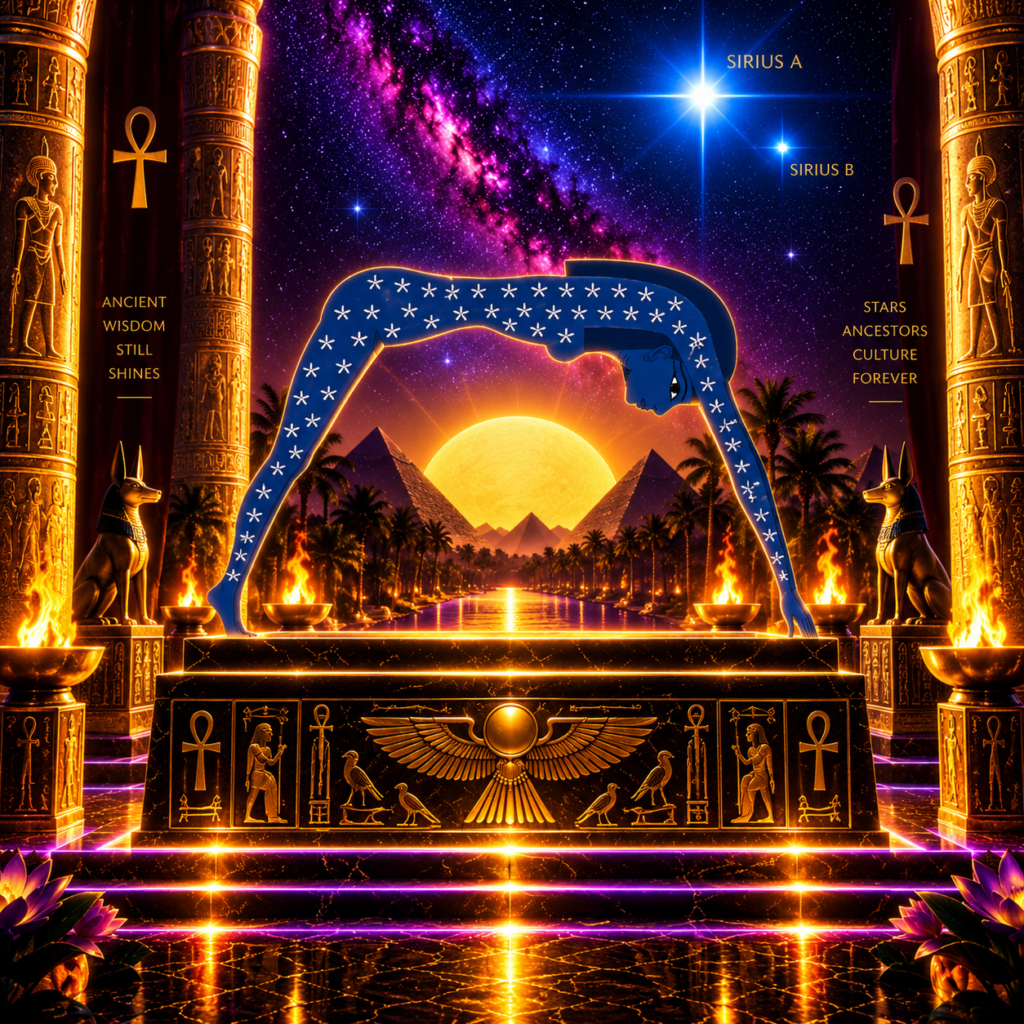
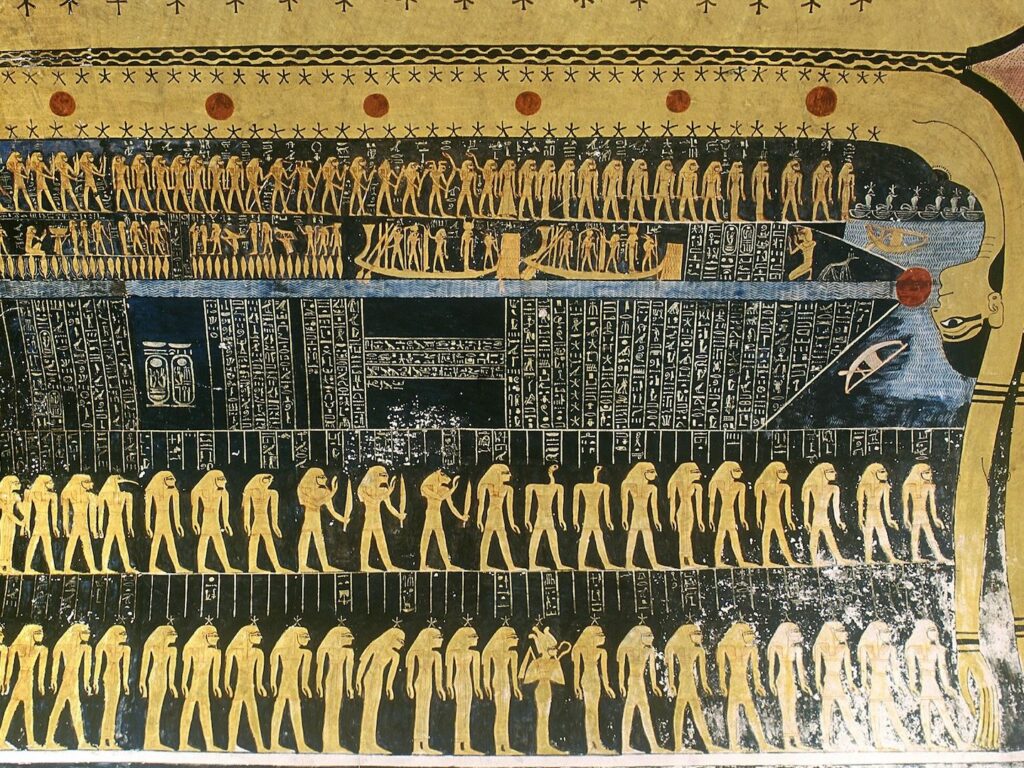
She was frequently portrayed as a woman arching over the earth, with her body extending from one horizon to the other. Stars could cover her body, emphasizing her identity as the celestial sky.
Below her often lies Geb, representing the earth.
Between Nut and Geb may stand Shu, whose raised arms separate the sky from the earth.
The scene is more than beautiful religious artwork.
It represents the organization of the Egyptian cosmos.
In one conception of creation, Nut and Geb were originally joined together until Shu separated them, creating the space in which the ordered world could exist.
Nut became the heavens above.
Geb became the earth below.
Shu occupied the space between them.
For the ancient Egyptians, this divine imagery transformed the structure of the natural world into a sacred story.
Why Was Nut Covered With Stars?
Nut's association with the stars was fundamental to her celestial identity.
Imagine standing beside the Nile thousands of years ago.
There are no modern city lights illuminating the horizon. Above you stretches an enormous night sky filled with countless stars.
For ancient Egyptians carefully observing the heavens, these celestial movements were intertwined with concepts of divine order, time, death, and renewal.
Nut could therefore be portrayed with stars spread across her body.
In some representations, the sun travels in relation to her celestial form as part of its daily cycle.
The heavens were alive—and Nut embodied them.
Did Nut Really Swallow the Sun?
One of the most fascinating aspects of Nut's mythology concerns the daily journey of the sun.
Egyptian religious traditions could describe Nut as receiving or swallowing the sun in the evening. During the night, the solar deity traveled through the mysterious realm beyond ordinary human sight.
At dawn, the sun emerged again.
This cosmic cycle repeated every day:
Sunset → Night → Renewal → Sunrise
The disappearance of the sun was therefore not necessarily understood as a permanent ending.
It was part of a cycle.
Night led toward morning.
Death could lead toward renewed existence.
And Nut stood at the center of this celestial transformation.
Nut and the Birth of the Sun
Nut's mythology demonstrates something essential about ancient Egyptian religion: divine identities and cosmic explanations were not always limited to one rigid story.
Different religious texts, temples, periods, and theological traditions could express the cosmos in different ways.
Nut could be envisioned as the celestial mother through whom the sun was renewed.
The solar deity's nightly passage and morning reappearance transformed the sky into something resembling a cosmic womb.
Every sunrise became another victory of renewal.
This imagery also helps explain why Nut became so important in Egyptian funerary religion.
The same celestial power that renewed the sun could symbolize renewed existence for the deceased.
Nut, Death, and Rebirth
Nut's role extended deeply into ancient Egyptian beliefs about death and the afterlife.
This may initially seem surprising.
Why would a sky goddess appear so prominently in funerary contexts?
The answer lies in renewal.
If Nut could receive the sun and participate in its reappearance, she could also represent the possibility that death was a transition rather than an absolute end.
Ancient Egyptians developed elaborate funerary traditions intended to help the deceased successfully enter and continue existence in the afterlife.
Nut became associated with this protective and regenerative journey.
Her image and words invoking her could appear on coffins, sarcophagi, tombs, and funerary objects.
The deceased could symbolically enter her celestial realm and participate in the same pattern of regeneration visible in the heavens.
Why Nut Appears Inside Egyptian Coffins
One of the most meaningful places to encounter Nut is inside ancient Egyptian funerary equipment.
Her image was sometimes painted on the interior of coffin lids.
This placement carried profound symbolism.
When the coffin closed, the deceased could symbolically lie beneath—or within—the celestial goddess.
Nut surrounded the dead just as the sky surrounded the living world.
Her presence expressed protection, celestial transformation, and rebirth.
This relationship became so important that Nut could be invoked as a divine mother receiving the deceased into the heavens.
A coffin, therefore, was not merely a container for a body.
Within Egyptian funerary belief, it could become part of a sacred environment designed for transformation and eternal existence.
The Goddess Nut and the Pharaohs
Nut's celestial role also appears in royal funerary traditions.
The Pyramid Texts, among the oldest extensive bodies of ancient Egyptian religious writings, preserve spells associated with the afterlife of Egyptian kings.
Within these traditions, Nut is repeatedly connected with the deceased king and his ascent or integration into the celestial realm.
Her role as a divine mother and heavenly protector made her particularly significant.
The dead ruler could be connected with the gods and stars, entering an eternal cosmic existence rather than simply disappearing from the world.
This gives Nut an important place in understanding ancient Egyptian concepts of royal immortality.
Nut and the Five Additional Days of the Egyptian Year
A later famous story involving Nut concerns the birth of her children and the structure of the Egyptian calendar.
In a version preserved by the Greek writer Plutarch, the sun god placed a restriction preventing Nut from giving birth on any day of the existing year.
The god Thoth then obtained additional portions of light and created extra days outside the original calendar.
Nut could give birth during these added days.
The story became associated with the five epagomenal days added to the 360-day calendar, producing a civil year of 365 days.
These days became associated with the births of major gods.
It is important, however, to distinguish later literary retellings from evidence originating directly in much earlier Egyptian periods. Ancient Egyptian religion developed over thousands of years, and surviving versions of myths do not always come from the same era.
Nut and Geb: The Sky and Earth
The relationship between Nut and Geb is among the most visually powerful expressions of ancient Egyptian cosmology.
Interestingly, Egyptian mythology reverses a pattern found in several other ancient traditions.
Here, the sky is female and the earth is male.
Nut stretches above as the sky.
Geb rests beneath as the earth.
Their separation establishes the space occupied by creation.
Yet visually, Nut still appears to surround Geb.
Her fingers reach toward one horizon while her toes touch the other, creating a celestial arch over the earth.
The entire inhabited world exists within this divine cosmic structure.
Nut and Ma'at: Understanding Cosmic Order
Nut should also be understood within the broader Egyptian concept of Ma'at, truth, balance, justice, proper order, and cosmic stability.
Nut was not simply a character in isolated mythology.
The movements of celestial bodies, the rising and setting of the sun, the annual rhythms of nature, divine kingship, temple ritual, and the afterlife all existed within a worldview concerned with maintaining order against disorder.
Every sunrise demonstrated continuity.
The stars moved according to celestial patterns.
The Nile followed seasonal rhythms, even though its inundations naturally varied.
The universe appeared governed by recurring cycles.
Nut visually embodied part of this ordered cosmos.
The Book of Nut and Ancient Egyptian Astronomy
Nut is especially fascinating because studying her can bring religion and ancient Egyptian astronomy together.
A group of astronomical and religious compositions conventionally known today as the Book of Nut describes aspects of the sky and celestial phenomena through the body of the goddess.
Versions and related material survive from Egyptian monuments and later manuscripts.
These compositions demonstrate how closely Egyptian observations of celestial cycles could intertwine with religious cosmology.
Stars were not merely decorative dots painted around Nut.
Their movements mattered.
The Egyptians observed celestial bodies for practical and religious purposes, including calendrical and timekeeping systems.
The sky was simultaneously something to observe, measure, interpret, and worship.
Was Nut the Egyptian Goddess of the Milky Way?
Modern discussions sometimes claim that Nut specifically represented the Milky Way.
This idea should be treated carefully.
Nut unquestionably represented the sky and was strongly associated with celestial bodies and stars. Scholars have explored possible relationships between Egyptian depictions of Nut and visible features of the night sky.
However, it is safer not to reduce Nut to simply "the goddess of the Milky Way."
Her documented religious significance was much broader.
She represented the celestial sky itself and played major roles in Egyptian concepts of solar renewal, the stars, death, protection, and rebirth.
Nut Was More Than a Sky Goddess
Calling Nut the Egyptian goddess of the sky is accurate, but it barely captures the scale of her importance.
Her body could represent the boundary of the visible cosmos.
She was a mother of gods.
She received the dead.
She was associated with stars.
She participated symbolically in the daily renewal of the sun.
She stretched across the world itself.
Through Nut, the ancient Egyptians transformed the sky into a divine expression of one of their civilization's most enduring ideas:
existence moves through cycles.
Day becomes night.
The sun disappears and returns.
Life leads to death.
And within Egyptian religious thought, death could lead toward transformation and renewed existence.
Why the Goddess Nut Still Fascinates Us
Thousands of years later, images of Nut remain among the most unforgettable works inherited from ancient Egypt.
Part of their power comes from their scale.
The ancient Egyptians looked upward and imagined the entire sky as the body of a goddess.
Every star existed within her celestial domain.
Every sunset participated in a divine cycle.
Every sunrise represented renewal.
And for those preparing for the journey beyond death, Nut offered the possibility of being welcomed into that cosmic cycle.
Her mythology reminds us that ancient Egyptian religion was not simply a collection of gods with individual powers. It was an intricate attempt to understand creation, nature, time, mortality, and humanity's place within an ordered universe.
Nut stood above it all—quite literally.
Her star-filled body stretched from horizon to horizon, embracing the world below while the eternal celestial cycles continued.
And perhaps that is the most powerful legacy of Nut, the ancient Egyptian goddess of the sky:
She transformed the heavens into a symbol of eternal renewal.
Frequently Asked Questions About Nut
Who is Nut in ancient Egyptian mythology?
Nut was the ancient Egyptian goddess and personification of the sky. She was associated with the heavens, stars, solar renewal, protection of the dead, and rebirth.
What was Nut the goddess of?
Nut was primarily the goddess of the sky. Her religious roles also connected her with stars, the sun's celestial cycle, funerary protection, and regeneration.
Who were Nut's parents?
In the Heliopolitan tradition, Nut was the daughter of Shu and Tefnut.
Who was Nut's husband?
Nut's consort was Geb, the ancient Egyptian god associated with the earth. They were also siblings within the Heliopolitan genealogy.
Who were the children of Nut?
Nut was the mother of Osiris, Isis, Seth, and Nephthys. Some traditions also include Horus the Elder in the group associated with the five additional days of the Egyptian year.
Why does Nut have stars on her body?
The stars emphasize Nut's identity as the personification of the celestial sky. Her arched, star-covered body became one of ancient Egypt's most recognizable representations of the cosmos.
Why was Nut painted on coffins?
Nut's funerary imagery represented celestial protection, regeneration, and rebirth. Her placement within coffins symbolically connected the deceased with the heavens and the continuing cycles of existence.
What is Nut's symbol?
Nut does not have only one universal symbol. She is most famously represented as an arched woman covered with stars, although she can also appear in other forms and celestial imagery.
Few women of the ancient world have inspired as much fascination as the Queen of Sheba.
She appears only briefly in the Hebrew Bible, yet her story grew across thousands of years and several religious and cultural traditions. She became a queen of extraordinary wealth, a seeker of wisdom, a challenger of King Solomon, an African royal figure in ancient and medieval traditions, and according to Ethiopia’s celebrated Kebra Nagast, the mother of a royal dynasty.
In Ethiopia she is remembered as Makeda.
In Islamic tradition, she became associated with the queen commonly called Bilqis.
The first-century Jewish historian Flavius Josephus described Solomon’s famous visitor as a ruler connected with Egypt and Ethiopia.
And in February 1994, Ebony magazine brought renewed attention to the African dimensions of the biblical world in its influential article “Blacks in the Bible.”
But who was the Queen of Sheba?
Was Sheba in Africa, Arabia, or part of an interconnected Red Sea world that makes our modern geographical boundaries inadequate for understanding her story?
The answer leads into one of antiquity’s most compelling historical mysteries.
Who Was the Queen of Sheba?
The Queen of Sheba enters the biblical narrative during the reign of King Solomon, traditionally placed in the 10th century BCE.
Her story appears principally in 1 Kings 10:1–13 and 2 Chronicles 9:1–12.
The biblical writers never provide her personal name. She is simply called the Queen of Sheba.
Yet she is no ordinary visitor.
She hears reports concerning Solomon's extraordinary wisdom and travels to Jerusalem to test him with difficult questions.
She arrives with an impressive caravan carrying camels, spices, precious stones and enormous quantities of gold.
This detail matters.
The Queen of Sheba does not appear as a powerless visitor approaching a great king. She arrives with the resources and diplomatic presence of a wealthy sovereign.
She questions Solomon.
Solomon answers her challenges.
She examines his palace, administration and prosperity and is overwhelmed by what she witnesses. The two monarchs exchange valuable gifts before the queen returns to her homeland.
The encounter is remarkably diplomatic.
It is a meeting between rulers.
And although the biblical account is relatively short, the mystery surrounding the queen's identity would grow for centuries.
The Queen of Sheba and the African World
One of the most important questions is also the most controversial:
Where was Sheba?
Many modern historians associate biblical Sheba with the ancient Sabaean kingdom of southern Arabia, centered in what is now Yemen.
There is substantial historical reason for this interpretation. Saba was a prosperous civilization connected to the lucrative trade in incense and other commodities moving through Arabia and the Red Sea.
But the story becomes considerably more complicated when Africa enters the picture.
The Red Sea was not an impenetrable barrier separating Africa from Arabia. It functioned as a corridor through which communities, merchants, languages, ideas and goods circulated.
Ancient populations on the African and Arabian sides of the Red Sea interacted for centuries.
This means the question “Africa or Arabia?” can sometimes impose a modern geographical distinction on an ancient interconnected world.
And there is another extraordinary piece of evidence.
What Ebony Magazine Said About the Queen of Sheba
This African interpretation received renewed attention among African American readers in the February 1994 issue of Ebony magazine.
The issue contained an article by Lisa C. Jones titled “Blacks in the Bible.”
The article examined scholarship challenging the overwhelmingly European imagery through which biblical history had often been presented in Western art, cinema and popular culture.
Among the scholars discussed was Dr. Cain Hope Felder, then a professor at Howard University School of Divinity and an important scholar of African presence in the biblical world.
The article emphasized that Africans were not peripheral to biblical history.
Egypt.
Cush.
Ethiopia.
North Africa.
These regions and their peoples repeatedly intersect with biblical narratives.
Among the personalities highlighted was the Queen of Sheba.
The article presented her within an African framework and associated her with Ethiopia and Egypt, reflecting a tradition with roots much older than the twentieth century.
That point is important.
The African interpretation of Sheba was not simply invented by Ebony magazine. As we have already seen, Josephus had associated Solomon's mysterious visitor with Egypt and Ethiopia nearly two thousand years earlier.
The Ebony article belonged to a larger effort to recover African presence from biblical history after centuries in which Western religious artwork routinely transformed ancient African and Near Eastern populations into Europeans.
Queen Makeda: Ethiopia's Queen of Sheba
Nowhere did the Queen of Sheba become more culturally important than in Ethiopia.
In Ethiopian tradition, the Queen of Sheba is known as Makeda.
Her extraordinary story is preserved most famously in the Kebra Nagast, or Glory of the Kings, one of the great works of Ethiopian literary and religious tradition.
The surviving Ethiopic form of the Kebra Nagast dates primarily to the medieval period, particularly the 14th century, although scholars recognize that it incorporates older biblical, legendary and traditional material.
The text dramatically expands the short biblical encounter between Solomon and Sheba.
Here the queen is no longer simply an unnamed monarch who visits Jerusalem.
She becomes Makeda, Queen of Ethiopia.
And her meeting with Solomon changes the destiny of a kingdom.
Makeda Meets King Solomon
According to the Ethiopian narrative, Makeda hears of Solomon's extraordinary wisdom and travels to Jerusalem.
Their meeting becomes far more elaborate than the account in Kings.
Makeda is impressed not merely by Solomon's wealth but by his wisdom and his relationship with the God of Israel.
Eventually, the relationship between the two rulers becomes intimate.
When Makeda returns to Ethiopia, she is carrying Solomon's child.
That child becomes Menelik I.
This is one of the most consequential additions to the Queen of Sheba tradition.
The biblical books of Kings and Chronicles do not say that Solomon and the Queen of Sheba had a child.
The story belongs to the Ethiopian tradition preserved in the Kebra Nagast.
That distinction is essential when separating biblical text from later sacred and national tradition.
Menelik I and the Solomonic Dynasty
According to the Kebra Nagast, Makeda's son grows up in Ethiopia and eventually travels to Jerusalem to meet his father.
Solomon recognizes Menelik as his son and wishes him to remain.
Menelik ultimately returns to Ethiopia.
But his journey home introduces an even greater mystery.
The Ark of the Covenant.
According to Ethiopian tradition, Menelik and his companions carried the Ark from Jerusalem to Ethiopia, where it eventually came to be associated with the sacred city of Aksum.
The Ethiopian Orthodox tradition maintains that the Ark is preserved there.
Historians cannot independently verify the Ark tradition, but its cultural and religious importance to Ethiopia is immense.
The story also became fundamental to Ethiopian royal ideology.
For centuries, Ethiopian rulers of the Solomonic dynasty claimed descent through:
King Solomon → Queen Makeda → Menelik I → the Ethiopian royal line.
The tradition survived into modern history and was associated with Emperor Haile Selassie I, the last emperor of Ethiopia.
Thus a brief encounter recorded in the Hebrew Bible became part of one of Africa's most enduring royal traditions.
Was the Queen of Sheba Black?
The question requires historical care because modern racial categories cannot simply be projected backward three thousand years.
The Bible itself does not describe the Queen of Sheba's skin color.
Nor does it explicitly call her Ethiopian.
However, there are legitimate historical reasons she became identified as an African and Black queen.
Josephus associated her with Egypt and Ethiopia.
Later Ethiopian tradition unequivocally claimed her as Makeda, an Ethiopian monarch.
Early Christian interpretation also helped associate the Queen of Sheba with African and Ethiopian imagery.
Modern scholarship has consequently examined how geography, biblical interpretation, ethnicity and later ideas about race shaped representations of the queen.
Scholar Jillian Stinchcomb, for example, has examined precisely how the Queen of Sheba became one of the Bible's most recognizable Black queens through ancient and later traditions.
Therefore, saying simply that “the Bible says the Queen of Sheba was Black” would go beyond what the biblical text actually states.
A more historically accurate statement is:
The Bible leaves her ethnicity and physical appearance unspecified, but an African identification of the Queen of Sheba developed in antiquity and became especially powerful in Ethiopian tradition.
That distinction does not weaken her African legacy.
It allows us to understand where that legacy actually comes from.
Was Sheba in Ethiopia or Yemen?
Archaeology adds another layer to the mystery.
The ancient kingdom of Saba flourished in southern Arabia, particularly in present-day Yemen. Sabaean civilization became wealthy through regional and long-distance commerce, including the trade in valuable aromatics such as frankincense and myrrh.
This makes southern Arabia a strong candidate for biblical Sheba.
Yet Sabaean culture was also connected across the Red Sea with the Horn of Africa.
Ancient communities did not live according to today's national boundaries.
The waterways connecting northeast Africa and Arabia facilitated trade and cultural exchange rather than simply separating the two regions.
This has led some researchers to argue that the Queen of Sheba story should be understood within a wider African–Arabian Red Sea civilization.
National Geographic has likewise examined the continuing debate between African and Arabian interpretations while noting the historical connections across the Red Sea.
There is therefore no universally accepted archaeological discovery identifying a particular historical woman as “the Queen of Sheba.”
No inscription has been discovered saying, in effect:
“I am the queen who visited Solomon.”
Her historical identity remains unresolved.
Could She Have Come From an Older African Civilization?
An intriguing modern proposal connects the Queen of Sheba with the wider commercial world of northeast Africa.
Scholar Wendy Laura Belcher has suggested considering connections with the ancient African land of Punt, known from Egyptian records centuries before the traditional age of Solomon.
Ancient Kemet traded extensively with Punt for valuable commodities including incense and other luxury goods.
The precise location and political geography of Punt remain debated, although scholars generally place it somewhere in the Horn of Africa/Red Sea region.
The suggestion does not prove that Makeda was a historical queen of Punt.
It does, however, remind us that sophisticated African trading societies existed in the region long before the rise of Aksum.
A wealthy African queen participating in international trade would therefore not have been inherently implausible.
The Queen of Sheba Was More Than Solomon's Visitor
Popular retellings sometimes reduce the Queen of Sheba to a beautiful woman fascinated by Solomon.
The oldest story gives us something much more interesting.
She is a ruler.
She controls enormous wealth.
She commands a major expedition.
She conducts diplomacy.
She asks difficult questions.
She seeks knowledge.
And she evaluates another monarch for herself.
The biblical story revolves around her intellectual curiosity almost as much as Solomon's wisdom.
She does not accept Solomon's reputation merely because others tell her about him.
She travels to investigate.
That makes the Queen of Sheba an extraordinary symbol of sovereignty, intelligence, curiosity and independent judgment.
The Ethiopian tradition magnifies those qualities further by making Makeda a foundational mother of the nation and dynasty.
Sheba, Kemet and the African Biblical World
The Queen of Sheba story also opens a larger conversation about Africa's place in biblical history.
Africa is not absent from the biblical world.
Ancient Kemet (Egypt) is everywhere in the biblical narrative.
Cush appears repeatedly.
African kingdoms interacted with the Levant through diplomacy, migration, warfare and commerce.
Moses' story is inseparable from Egypt.
Hagar is Egyptian.
The Hebrew Bible mentions Cushites repeatedly.
The New Testament's Acts of the Apostles famously describes an Ethiopian official traveling from Jerusalem.
The problem is therefore not that Africa is missing from biblical literature.
The problem is that generations of Western popular imagery often trained audiences not to see Africa even when Africa was explicitly present.
That was one of the important themes behind Ebony magazine's 1994 “Blacks in the Bible” article.
Recovering Africa's role does not require inventing history.
It requires examining the ancient sources more carefully.
The Queen Who Crossed Civilizations
Perhaps the greatest reason the Queen of Sheba remains so compelling is that no single tradition owns her.
In Jewish and Christian scripture, she is the mysterious Queen of Sheba who tests Solomon.
Josephus connects her with Egypt and Ethiopia.
Christian interpretation transforms her into a symbol carrying theological meaning.
Islamic tradition develops the story of Solomon and the Queen of Saba further.
Ethiopia knows her as Makeda, ancestral queen and mother of Menelik.
Arab traditions remember her as Bilqis.
African traditions turned her into one of antiquity's most celebrated queens.
And modern historians continue debating the historical kingdom behind the legend.
Her story crosses Africa, Arabia and the ancient Near East.
Perhaps that geographical complexity is not a weakness in the story.
Perhaps it is the key to understanding it.
The Queen of Sheba belongs to a period when the Red Sea connected powerful civilizations through commerce, migration and cultural exchange.
The Enduring Legacy of Queen Makeda
More than three thousand years after the era traditionally associated with Solomon, the Queen of Sheba remains unforgettable.
Her historical identity is still uncertain.
Her original name is unknown.
Her kingdom continues to be debated.
We cannot prove that she and Solomon had a son named Menelik, nor can archaeology currently verify the Ethiopian story of the Ark of the Covenant.
But some things are clear.
The Queen of Sheba was remembered in one of antiquity's most influential literary traditions.
An ancient Jewish historian explicitly connected her with Egypt and Ethiopia.
Ethiopia transformed her into Queen Makeda, one of the foundational figures of its national and religious memory.
And her legacy continues to challenge simplistic images of the ancient biblical world as a place disconnected from Africa.
The question may therefore be larger than “Was the Queen of Sheba African?”
Her story asks us to reconsider the interconnected world in which Africa, Arabia, Kemet and the ancient Near East encountered one another.
Behind the legends of gold, riddles, Solomon, Menelik and the Ark stands the image of an extraordinary queen who traveled across the ancient world in pursuit of wisdom.
Thousands of years later, Queen Makeda is still making the world ask questions.
High above Earth shines Sirius, the brilliant star that has fascinated civilizations for thousands of years. Known today as the brightest star visible in Earth’s night sky, Sirius held particular importance across parts of Africa, including ancient Egypt.
Yet one of the most intriguing stories connected with Sirius comes not from a modern observatory, but from West Africa.
Among the Dogon people of Mali, researchers in the twentieth century recorded traditions that they interpreted as describing an extraordinarily small, heavy, and invisible companion associated with Sirius. The star described in these accounts became popularly identified with Sirius B, a white dwarf that cannot be seen with the naked eye.
The resulting question has fascinated historians, astronomers, anthropologists, and alternative-history researchers for decades:
Did the Dogon possess sophisticated knowledge of the Sirius star system, and if so, where did that knowledge come from?
The answer remains controversial.
Sirius: The Brilliant Star of the Night Sky
Sirius lies approximately 8.6 light-years from Earth and appears in the constellation Canis Major. Although it looks like a single brilliant point of light to the unaided eye, Sirius is actually a binary star system.
The dominant star is Sirius A, the luminous object we see in the night sky.
Its companion is Sirius B, an extraordinarily dense stellar remnant known as a white dwarf.
Sirius B is only about 7,500 miles (12,000 kilometers) in diameter and roughly 10,000 times fainter than Sirius A. Sirius A and Sirius B orbit their common center of mass over a period of approximately 50 years.
Sirius B was first observed telescopically in 1862 by American astronomer Alvan Graham Clark, after mathematician and astronomer Friedrich Bessel had earlier inferred the existence of an unseen companion from irregularities in Sirius A's motion.
None of this would be particularly mysterious on its own.
The mystery begins when we travel to Mali.
The Dogon and the Mystery of Sirius
The Dogon are an Indigenous West African people whose traditional homeland is centered around the Bandiagara region of Mali.
Their cultural traditions include complex systems of symbolism, ritual, agriculture, ancestry, creation, and cosmology.
Beginning in the 1930s, French ethnographer Marcel Griaule conducted extensive research among the Dogon. He was later joined in this work by ethnologist Germaine Dieterlen.
In 1950, Griaule and Dieterlen published a paper titled Un système soudanais de Sirius, roughly, “A Sudanese System of Sirius.”
Their account would eventually ignite one of the most famous astronomical controversies associated with African traditional knowledge.
The researchers reported information from several Dogon informants concerning a cosmological system centered partly on Sirius.
Within their interpretation of those traditions appeared something extraordinary.
A star known as Po Tolo was described as extremely small yet extraordinarily heavy.
Griaule and Dieterlen associated this mysterious object with the invisible companion of Sirius.
Today, that companion is known as Sirius B.
Po Tolo: The Mysterious “Seed Star”
The name Po Tolo has commonly been translated in discussions of Dogon cosmology as the “fonio star” or “seed star.”
Fonio is an extremely small West African grain.
This imagery is important because the star was represented as something incredibly small while simultaneously possessing tremendous weight or density.
That description immediately attracted attention because Sirius B is exactly the kind of astronomical object that combines small physical size with extraordinary density.
A white dwarf contains an enormous amount of mass compressed into a sphere roughly comparable in size to Earth.
Popular accounts of the Dogon mystery therefore ask an obvious question:
How could people without modern astronomical instruments have known that an invisible companion of Sirius was both small and extraordinarily dense?
That question became the heart of the Sirius mystery.
The 50-Year Orbit
The mystery became even more fascinating because Griaule and Dieterlen's account was interpreted as connecting Po Tolo with a cycle of approximately 50 years.
Modern astronomy shows that Sirius B takes roughly 50 years to orbit Sirius A.
The similarity is striking.
The Dogon also traditionally perform an important ceremonial cycle known as the Sigui, although interpretations of its astronomical significance and exact relationship to Sirius are disputed.
Supporters of the Sirius B interpretation have argued that the combination of an invisible companion, extreme density, and a roughly 50-year cycle is too specific to dismiss easily.
Critics strongly disagree.
And that disagreement is where the story becomes even more interesting.
Nommo and the Dogon Creation Tradition
Another element frequently connected with the Sirius mystery is Nommo.
In accounts recorded by Griaule and Dieterlen, Nommo occupies an important place within Dogon cosmological traditions and is associated with creation, order, water, regeneration, and ancestral or spiritual beings.
Later popular writers dramatically expanded this part of the story.
The best-known example was Robert Temple, whose 1976 book The Sirius Mystery proposed that the Dogon's astronomical knowledge might preserve memories of contact with intelligent beings associated with the Sirius system.
Temple connected the Nommo traditions with this hypothesis.
This is where an important distinction must be made.
The claim that extraterrestrial beings from Sirius taught astronomy to the Dogon is an interpretation—not an established conclusion of archaeology, anthropology, or astronomy.
It nevertheless transformed the Dogon story into an international mystery.
Did the Dogon Really Know About Sirius B?
This is the central controversy.
Griaule and Dieterlen did indeed publish an ethnographic account in 1950 describing a Dogon Sirius system. Their paper identifies multiple principal informants and presents traditions that the researchers interpreted in astronomical terms.
But later researchers questioned whether these traditions actually demonstrated independent, ancient knowledge of Sirius B.
Anthropologist Walter E. A. van Beek returned to Dogon communities decades later and attempted to investigate Griaule's findings.
His conclusions were dramatically different.
Van Beek reported that he could not independently reproduce much of the elaborate cosmological system Griaule had described. In particular, he found that Sirius did not hold the extraordinary central importance among his Dogon informants that Griaule's work seemed to suggest.
This created several competing explanations.
Perhaps Griaule accurately recorded specialized knowledge possessed only by certain initiated individuals.
Perhaps elements of European astronomical knowledge had reached Dogon communities before or during the period of ethnographic research.
Perhaps researchers and informants influenced one another during lengthy interviews.
Or perhaps later fieldwork simply failed to recover traditions that had changed, disappeared, or were restricted.
The available evidence has not established the sensational version of the story as historical fact.
What Astronomy Actually Tells Us About Sirius B
Whatever one concludes about the Dogon story, Sirius B itself is extraordinary.
NASA describes Sirius B as a faint white dwarf orbiting Sirius A. The two stars revolve around one another approximately every 50 years, while Sirius B is around 10,000 times fainter than its brilliant companion.
White dwarfs are stellar remnants.
When certain stars exhaust their nuclear fuel, their outer material is eventually expelled and the remaining core collapses into an incredibly compact object.
This means Sirius B represents the remains of a star that underwent a profound transformation long before recorded human history.
To someone standing beneath the African night sky, none of this is visible.
There appears to be only one brilliant Sirius.
The hidden companion requires astronomy to reveal itself.
That is precisely why the Dogon story became so famous.
Sirius and Ancient Egypt
The mystery becomes especially fascinating when Sirius is placed within the broader history of African astronomy.
Thousands of years before modern astrophysics, ancient Egyptians carefully observed Sirius.
The Egyptians called the star Sopdet, later associated by the Greeks with Sothis. Its heliacal rising—its seasonal reappearance shortly before sunrise after a period of invisibility—became closely associated with the annual rhythm of the Nile and Egyptian calendrical traditions.
Sirius therefore occupied an important place within Egyptian religious and astronomical culture.
Sopdet became closely associated with Isis, while nearby Orion was associated with Osiris.
This does not prove that ancient Egyptians knew about Sirius B.
Nor does it demonstrate that Egyptian astronomical knowledge was transmitted to the Dogon.
But it reveals something historically important that can sometimes disappear from popular retellings of the Sirius mystery:
African civilizations and cultures possessed significant traditions of observing, interpreting, and preserving knowledge about the sky.
The history of astronomy is not exclusively European.
An African Astronomy Mystery Worth Exploring Carefully
The most compelling version of the Dogon story does not require us to declare the mystery solved.
There are really two extraordinary stories here.
The first is astronomical.
Sirius, apparently a solitary blazing star to the human eye, possesses a tiny, incredibly dense stellar companion orbiting beside it in darkness.
The second is cultural.
Twentieth-century ethnographers reported Dogon traditions that they interpreted as containing remarkably similar characteristics: a tiny, heavy star associated with Sirius and a long orbital cycle.
Whether those similarities represent ancient astronomical knowledge, cultural transmission, ethnographic misunderstanding, specialized religious symbolism, or some combination remains debated.
Treating the story responsibly means acknowledging both sides.
We should not automatically transform oral traditions into proof of extraterrestrial contact.
But neither should African cosmological traditions be dismissed merely because they do not resemble modern scientific textbooks.
They deserve to be studied within their own cultural, historical, linguistic, and spiritual contexts.
Sirius B: Mystery, Memory, or Misinterpretation?
The Dogon Sirius story ultimately raises a larger question about how knowledge survives.
Human societies have preserved information through monuments, writing, mathematics, songs, ceremonies, myths, priesthoods, storytelling, symbols, and oral traditions.
Some traditions encode observations of the natural world.
Others express spiritual or philosophical ideas.
And sometimes the boundary between the two is difficult for modern researchers to reconstruct.
A tiny star invisible to ordinary human sight circles the brightest star in our night sky.
More than seventy years after Griaule and Dieterlen published their account, people are still asking the same question:
What exactly did the Dogon know about Sirius and how did they know it?
Perhaps the enduring importance of the Sirius mystery lies not in forcing a spectacular answer, but in continuing to investigate the history of African astronomy with curiosity, evidence, and respect.
Few rulers of ancient Egypt have left a monument as recognizable or mysterious as Pharaoh Khufu. More than 4,500 years after his reign, the enormous Great Pyramid of Giza continues to dominate the landscape outside modern Cairo and remains one of the greatest architectural achievements of the ancient world.
Known to the Greeks as Cheops, Khufu was a pharaoh of Egypt's Fourth Dynasty during the Old Kingdom. Although surprisingly little is known about Khufu himself, the extraordinary monument associated with his reign transformed the Giza Plateau and helped establish his name among the most famous rulers in ancient Egyptian history.
Yet Khufu's story extends beyond the Great Pyramid. His reign offers a fascinating window into royal authority, religion, engineering, labor, administration, and monumental architecture in one of Africa's most influential ancient civilizations.
Who Was Khufu?
Khufu was an ancient Egyptian pharaoh of the Fourth Dynasty, generally placed in the 26th century BCE. He succeeded his father, Sneferu, a ruler whose reign was particularly important to the development of pyramid construction.
Khufu's Egyptian name is commonly represented as Khnum-Khufu, traditionally interpreted along the lines of "Khnum protects me." The name invokes Khnum, an ancient Egyptian deity associated with creation and the Nile region.
Khufu became known as Cheops through later Greek traditions, particularly the writings of the Greek historian Herodotus.
Despite Khufu's fame today, surviving information about his personality and everyday activities is remarkably limited. His enormous pyramid became far more visible to history than the person who commissioned it.
That contrast has helped make Khufu one of ancient Egypt's most intriguing pharaohs.
Khufu and the Fourth Dynasty of Ancient Egypt
Khufu ruled during the Old Kingdom, an era famous for the development of some of ancient Egypt's most ambitious monumental architecture.
The Fourth Dynasty represents a particularly important stage in pyramid construction.
Before Khufu, Sneferu oversaw several monumental pyramid projects, including the Bent Pyramid and Red Pyramid at Dahshur. These structures reveal significant developments in the techniques required to create a true smooth-sided pyramid.
Khufu inherited a kingdom with considerable architectural knowledge, administrative organization, skilled craftspeople, and access to large labor forces.
Under his reign, these capabilities culminated in something unprecedented:
The Great Pyramid of Giza.
The Great Pyramid of Giza: Khufu's Monument to Eternity
The Great Pyramid of Giza, also called the Pyramid of Khufu, was constructed on the Giza Plateau near the Nile.
Originally standing at approximately 146.6 meters (481 feet) tall, the monument remained the tallest human-made structure on Earth for thousands of years.
Its scale is extraordinary.
The pyramid was constructed using an immense quantity of stone, with estimates commonly placing the number of blocks at roughly 2.3 million. Individual stones vary significantly in size and weight, while some of the granite components used within the monument are considerably heavier than typical limestone blocks.
The precision of the pyramid is equally remarkable.
Its four sides were carefully aligned with the cardinal directions, demonstrating the sophisticated surveying, mathematical, organizational, and observational abilities available to ancient Egyptian builders.
The structure was not simply an enormous pile of stone.
It was the centerpiece of an elaborate royal funerary complex designed around ancient Egyptian beliefs concerning kingship, death, transformation, and the afterlife.
How Was the Great Pyramid Built?
Exactly how Khufu's builders constructed the Great Pyramid continues to be studied and debated.
Researchers generally agree that its construction required sophisticated planning, transportation systems, surveying, quarrying, logistics, food production, skilled labor, and centralized administration.
Different theories have been proposed regarding the ramps and lifting techniques used during construction. No single reconstruction explains every stage of the building process with complete certainty.
Archaeological discoveries around Giza have nevertheless transformed our understanding of the people responsible for building the pyramids.
Evidence from settlements, cemeteries, food remains, administrative systems, and other archaeological material indicates that pyramid construction involved organized communities of workers, including skilled specialists and rotating labor forces.
This evidence challenges the popular image, heavily influenced by later traditions and modern entertainment, that the Great Pyramid was simply constructed by vast armies of enslaved people.
Instead, the archaeological picture reveals an enormous state-organized construction project supported by a complex workforce.
The Lost Diary That Revealed Khufu's Pyramid Network
One of the most extraordinary discoveries connected with Khufu's reign is the Diary of Merer.
Discovered at Wadi al-Jarf on Egypt's Red Sea coast, these ancient papyrus documents date to Khufu's reign and are among the oldest surviving papyri known from ancient Egypt.
Merer was an official responsible for a team of workers.
His records describe the transportation of limestone from the Tura quarries toward Akhet-Khufu, the ancient name associated with Khufu's Great Pyramid complex.
The documents provide remarkable evidence of the administrative and transportation networks operating during Khufu's reign.
Rather than explaining exactly how every stone was positioned on the pyramid, the papyri reveal something equally important: the logistical sophistication behind the project.
Workers transported construction materials through waterways connecting quarrying areas with the pyramid project.
The discovery provides a rare contemporary glimpse into the enormous system of people, materials, boats, waterways, administrators, and resources required to build Khufu's monument.
Inside the Great Pyramid of Khufu
The interior of the Great Pyramid contains a complex arrangement of corridors, chambers, shafts, and passages.
Among its best-known features are the:
King's Chamber
Queen's Chamber
Grand Gallery
Descending Passage
Ascending Passage
Subterranean Chamber
The so-called King's Chamber contains a granite sarcophagus, although Khufu's mummy has never been found.
Above the chamber are additional spaces that helped distribute the enormous weight of the masonry overhead.
Modern technologies have also revealed previously unknown spaces within the pyramid.
Muon imaging, a technique that detects naturally occurring cosmic particles, has allowed researchers to investigate the interior without damaging the monument. Such research has identified previously unknown voids, adding new questions to a structure that has been studied for centuries.
Their precise purposes remain subjects of continuing investigation.
Why Did Khufu Build the Great Pyramid?
The Great Pyramid cannot be fully understood without considering ancient Egyptian religion and kingship.
Death was not necessarily viewed as absolute annihilation. Ancient Egyptian religious traditions developed elaborate ideas concerning continued existence, transformation, divine order, and the afterlife.
Royal tombs therefore carried profound religious and political significance.
The pyramid complex helped prepare the deceased king for his transition into the afterlife while reinforcing the sacred character of Egyptian kingship.
Khufu's pyramid was called Akhet-Khufu, commonly translated as the "Horizon of Khufu."
The name itself evokes ideas of emergence, transformation, and the horizon—an important symbolic space associated with the sun's daily cycle.
The Great Pyramid therefore represented more than architectural power.
It stood at the intersection of religion, royal authority, astronomy, landscape, engineering, and eternity.
The Tiny Statue of a Giant Pharaoh
One of the fascinating ironies surrounding Khufu is that the ruler responsible for the largest pyramid in Egypt is represented by very few securely identified surviving royal images.
The most famous is a small ivory figurine associated with Khufu, discovered at Abydos.
It is only several centimeters tall.
The contrast is striking.
Khufu's pyramid rises dramatically over the Giza Plateau, yet one of the most recognizable objects associated with the king himself can fit into a person's hand.
This scarcity of surviving royal representations contributes to the mystery surrounding his appearance and personality.
We know Khufu primarily through inscriptions, archaeological evidence, later traditions, and—above all—the monument that bears his name.
Khufu's Family and Royal Dynasty
Khufu belonged to one of ancient Egypt's most important royal families.
His father, Sneferu, is closely associated with major developments in pyramid architecture. Khufu's mother is generally identified as Queen Hetepheres I, whose burial assemblage at Giza produced extraordinary examples of Old Kingdom royal craftsmanship.
Khufu was followed within the Fourth Dynasty by rulers including Djedefre and Khafre.
Khafre is associated with the second great pyramid at Giza, while Menkaure, another Fourth Dynasty ruler, constructed the third major pyramid.
Together, these monuments created the extraordinary pyramid landscape that defines Giza today.
The famous three-pyramid arrangement therefore represents multiple generations of Fourth Dynasty royal building rather than a single construction project.
Khufu's Boats and the Journey Beyond Death
Another remarkable discovery associated with Khufu's pyramid complex was a large ancient Egyptian wooden vessel buried near the Great Pyramid.
Often called Khufu's ship or solar boat, the vessel was discovered dismantled in a pit beside the pyramid and later reconstructed.
Its exact ritual function has been debated.
Ships carried powerful practical and religious meanings in ancient Egypt. The Nile was central to transportation and daily life, while divine beings—including the solar deity—could be represented traveling across the heavens in sacred boats.
The vessel's placement beside Khufu's pyramid therefore connects the king's funerary complex with broader themes of movement, rebirth, royal ritual, and the journey into the afterlife.
Khufu and Ancient Egyptian Engineering
The Great Pyramid is often discussed as though its construction required a mysterious technology lost to history.
The archaeological evidence instead reveals something arguably more impressive:
Ancient Egyptians developed the knowledge and organizational systems necessary to accomplish the project themselves.
Building the Great Pyramid required expertise across numerous fields, including:
Stone quarrying
Masonry
Surveying
Transportation
Mathematics
Water management
Woodworking
Metalworking
Food production
Administration
Workforce organization
Thousands of interconnected tasks had to operate effectively over many years.
The Great Pyramid should therefore be understood not simply as Khufu's personal achievement but as the product of the collective knowledge, labor, craftsmanship, engineering, and administrative power of ancient Egyptian society.
Ancient Egypt's African Setting
Understanding Khufu also requires understanding where his civilization developed.
Ancient Egypt emerged in northeastern Africa, with the Nile providing the environmental foundation around which communities, agriculture, transportation networks, religious traditions, and political institutions developed.
Khufu's kingdom was part of this ancient Nile Valley world.
The Great Pyramid itself was constructed using resources and labor networks connected across Egypt, while the kingdom interacted with surrounding African regions as well as neighboring areas beyond the continent.
Recognizing ancient Egypt's African geographical and historical setting provides essential context for understanding the civilization that produced Khufu and the monumental architecture of the Old Kingdom.
Mysteries Surrounding Khufu
Despite centuries of research, many questions remain.
Khufu's mummy has not been securely identified. His original burial goods largely disappeared in antiquity. We possess relatively little contemporary information describing his personality, and scholars continue investigating aspects of the Great Pyramid's construction and internal architecture.
Modern scanning technology has even revealed previously unknown spaces within the monument.
These unanswered questions make Khufu particularly fascinating.
But mystery should not be confused with absence of evidence.
Archaeology has revealed extensive evidence for quarrying, transportation, workforce settlements, administration, architectural development, and the religious culture surrounding pyramid construction.
New discoveries continue to refine that picture.
The Enduring Legacy of Pharaoh Khufu
Khufu probably could never have imagined the global reach his monument would eventually achieve.
More than four millennia after his reign, the Great Pyramid of Giza remains standing.
It is the oldest and only substantially surviving monument among the traditional Seven Wonders of the Ancient World.
Millions of people recognize its silhouette instantly.
Yet the pyramid's greatest legacy may not simply be its size.
It demonstrates what ancient Egyptian society could accomplish through generations of accumulated architectural knowledge, specialized craftsmanship, administration, planning, and coordinated labor.
Khufu's own voice has largely disappeared from history.
His monument has not.
Standing on the African landscape for more than 4,500 years, the Great Pyramid remains an extraordinary testament to the civilization of the ancient Nile Valley and to the people whose knowledge and labor transformed millions of pieces of stone into one of history's most enduring monuments.
Frequently Asked Questions About Khufu
Who was Khufu in ancient Egypt?
Khufu was a Fourth Dynasty pharaoh of ancient Egypt who ruled during the Old Kingdom in the 26th century BCE. He is most famous for commissioning the Great Pyramid of Giza.
Is Khufu the same person as Cheops?
Yes. Cheops is the Greek form traditionally used for Khufu's name.
What pyramid did Khufu build?
Khufu commissioned the Great Pyramid of Giza, the largest of the three major pyramids on the Giza Plateau.
How tall was Khufu's Great Pyramid?
The Great Pyramid originally stood approximately 146.6 meters, or 481 feet, tall. Loss of its outer casing and uppermost portions has reduced its present height.
Was the Great Pyramid built by enslaved people?
Archaeological discoveries point toward an organized workforce that included skilled specialists and rotating labor groups supported by a large state-run system. This evidence has challenged the popular portrayal of the pyramid as simply being built by enormous masses of enslaved workers.
Has Khufu's mummy ever been found?
No mummy has been securely identified as Pharaoh Khufu.
What was the ancient name of Khufu's pyramid?
Khufu's pyramid complex was known as Akhet-Khufu, commonly translated as "Horizon of Khufu."
Why is Khufu important today?
Khufu's reign produced the Great Pyramid, one of humanity's most famous surviving ancient monuments. The pyramid also provides extraordinary evidence of the architectural, engineering, administrative, and organizational capabilities of Old Kingdom Egypt.
Final Thoughts: Khufu and the Monument That Defied Time
Pharaoh Khufu remains one of the most recognizable yet mysterious rulers of ancient Egypt.
We know surprisingly little about the individual behind the crown, but the civilization of his era left something almost impossible to ignore.
The Great Pyramid.
It survived changing dynasties, foreign rulers, shifting religions, earthquakes, stone removal, exploration, excavation, and more than four thousand years of environmental exposure.
Today, Khufu's Great Pyramid of Giza remains a powerful monument to ancient Egypt's architectural knowledge and the extraordinary capabilities of the people of the Nile Valley.
Khufu sought permanence.
More than 4,500 years later, his horizon still stands.
Few rulers of ancient Egypt capture the world’s imagination quite like King Tutankhamun, better known as King Tut. His reign was relatively short, and he died while still a teenager, yet thousands of years later, Tutankhamun has become one of the most recognizable pharaohs in history.
His fame comes not from great military conquests or decades of rule, but from an extraordinary archaeological discovery. In 1922, archaeologist Howard Carter uncovered Tutankhamun’s remarkably well preserved tomb in the Valley of the Kings. Inside were thousands of objects, including royal furniture, jewelry, chariots, weapons, ritual objects, and the magnificent golden funerary mask that became an international symbol of ancient Egypt.
But behind the gold was a young ruler living during one of the most complicated periods in Egyptian history.
Who was King Tutankhamun? Why did he become pharaoh at such a young age? What happened during his reign? And what do we actually know about his mysterious death?
Who Was King Tutankhamun?
Tutankhamun was a pharaoh of ancient Egypt's 18th Dynasty, ruling during the New Kingdom in the 14th century BCE. His reign is generally dated to approximately 1332 to 1323 BCE, although exact dates vary among scholars.
Tutankhamun came to the throne when he was still a child, probably around eight or nine years old.
His original name was Tutankhaten, which is commonly interpreted as "Living Image of Aten." The name reflected the religious environment created by Pharaoh Akhenaten, who had elevated the solar deity Aten and dramatically changed Egypt's traditional religious system.
Tutankhamun would eventually abandon the name Tutankhaten and become Tutankhamun, reflecting the renewed importance of Amun, one of Egypt's most important deities.
This change represented something much larger than the personal name of a young king.
It symbolized Egypt's return toward its traditional religious order.
Was King Tut the Son of Akhenaten?
Tutankhamun is widely understood to have been closely connected to Akhenaten, the controversial pharaoh associated with the religious transformation known as the Amarna Period.
Genetic research conducted on royal mummies has supported the conclusion that the mummy identified as Akhenaten's probable remains was Tutankhamun's father. The identity of Tutankhamun's mother remains more complicated. DNA research identified a mummy from tomb KV35, often called the Younger Lady, as Tutankhamun's mother and a close relative of his father.
The precise identities and relationships within the Amarna royal family continue to generate scholarly discussion.
What is clear is that Tutankhamun inherited a kingdom emerging from enormous religious and political upheaval.
Akhenaten and the Religious Revolution Before King Tut
To understand King Tutankhamun, it is important to understand what happened before his reign.
Akhenaten radically transformed Egyptian religion by promoting the worship of the Aten, represented by the sun disk whose rays extended toward the royal family.
He also established a new royal capital called Akhetaten, located at modern day Amarna.
The religious transformation disrupted institutions that had played major roles in Egyptian society for generations, particularly those associated with Amun.
After Akhenaten's death, Egypt gradually moved away from these policies.
The young Tutankhamun became an important figure in that restoration.
Why Did Tutankhaten Become Tutankhamun?
One of the most important developments of Tutankhamun's reign was the restoration of Egypt's traditional religious practices.
His name changed from Tutankhaten to Tutankhamun, while his queen, Ankhesenpaaten, became known as Ankhesenamun.
The change reflected a renewed connection with Amun.
Temples and religious institutions associated with Egypt's traditional deities were restored, and the royal court moved away from Akhetaten.
An important surviving text known as the Restoration Stela describes the poor condition of temples and sacred places before presenting Tutankhamun as the king responsible for restoring religious order.
Because Tutankhamun was extremely young, powerful officials almost certainly played major roles in government.
Among the most important were Ay, who would later become pharaoh, and the military commander Horemheb, who would also eventually rule Egypt.
King Tut and Queen Ankhesenamun
Tutankhamun was married to Ankhesenamun, a royal woman associated with the Amarna family and generally identified as a daughter of Akhenaten and Nefertiti.
Their marriage would have reinforced Tutankhamun's connection to the royal dynasty.
Some of the most fascinating objects discovered in Tutankhamun's tomb portray the royal couple in unusually intimate scenes.
One famous image on Tutankhamun's golden throne shows Ankhesenamun standing before the seated king while rays from the Aten extend above them.
These images offer a rare glimpse of royal life beyond formal images of kingship.
Evidence also indicates that the couple experienced tragedy.
Two small mummified fetuses were discovered inside Tutankhamun's tomb. Genetic and archaeological studies have supported their identification as daughters of Tutankhamun, although many details surrounding the pregnancies remain uncertain.
Tutankhamun appears to have died without a surviving heir.
That would have major consequences for Egypt's royal succession.
What Did King Tut Look Like?
Tutankhamun's appearance has fascinated researchers for decades.
Ancient Egyptian royal art was highly symbolic and should not automatically be treated as photographic portraiture. However, his mummy, statues, coffins, and other representations provide researchers with evidence for studying the young king.
Modern CT scans and genetic investigations have also contributed information about his physical condition.
Researchers have identified several health concerns associated with Tutankhamun, including a clubfoot and evidence of other physical abnormalities.
Numerous walking sticks were discovered inside his tomb. Some showed signs consistent with actual use, suggesting they may not have been purely ceremonial.
This creates a very different image of Tutankhamun from the flawless golden king represented by his famous funerary mask.
Behind the royal imagery was a real young person whose health may have been fragile.
How Did King Tut Die?
The death of King Tutankhamun remains one of the greatest mysteries associated with ancient Egypt.
He died at approximately 18 or 19 years old.
For decades, theories suggested that Tutankhamun may have been murdered. Damage visible on his skull helped fuel speculation that he had suffered a fatal blow to the head.
Later examinations, however, weakened that theory.
Modern CT scans and other studies have identified additional medical evidence, including a serious injury to his leg.
DNA based research also reported evidence associated with Plasmodium falciparum, the parasite responsible for severe malaria.
One influential interpretation suggested that malaria combined with other health complications may have contributed to his death.
However, scientists have not reached universal agreement on a single definitive cause.
Murder, accident, infection, genetic vulnerabilities, and combinations of medical complications have all appeared in discussions of Tutankhamun's death.
The most responsible conclusion is simple:
We still do not know exactly what killed King Tutankhamun.
And that uncertainty remains one of the reasons his story continues to fascinate the world.
The Death of a Young Pharaoh
Tutankhamun's death created an urgent political problem.
The young pharaoh apparently had no surviving children to inherit the throne.
Following his death, Ay became pharaoh. Horemheb later succeeded Ay and eventually worked to remove or overwrite parts of the legacy associated with the Amarna rulers.
Ironically, Tutankhamun's relatively minor historical position may have helped preserve his memory in an unexpected way.
His name disappeared from many later royal records.
But his tomb remained hidden beneath the sands and debris of the Valley of the Kings.
For more than 3,000 years, its treasures waited in darkness.
Howard Carter Discovers King Tut's Tomb
Everything changed in 1922.
British archaeologist Howard Carter, whose excavations were financed by Lord Carnarvon, had spent years searching the Valley of the Kings for the missing tomb of Tutankhamun.
On November 4, 1922, Carter's team discovered a step cut into the ground.
More steps were uncovered.
Then came a sealed doorway.
The discovery ultimately led Carter to KV62, the tomb of Tutankhamun.
When Carter made a small opening and looked into the tomb by candlelight, he saw extraordinary objects filling the chamber.
The discovery would become one of the most famous moments in the history of archaeology.
What Was Found Inside King Tut's Tomb?
Tutankhamun's tomb contained more than 5,000 objects.
The collection provided archaeologists with an extraordinary look into royal burial practices, craftsmanship, religion, technology, clothing, warfare, transportation, and daily life during Egypt's New Kingdom.
Among the objects discovered were:
Golden shrines
Royal chariots
Ceremonial beds
Thrones
Jewelry
Sandals
Clothing
Weapons
Walking sticks
Food and wine containers
Statues
Ritual objects
Canopic equipment
Coffins
Personal possessions
These objects were not simply treasure.
They were part of a carefully constructed funerary world designed to prepare the deceased king for existence beyond death.
King Tut's Golden Mask
Perhaps no object from ancient Egypt is more instantly recognizable than the golden funerary mask of Tutankhamun.
The mask covered the head and shoulders of the mummified pharaoh.
Made primarily from gold and decorated with colored materials, the mask presents Tutankhamun in an idealized royal form.
The striped nemes headdress frames his face, while the cobra and vulture positioned on his forehead represent royal authority and protection connected with Upper and Lower Egypt.
The mask was more than an extraordinary work of art.
Within Egyptian funerary belief, preserving and identifying the deceased was connected to the transformation necessary for existence in the afterlife.
Today, the mask has become one of the most famous symbols of ancient Egyptian civilization.
Why Was King Tut's Tomb So Important?
Tutankhamun was not among ancient Egypt's longest reigning or most militarily powerful kings.
Yet his tomb became one of archaeology's most important discoveries.
Why?
Many royal tombs in the Valley of the Kings had been robbed in antiquity. Tutankhamun's tomb had also been entered in ancient times, but much of its extraordinary collection remained inside when Carter discovered it.
This gave archaeologists an unprecedented opportunity to study the burial equipment associated with a New Kingdom pharaoh.
The tomb helped transform modern understanding of Egyptian royal burial traditions.
It also transformed Tutankhamun into a global cultural phenomenon.
Was King Tut's Tomb Small?
Compared with several other royal tombs in the Valley of the Kings, Tutankhamun's tomb is relatively modest.
This has encouraged theories that his unexpected death may have occurred before a larger royal tomb could be completed.
Some researchers have proposed that KV62 may originally have been intended for someone else and was adapted for Tutankhamun after his sudden death.
The tomb consists of several principal spaces, including the antechamber, annex, burial chamber, and treasury.
Despite its relatively small size, the amount of material placed inside was astonishing.
Objects were packed tightly into its chambers, creating an archaeological time capsule that survived for thousands of years.
The Mystery of King Tut's Curse
The discovery of Tutankhamun's tomb created another enduring legend:
the curse of the pharaoh.
After Lord Carnarvon died in 1923, newspapers helped popularize stories claiming that people connected with the tomb were being struck down by an ancient Egyptian curse.
The idea became irresistible to the public.
But there is no convincing scientific evidence that Tutankhamun's tomb contained a supernatural curse responsible for the deaths of those associated with its discovery.
Howard Carter himself lived until 1939, more than 16 years after entering the tomb.
The "curse" became part of popular culture, helping turn Tutankhamun from an archaeological discovery into an international legend.
King Tut and Ancient Egyptian Beliefs About the Afterlife
The treasures buried with Tutankhamun cannot be fully understood without considering ancient Egyptian beliefs about death.
Death was not necessarily understood as the absolute end of existence.
Egyptian funerary traditions developed around preserving the body, performing rituals, providing magical protection, and supplying the deceased with objects necessary for the next stage of existence.
Tutankhamun's tomb contained objects designed to serve different purposes in this journey.
Food could provide nourishment.
Clothing could dress the king.
Weapons could offer protection.
Shabti figures could perform labor on his behalf.
Protective amulets could provide magical assistance.
His coffins, shrines, and funerary texts placed the young ruler within a sacred system intended to help him achieve transformation and continue into the afterlife.
The extraordinary wealth inside the tomb therefore represented much more than royal luxury.
It reflected a worldview connecting kingship, divinity, death, rebirth, and eternity.
Why Is King Tut So Famous Today?
Tutankhamun's fame is one of history's great paradoxes.
During his lifetime, he was a young ruler whose reign lasted roughly a decade.
After his death, later rulers diminished the legacy of the royal family associated with the Amarna Period.
Thousands of years later, however, the discovery of his tomb made Tutankhamun arguably the world's most famous Egyptian pharaoh.
The timing of Carter's discovery helped create worldwide fascination with ancient Egypt.
Newspapers covered the excavation intensely. Egyptian inspired designs appeared in jewelry, fashion, architecture, movies, and popular entertainment.
The phenomenon became known as Tutmania.
Tutankhamun had entered modern popular culture.
(Photo courtesy of Beyond King Tut)
King Tutankhamun's Legacy
Tutankhamun's greatest historical importance may not lie in what he conquered but in what his tomb preserved.
His burial created a remarkable bridge between the modern world and ancient Kemet.
Through his tomb, we can examine the work of ancient artists, jewelers, carpenters, metalworkers, embalmers, priests, scribes, and other skilled people whose knowledge helped shape one of history's most influential civilizations.
The golden objects attract attention, but the deeper value of Tutankhamun's tomb lies in the information those objects preserve.
They reveal pieces of a civilization's technology, spirituality, craftsmanship, political structure, royal traditions, and understanding of life and death.
Frequently Asked Questions About King Tut
What was King Tut's real name?
King Tut was born Tutankhaten and later changed his name to Tutankhamun as Egypt restored traditional religious practices associated with Amun.
How old was King Tut when he became pharaoh?
Tutankhamun probably became pharaoh at approximately eight or nine years old.
How old was King Tut when he died?
He was approximately 18 or 19 years old when he died.
When did King Tut rule Egypt?
Tutankhamun ruled during Egypt's 18th Dynasty, approximately 1332 to 1323 BCE, although chronological estimates vary.
Where was King Tut buried?
Tutankhamun was buried in tomb KV62 in the Valley of the Kings, near modern Luxor, Egypt.
Who discovered King Tut's tomb?
Archaeologist Howard Carter and his excavation team discovered the entrance to Tutankhamun's tomb in 1922 during excavations funded by Lord Carnarvon.
How many objects were found in King Tut's tomb?
More than 5,000 objects were documented from Tutankhamun's tomb.
What killed King Tut?
The exact cause of Tutankhamun's death remains uncertain. Research has identified malaria, physical health problems, and a serious leg injury among factors that may have contributed to his death.
Was King Tut murdered?
There is currently no conclusive evidence proving that Tutankhamun was murdered. Earlier theories involving a fatal blow to the head have largely lost support following modern examinations of his mummy.
Why is King Tut famous?
Tutankhamun became internationally famous because his tomb survived with an extraordinary collection of royal funerary objects. Its discovery in 1922 became one of the most celebrated archaeological discoveries in history.
The Eternal King
Tutankhamun's reign lasted only a fraction of Egypt's extraordinary history.
Yet more than three thousand years after his death, his name remains known across the globe.
There is something profoundly compelling about that transformation.
A child became king during a period of religious upheaval. A young pharaoh attempted to restore traditions disrupted before his reign. He died before reaching adulthood, leaving no surviving heir. His burial place gradually disappeared from memory.
Then, thousands of years later, a staircase beneath the Valley of the Kings brought his story back into the light.
The treasures of Tutankhamun are breathtaking, but gold alone does not explain his enduring fascination.
His story combines royalty, religion, family, death, archaeology, mystery, and rediscovery in a way few ancient lives can match.
King Tutankhamun may have ruled ancient Egypt for only about a decade, but his journey into eternity has lasted more than 3,000 years.