The Pineal Gland and Ancient Egypt: The Eye of Horus, Uraeus, and the Mysterious “Eye of the Gods”
For thousands of years, one of ancient Egypt’s most recognizable symbols has stared back at us: the sacred eye associated with Horus.
Another powerful symbol appeared directly above the brow of Egyptian kings and queens: the raised cobra associated with divine protection, royal authority, and the goddess Wadjet.
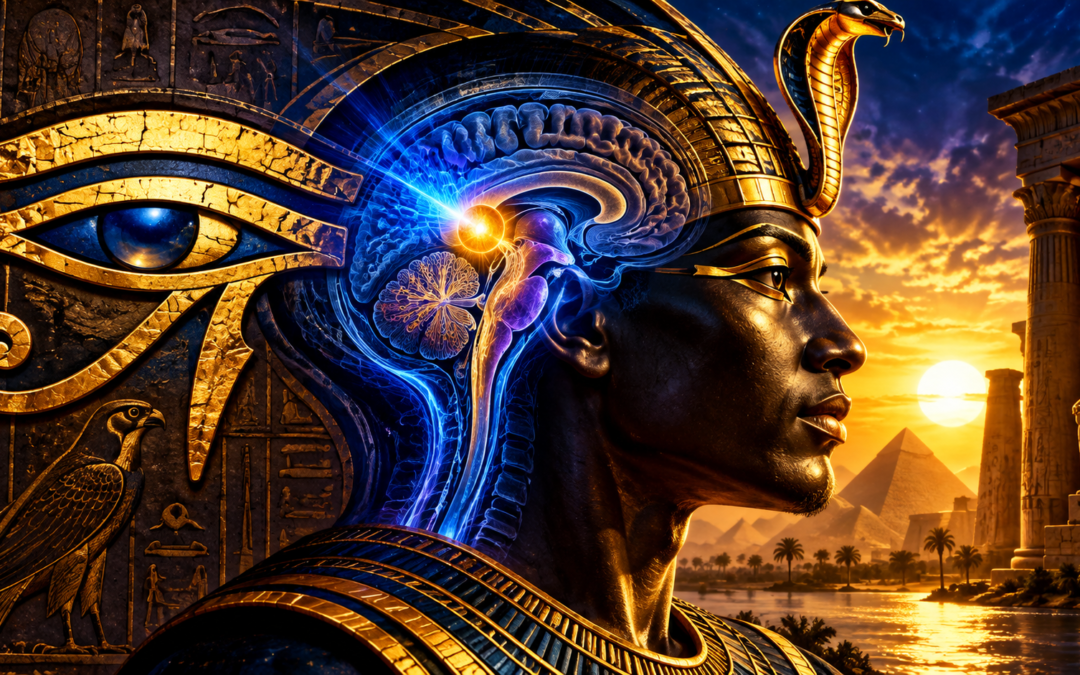
Today, both symbols are sometimes connected with one of the smallest and most mysterious structures in the human brain: the pineal gland.
The resemblance between the Wedjat Eye, commonly called the Eye of Horus, and structures within the human brain has inspired striking anatomical comparisons. The placement of the royal cobra on the forehead has produced another provocative question: did the ancient Egyptians associate the forehead, sight, divine perception, or the serpent with knowledge of an internal organ related to light?
In the twentieth century, esoteric philosopher Manly P. Hall took the idea even further. In Man: The Grand Symbol of the Mysteries, he proposed a relationship between the pineal gland, the Egyptian royal cobra, reptiles, Horus, and what he called the “Eye of the Gods.”
Some aspects of this discussion rest on fascinating biological and ancient Egyptian evidence. Others belong to modern interpretation.
Understanding the difference makes the mystery even more interesting.
What Is the Pineal Gland?
The pineal gland is a small neuroendocrine organ located near the center of the human brain, attached near the roof of the third ventricle.
Its established biological function is closely connected with light, darkness, and the body’s internal clock.
The pineal gland produces the hormone melatonin, with production normally increasing during darkness. Through this system, the pineal gland participates in regulating circadian rhythms and sleep timing.
Humans do not possess a functioning external “third eye” connected directly to the pineal gland.
However, the evolutionary story becomes considerably more interesting when other vertebrates are considered.
The Reptilian “Third Eye”
Some reptiles possess a specialized photosensitive structure called the parietal eye, popularly described as a “third eye.”
The parietal eye and pineal organ belong to a related group of light-sensitive structures derived from the developing diencephalon. In certain lizards and the tuatara, the parietal eye can detect environmental light and participate in biological processes associated with daily and seasonal rhythms.
It is not simply another ordinary eye like the two lateral eyes. Nevertheless, it contains genuine photoreceptor structures.
Modern research also shows that reptilian pineal systems vary considerably between species. Some reptiles possess well-developed parietal eyes, while others do not.
This biological connection between light-sensitive organs and the pineal complex helps explain why the pineal gland acquired such a powerful reputation as a “third eye” in later philosophical and esoteric traditions.
It also brings us to Manly P. Hall.
Manly P. Hall and the “Eye of the Gods”
In 1932, Manly P. Hall published Man: The Grand Symbol of the Mysteries, a study combining anatomy with comparative religion, symbolism, philosophy, and occult interpretation.
Chapter XVI was titled “The Pineal Gland, the Eye of the Gods.”
Hall discussed the evolutionary history of pineal and parietal structures before turning his attention toward ancient Egypt.
He asked whether the Egyptians knew about the unusual development of the pineal complex among reptiles and whether this could explain the placement of the serpent upon the forehead of Egyptian royalty.
This is an important distinction.
Hall was posing an interpretive question, not presenting an ancient Egyptian inscription stating that the royal cobra represented the pineal gland.
Hall then developed the idea further.
Because Egyptian kingship was closely connected with the divine world, he reasoned that an organ interpreted esoterically as representing higher perception or divinity might naturally become associated with royalty.
From there he connected the royal serpent, the forehead, Horus, and the pineal gland within a larger system of occult anatomy.
It is an intriguing theory.
But what do ancient Egyptian sources actually tell us?
The Uraeus: The Serpent on the Royal Forehead
The rearing cobra seen on Egyptian crowns is commonly known today by the Greek-derived term uraeus. The ancient Egyptian term was iaret.
Its Egyptian meaning is well documented.
The cobra was intimately connected with Wadjet, an ancient Egyptian goddess associated with Lower Egypt, royal authority, and divine protection.
When represented on the brow of the king, the cobra stood ready to defend the ruler against his enemies.
Ancient Egyptian imagery could portray the royal cobra as projecting destructive fire against hostile forces. The serpent therefore communicated far more than royal status. It embodied supernatural protection and the dangerous power surrounding legitimate kingship.
Archaeological evidence confirms its importance across Egyptian history.
A relief of King Mentuhotep II dating to approximately 2020–2000 BCE, for example, preserves the protective cobra directly above the king’s forehead.
Gold and electrum examples of royal cobras also survive.
Its placement on the forehead is therefore unquestionably ancient.
What remains unproven is whether that placement was intended to identify the pineal gland.
No known Egyptian inscription has yet been demonstrated to say that the iaret represented the pineal gland or an anatomical “third eye.”
Wadjet, the Cobra, and the Divine Eye
The story becomes even more interesting because Egyptian serpent and eye symbolism were not entirely separate religious worlds.
Wadjet herself could participate in traditions surrounding the Eye of Re.
The Eye of Re was not simply a physical eye. In Egyptian religious thought, the divine Eye could become an active manifestation of the sun god’s power, sometimes personified as a goddess capable of protecting the divine order and destroying enemies.
Wadjet could occupy this role.
This creates a genuine ancient Egyptian relationship among the cobra, divine power, protection, kingship, and the concept of the divine Eye.
That relationship does not prove a pineal connection.
But it demonstrates why Egyptian eye and serpent symbolism should be understood through Egyptian religion before modern anatomical interpretations are added.
The Wedjat: The Eye of Horus
The symbol commonly called the Eye of Horus was known in ancient Egyptian as the Wedjat.
The term carries the sense of being whole, sound, restored, or made complete.
According to Egyptian religious traditions, the eye of Horus was damaged or lost during his conflict with Seth. The eye was subsequently restored, commonly through the intervention of Thoth.
The restored eye therefore became a powerful symbol of:
wholeness, restoration, regeneration, protection, and renewed life.
Wedjat amulets became extraordinarily popular throughout ancient Egyptian history. They were worn by the living and placed with the dead.
Its visual appearance also reflects Horus himself.
Horus was strongly associated with the falcon, and the Wedjat combines characteristics of a human eye with stylized falcon markings.
This detail becomes particularly important when evaluating modern claims about its resemblance to the brain.
Does the Eye of Horus Depict the Human Brain?
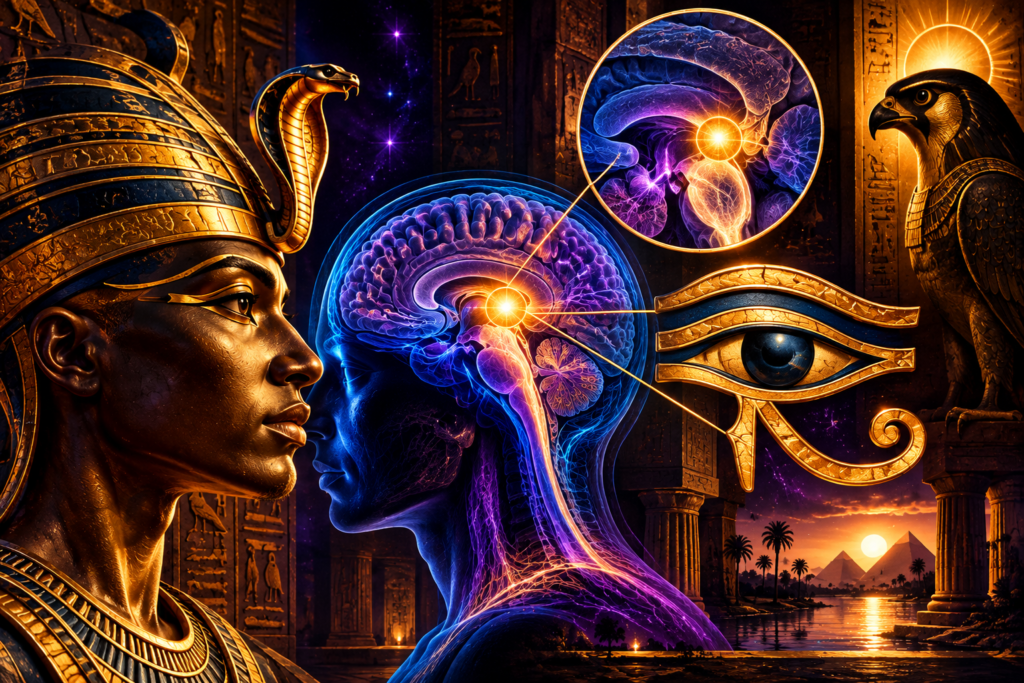
One of the most widely circulated modern theories proposes that the Wedjat Eye is actually a diagram of the human brain.
When a stylized Eye of Horus is placed over a sagittal section of the brain, certain lines and curves can appear to correspond with anatomical structures.
Modern authors have proposed similarities involving structures in and around the thalamus, corpus callosum, brainstem and other regions.
Some researchers have even suggested that different components of the symbol might correspond to sensory functions.
The visual comparison is undeniably intriguing.
A published medical paper examining the Eye of Horus and neuroanatomy described these similarities and proposed that they could reflect ancient Egyptian anatomical knowledge.
But even that study characterized the idea as scientific speculation.
There is currently no surviving Egyptian text explaining the Wedjat as a diagram of the brain.
Nor is there an Egyptian inscription identifying its components with the pineal gland, thalamus, corpus callosum, or modern neurological structures.
Therefore, the responsible conclusion is not that the resemblance is meaningless, nor that it proves secret neurological knowledge.
It is that the resemblance represents an interesting hypothesis that has not been archaeologically demonstrated.
But Did Ancient Egyptians Understand the Brain?
Here the evidence becomes extremely important.
Ancient Egyptians did possess genuine knowledge of the brain.
One of the strongest pieces of evidence comes from the ancient Egyptian surgical text now called the Edwin Smith Papyrus.
The surviving manuscript dates to approximately the seventeenth century BCE, although its contents are generally understood to preserve material originating from an older medical tradition.
The document presents dozens of trauma cases in a remarkably systematic fashion.
Among its observations are descriptions involving the brain, membranes surrounding the brain, cerebrospinal fluid, cranial injuries, neurological symptoms, and pulsations associated with exposed brain tissue.
It contains the earliest surviving written use of a term referring to the brain known to scholarship.
Egyptian physicians could also observe relationships between injuries to the head and resulting physical symptoms.
This is significant.
It establishes that ancient Egyptian physicians were not anatomically ignorant. They observed the consequences of cranial trauma carefully and developed sophisticated clinical knowledge within the limitations of their period.
But recognizing the brain is different from identifying the pineal gland.
No surviving Egyptian medical document presently provides clear evidence that Egyptian physicians isolated the pineal gland as a distinct organ or assigned it the functions recognized by modern endocrinology.
That distinction must remain central to any discussion of the Egyptian “third eye.”
Did Mummification Give Egyptians Anatomical Knowledge?
Mummification provided Egyptian specialists with extensive practical contact with the human body.
During many forms of elite mummification, organs were removed and the body underwent complex preparation for burial.
The brain itself could be removed during embalming, particularly in later periods, frequently through the nasal region.
It might therefore seem logical to assume that embalmers possessed detailed neurological knowledge.
However, practical familiarity with internal anatomy does not automatically mean that every internal structure was scientifically isolated, named, and understood.
The surviving medical evidence demonstrates real Egyptian anatomical observation.
It does not, at present, demonstrate an Egyptian doctrine identifying the pineal gland as the seat of spiritual perception.
The Eye, Light, and the Pineal Gland
There is nevertheless a fascinating modern biological relationship among the eye, environmental light, and pineal function.
In humans, information about environmental light reaches the brain through the eyes and contributes to regulation of the circadian system. That system ultimately influences melatonin production by the pineal gland.
In some non-mammalian vertebrates, pineal and related structures can themselves possess photoreceptive properties.
The connection between light and the pineal system is therefore biological reality.
What cannot currently be demonstrated is that ancient Egyptians understood that physiology and encoded it into the Wedjat or royal cobra.
This is precisely where established science, Egyptian religious symbolism, and later esoteric interpretation meet without necessarily being identical.
Why Hall Connected Reptiles With the Egyptian Cobra
Hall's argument becomes easier to understand when viewed in this context.
He knew of scientific discussions concerning pineal and parietal structures in reptiles. He also knew that Egyptian rulers displayed a conspicuous serpent directly upon the forehead.
He therefore asked whether the two could be connected.
Visually and symbolically, the idea is powerful:
a reptile, a forehead, an eye-like light-sensitive structure, divine kingship, and hidden perception.
But the sequence of reasoning moves from biological observation to symbolic interpretation.
The first part can be examined scientifically.
The second requires Egyptian textual and archaeological evidence.
So far, that final bridge has not been established.
Hall's theory should therefore be understood as an influential esoteric interpretation of Egyptian symbolism, rather than a translation of documented Egyptian teachings about the pineal gland.
Horus and the Pineal Gland in Hall's Interpretation
Hall went further still.
He associated the eye of Horus with the pineal gland and interpreted Horus through his system of occult anatomy.
This idea helped contribute to a broader modern tradition in which the Eye of Horus became associated with the third eye, inner vision, expanded consciousness, and the pineal gland.
Ancient Egyptian sources unquestionably establish Horus and his restored eye as major religious concepts.
They establish the Wedjat as a symbol of restoration and protection.
They establish the royal cobra as a manifestation of divine and royal protective power.
They do not currently establish Hall's additional identification of the Eye of Horus with the pineal gland.
That distinction does not diminish ancient Egyptian spirituality.
In fact, it allows the Egyptian concepts to speak on their own terms.
The Pineal Gland Was Not the Egyptian “Seat of the Soul”
Another misconception deserves clarification.
The pineal gland is frequently called the “seat of the soul.”
That famous formulation is associated particularly with the seventeenth-century French philosopher René Descartes, who gave the pineal gland a unique role in his philosophical explanation of interactions between mind and body.
This should not automatically be projected backward into ancient Egypt.
Ancient Egyptian ideas concerning the human person were much more complex.
Egyptian religious thought recognized interconnected aspects of existence including the ka, ba, akh, ib, ren, and physical body.
Of particular importance was the ib, the heart, which carried profound associations with identity, thought, character, memory, and moral judgment.
The heart, rather than the brain or pineal gland, occupied a central position in Egyptian conceptions of the individual and the afterlife.
This is vividly expressed in traditions surrounding the weighing of the heart.
So while later Western esoteric traditions often elevated the pineal gland as the seat of spiritual consciousness, we should not substitute that later idea for documented Egyptian concepts of personhood.
Ancient Egyptian Symbolism Was Layered
One reason theories surrounding the Eye of Horus remain so compelling is that Egyptian symbols frequently carried several interconnected meanings.
The Wedjat could signify restoration, protection, regeneration, divine power, and completeness.
The cobra could represent Wadjet, protection, royal authority, and the destructive power directed against the enemies of divine order.
Horus could embody kingship while participating in solar, celestial, royal, and mythological traditions that changed and developed over thousands of years.
Ancient Egyptian symbolism was therefore sophisticated enough without requiring every image to conceal a modern anatomical diagram.
At the same time, ancient Egyptian physicians possessed genuine observational knowledge of the brain.
Both facts can coexist.
So Did Ancient Egyptians Know About the Pineal Gland?
Based on currently available textual and archaeological evidence, we cannot demonstrate that ancient Egyptians identified the pineal gland as a distinct spiritual organ or deliberately represented it through the Wedjat Eye or royal cobra.
That is the most historically responsible answer.
But it is not the end of the story.
Ancient Egyptians demonstrably possessed medical knowledge of the brain.
They developed one of history's most sophisticated symbolic traditions surrounding eyes, vision, restoration, solar power, serpents, protection, and divine kingship.
The cobra really was positioned prominently on the royal forehead.
The Wedjat really did represent a sacred restored eye connected with Horus.
Some reptiles really do possess light-sensitive parietal structures associated developmentally and evolutionarily with the pineal complex.
And the human pineal gland really does participate in biological responses to the cycle of light and darkness.
Those facts are remarkable on their own.
What remains unproven is the connecting proposition: that ancient Egyptians consciously understood these biological relationships and encoded them into their religious symbols.
The Mystery of the “Eye of the Gods”
Perhaps the greatest value of Manly P. Hall's theory is not that it solves the mystery, but that it raises a question worth examining.
Why does the serpent occupy such a prominent position on the Egyptian royal forehead?
Ancient Egyptian evidence already supplies a powerful answer: the cobra represented divine protection, royal authority, Wadjet, and the fiery force capable of destroying the king's enemies.
Could Egyptian symbolism have contained additional meanings that have not survived clearly in written form?
Possibly.
Ancient Egypt existed for more than three thousand years, and much of its intellectual and religious world has been lost.
But possibility must remain distinct from evidence.
The pineal interpretation is therefore best understood as a fascinating modern hypothesis situated at the intersection of Egyptian religion, anatomy, comparative biology, and esoteric philosophy.
The Wedjat does not need to be a hidden anatomical drawing to be extraordinary.
Nor does the iaret need to represent a pineal gland to possess profound meaning.
Both emerged from an African civilization whose physicians studied the injured brain, whose theologians developed complex concepts of divine sight and cosmic order, and whose artists transformed the eye and cobra into some of the most enduring sacred symbols in human history.
The mystery becomes more meaningful when we distinguish what the ancient Egyptians actually left behind from what later generations have seen within their symbols.
And for now, the question remains open:
Did the ancient Egyptians encode knowledge of the pineal gland into the sacred eye and royal serpent—or are we looking at an extraordinary convergence of ancient symbolism, human anatomy, and modern interpretation?
The surviving evidence has not yet given us a definitive answer.
That is precisely what makes the question so fascinating.