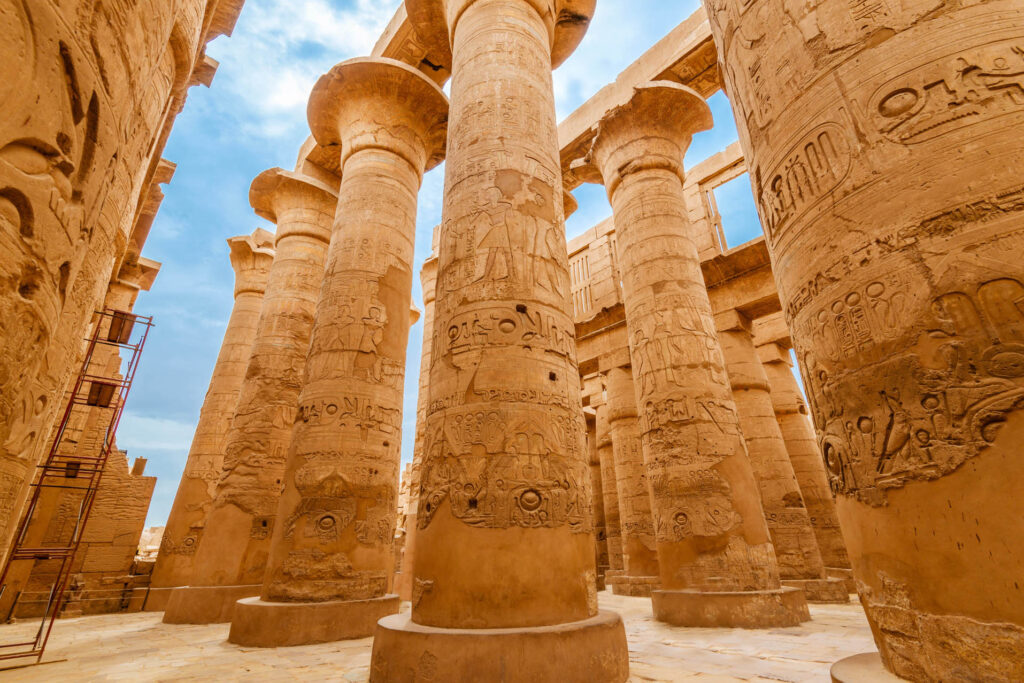
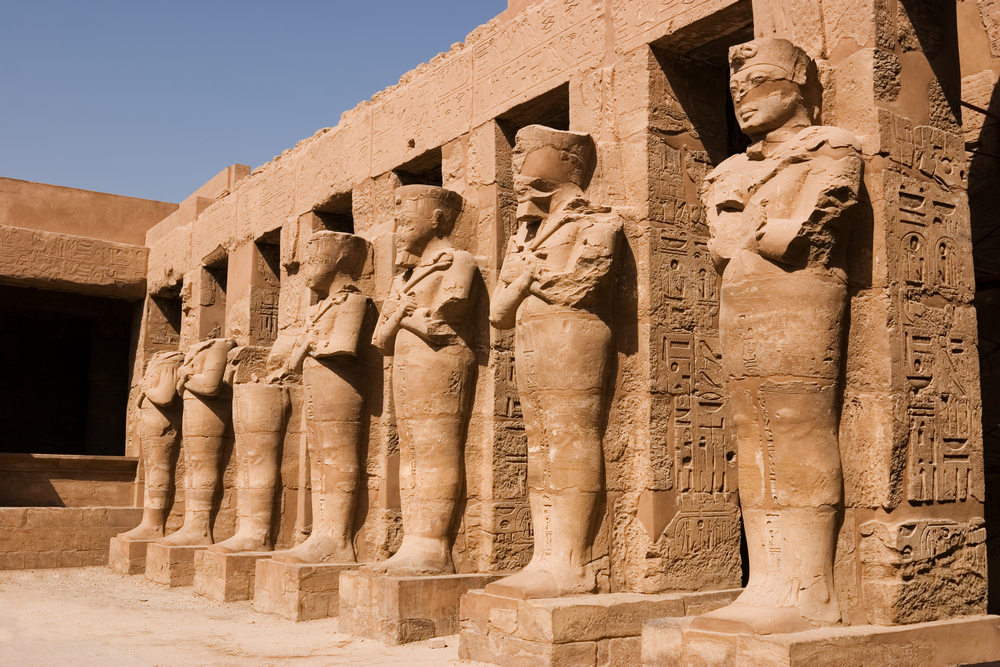
Few rulers of ancient Egypt have left a monument as recognizable or mysterious as Pharaoh Khufu. More than 4,500 years after his reign, the enormous Great Pyramid of Giza continues to dominate the landscape outside modern Cairo and remains one of the greatest architectural achievements of the ancient world.
Known to the Greeks as Cheops, Khufu was a pharaoh of Egypt's Fourth Dynasty during the Old Kingdom. Although surprisingly little is known about Khufu himself, the extraordinary monument associated with his reign transformed the Giza Plateau and helped establish his name among the most famous rulers in ancient Egyptian history.
Yet Khufu's story extends beyond the Great Pyramid. His reign offers a fascinating window into royal authority, religion, engineering, labor, administration, and monumental architecture in one of Africa's most influential ancient civilizations.
Who Was Khufu?
Khufu was an ancient Egyptian pharaoh of the Fourth Dynasty, generally placed in the 26th century BCE. He succeeded his father, Sneferu, a ruler whose reign was particularly important to the development of pyramid construction.
Khufu's Egyptian name is commonly represented as Khnum-Khufu, traditionally interpreted along the lines of "Khnum protects me." The name invokes Khnum, an ancient Egyptian deity associated with creation and the Nile region.
Khufu became known as Cheops through later Greek traditions, particularly the writings of the Greek historian Herodotus.
Despite Khufu's fame today, surviving information about his personality and everyday activities is remarkably limited. His enormous pyramid became far more visible to history than the person who commissioned it.
That contrast has helped make Khufu one of ancient Egypt's most intriguing pharaohs.
Khufu and the Fourth Dynasty of Ancient Egypt
Khufu ruled during the Old Kingdom, an era famous for the development of some of ancient Egypt's most ambitious monumental architecture.
The Fourth Dynasty represents a particularly important stage in pyramid construction.
Before Khufu, Sneferu oversaw several monumental pyramid projects, including the Bent Pyramid and Red Pyramid at Dahshur. These structures reveal significant developments in the techniques required to create a true smooth-sided pyramid.
Khufu inherited a kingdom with considerable architectural knowledge, administrative organization, skilled craftspeople, and access to large labor forces.
Under his reign, these capabilities culminated in something unprecedented:
The Great Pyramid of Giza.
The Great Pyramid of Giza: Khufu's Monument to Eternity
The Great Pyramid of Giza, also called the Pyramid of Khufu, was constructed on the Giza Plateau near the Nile.
Originally standing at approximately 146.6 meters (481 feet) tall, the monument remained the tallest human-made structure on Earth for thousands of years.
Its scale is extraordinary.
The pyramid was constructed using an immense quantity of stone, with estimates commonly placing the number of blocks at roughly 2.3 million. Individual stones vary significantly in size and weight, while some of the granite components used within the monument are considerably heavier than typical limestone blocks.
The precision of the pyramid is equally remarkable.
Its four sides were carefully aligned with the cardinal directions, demonstrating the sophisticated surveying, mathematical, organizational, and observational abilities available to ancient Egyptian builders.
The structure was not simply an enormous pile of stone.
It was the centerpiece of an elaborate royal funerary complex designed around ancient Egyptian beliefs concerning kingship, death, transformation, and the afterlife.
How Was the Great Pyramid Built?
Exactly how Khufu's builders constructed the Great Pyramid continues to be studied and debated.
Researchers generally agree that its construction required sophisticated planning, transportation systems, surveying, quarrying, logistics, food production, skilled labor, and centralized administration.
Different theories have been proposed regarding the ramps and lifting techniques used during construction. No single reconstruction explains every stage of the building process with complete certainty.
Archaeological discoveries around Giza have nevertheless transformed our understanding of the people responsible for building the pyramids.
Evidence from settlements, cemeteries, food remains, administrative systems, and other archaeological material indicates that pyramid construction involved organized communities of workers, including skilled specialists and rotating labor forces.
This evidence challenges the popular image, heavily influenced by later traditions and modern entertainment, that the Great Pyramid was simply constructed by vast armies of enslaved people.
Instead, the archaeological picture reveals an enormous state-organized construction project supported by a complex workforce.
The Lost Diary That Revealed Khufu's Pyramid Network
One of the most extraordinary discoveries connected with Khufu's reign is the Diary of Merer.
Discovered at Wadi al-Jarf on Egypt's Red Sea coast, these ancient papyrus documents date to Khufu's reign and are among the oldest surviving papyri known from ancient Egypt.
Merer was an official responsible for a team of workers.
His records describe the transportation of limestone from the Tura quarries toward Akhet-Khufu, the ancient name associated with Khufu's Great Pyramid complex.
The documents provide remarkable evidence of the administrative and transportation networks operating during Khufu's reign.
Rather than explaining exactly how every stone was positioned on the pyramid, the papyri reveal something equally important: the logistical sophistication behind the project.
Workers transported construction materials through waterways connecting quarrying areas with the pyramid project.
The discovery provides a rare contemporary glimpse into the enormous system of people, materials, boats, waterways, administrators, and resources required to build Khufu's monument.
Inside the Great Pyramid of Khufu
The interior of the Great Pyramid contains a complex arrangement of corridors, chambers, shafts, and passages.
Among its best-known features are the:
King's Chamber
Queen's Chamber
Grand Gallery
Descending Passage
Ascending Passage
Subterranean Chamber
The so-called King's Chamber contains a granite sarcophagus, although Khufu's mummy has never been found.
Above the chamber are additional spaces that helped distribute the enormous weight of the masonry overhead.
Modern technologies have also revealed previously unknown spaces within the pyramid.
Muon imaging, a technique that detects naturally occurring cosmic particles, has allowed researchers to investigate the interior without damaging the monument. Such research has identified previously unknown voids, adding new questions to a structure that has been studied for centuries.
Their precise purposes remain subjects of continuing investigation.
Why Did Khufu Build the Great Pyramid?
The Great Pyramid cannot be fully understood without considering ancient Egyptian religion and kingship.
Death was not necessarily viewed as absolute annihilation. Ancient Egyptian religious traditions developed elaborate ideas concerning continued existence, transformation, divine order, and the afterlife.
Royal tombs therefore carried profound religious and political significance.
The pyramid complex helped prepare the deceased king for his transition into the afterlife while reinforcing the sacred character of Egyptian kingship.
Khufu's pyramid was called Akhet-Khufu, commonly translated as the "Horizon of Khufu."
The name itself evokes ideas of emergence, transformation, and the horizon—an important symbolic space associated with the sun's daily cycle.
The Great Pyramid therefore represented more than architectural power.
It stood at the intersection of religion, royal authority, astronomy, landscape, engineering, and eternity.
The Tiny Statue of a Giant Pharaoh
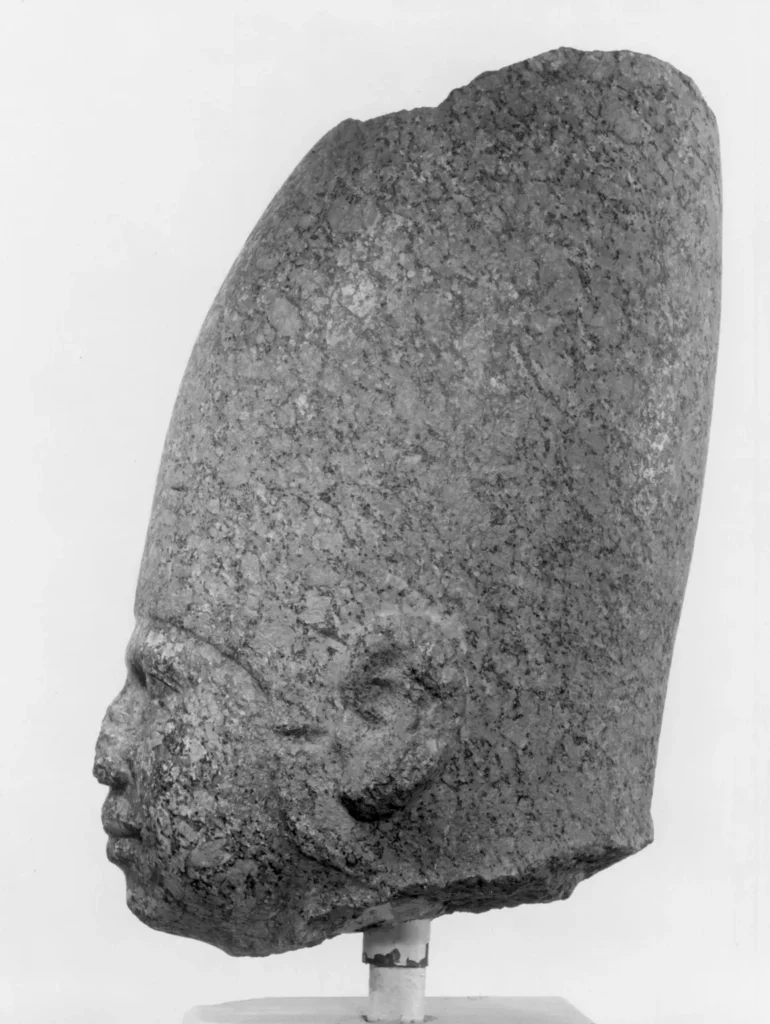
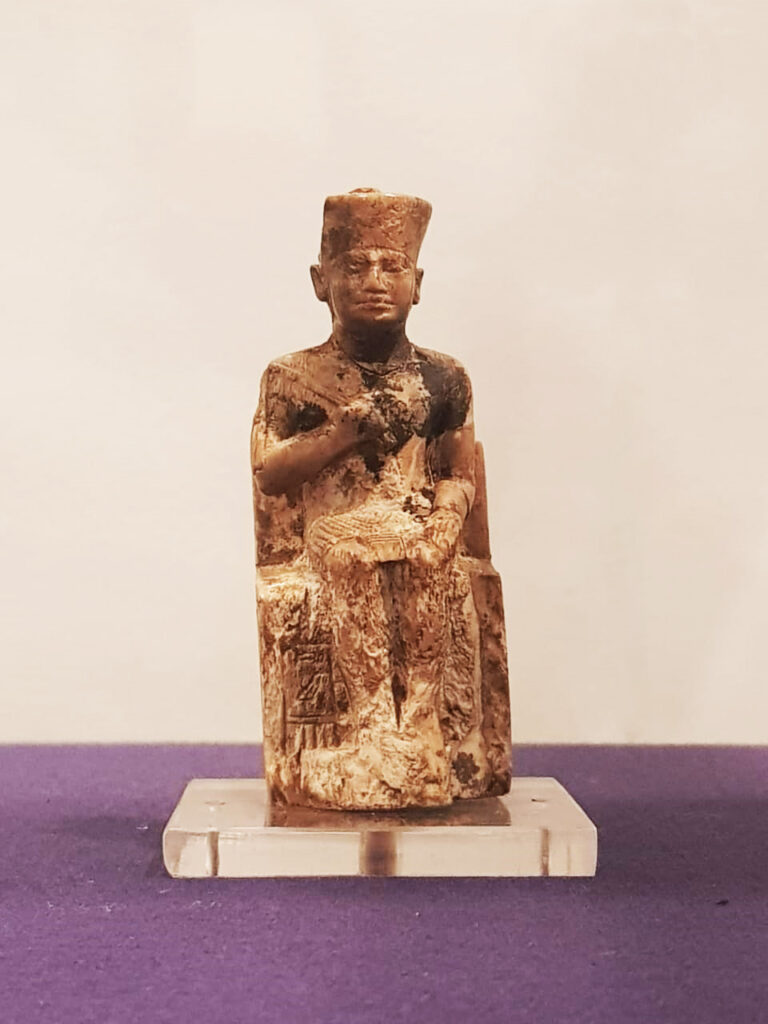
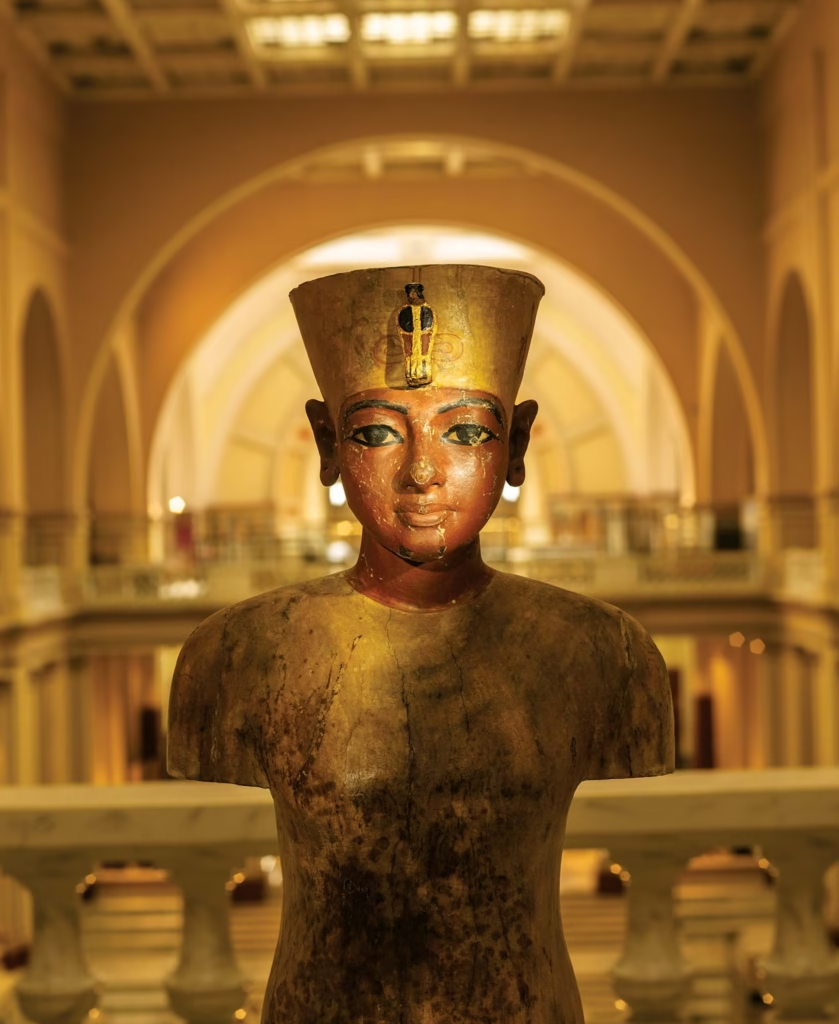
One of the fascinating ironies surrounding Khufu is that the ruler responsible for the largest pyramid in Egypt is represented by very few securely identified surviving royal images.
The most famous is a small ivory figurine associated with Khufu, discovered at Abydos.
It is only several centimeters tall.
The contrast is striking.
Khufu's pyramid rises dramatically over the Giza Plateau, yet one of the most recognizable objects associated with the king himself can fit into a person's hand.
This scarcity of surviving royal representations contributes to the mystery surrounding his appearance and personality.
We know Khufu primarily through inscriptions, archaeological evidence, later traditions, and—above all—the monument that bears his name.
Khufu's Family and Royal Dynasty
Khufu belonged to one of ancient Egypt's most important royal families.
His father, Sneferu, is closely associated with major developments in pyramid architecture. Khufu's mother is generally identified as Queen Hetepheres I, whose burial assemblage at Giza produced extraordinary examples of Old Kingdom royal craftsmanship.
Khufu was followed within the Fourth Dynasty by rulers including Djedefre and Khafre.
Khafre is associated with the second great pyramid at Giza, while Menkaure, another Fourth Dynasty ruler, constructed the third major pyramid.
Together, these monuments created the extraordinary pyramid landscape that defines Giza today.
The famous three-pyramid arrangement therefore represents multiple generations of Fourth Dynasty royal building rather than a single construction project.
Khufu's Boats and the Journey Beyond Death
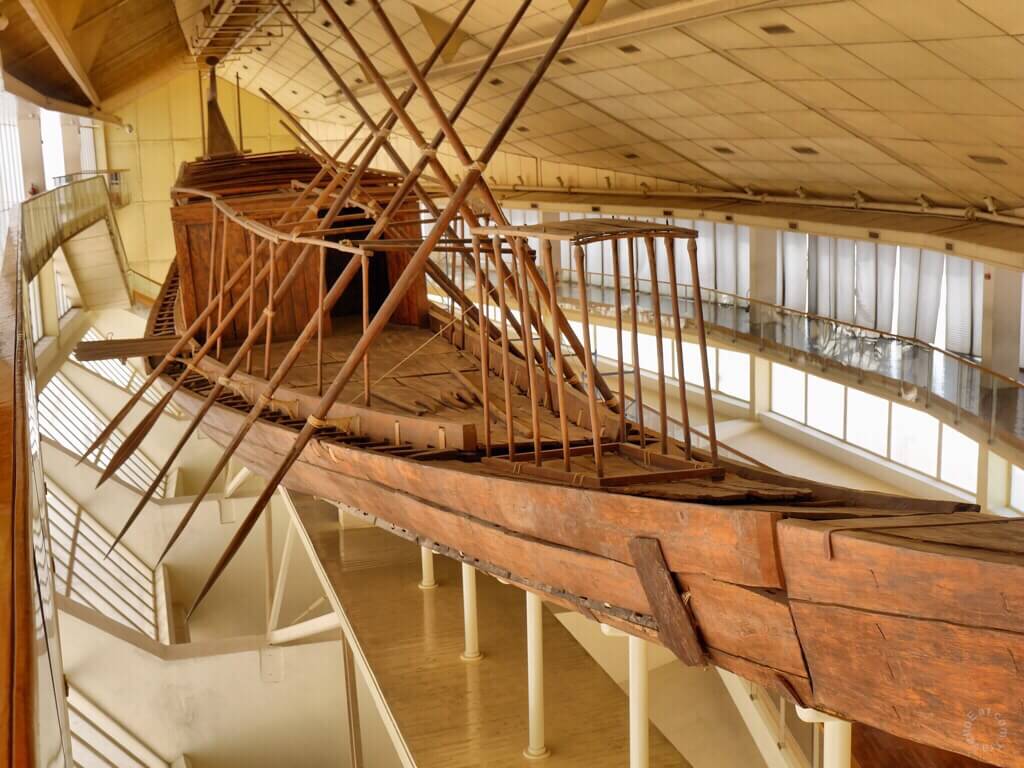
Another remarkable discovery associated with Khufu's pyramid complex was a large ancient Egyptian wooden vessel buried near the Great Pyramid.
Often called Khufu's ship or solar boat, the vessel was discovered dismantled in a pit beside the pyramid and later reconstructed.
Its exact ritual function has been debated.
Ships carried powerful practical and religious meanings in ancient Egypt. The Nile was central to transportation and daily life, while divine beings—including the solar deity—could be represented traveling across the heavens in sacred boats.
The vessel's placement beside Khufu's pyramid therefore connects the king's funerary complex with broader themes of movement, rebirth, royal ritual, and the journey into the afterlife.
Khufu and Ancient Egyptian Engineering
The Great Pyramid is often discussed as though its construction required a mysterious technology lost to history.
The archaeological evidence instead reveals something arguably more impressive:
Ancient Egyptians developed the knowledge and organizational systems necessary to accomplish the project themselves.
Building the Great Pyramid required expertise across numerous fields, including:
Stone quarrying
Masonry
Surveying
Transportation
Mathematics
Water management
Woodworking
Metalworking
Food production
Administration
Workforce organization
Thousands of interconnected tasks had to operate effectively over many years.
The Great Pyramid should therefore be understood not simply as Khufu's personal achievement but as the product of the collective knowledge, labor, craftsmanship, engineering, and administrative power of ancient Egyptian society.
Ancient Egypt's African Setting
Understanding Khufu also requires understanding where his civilization developed.
Ancient Egypt emerged in northeastern Africa, with the Nile providing the environmental foundation around which communities, agriculture, transportation networks, religious traditions, and political institutions developed.
Khufu's kingdom was part of this ancient Nile Valley world.
The Great Pyramid itself was constructed using resources and labor networks connected across Egypt, while the kingdom interacted with surrounding African regions as well as neighboring areas beyond the continent.
Recognizing ancient Egypt's African geographical and historical setting provides essential context for understanding the civilization that produced Khufu and the monumental architecture of the Old Kingdom.
Mysteries Surrounding Khufu
Despite centuries of research, many questions remain.
Khufu's mummy has not been securely identified. His original burial goods largely disappeared in antiquity. We possess relatively little contemporary information describing his personality, and scholars continue investigating aspects of the Great Pyramid's construction and internal architecture.
Modern scanning technology has even revealed previously unknown spaces within the monument.
These unanswered questions make Khufu particularly fascinating.
But mystery should not be confused with absence of evidence.
Archaeology has revealed extensive evidence for quarrying, transportation, workforce settlements, administration, architectural development, and the religious culture surrounding pyramid construction.
New discoveries continue to refine that picture.
The Enduring Legacy of Pharaoh Khufu
Khufu probably could never have imagined the global reach his monument would eventually achieve.
More than four millennia after his reign, the Great Pyramid of Giza remains standing.
It is the oldest and only substantially surviving monument among the traditional Seven Wonders of the Ancient World.
Millions of people recognize its silhouette instantly.
Yet the pyramid's greatest legacy may not simply be its size.
It demonstrates what ancient Egyptian society could accomplish through generations of accumulated architectural knowledge, specialized craftsmanship, administration, planning, and coordinated labor.
Khufu's own voice has largely disappeared from history.
His monument has not.
Standing on the African landscape for more than 4,500 years, the Great Pyramid remains an extraordinary testament to the civilization of the ancient Nile Valley and to the people whose knowledge and labor transformed millions of pieces of stone into one of history's most enduring monuments.
Frequently Asked Questions About Khufu
Who was Khufu in ancient Egypt?
Khufu was a Fourth Dynasty pharaoh of ancient Egypt who ruled during the Old Kingdom in the 26th century BCE. He is most famous for commissioning the Great Pyramid of Giza.
Is Khufu the same person as Cheops?
Yes. Cheops is the Greek form traditionally used for Khufu's name.
What pyramid did Khufu build?
Khufu commissioned the Great Pyramid of Giza, the largest of the three major pyramids on the Giza Plateau.
How tall was Khufu's Great Pyramid?
The Great Pyramid originally stood approximately 146.6 meters, or 481 feet, tall. Loss of its outer casing and uppermost portions has reduced its present height.
Was the Great Pyramid built by enslaved people?
Archaeological discoveries point toward an organized workforce that included skilled specialists and rotating labor groups supported by a large state-run system. This evidence has challenged the popular portrayal of the pyramid as simply being built by enormous masses of enslaved workers.
Has Khufu's mummy ever been found?
No mummy has been securely identified as Pharaoh Khufu.
What was the ancient name of Khufu's pyramid?
Khufu's pyramid complex was known as Akhet-Khufu, commonly translated as "Horizon of Khufu."
Why is Khufu important today?
Khufu's reign produced the Great Pyramid, one of humanity's most famous surviving ancient monuments. The pyramid also provides extraordinary evidence of the architectural, engineering, administrative, and organizational capabilities of Old Kingdom Egypt.
Final Thoughts: Khufu and the Monument That Defied Time
Pharaoh Khufu remains one of the most recognizable yet mysterious rulers of ancient Egypt.
We know surprisingly little about the individual behind the crown, but the civilization of his era left something almost impossible to ignore.
The Great Pyramid.
It survived changing dynasties, foreign rulers, shifting religions, earthquakes, stone removal, exploration, excavation, and more than four thousand years of environmental exposure.
Today, Khufu's Great Pyramid of Giza remains a powerful monument to ancient Egypt's architectural knowledge and the extraordinary capabilities of the people of the Nile Valley.
Khufu sought permanence.
More than 4,500 years later, his horizon still stands.
Few rulers of ancient Egypt capture the world’s imagination quite like King Tutankhamun, better known as King Tut. His reign was relatively short, and he died while still a teenager, yet thousands of years later, Tutankhamun has become one of the most recognizable pharaohs in history.
His fame comes not from great military conquests or decades of rule, but from an extraordinary archaeological discovery. In 1922, archaeologist Howard Carter uncovered Tutankhamun’s remarkably well preserved tomb in the Valley of the Kings. Inside were thousands of objects, including royal furniture, jewelry, chariots, weapons, ritual objects, and the magnificent golden funerary mask that became an international symbol of ancient Egypt.
But behind the gold was a young ruler living during one of the most complicated periods in Egyptian history.
Who was King Tutankhamun? Why did he become pharaoh at such a young age? What happened during his reign? And what do we actually know about his mysterious death?
Who Was King Tutankhamun?
Tutankhamun was a pharaoh of ancient Egypt's 18th Dynasty, ruling during the New Kingdom in the 14th century BCE. His reign is generally dated to approximately 1332 to 1323 BCE, although exact dates vary among scholars.
Tutankhamun came to the throne when he was still a child, probably around eight or nine years old.
His original name was Tutankhaten, which is commonly interpreted as "Living Image of Aten." The name reflected the religious environment created by Pharaoh Akhenaten, who had elevated the solar deity Aten and dramatically changed Egypt's traditional religious system.
Tutankhamun would eventually abandon the name Tutankhaten and become Tutankhamun, reflecting the renewed importance of Amun, one of Egypt's most important deities.
This change represented something much larger than the personal name of a young king.
It symbolized Egypt's return toward its traditional religious order.
Was King Tut the Son of Akhenaten?
Tutankhamun is widely understood to have been closely connected to Akhenaten, the controversial pharaoh associated with the religious transformation known as the Amarna Period.
Genetic research conducted on royal mummies has supported the conclusion that the mummy identified as Akhenaten's probable remains was Tutankhamun's father. The identity of Tutankhamun's mother remains more complicated. DNA research identified a mummy from tomb KV35, often called the Younger Lady, as Tutankhamun's mother and a close relative of his father.
The precise identities and relationships within the Amarna royal family continue to generate scholarly discussion.
What is clear is that Tutankhamun inherited a kingdom emerging from enormous religious and political upheaval.
Akhenaten and the Religious Revolution Before King Tut
To understand King Tutankhamun, it is important to understand what happened before his reign.
Akhenaten radically transformed Egyptian religion by promoting the worship of the Aten, represented by the sun disk whose rays extended toward the royal family.
He also established a new royal capital called Akhetaten, located at modern day Amarna.
The religious transformation disrupted institutions that had played major roles in Egyptian society for generations, particularly those associated with Amun.
After Akhenaten's death, Egypt gradually moved away from these policies.
The young Tutankhamun became an important figure in that restoration.
Why Did Tutankhaten Become Tutankhamun?
One of the most important developments of Tutankhamun's reign was the restoration of Egypt's traditional religious practices.
His name changed from Tutankhaten to Tutankhamun, while his queen, Ankhesenpaaten, became known as Ankhesenamun.
The change reflected a renewed connection with Amun.
Temples and religious institutions associated with Egypt's traditional deities were restored, and the royal court moved away from Akhetaten.
An important surviving text known as the Restoration Stela describes the poor condition of temples and sacred places before presenting Tutankhamun as the king responsible for restoring religious order.
Because Tutankhamun was extremely young, powerful officials almost certainly played major roles in government.
Among the most important were Ay, who would later become pharaoh, and the military commander Horemheb, who would also eventually rule Egypt.
King Tut and Queen Ankhesenamun
Tutankhamun was married to Ankhesenamun, a royal woman associated with the Amarna family and generally identified as a daughter of Akhenaten and Nefertiti.
Their marriage would have reinforced Tutankhamun's connection to the royal dynasty.
Some of the most fascinating objects discovered in Tutankhamun's tomb portray the royal couple in unusually intimate scenes.
One famous image on Tutankhamun's golden throne shows Ankhesenamun standing before the seated king while rays from the Aten extend above them.
These images offer a rare glimpse of royal life beyond formal images of kingship.
Evidence also indicates that the couple experienced tragedy.
Two small mummified fetuses were discovered inside Tutankhamun's tomb. Genetic and archaeological studies have supported their identification as daughters of Tutankhamun, although many details surrounding the pregnancies remain uncertain.
Tutankhamun appears to have died without a surviving heir.
That would have major consequences for Egypt's royal succession.
What Did King Tut Look Like?
Tutankhamun's appearance has fascinated researchers for decades.
Ancient Egyptian royal art was highly symbolic and should not automatically be treated as photographic portraiture. However, his mummy, statues, coffins, and other representations provide researchers with evidence for studying the young king.
Modern CT scans and genetic investigations have also contributed information about his physical condition.
Researchers have identified several health concerns associated with Tutankhamun, including a clubfoot and evidence of other physical abnormalities.
Numerous walking sticks were discovered inside his tomb. Some showed signs consistent with actual use, suggesting they may not have been purely ceremonial.
This creates a very different image of Tutankhamun from the flawless golden king represented by his famous funerary mask.
Behind the royal imagery was a real young person whose health may have been fragile.
How Did King Tut Die?
The death of King Tutankhamun remains one of the greatest mysteries associated with ancient Egypt.
He died at approximately 18 or 19 years old.
For decades, theories suggested that Tutankhamun may have been murdered. Damage visible on his skull helped fuel speculation that he had suffered a fatal blow to the head.
Later examinations, however, weakened that theory.
Modern CT scans and other studies have identified additional medical evidence, including a serious injury to his leg.
DNA based research also reported evidence associated with Plasmodium falciparum, the parasite responsible for severe malaria.
One influential interpretation suggested that malaria combined with other health complications may have contributed to his death.
However, scientists have not reached universal agreement on a single definitive cause.
Murder, accident, infection, genetic vulnerabilities, and combinations of medical complications have all appeared in discussions of Tutankhamun's death.
The most responsible conclusion is simple:
We still do not know exactly what killed King Tutankhamun.
And that uncertainty remains one of the reasons his story continues to fascinate the world.
The Death of a Young Pharaoh
Tutankhamun's death created an urgent political problem.
The young pharaoh apparently had no surviving children to inherit the throne.
Following his death, Ay became pharaoh. Horemheb later succeeded Ay and eventually worked to remove or overwrite parts of the legacy associated with the Amarna rulers.
Ironically, Tutankhamun's relatively minor historical position may have helped preserve his memory in an unexpected way.
His name disappeared from many later royal records.
But his tomb remained hidden beneath the sands and debris of the Valley of the Kings.
For more than 3,000 years, its treasures waited in darkness.
Howard Carter Discovers King Tut's Tomb
Everything changed in 1922.
British archaeologist Howard Carter, whose excavations were financed by Lord Carnarvon, had spent years searching the Valley of the Kings for the missing tomb of Tutankhamun.
On November 4, 1922, Carter's team discovered a step cut into the ground.
More steps were uncovered.
Then came a sealed doorway.
The discovery ultimately led Carter to KV62, the tomb of Tutankhamun.
When Carter made a small opening and looked into the tomb by candlelight, he saw extraordinary objects filling the chamber.
The discovery would become one of the most famous moments in the history of archaeology.
What Was Found Inside King Tut's Tomb?
Tutankhamun's tomb contained more than 5,000 objects.
The collection provided archaeologists with an extraordinary look into royal burial practices, craftsmanship, religion, technology, clothing, warfare, transportation, and daily life during Egypt's New Kingdom.
Among the objects discovered were:
Golden shrines
Royal chariots
Ceremonial beds
Thrones
Jewelry
Sandals
Clothing
Weapons
Walking sticks
Food and wine containers
Statues
Ritual objects
Canopic equipment
Coffins
Personal possessions
These objects were not simply treasure.
They were part of a carefully constructed funerary world designed to prepare the deceased king for existence beyond death.
King Tut's Golden Mask
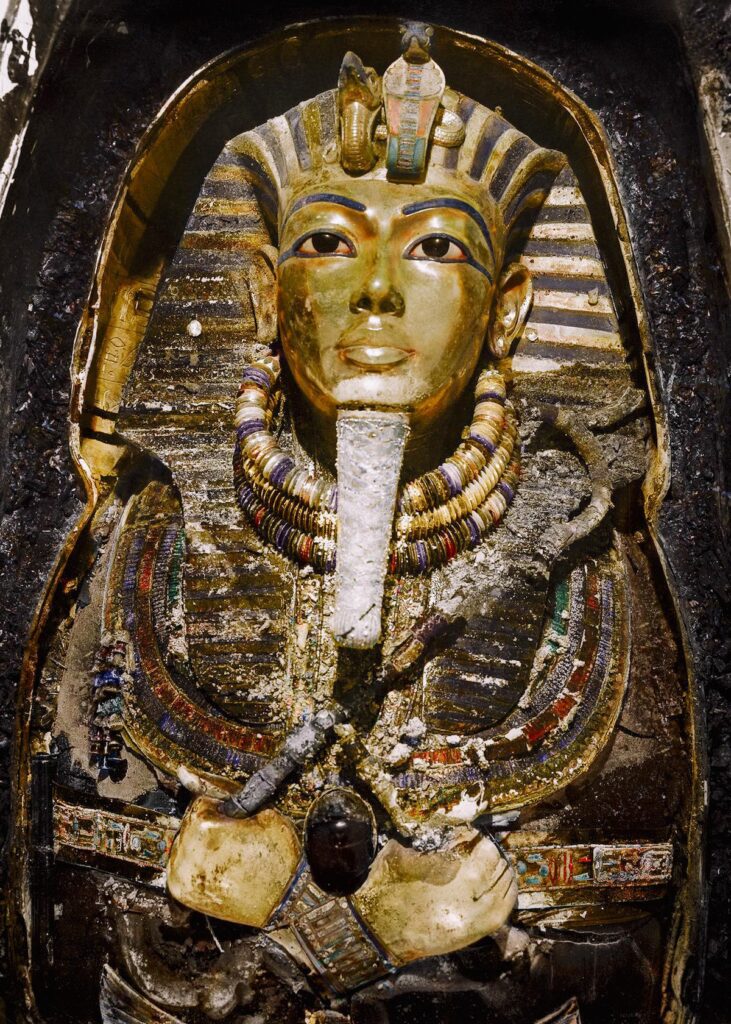
Perhaps no object from ancient Egypt is more instantly recognizable than the golden funerary mask of Tutankhamun.
The mask covered the head and shoulders of the mummified pharaoh.
Made primarily from gold and decorated with colored materials, the mask presents Tutankhamun in an idealized royal form.
The striped nemes headdress frames his face, while the cobra and vulture positioned on his forehead represent royal authority and protection connected with Upper and Lower Egypt.
The mask was more than an extraordinary work of art.
Within Egyptian funerary belief, preserving and identifying the deceased was connected to the transformation necessary for existence in the afterlife.
Today, the mask has become one of the most famous symbols of ancient Egyptian civilization.
Why Was King Tut's Tomb So Important?
Tutankhamun was not among ancient Egypt's longest reigning or most militarily powerful kings.
Yet his tomb became one of archaeology's most important discoveries.
Why?
Many royal tombs in the Valley of the Kings had been robbed in antiquity. Tutankhamun's tomb had also been entered in ancient times, but much of its extraordinary collection remained inside when Carter discovered it.
This gave archaeologists an unprecedented opportunity to study the burial equipment associated with a New Kingdom pharaoh.
The tomb helped transform modern understanding of Egyptian royal burial traditions.
It also transformed Tutankhamun into a global cultural phenomenon.
Was King Tut's Tomb Small?
Compared with several other royal tombs in the Valley of the Kings, Tutankhamun's tomb is relatively modest.
This has encouraged theories that his unexpected death may have occurred before a larger royal tomb could be completed.
Some researchers have proposed that KV62 may originally have been intended for someone else and was adapted for Tutankhamun after his sudden death.
The tomb consists of several principal spaces, including the antechamber, annex, burial chamber, and treasury.
Despite its relatively small size, the amount of material placed inside was astonishing.
Objects were packed tightly into its chambers, creating an archaeological time capsule that survived for thousands of years.
The Mystery of King Tut's Curse
The discovery of Tutankhamun's tomb created another enduring legend:
the curse of the pharaoh.
After Lord Carnarvon died in 1923, newspapers helped popularize stories claiming that people connected with the tomb were being struck down by an ancient Egyptian curse.
The idea became irresistible to the public.
But there is no convincing scientific evidence that Tutankhamun's tomb contained a supernatural curse responsible for the deaths of those associated with its discovery.
Howard Carter himself lived until 1939, more than 16 years after entering the tomb.
The "curse" became part of popular culture, helping turn Tutankhamun from an archaeological discovery into an international legend.
King Tut and Ancient Egyptian Beliefs About the Afterlife
The treasures buried with Tutankhamun cannot be fully understood without considering ancient Egyptian beliefs about death.
Death was not necessarily understood as the absolute end of existence.
Egyptian funerary traditions developed around preserving the body, performing rituals, providing magical protection, and supplying the deceased with objects necessary for the next stage of existence.
Tutankhamun's tomb contained objects designed to serve different purposes in this journey.
Food could provide nourishment.
Clothing could dress the king.
Weapons could offer protection.
Shabti figures could perform labor on his behalf.
Protective amulets could provide magical assistance.
His coffins, shrines, and funerary texts placed the young ruler within a sacred system intended to help him achieve transformation and continue into the afterlife.
The extraordinary wealth inside the tomb therefore represented much more than royal luxury.
It reflected a worldview connecting kingship, divinity, death, rebirth, and eternity.
Why Is King Tut So Famous Today?
Tutankhamun's fame is one of history's great paradoxes.
During his lifetime, he was a young ruler whose reign lasted roughly a decade.
After his death, later rulers diminished the legacy of the royal family associated with the Amarna Period.
Thousands of years later, however, the discovery of his tomb made Tutankhamun arguably the world's most famous Egyptian pharaoh.
The timing of Carter's discovery helped create worldwide fascination with ancient Egypt.
Newspapers covered the excavation intensely. Egyptian inspired designs appeared in jewelry, fashion, architecture, movies, and popular entertainment.
The phenomenon became known as Tutmania.
Tutankhamun had entered modern popular culture.
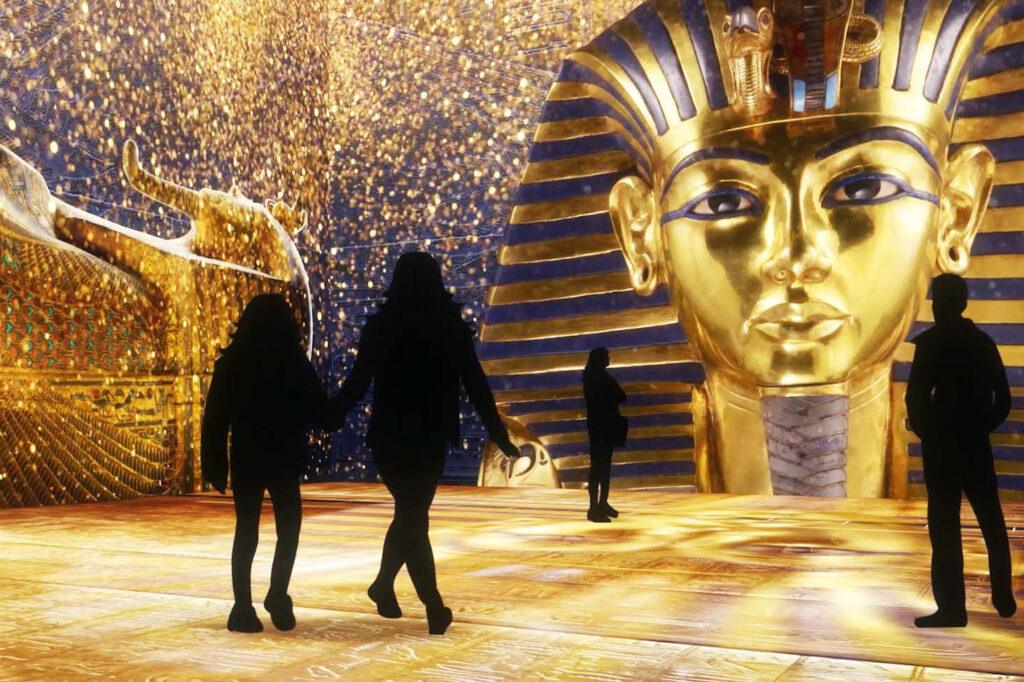
(Photo courtesy of Beyond King Tut)
King Tutankhamun's Legacy
Tutankhamun's greatest historical importance may not lie in what he conquered but in what his tomb preserved.
His burial created a remarkable bridge between the modern world and ancient Kemet.
Through his tomb, we can examine the work of ancient artists, jewelers, carpenters, metalworkers, embalmers, priests, scribes, and other skilled people whose knowledge helped shape one of history's most influential civilizations.
The golden objects attract attention, but the deeper value of Tutankhamun's tomb lies in the information those objects preserve.
They reveal pieces of a civilization's technology, spirituality, craftsmanship, political structure, royal traditions, and understanding of life and death.
Frequently Asked Questions About King Tut
What was King Tut's real name?
King Tut was born Tutankhaten and later changed his name to Tutankhamun as Egypt restored traditional religious practices associated with Amun.
How old was King Tut when he became pharaoh?
Tutankhamun probably became pharaoh at approximately eight or nine years old.
How old was King Tut when he died?
He was approximately 18 or 19 years old when he died.
When did King Tut rule Egypt?
Tutankhamun ruled during Egypt's 18th Dynasty, approximately 1332 to 1323 BCE, although chronological estimates vary.
Where was King Tut buried?
Tutankhamun was buried in tomb KV62 in the Valley of the Kings, near modern Luxor, Egypt.
Who discovered King Tut's tomb?
Archaeologist Howard Carter and his excavation team discovered the entrance to Tutankhamun's tomb in 1922 during excavations funded by Lord Carnarvon.
How many objects were found in King Tut's tomb?
More than 5,000 objects were documented from Tutankhamun's tomb.
What killed King Tut?
The exact cause of Tutankhamun's death remains uncertain. Research has identified malaria, physical health problems, and a serious leg injury among factors that may have contributed to his death.
Was King Tut murdered?
There is currently no conclusive evidence proving that Tutankhamun was murdered. Earlier theories involving a fatal blow to the head have largely lost support following modern examinations of his mummy.
Why is King Tut famous?
Tutankhamun became internationally famous because his tomb survived with an extraordinary collection of royal funerary objects. Its discovery in 1922 became one of the most celebrated archaeological discoveries in history.
The Eternal King
Tutankhamun's reign lasted only a fraction of Egypt's extraordinary history.
Yet more than three thousand years after his death, his name remains known across the globe.
There is something profoundly compelling about that transformation.
A child became king during a period of religious upheaval. A young pharaoh attempted to restore traditions disrupted before his reign. He died before reaching adulthood, leaving no surviving heir. His burial place gradually disappeared from memory.
Then, thousands of years later, a staircase beneath the Valley of the Kings brought his story back into the light.
The treasures of Tutankhamun are breathtaking, but gold alone does not explain his enduring fascination.
His story combines royalty, religion, family, death, archaeology, mystery, and rediscovery in a way few ancient lives can match.
King Tutankhamun may have ruled ancient Egypt for only about a decade, but his journey into eternity has lasted more than 3,000 years.
Few rulers of ancient Egypt have a story as extraordinary as Hatshepsut. Rising from royal wife to one of Egypt’s most powerful pharaohs, Hatshepsut challenged traditional expectations of kingship and presided over a period remembered for monumental construction, international trade, and prosperity.
Rather than building her legacy primarily through military conquest, Hatshepsut invested heavily in temples, monuments, commerce, and the religious institutions that supported her authority. Her reign left an architectural mark across Egypt, most famously at her spectacular mortuary temple at Dear el Bahri.
Centuries after attempts were made to remove her name and images from monuments, Hatshepsut has emerged as one of the most recognizable rulers of ancient Egypt.
Who Was Hatshepsut?
Hatshepsut was a ruler of Egypt’s 18th Dynasty during the New Kingdom. She was the daughter of Pharaoh Thutmose I and Queen Ahmose and later became the principal wife of her half brother, Thutmose II.
After Thutmose II died, the throne passed to the young Thutmose III, his son by another woman named Iset. Because Thutmose III was still a child, Hatshepsut initially acted as regent.
Her position eventually changed dramatically.
Instead of remaining only a regent, Hatshepsut adopted the full titles and symbols of Egyptian kingship and became pharaoh. She ruled alongside Thutmose III as co ruler, although Hatshepsut appears to have been the dominant royal figure during much of this period.
Her reign as king is generally dated from approximately 1479 to 1458 BCE, although exact ancient Egyptian chronologies can vary.
How Hatshepsut Became Pharaoh
Hatshepsut's rise was remarkable, but she did not simply present herself as someone rejecting Egyptian royal traditions. Instead, she carefully worked within them.
Her monuments connected her kingship with divine authority and royal ancestry. At her mortuary temple, inscriptions and reliefs presented a divine birth narrative in which the god Amun was associated with her conception and future rule.
Hatshepsut also emphasized her relationship to her father, Thutmose I, strengthening the idea that she was his legitimate royal successor.
This combination of lineage, religion, ceremony, and royal imagery helped establish her authority.
Hatshepsut ultimately assumed the traditional fivefold royal titulary of an Egyptian king. Her throne name was Maatkare, commonly translated as “Maat is the Ka of Ra.”
Her use of Maat was particularly meaningful. In ancient Egyptian thought, Maat represented truth, justice, balance, harmony, and the proper order of the cosmos. Maintaining Maat was one of the pharaoh's most important responsibilities.
Why Did Hatshepsut Sometimes Appear as a Man?
One of the most fascinating aspects of Hatshepsut's reign is the way she was represented in Egyptian art.
Early images could depict her with a more traditionally feminine appearance. As her kingship developed, however, Hatshepsut was increasingly portrayed using the established visual language of Egyptian pharaohs.
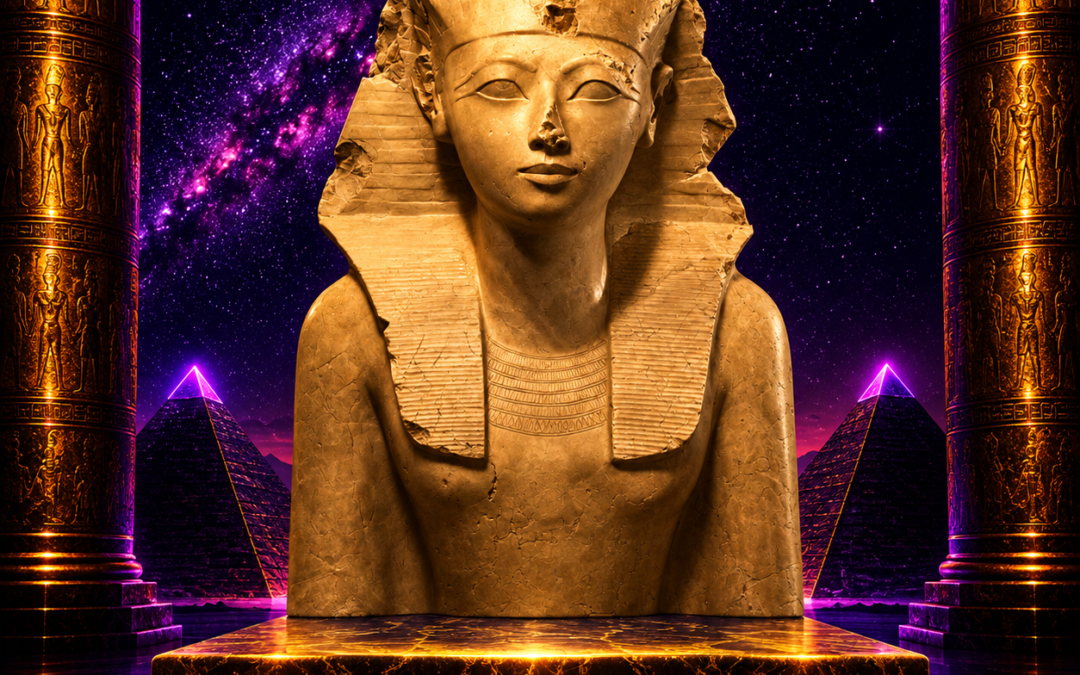
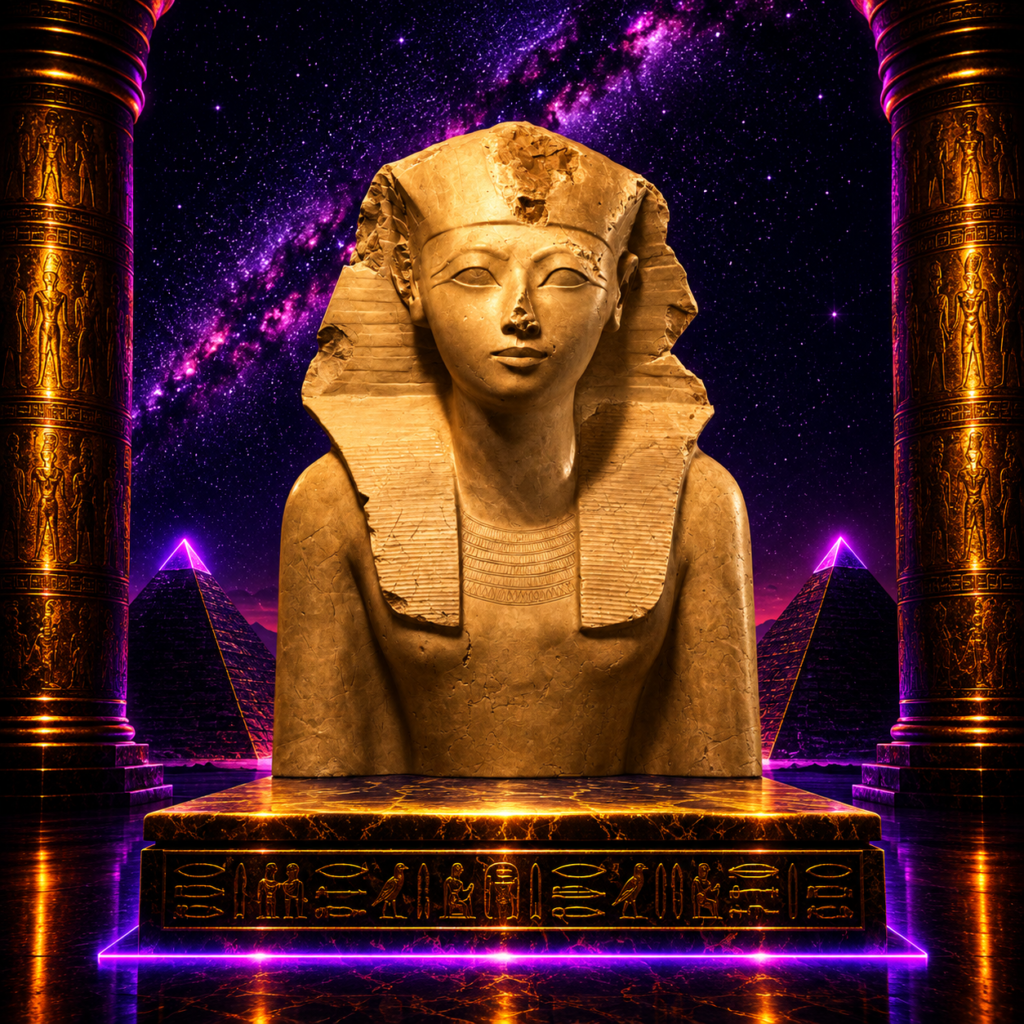
Some statues show her with the nemes headdress, royal regalia, a masculine body, and the ceremonial false beard associated with kingship.
This does not necessarily mean Hatshepsut was attempting to conceal that she was female.
Egyptian royal art was highly symbolic. Pharaohs were depicted according to conventions designed to communicate divine authority, power, legitimacy, and eternal kingship rather than simply reproduce a ruler's everyday physical appearance.
Hatshepsut's changing representation can therefore be understood as part of her adoption of the traditional role of pharaoh.
Hatshepsut's Magnificent Temple at Dear el Bahri
Perhaps the greatest surviving monument associated with Hatshepsut is her mortuary temple at Dear el Bahri, near modern Luxor.
Known in ancient times as Djeser Djeseru, often translated as “Holy of Holies,” the temple was constructed against the dramatic cliffs on the western side of the Nile.
Its enormous terraces, colonnades, ramps, chapels, statues, and reliefs created one of the architectural masterpieces of the New Kingdom.
The temple was closely connected with the worship of Amun and Hatshepsut's mortuary cult. It also contained sacred spaces associated with other deities, including Hathor and Anubis.
Its walls preserve some of the most important visual records of Hatshepsut's reign.
The Famous Expedition to Punt
Among the most celebrated events depicted at Dear el Bahri is Hatshepsut's expedition to the mysterious land known to the Egyptians as Punt.
Punt had longstanding commercial connections with ancient Egypt. Scholars generally associate it with areas around the Red Sea and Horn of Africa, although its precise geographic boundaries remain debated.
Hatshepsut's reliefs depict ships traveling to Punt and returning with valuable commodities.
These included incense, myrrh, ebony, ivory, exotic animals, and other luxury goods.
Particularly remarkable are representations of living myrrh trees being transported back to Egypt.
The expedition was more than a commercial achievement. Its depiction on a royal monument communicated Hatshepsut's ability to obtain valuable resources from distant lands and maintain Egypt's international connections.
For modern historians, the Punt reliefs also provide extraordinary evidence of ancient Egyptian ships, commerce, geography, diplomacy, and interactions with neighboring African regions.
Hatshepsut's Massive Building Program
Hatshepsut was one of the New Kingdom's great builders.
Her construction projects appeared throughout Egypt, but Karnak Temple became an especially important center of her royal activity.
She commissioned enormous obelisks dedicated to Amun. One of her obelisks at Karnak remains standing today and is among the most recognizable monuments associated with her reign.
Hatshepsut proudly commemorated these projects in inscriptions.
Building temples was not simply an act of personal ambition. Egyptian kings used construction to honor the gods, demonstrate royal legitimacy, celebrate political achievements, preserve their names, and participate symbolically in maintaining cosmic order.
Hatshepsut understood the extraordinary power of monumental architecture.
Thousands of years later, her monuments are still accomplishing what Egyptian royal architecture was designed to do.
They preserve the memory of the king.
Hatshepsut and the God Amun
Religion played a central role in Hatshepsut's kingship.
The cult of Amun, particularly Amun Ra, had become increasingly influential during the New Kingdom. Hatshepsut strongly associated herself with the deity and invested heavily in his religious institutions.
Her monuments described divine support for her rule and emphasized her special relationship with Amun.
This connection helped reinforce her legitimacy.
The relationship between Egyptian religion and political authority was deeply intertwined. Pharaoh was not simply a political leader in the modern sense. Egyptian kingship carried sacred responsibilities involving the gods, temples, offerings, Maat, and the preservation of cosmic order.
Hatshepsut presented herself as fully capable of performing these responsibilities.
Hatshepsut's relationship with Thutmose III is sometimes portrayed as a dramatic struggle for the throne, but the surviving evidence presents a more complicated picture.
Thutmose III remained king during Hatshepsut's reign and appeared with her on monuments. He was not simply removed from royal life.
After Hatshepsut's death, Thutmose III became the sole ruler and eventually developed a reputation as one of ancient Egypt's most successful military pharaohs.
Years later, however, something unusual happened.
Images and names of Hatshepsut began to disappear.
Why Was Hatshepsut Erased From History?
One of the greatest mysteries surrounding Hatshepsut concerns the destruction of her memory.
Her names were removed from certain monuments. Statues were damaged, altered, buried, or destroyed. Images of Hatshepsut were chiseled away in selected locations.
For many years, this destruction encouraged a dramatic interpretation: Thutmose III hated his stepmother and sought revenge after finally gaining control.
Modern scholarship has made that explanation considerably less certain.
Importantly, much of the campaign against Hatshepsut appears to have occurred years after her death, rather than immediately afterward.
This delayed timing has encouraged historians to consider political and dynastic explanations.
One possibility is that removing Hatshepsut from the official sequence of kings helped reinforce a conventional male line of succession, particularly as Thutmose III prepared the future succession of his son Amenhotep II.
The exact motivations remain debated.
What is clear is that the destruction was selective and significant enough to obscure Hatshepsut's unusual kingship for centuries.
Rediscovering the Female Pharaoh
The attempt to diminish Hatshepsut's royal identity ultimately failed.
Archaeologists and Egyptologists gradually reconstructed her history through surviving inscriptions, statues, temples, reliefs, and archaeological discoveries.
Her monuments revealed something extraordinary.
The apparently male king represented on some monuments and the royal woman Hatshepsut were the same ruler.
Modern archaeological work at Dear el Bahri and other locations has continued to reveal information about her reign, officials, religious program, architecture, and royal identity.
Today, Hatshepsut has reclaimed her place among the most important rulers of ancient Egypt.
The Mystery of Hatshepsut's Mummy
The identification of Hatshepsut's mummy has generated considerable attention and debate.
In 2007, Egyptian authorities announced that a female mummy from tomb KV60 in the Valley of the Kings had been identified as Hatshepsut. The proposed identification involved archaeological evidence and comparisons involving a tooth reportedly associated with Hatshepsut.
The identification became widely publicized, but scholars have continued to discuss the strength of the evidence.
Because ancient remains present difficult archaeological and scientific challenges, conclusions surrounding royal mummy identification should be treated carefully when evidence remains disputed.
The continuing investigation illustrates how archaeology can transform our understanding of individuals who lived more than three thousand years ago.
What Did Hatshepsut Accomplish?
Hatshepsut's reign demonstrates that political power in ancient Egypt could sometimes operate beyond the expectations we might assume existed in the ancient world.
Her accomplishments included extensive monumental construction, temple restoration and expansion, international commerce, religious patronage, and the strengthening of royal institutions.
She also created one of the most distinctive presentations of kingship in Egyptian history.
Rather than abandoning the institution because its imagery had traditionally been masculine, Hatshepsut adapted herself to its symbols while simultaneously preserving references to her identity as a woman.
That makes her reign especially valuable for understanding how ancient Egyptians conceptualized gender, political authority, religion, and kingship.
Hatshepsut's Powerful Legacy
Hatshepsut ruled more than three thousand years ago, yet her story remains remarkably compelling.
She inherited a political situation in which she was expected to serve as regent for a young king. She ultimately transformed that position into full pharaonic authority.
She constructed monumental temples.
She raised enormous obelisks.
She celebrated expeditions to distant lands.
She presented herself as chosen by the gods.
And when later generations attempted to remove portions of her royal identity from Egypt's monuments, enough evidence survived for history to reconstruct her remarkable reign.
Hatshepsut's story is therefore not simply the story of a female ruler.
It is the story of power, legitimacy, transformation, memory, and survival in one of the world's most influential ancient civilizations.
Her monuments still rise above the Egyptian landscape, reminding the world that even an attempted erasure could not completely silence one of ancient Egypt's most extraordinary pharaohs.
Frequently Asked Questions About Hatshepsut
Was Hatshepsut really a pharaoh?
Yes. Hatshepsut adopted the full titles, regalia, and political and religious responsibilities associated with Egyptian kingship. She ruled as pharaoh during Egypt's 18th Dynasty.
Was Hatshepsut the first female pharaoh?
No. Women ruled Egypt before Hatshepsut. Earlier female rulers included Sobekneferu of the 12th Dynasty. Hatshepsut is significant because of the length, prosperity, monumental scale, and documentation of her reign.
Why did Hatshepsut wear a false beard?
The ceremonial beard was part of traditional Egyptian royal iconography. Hatshepsut's use of masculine royal symbols represented her status as pharaoh rather than necessarily an attempt to disguise her sex.
What is Hatshepsut most famous for?
Hatshepsut is especially famous for becoming pharaoh, her monumental building projects, her mortuary temple at Dear el Bahri, her obelisks at Karnak, and the celebrated trading expedition to Punt.
Who ruled after Hatshepsut?
Thutmose III, who had technically ruled alongside Hatshepsut, became the sole pharaoh following her death.
Why was Hatshepsut's name erased?
Parts of Hatshepsut's royal imagery and names were deliberately removed after her death. Scholars continue to debate the precise motivation, although dynastic succession and the desire to reshape the official royal lineage are important explanations.
Final Thoughts
Hatshepsut remains one of the most fascinating figures in the history of ancient Kemet.
Her reign reveals a civilization in which political authority, divine legitimacy, architecture, trade, symbolism, and remembrance were deeply interconnected.
Attempts to erase her could damage stone, remove names, and destroy statues.
They could not erase her completely.
More than three millennia later, Hatshepsut stands again among the great pharaohs of ancient Egypt, her temple beneath the cliffs of Dear el Bahri serving as one of the most spectacular surviving monuments to her reign.
More than 5,000 years ago, along the fertile banks of the Nile, a ruler emerged whose reign became closely associated with one of the most important transformations in ancient Egyptian history: the political consolidation of Upper and Lower Egypt.
His name was Narmer.
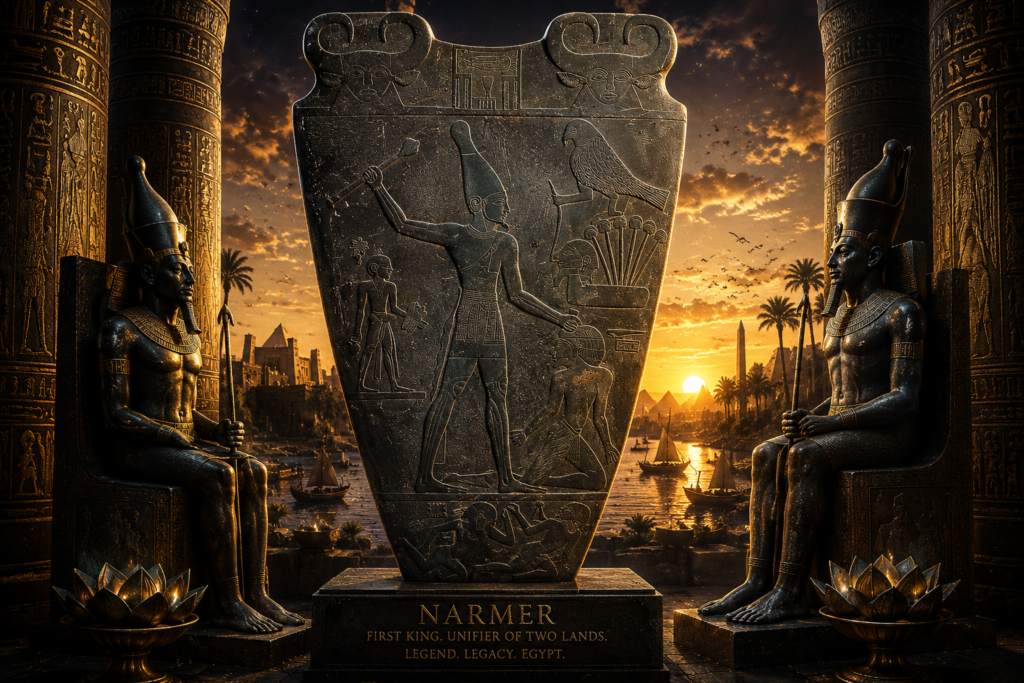
King Narmer is one of the earliest rulers known from ancient Egypt and is traditionally placed near the beginning of the First Dynasty, around 3100 BCE. His name appears on some of the most significant artifacts surviving from Egypt's formative period, including the extraordinary Narmer Palette.
For generations, Narmer has been associated with the unification of Egypt and the establishment of the centralized kingship that would define ancient Egyptian civilization for thousands of years.
But who exactly was King Narmer? Did he truly unite Upper and Lower Egypt? Was Narmer the legendary Menes described by later Egyptian traditions? And what can archaeology actually tell us about this mysterious ruler?
The story of Narmer takes us back to the very beginning of dynastic Egypt.
Who Was King Narmer?
King Narmer was an early Egyptian ruler who lived around the transition between the Predynastic Period and Egypt's First Dynasty, approximately 3100 BCE.
He ruled during a period when communities throughout the Nile Valley were becoming increasingly interconnected and politically organized.
Before Egypt developed into the centralized kingdom familiar from later periods, the Nile Valley contained different settlements and regional centers of power. Over generations, increasingly powerful rulers based in southern Egypt expanded their influence northward.
Narmer appears near the culmination of this process.
His reign is therefore frequently associated with the emergence of the Egyptian state and the beginning of what historians call the Early Dynastic Period.
Narmer's name has been discovered at several archaeological sites, demonstrating that his authority or influence extended across a considerable geographic area.
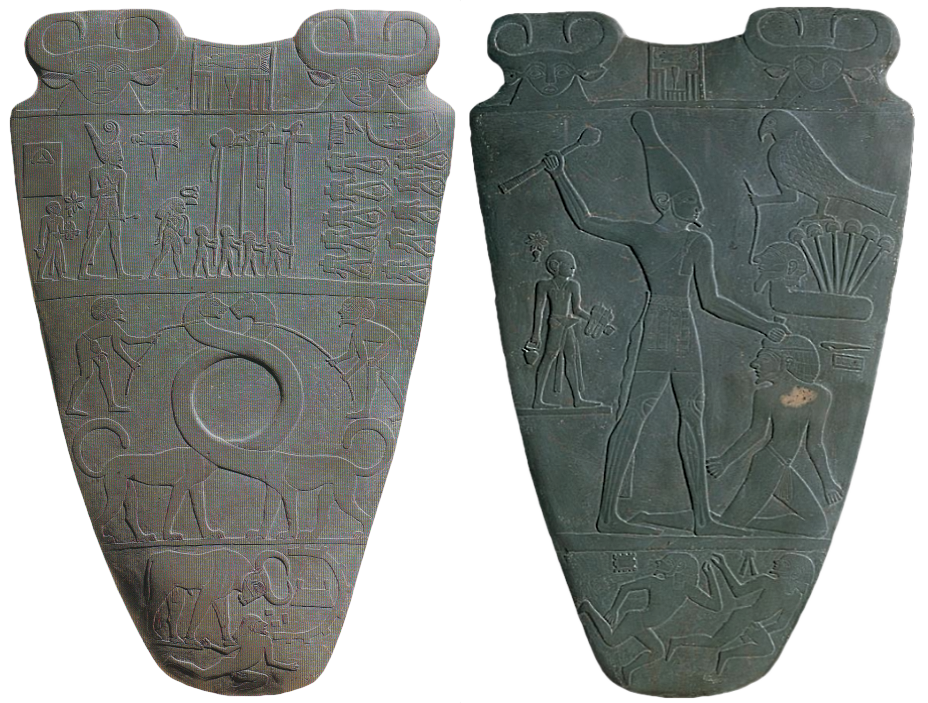
Yet the most famous evidence connected to him comes from a ceremonial object discovered at Hierakonpolis, known today as the Narmer Palette.
The Narmer Palette: An Extraordinary Window Into Early Egypt
Few ancient Egyptian artifacts are as important to our understanding of early kingship as the Narmer Palette.
Discovered in the late nineteenth century at Hierakonpolis in Upper Egypt, the ceremonial stone palette dates to around 3100 BCE.
Both sides contain intricately carved scenes centered on King Narmer.
On one side, Narmer appears wearing the White Crown, traditionally associated with Upper Egypt. He raises a mace over a kneeling captive while the falcon god Horus appears nearby.
On the opposite side, Narmer is depicted wearing the Red Crown, traditionally associated with Lower Egypt.
This combination is one of the primary reasons the palette has long been interpreted as evidence of Narmer's connection with the unification of Upper and Lower Egypt.
The imagery also reveals something profound about early Egyptian kingship.
Narmer is depicted much larger than the people surrounding him, a visual convention known as hierarchical scale. His enormous size communicates his elevated political and sacred status.
This artistic convention would remain a recognizable feature of Egyptian royal art for thousands of years.
Did King Narmer Unite Upper and Lower Egypt?
Narmer is commonly described as the ruler who unified Upper and Lower Egypt, creating one of the world's earliest centralized territorial states.
The traditional interpretation is compelling.
Narmer appears wearing the crowns associated with both regions on the Narmer Palette. The artifact also contains scenes of military victory and royal authority.
However, historians today generally treat Egyptian unification as more complicated than a single dramatic conquest.
Archaeological evidence suggests that political consolidation developed over generations. Rulers preceding Narmer, including kings associated with the late Predynastic period, were already expanding political and economic networks throughout the Nile Valley.
Narmer may therefore have completed, strengthened, or symbolized a process that had already been underway.
Rather than imagining Egypt becoming unified on a single day, it may be more accurate to see Narmer as one of the pivotal rulers in a long transformation that produced the dynastic Egyptian state.
Upper Egypt and Lower Egypt Explained
Understanding Narmer requires understanding one of the distinctive features of Egyptian geography.
Ancient Egypt was traditionally divided into two regions.
Upper Egypt was located in the south, extending along the Nile Valley toward the First Cataract.
Lower Egypt was located in the north, particularly around the broad Nile Delta.
The terminology may initially seem reversed. Upper Egypt is geographically south because it lies upstream, while Lower Egypt lies downstream toward the Mediterranean coast.
These two regions became central to Egyptian royal ideology.
Later pharaohs regularly presented themselves as rulers of the Two Lands, emphasizing the unity of Upper and Lower Egypt under one monarch.
Narmer's imagery appears at the beginning of this enduring political tradition.
Narmer and the Meaning of the Two Crowns
The crowns worn by Narmer on his famous palette carried powerful political symbolism.
The White Crown, or Hedjet, became associated with Upper Egypt.
The Red Crown, or Deshret, became associated with Lower Egypt.
Eventually, the two crowns were combined into the Double Crown, symbolizing royal authority over the unified Two Lands.
The presence of Narmer wearing both regional crowns on the same ceremonial object is therefore particularly significant.
Whether the scenes represent a literal historical battle, ceremonial symbolism, or a combination of both remains debated. Nevertheless, the imagery clearly presents Narmer as a ruler whose authority encompassed, or claimed to encompass, both regions.
Was Narmer the Same Person as Menes?
One of the great historical questions surrounding Narmer concerns another mysterious figure: Menes.
Later Egyptian tradition remembered Menes as the first king of unified Egypt.
Ancient writers such as Manetho, an Egyptian priest who lived thousands of years after the beginning of the First Dynasty, placed Menes at the beginning of Egypt's dynastic history.
The difficulty is that contemporary archaeological evidence has not produced a king whose Horus name was simply "Menes."
This has led scholars to several possibilities.
Narmer may have been the historical ruler remembered later as Menes.
Alternatively, Menes may have referred to Narmer's successor, Hor-Aha.
Another possibility is that the later Menes tradition compressed memories of Egypt's complex unification process into the story of a single founding ruler.
The exact relationship remains uncertain.
For this reason, it is safer to describe Narmer as one of the strongest historical candidates behind the later tradition of Menes rather than stating definitively that the two names represented the same individual.
The Meaning of Narmer's Name
Narmer's royal name appears inside a serekh, an early rectangular royal emblem representing the façade of a palace and topped by the falcon god Horus.
The hieroglyphic signs associated with his name include a catfish and a chisel-like object.
Because of this, Narmer's name has sometimes been popularly translated using expressions connected with the catfish symbol, although the precise linguistic interpretation remains debated.
More important historically is the way his name was displayed.
The serekh became an important feature of early Egyptian kingship, associating the ruler with Horus, one of the most significant divine figures connected with royal authority.
Narmer therefore belonged to a developing ideological system in which political leadership, divine legitimacy, symbolism, and royal identity were deeply interconnected.
Horus and the Divine Authority of Narmer
The falcon god Horus occupies a prominent position on the Narmer Palette.
In one scene, a falcon representing Horus stands above a group of papyrus plants while controlling a human figure.
Papyrus was strongly associated with the marshlands of northern Egypt, causing many scholars to interpret the imagery as a symbolic representation of Narmer's domination over territories in Lower Egypt.
The scene demonstrates how religion and kingship were already becoming intertwined at the dawn of dynastic Egypt.
Egyptian kings were not simply political administrators.
Their authority existed within a sacred worldview.
The king maintained order, defended the land, honored the gods, and stood at the center of the relationship between the divine and earthly worlds.
These concepts would later become fundamental to pharaonic ideology.
Narmer and the Birth of Pharaonic Kingship
Narmer lived centuries before the Great Pyramid of Giza, Tutankhamun, Hatshepsut, Akhenaten, or Ramesses II.
Yet many features commonly associated with later Egyptian kingship were already emerging during his era.
Royal imagery emphasized enormous authority.
The king was closely connected with Horus.
Egypt was conceived as the union of two complementary lands.
Military victory could represent the triumph of order over enemies.
Royal regalia communicated political and sacred authority.
These ideas became increasingly sophisticated over subsequent dynasties, but their early development can be seen in objects associated with Narmer.
That makes his reign important not merely because of territorial politics but because it stands near the beginning of a distinctive Egyptian conception of kingship that survived for millennia.
Where Was King Narmer Buried?
Narmer's tomb is generally identified at Umm el-Qa'ab in Abydos, one of ancient Egypt's most important early royal burial grounds.
His burial consisted of relatively modest mud-brick chambers compared with the enormous pyramids constructed by later rulers.
This difference reveals how dramatically Egyptian royal architecture evolved.
Narmer lived roughly four centuries before the Great Pyramid of Khufu.
The monumental stone pyramid complexes associated with the Old Kingdom had not yet developed.
Nevertheless, Abydos was already becoming a major center of royal burial and sacred tradition.
Several of Egypt's earliest kings were buried there, and the area later became closely associated with Osiris, god of the afterlife and regeneration.
Archaeological Evidence for Narmer Beyond Egypt
One fascinating aspect of Narmer's reign is the geographic distribution of objects bearing his name.
Artifacts connected with Narmer have been discovered beyond the heartland of the Nile Valley, including areas of the southern Levant.
These discoveries demonstrate that early Egypt participated in broader systems of exchange and interaction.
Egypt was not an isolated civilization suddenly appearing along the Nile.
Its early rulers existed within networks connecting northeastern Africa and neighboring regions of western Asia.
Goods, materials, technologies, and cultural influences traveled through these networks long before Egypt's famous pyramids were constructed.
Narmer's era therefore provides evidence not only for the formation of the Egyptian state but also for Egypt's participation in an interconnected ancient world.
Was Narmer Really the First Pharaoh?
Calling Narmer the "first pharaoh" is common, but it requires some clarification.
Egypt had rulers before Narmer.
Archaeological evidence from Predynastic Egypt identifies earlier kings, particularly those associated with powerful centers in Upper Egypt.
Furthermore, the Egyptian royal title translated today as pharaoh developed much later. The ancient Egyptian term per-aa, meaning "Great House," originally referred to the royal palace before eventually becoming a designation for the king.
So Narmer would not have called himself "Pharaoh Narmer" in the way the expression is commonly used today.
Nevertheless, in popular historical language, he is frequently described as one of Egypt's earliest pharaohs because he stood near the beginning of the dynastic monarchy that later produced Egypt's famous royal tradition.
What Egypt Was Like During Narmer's Lifetime
Narmer's Egypt looked dramatically different from the Egypt of the pyramid builders.
There were no massive pyramids dominating the horizon at Giza.
The temples of Karnak had not yet been constructed.
The Valley of the Kings did not exist.
Instead, settlements stretched along the Nile, surrounded by agricultural land supported by the river's annual cycles.
Communities produced pottery, stone vessels, tools, textiles, jewelry, and increasingly sophisticated works of art.
Trade networks connected different regions, while political authority became more centralized.
Writing was also developing.
Some of Egypt's earliest hieroglyphic inscriptions date to the centuries surrounding Narmer's reign, reflecting the growth of administrative systems and royal institutions.
Narmer therefore lived during one of the most transformative periods in Egyptian history.
The Nile and the Rise of the Egyptian State
No discussion of early Egypt is complete without the Nile River.
The Nile provided water, fertile agricultural land, transportation, fish, reeds, and a natural corridor connecting communities across northeastern Africa.
Its geography also helped make political integration possible.
Instead of being separated by enormous mountain ranges, communities along much of the Egyptian Nile Valley were connected by the river.
Boats could transport people, goods, officials, and military forces over considerable distances.
As powerful rulers expanded their influence, the Nile became the central artery of the emerging Egyptian state.
Narmer inherited, and helped shape, a civilization whose political organization was inseparable from this extraordinary African river.
Why King Narmer Matters
Narmer's importance extends far beyond the details of his individual reign.
He represents a turning point between Predynastic Egypt and dynastic Egyptian civilization.
During this transformation, increasingly complex communities became incorporated into a centralized kingdom capable of administering territory stretching along hundreds of miles of the Nile.
The state that emerged would eventually build enormous monuments, develop sophisticated religious traditions, produce remarkable art and literature, and influence surrounding regions for thousands of years.
Narmer stands remarkably close to the beginning of that story.
The surviving evidence from his reign provides a rare glimpse into the moment when many of the symbols later associated with ancient Egyptian civilization were still taking shape.
The Enduring Legacy of King Narmer
More than five millennia after Narmer lived, his image remains immediately recognizable.
A king wearing an ancient crown raises his mace above a defeated enemy.
Horus watches over the scene.
Royal standards move through ceremonial processions.
The imagery communicates power, sacred authority, victory, and political order without requiring a lengthy written explanation.
That visual language would become one of ancient Egypt's greatest cultural achievements.
Narmer's historical importance therefore lies not only in the question of whether he personally "unified Egypt."
His reign represents the emergence of an extraordinary political and cultural system.
From the early rulers of Abydos to the pyramid builders of the Old Kingdom and the powerful monarchs of the New Kingdom, the institution of Egyptian kingship continued to evolve while preserving ideas whose roots stretched back to Narmer's world.
King Narmer and the Dawn of Ancient Egypt
King Narmer remains one of the most fascinating figures in ancient Egyptian history precisely because so much about him exists at the boundary between archaeology, royal symbolism, and later tradition.
The evidence strongly establishes him as a major ruler at the beginning of Egypt's First Dynasty and connects his reign with the political consolidation of Upper and Lower Egypt.
Whether Narmer alone united the Two Lands, completed a process begun by earlier rulers, or later became remembered through the legendary figure Menes remains debated.
What is clear is his extraordinary historical position.
Narmer stood at the threshold of dynastic Egypt.
The kingdom that emerged from this formative era would endure, transform, and influence the ancient world for approximately three thousand years.
More than 5,000 years later, the Narmer Palette still preserves the image of a ruler standing at the dawn of one of Africa's most extraordinary civilizations.
Frequently Asked Questions About King Narmer
Who was King Narmer?
King Narmer was an early Egyptian ruler who reigned around 3100 BCE and is generally associated with the beginning of Egypt's First Dynasty and the political consolidation of Upper and Lower Egypt.
What is King Narmer famous for?
Narmer is best known for his association with the unification of ancient Egypt and for the Narmer Palette, one of the most important surviving artifacts from early dynastic Egypt.
Did Narmer unite Upper and Lower Egypt?
Narmer has traditionally been credited with unifying Upper and Lower Egypt. Modern archaeology suggests unification was probably a gradual process involving several rulers, with Narmer playing a major role near its culmination.
Was Narmer the first pharaoh of Egypt?
Narmer is frequently called Egypt's first pharaoh in popular history, although rulers existed before him and the actual title translated as "pharaoh" came into use much later.
Are Narmer and Menes the same person?
Possibly, but the identification remains debated. Some scholars have associated Menes with Narmer, while others have proposed Narmer's successor Hor-Aha or interpret Menes as a later traditional representation of Egypt's founding ruler.
Where is the Narmer Palette today?
The Narmer Palette is preserved in the Egyptian Museum in Cairo and remains one of the most important artifacts from the formative period of the Egyptian state.
Where was King Narmer buried?
Narmer's tomb is generally identified at Umm el-Qa'ab in Abydos, an important royal cemetery used by Egypt's earliest dynastic rulers.