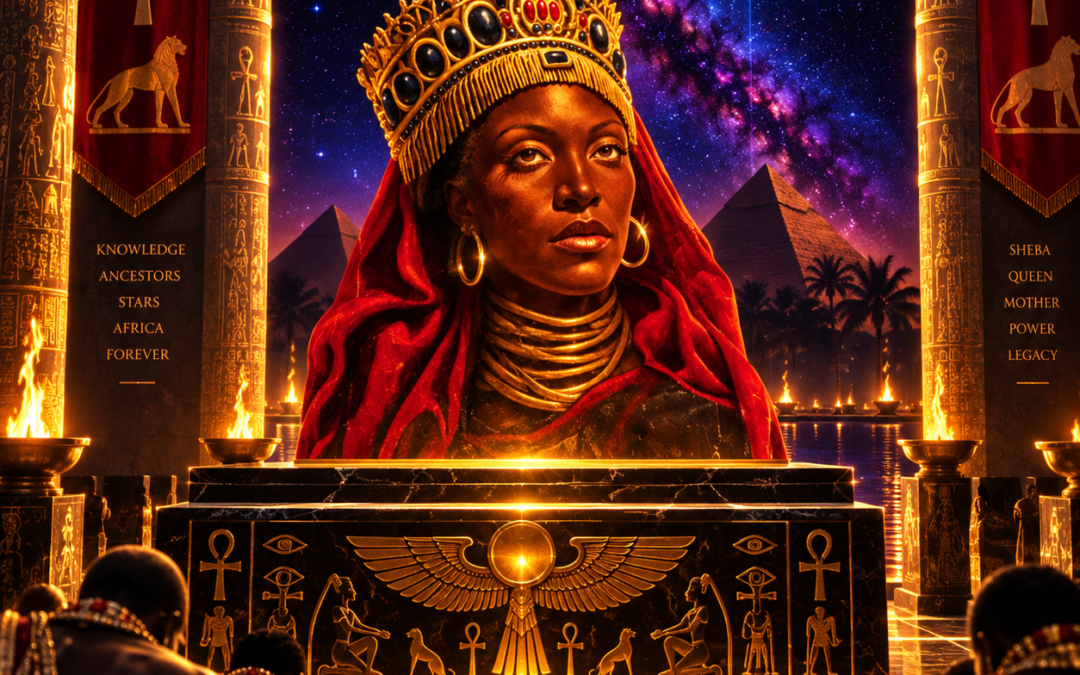
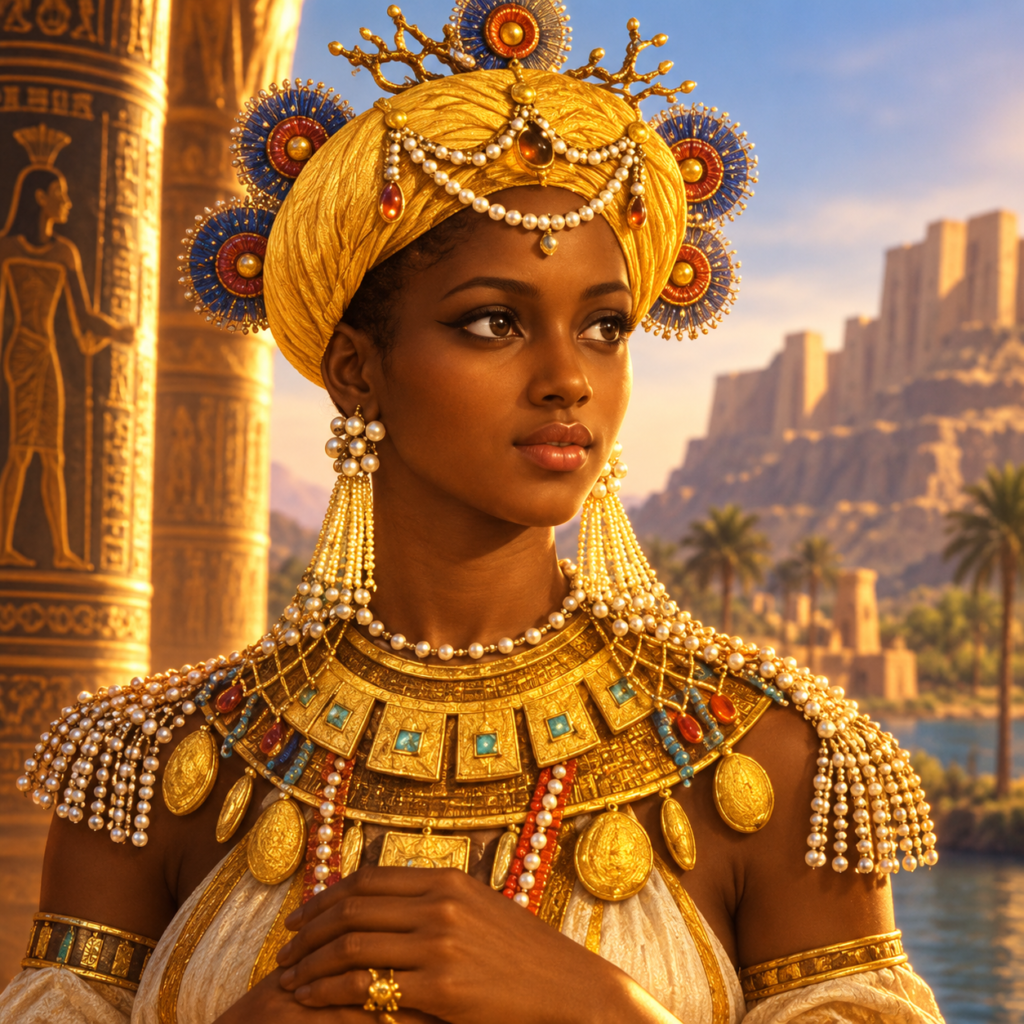
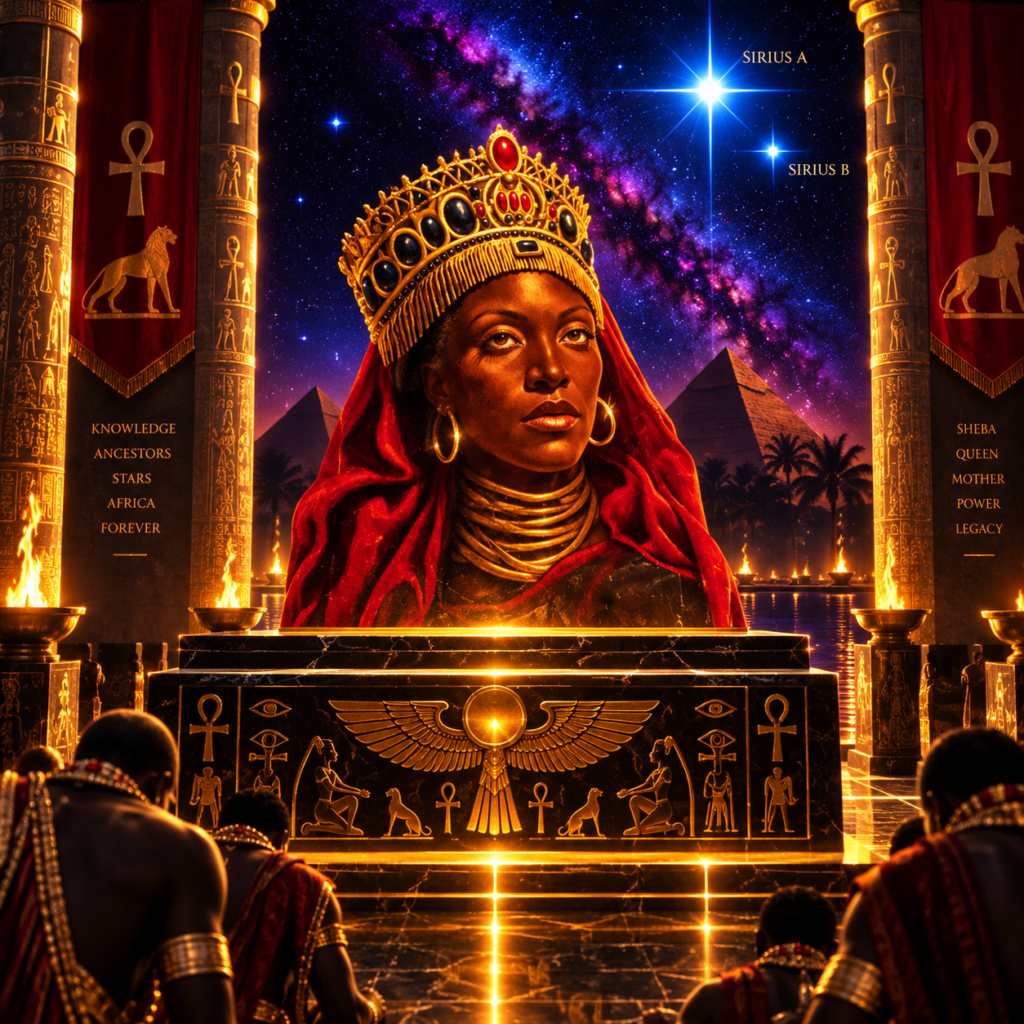
Few women of the ancient world have inspired as much fascination as the Queen of Sheba.
She appears only briefly in the Hebrew Bible, yet her story grew across thousands of years and several religious and cultural traditions. She became a queen of extraordinary wealth, a seeker of wisdom, a challenger of King Solomon, an African royal figure in ancient and medieval traditions, and according to Ethiopia’s celebrated Kebra Nagast, the mother of a royal dynasty.
In Ethiopia she is remembered as Makeda.
In Islamic tradition, she became associated with the queen commonly called Bilqis.
The first-century Jewish historian Flavius Josephus described Solomon’s famous visitor as a ruler connected with Egypt and Ethiopia.
And in February 1994, Ebony magazine brought renewed attention to the African dimensions of the biblical world in its influential article “Blacks in the Bible.”
But who was the Queen of Sheba?
Was Sheba in Africa, Arabia, or part of an interconnected Red Sea world that makes our modern geographical boundaries inadequate for understanding her story?
The answer leads into one of antiquity’s most compelling historical mysteries.
Who Was the Queen of Sheba?
The Queen of Sheba enters the biblical narrative during the reign of King Solomon, traditionally placed in the 10th century BCE.
Her story appears principally in 1 Kings 10:1–13 and 2 Chronicles 9:1–12.
The biblical writers never provide her personal name. She is simply called the Queen of Sheba.
Yet she is no ordinary visitor.
She hears reports concerning Solomon's extraordinary wisdom and travels to Jerusalem to test him with difficult questions.
She arrives with an impressive caravan carrying camels, spices, precious stones and enormous quantities of gold.
This detail matters.
The Queen of Sheba does not appear as a powerless visitor approaching a great king. She arrives with the resources and diplomatic presence of a wealthy sovereign.
She questions Solomon.
Solomon answers her challenges.
She examines his palace, administration and prosperity and is overwhelmed by what she witnesses. The two monarchs exchange valuable gifts before the queen returns to her homeland.
The encounter is remarkably diplomatic.
It is a meeting between rulers.
And although the biblical account is relatively short, the mystery surrounding the queen's identity would grow for centuries.
The Queen of Sheba and the African World
One of the most important questions is also the most controversial:
Where was Sheba?
Many modern historians associate biblical Sheba with the ancient Sabaean kingdom of southern Arabia, centered in what is now Yemen.
There is substantial historical reason for this interpretation. Saba was a prosperous civilization connected to the lucrative trade in incense and other commodities moving through Arabia and the Red Sea.
But the story becomes considerably more complicated when Africa enters the picture.
The Red Sea was not an impenetrable barrier separating Africa from Arabia. It functioned as a corridor through which communities, merchants, languages, ideas and goods circulated.
Ancient populations on the African and Arabian sides of the Red Sea interacted for centuries.
This means the question “Africa or Arabia?” can sometimes impose a modern geographical distinction on an ancient interconnected world.
And there is another extraordinary piece of evidence.
What Ebony Magazine Said About the Queen of Sheba
This African interpretation received renewed attention among African American readers in the February 1994 issue of Ebony magazine.
The issue contained an article by Lisa C. Jones titled “Blacks in the Bible.”
The article examined scholarship challenging the overwhelmingly European imagery through which biblical history had often been presented in Western art, cinema and popular culture.
Among the scholars discussed was Dr. Cain Hope Felder, then a professor at Howard University School of Divinity and an important scholar of African presence in the biblical world.
The article emphasized that Africans were not peripheral to biblical history.
Egypt.
Cush.
Ethiopia.
North Africa.
These regions and their peoples repeatedly intersect with biblical narratives.
Among the personalities highlighted was the Queen of Sheba.
The article presented her within an African framework and associated her with Ethiopia and Egypt, reflecting a tradition with roots much older than the twentieth century.
That point is important.
The African interpretation of Sheba was not simply invented by Ebony magazine. As we have already seen, Josephus had associated Solomon's mysterious visitor with Egypt and Ethiopia nearly two thousand years earlier.
The Ebony article belonged to a larger effort to recover African presence from biblical history after centuries in which Western religious artwork routinely transformed ancient African and Near Eastern populations into Europeans.
Queen Makeda: Ethiopia's Queen of Sheba
Nowhere did the Queen of Sheba become more culturally important than in Ethiopia.
In Ethiopian tradition, the Queen of Sheba is known as Makeda.
Her extraordinary story is preserved most famously in the Kebra Nagast, or Glory of the Kings, one of the great works of Ethiopian literary and religious tradition.
The surviving Ethiopic form of the Kebra Nagast dates primarily to the medieval period, particularly the 14th century, although scholars recognize that it incorporates older biblical, legendary and traditional material.
The text dramatically expands the short biblical encounter between Solomon and Sheba.
Here the queen is no longer simply an unnamed monarch who visits Jerusalem.
She becomes Makeda, Queen of Ethiopia.
And her meeting with Solomon changes the destiny of a kingdom.
Makeda Meets King Solomon
According to the Ethiopian narrative, Makeda hears of Solomon's extraordinary wisdom and travels to Jerusalem.
Their meeting becomes far more elaborate than the account in Kings.
Makeda is impressed not merely by Solomon's wealth but by his wisdom and his relationship with the God of Israel.
Eventually, the relationship between the two rulers becomes intimate.
When Makeda returns to Ethiopia, she is carrying Solomon's child.
That child becomes Menelik I.
This is one of the most consequential additions to the Queen of Sheba tradition.
The biblical books of Kings and Chronicles do not say that Solomon and the Queen of Sheba had a child.
The story belongs to the Ethiopian tradition preserved in the Kebra Nagast.
That distinction is essential when separating biblical text from later sacred and national tradition.
Menelik I and the Solomonic Dynasty
According to the Kebra Nagast, Makeda's son grows up in Ethiopia and eventually travels to Jerusalem to meet his father.
Solomon recognizes Menelik as his son and wishes him to remain.
Menelik ultimately returns to Ethiopia.
But his journey home introduces an even greater mystery.
The Ark of the Covenant.
According to Ethiopian tradition, Menelik and his companions carried the Ark from Jerusalem to Ethiopia, where it eventually came to be associated with the sacred city of Aksum.
The Ethiopian Orthodox tradition maintains that the Ark is preserved there.
Historians cannot independently verify the Ark tradition, but its cultural and religious importance to Ethiopia is immense.
The story also became fundamental to Ethiopian royal ideology.
For centuries, Ethiopian rulers of the Solomonic dynasty claimed descent through:
King Solomon → Queen Makeda → Menelik I → the Ethiopian royal line.
The tradition survived into modern history and was associated with Emperor Haile Selassie I, the last emperor of Ethiopia.
Thus a brief encounter recorded in the Hebrew Bible became part of one of Africa's most enduring royal traditions.
Was the Queen of Sheba Black?
The question requires historical care because modern racial categories cannot simply be projected backward three thousand years.
The Bible itself does not describe the Queen of Sheba's skin color.
Nor does it explicitly call her Ethiopian.
However, there are legitimate historical reasons she became identified as an African and Black queen.
Josephus associated her with Egypt and Ethiopia.
Later Ethiopian tradition unequivocally claimed her as Makeda, an Ethiopian monarch.
Early Christian interpretation also helped associate the Queen of Sheba with African and Ethiopian imagery.
Modern scholarship has consequently examined how geography, biblical interpretation, ethnicity and later ideas about race shaped representations of the queen.
Scholar Jillian Stinchcomb, for example, has examined precisely how the Queen of Sheba became one of the Bible's most recognizable Black queens through ancient and later traditions.
Therefore, saying simply that “the Bible says the Queen of Sheba was Black” would go beyond what the biblical text actually states.
A more historically accurate statement is:
The Bible leaves her ethnicity and physical appearance unspecified, but an African identification of the Queen of Sheba developed in antiquity and became especially powerful in Ethiopian tradition.
That distinction does not weaken her African legacy.
It allows us to understand where that legacy actually comes from.
Was Sheba in Ethiopia or Yemen?
Archaeology adds another layer to the mystery.
The ancient kingdom of Saba flourished in southern Arabia, particularly in present-day Yemen. Sabaean civilization became wealthy through regional and long-distance commerce, including the trade in valuable aromatics such as frankincense and myrrh.
This makes southern Arabia a strong candidate for biblical Sheba.
Yet Sabaean culture was also connected across the Red Sea with the Horn of Africa.
Ancient communities did not live according to today's national boundaries.
The waterways connecting northeast Africa and Arabia facilitated trade and cultural exchange rather than simply separating the two regions.
This has led some researchers to argue that the Queen of Sheba story should be understood within a wider African–Arabian Red Sea civilization.
National Geographic has likewise examined the continuing debate between African and Arabian interpretations while noting the historical connections across the Red Sea.
There is therefore no universally accepted archaeological discovery identifying a particular historical woman as “the Queen of Sheba.”
No inscription has been discovered saying, in effect:
“I am the queen who visited Solomon.”
Her historical identity remains unresolved.
Could She Have Come From an Older African Civilization?
An intriguing modern proposal connects the Queen of Sheba with the wider commercial world of northeast Africa.
Scholar Wendy Laura Belcher has suggested considering connections with the ancient African land of Punt, known from Egyptian records centuries before the traditional age of Solomon.
Ancient Kemet traded extensively with Punt for valuable commodities including incense and other luxury goods.
The precise location and political geography of Punt remain debated, although scholars generally place it somewhere in the Horn of Africa/Red Sea region.
The suggestion does not prove that Makeda was a historical queen of Punt.
It does, however, remind us that sophisticated African trading societies existed in the region long before the rise of Aksum.
A wealthy African queen participating in international trade would therefore not have been inherently implausible.
The Queen of Sheba Was More Than Solomon's Visitor
Popular retellings sometimes reduce the Queen of Sheba to a beautiful woman fascinated by Solomon.
The oldest story gives us something much more interesting.
She is a ruler.
She controls enormous wealth.
She commands a major expedition.
She conducts diplomacy.
She asks difficult questions.
She seeks knowledge.
And she evaluates another monarch for herself.
The biblical story revolves around her intellectual curiosity almost as much as Solomon's wisdom.
She does not accept Solomon's reputation merely because others tell her about him.
She travels to investigate.
That makes the Queen of Sheba an extraordinary symbol of sovereignty, intelligence, curiosity and independent judgment.
The Ethiopian tradition magnifies those qualities further by making Makeda a foundational mother of the nation and dynasty.
Sheba, Kemet and the African Biblical World
The Queen of Sheba story also opens a larger conversation about Africa's place in biblical history.
Africa is not absent from the biblical world.
Ancient Kemet (Egypt) is everywhere in the biblical narrative.
Cush appears repeatedly.
African kingdoms interacted with the Levant through diplomacy, migration, warfare and commerce.
Moses' story is inseparable from Egypt.
Hagar is Egyptian.
The Hebrew Bible mentions Cushites repeatedly.
The New Testament's Acts of the Apostles famously describes an Ethiopian official traveling from Jerusalem.
The problem is therefore not that Africa is missing from biblical literature.
The problem is that generations of Western popular imagery often trained audiences not to see Africa even when Africa was explicitly present.
That was one of the important themes behind Ebony magazine's 1994 “Blacks in the Bible” article.
Recovering Africa's role does not require inventing history.
It requires examining the ancient sources more carefully.
The Queen Who Crossed Civilizations
Perhaps the greatest reason the Queen of Sheba remains so compelling is that no single tradition owns her.
In Jewish and Christian scripture, she is the mysterious Queen of Sheba who tests Solomon.
Josephus connects her with Egypt and Ethiopia.
Christian interpretation transforms her into a symbol carrying theological meaning.
Islamic tradition develops the story of Solomon and the Queen of Saba further.
Ethiopia knows her as Makeda, ancestral queen and mother of Menelik.
Arab traditions remember her as Bilqis.
African traditions turned her into one of antiquity's most celebrated queens.
And modern historians continue debating the historical kingdom behind the legend.
Her story crosses Africa, Arabia and the ancient Near East.
Perhaps that geographical complexity is not a weakness in the story.
Perhaps it is the key to understanding it.
The Queen of Sheba belongs to a period when the Red Sea connected powerful civilizations through commerce, migration and cultural exchange.
The Enduring Legacy of Queen Makeda
More than three thousand years after the era traditionally associated with Solomon, the Queen of Sheba remains unforgettable.
Her historical identity is still uncertain.
Her original name is unknown.
Her kingdom continues to be debated.
We cannot prove that she and Solomon had a son named Menelik, nor can archaeology currently verify the Ethiopian story of the Ark of the Covenant.
But some things are clear.
The Queen of Sheba was remembered in one of antiquity's most influential literary traditions.
An ancient Jewish historian explicitly connected her with Egypt and Ethiopia.
Ethiopia transformed her into Queen Makeda, one of the foundational figures of its national and religious memory.
And her legacy continues to challenge simplistic images of the ancient biblical world as a place disconnected from Africa.
The question may therefore be larger than “Was the Queen of Sheba African?”
Her story asks us to reconsider the interconnected world in which Africa, Arabia, Kemet and the ancient Near East encountered one another.
Behind the legends of gold, riddles, Solomon, Menelik and the Ark stands the image of an extraordinary queen who traveled across the ancient world in pursuit of wisdom.
Thousands of years later, Queen Makeda is still making the world ask questions.
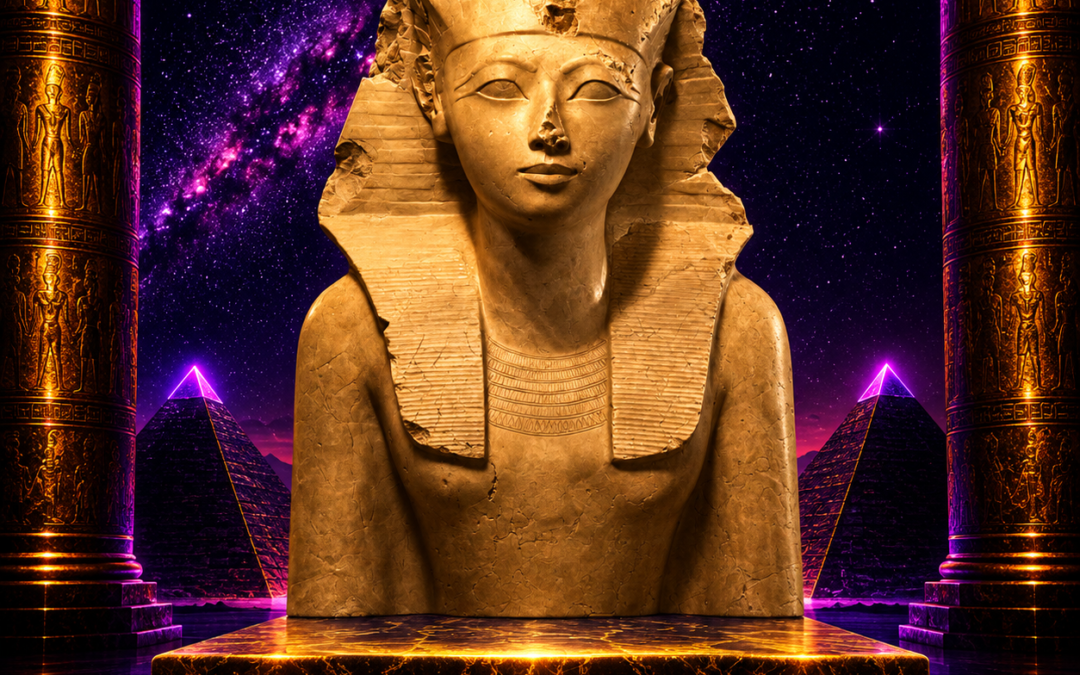
Few rulers of ancient Egypt have a story as extraordinary as Hatshepsut. Rising from royal wife to one of Egypt’s most powerful pharaohs, Hatshepsut challenged traditional expectations of kingship and presided over a period remembered for monumental construction, international trade, and prosperity.
Rather than building her legacy primarily through military conquest, Hatshepsut invested heavily in temples, monuments, commerce, and the religious institutions that supported her authority. Her reign left an architectural mark across Egypt, most famously at her spectacular mortuary temple at Dear el Bahri.
Centuries after attempts were made to remove her name and images from monuments, Hatshepsut has emerged as one of the most recognizable rulers of ancient Egypt.
Who Was Hatshepsut?
Hatshepsut was a ruler of Egypt’s 18th Dynasty during the New Kingdom. She was the daughter of Pharaoh Thutmose I and Queen Ahmose and later became the principal wife of her half brother, Thutmose II.
After Thutmose II died, the throne passed to the young Thutmose III, his son by another woman named Iset. Because Thutmose III was still a child, Hatshepsut initially acted as regent.
Her position eventually changed dramatically.
Instead of remaining only a regent, Hatshepsut adopted the full titles and symbols of Egyptian kingship and became pharaoh. She ruled alongside Thutmose III as co ruler, although Hatshepsut appears to have been the dominant royal figure during much of this period.
Her reign as king is generally dated from approximately 1479 to 1458 BCE, although exact ancient Egyptian chronologies can vary.
How Hatshepsut Became Pharaoh
Hatshepsut's rise was remarkable, but she did not simply present herself as someone rejecting Egyptian royal traditions. Instead, she carefully worked within them.
Her monuments connected her kingship with divine authority and royal ancestry. At her mortuary temple, inscriptions and reliefs presented a divine birth narrative in which the god Amun was associated with her conception and future rule.
Hatshepsut also emphasized her relationship to her father, Thutmose I, strengthening the idea that she was his legitimate royal successor.
This combination of lineage, religion, ceremony, and royal imagery helped establish her authority.
Hatshepsut ultimately assumed the traditional fivefold royal titulary of an Egyptian king. Her throne name was Maatkare, commonly translated as “Maat is the Ka of Ra.”
Her use of Maat was particularly meaningful. In ancient Egyptian thought, Maat represented truth, justice, balance, harmony, and the proper order of the cosmos. Maintaining Maat was one of the pharaoh's most important responsibilities.
Why Did Hatshepsut Sometimes Appear as a Man?
One of the most fascinating aspects of Hatshepsut's reign is the way she was represented in Egyptian art.
Early images could depict her with a more traditionally feminine appearance. As her kingship developed, however, Hatshepsut was increasingly portrayed using the established visual language of Egyptian pharaohs.
Some statues show her with the nemes headdress, royal regalia, a masculine body, and the ceremonial false beard associated with kingship.
This does not necessarily mean Hatshepsut was attempting to conceal that she was female.
Egyptian royal art was highly symbolic. Pharaohs were depicted according to conventions designed to communicate divine authority, power, legitimacy, and eternal kingship rather than simply reproduce a ruler's everyday physical appearance.
Hatshepsut's changing representation can therefore be understood as part of her adoption of the traditional role of pharaoh.
Hatshepsut's Magnificent Temple at Dear el Bahri
Perhaps the greatest surviving monument associated with Hatshepsut is her mortuary temple at Dear el Bahri, near modern Luxor.
Known in ancient times as Djeser Djeseru, often translated as “Holy of Holies,” the temple was constructed against the dramatic cliffs on the western side of the Nile.
Its enormous terraces, colonnades, ramps, chapels, statues, and reliefs created one of the architectural masterpieces of the New Kingdom.
The temple was closely connected with the worship of Amun and Hatshepsut's mortuary cult. It also contained sacred spaces associated with other deities, including Hathor and Anubis.
Its walls preserve some of the most important visual records of Hatshepsut's reign.
The Famous Expedition to Punt
Among the most celebrated events depicted at Dear el Bahri is Hatshepsut's expedition to the mysterious land known to the Egyptians as Punt.
Punt had longstanding commercial connections with ancient Egypt. Scholars generally associate it with areas around the Red Sea and Horn of Africa, although its precise geographic boundaries remain debated.
Hatshepsut's reliefs depict ships traveling to Punt and returning with valuable commodities.
These included incense, myrrh, ebony, ivory, exotic animals, and other luxury goods.
Particularly remarkable are representations of living myrrh trees being transported back to Egypt.
The expedition was more than a commercial achievement. Its depiction on a royal monument communicated Hatshepsut's ability to obtain valuable resources from distant lands and maintain Egypt's international connections.
For modern historians, the Punt reliefs also provide extraordinary evidence of ancient Egyptian ships, commerce, geography, diplomacy, and interactions with neighboring African regions.
Hatshepsut's Massive Building Program
Hatshepsut was one of the New Kingdom's great builders.
Her construction projects appeared throughout Egypt, but Karnak Temple became an especially important center of her royal activity.
She commissioned enormous obelisks dedicated to Amun. One of her obelisks at Karnak remains standing today and is among the most recognizable monuments associated with her reign.
Hatshepsut proudly commemorated these projects in inscriptions.
Building temples was not simply an act of personal ambition. Egyptian kings used construction to honor the gods, demonstrate royal legitimacy, celebrate political achievements, preserve their names, and participate symbolically in maintaining cosmic order.
Hatshepsut understood the extraordinary power of monumental architecture.
Thousands of years later, her monuments are still accomplishing what Egyptian royal architecture was designed to do.
They preserve the memory of the king.
Hatshepsut and the God Amun
Religion played a central role in Hatshepsut's kingship.
The cult of Amun, particularly Amun Ra, had become increasingly influential during the New Kingdom. Hatshepsut strongly associated herself with the deity and invested heavily in his religious institutions.
Her monuments described divine support for her rule and emphasized her special relationship with Amun.
This connection helped reinforce her legitimacy.
The relationship between Egyptian religion and political authority was deeply intertwined. Pharaoh was not simply a political leader in the modern sense. Egyptian kingship carried sacred responsibilities involving the gods, temples, offerings, Maat, and the preservation of cosmic order.
Hatshepsut presented herself as fully capable of performing these responsibilities.
Hatshepsut's relationship with Thutmose III is sometimes portrayed as a dramatic struggle for the throne, but the surviving evidence presents a more complicated picture.
Thutmose III remained king during Hatshepsut's reign and appeared with her on monuments. He was not simply removed from royal life.
After Hatshepsut's death, Thutmose III became the sole ruler and eventually developed a reputation as one of ancient Egypt's most successful military pharaohs.
Years later, however, something unusual happened.
Images and names of Hatshepsut began to disappear.
Why Was Hatshepsut Erased From History?
One of the greatest mysteries surrounding Hatshepsut concerns the destruction of her memory.
Her names were removed from certain monuments. Statues were damaged, altered, buried, or destroyed. Images of Hatshepsut were chiseled away in selected locations.
For many years, this destruction encouraged a dramatic interpretation: Thutmose III hated his stepmother and sought revenge after finally gaining control.
Modern scholarship has made that explanation considerably less certain.
Importantly, much of the campaign against Hatshepsut appears to have occurred years after her death, rather than immediately afterward.
This delayed timing has encouraged historians to consider political and dynastic explanations.
One possibility is that removing Hatshepsut from the official sequence of kings helped reinforce a conventional male line of succession, particularly as Thutmose III prepared the future succession of his son Amenhotep II.
The exact motivations remain debated.
What is clear is that the destruction was selective and significant enough to obscure Hatshepsut's unusual kingship for centuries.
Rediscovering the Female Pharaoh
The attempt to diminish Hatshepsut's royal identity ultimately failed.
Archaeologists and Egyptologists gradually reconstructed her history through surviving inscriptions, statues, temples, reliefs, and archaeological discoveries.
Her monuments revealed something extraordinary.
The apparently male king represented on some monuments and the royal woman Hatshepsut were the same ruler.
Modern archaeological work at Dear el Bahri and other locations has continued to reveal information about her reign, officials, religious program, architecture, and royal identity.
Today, Hatshepsut has reclaimed her place among the most important rulers of ancient Egypt.
The Mystery of Hatshepsut's Mummy
The identification of Hatshepsut's mummy has generated considerable attention and debate.
In 2007, Egyptian authorities announced that a female mummy from tomb KV60 in the Valley of the Kings had been identified as Hatshepsut. The proposed identification involved archaeological evidence and comparisons involving a tooth reportedly associated with Hatshepsut.
The identification became widely publicized, but scholars have continued to discuss the strength of the evidence.
Because ancient remains present difficult archaeological and scientific challenges, conclusions surrounding royal mummy identification should be treated carefully when evidence remains disputed.
The continuing investigation illustrates how archaeology can transform our understanding of individuals who lived more than three thousand years ago.
What Did Hatshepsut Accomplish?
Hatshepsut's reign demonstrates that political power in ancient Egypt could sometimes operate beyond the expectations we might assume existed in the ancient world.
Her accomplishments included extensive monumental construction, temple restoration and expansion, international commerce, religious patronage, and the strengthening of royal institutions.
She also created one of the most distinctive presentations of kingship in Egyptian history.
Rather than abandoning the institution because its imagery had traditionally been masculine, Hatshepsut adapted herself to its symbols while simultaneously preserving references to her identity as a woman.
That makes her reign especially valuable for understanding how ancient Egyptians conceptualized gender, political authority, religion, and kingship.
Hatshepsut's Powerful Legacy
Hatshepsut ruled more than three thousand years ago, yet her story remains remarkably compelling.
She inherited a political situation in which she was expected to serve as regent for a young king. She ultimately transformed that position into full pharaonic authority.
She constructed monumental temples.
She raised enormous obelisks.
She celebrated expeditions to distant lands.
She presented herself as chosen by the gods.
And when later generations attempted to remove portions of her royal identity from Egypt's monuments, enough evidence survived for history to reconstruct her remarkable reign.
Hatshepsut's story is therefore not simply the story of a female ruler.
It is the story of power, legitimacy, transformation, memory, and survival in one of the world's most influential ancient civilizations.
Her monuments still rise above the Egyptian landscape, reminding the world that even an attempted erasure could not completely silence one of ancient Egypt's most extraordinary pharaohs.
Frequently Asked Questions About Hatshepsut
Was Hatshepsut really a pharaoh?
Yes. Hatshepsut adopted the full titles, regalia, and political and religious responsibilities associated with Egyptian kingship. She ruled as pharaoh during Egypt's 18th Dynasty.
Was Hatshepsut the first female pharaoh?
No. Women ruled Egypt before Hatshepsut. Earlier female rulers included Sobekneferu of the 12th Dynasty. Hatshepsut is significant because of the length, prosperity, monumental scale, and documentation of her reign.
Why did Hatshepsut wear a false beard?
The ceremonial beard was part of traditional Egyptian royal iconography. Hatshepsut's use of masculine royal symbols represented her status as pharaoh rather than necessarily an attempt to disguise her sex.
What is Hatshepsut most famous for?
Hatshepsut is especially famous for becoming pharaoh, her monumental building projects, her mortuary temple at Dear el Bahri, her obelisks at Karnak, and the celebrated trading expedition to Punt.
Who ruled after Hatshepsut?
Thutmose III, who had technically ruled alongside Hatshepsut, became the sole pharaoh following her death.
Why was Hatshepsut's name erased?
Parts of Hatshepsut's royal imagery and names were deliberately removed after her death. Scholars continue to debate the precise motivation, although dynastic succession and the desire to reshape the official royal lineage are important explanations.
Final Thoughts
Hatshepsut remains one of the most fascinating figures in the history of ancient Kemet.
Her reign reveals a civilization in which political authority, divine legitimacy, architecture, trade, symbolism, and remembrance were deeply interconnected.
Attempts to erase her could damage stone, remove names, and destroy statues.
They could not erase her completely.
More than three millennia later, Hatshepsut stands again among the great pharaohs of ancient Egypt, her temple beneath the cliffs of Dear el Bahri serving as one of the most spectacular surviving monuments to her reign.
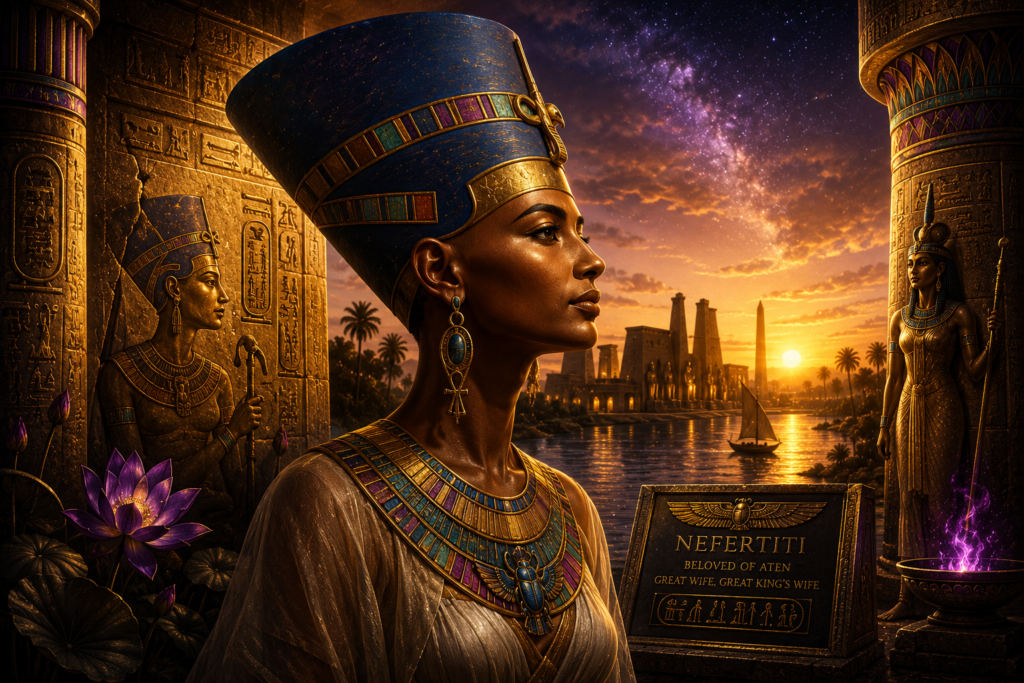
Few figures from ancient Egypt command the imagination quite like Queen Nefertiti. Her famous painted limestone bust has become one of the most recognizable images from the ancient world, yet the woman behind that celebrated face remains surrounded by unanswered questions.
Nefertiti was far more than a symbol of beauty. As the Great Royal Wife of Pharaoh Akhenaten, she occupied an extraordinary position during one of the most dramatic religious and political transformations in Egyptian history. Images from the Amarna Period portray her participating in rituals, appearing alongside the king and even striking Egypt's enemies, visual roles that reveal an exceptionally powerful queen.
Her life unfolded during the 18th Dynasty of Egypt's New Kingdom, an era associated with immense wealth, monumental building projects, international diplomacy and some of Egypt's most famous rulers.
But Nefertiti's story eventually becomes a mystery.
Her prominence in the historical record changes dramatically toward the later years of Akhenaten's reign, and scholars continue to debate what happened to her. Did she die? Did she adopt another royal name? Could she have become a co-regent—or even ruled Egypt herself?
The surviving evidence offers fascinating clues, but no universally accepted answer.
Who Was Queen Nefertiti?
Nefertiti was the Great Royal Wife of Pharaoh Akhenaten, originally known as Amenhotep IV. She lived during the 14th century BCE and became one of the most prominent royal women of ancient Egypt.
Her name is commonly translated as "The Beautiful One Has Come."
Despite her fame, Nefertiti's origins remain uncertain. Scholars have proposed several theories regarding her parentage, but no surviving evidence has conclusively identified her parents.
One frequently discussed possibility connects her with Ay, an influential court official who later became pharaoh following the reign of Tutankhamun. However, Nefertiti's precise relationship to Ay remains uncertain.
What is much clearer is that Nefertiti rose to extraordinary prominence beside Akhenaten.
Rather than appearing merely as a royal companion, she became an active participant in the revolutionary religious world created during her husband's reign.
Nefertiti and Pharaoh Akhenaten
Amenhotep IV inherited an Egypt whose religious traditions included a vast pantheon of deities and powerful temple institutions.
During his reign, however, the king increasingly elevated the Aten, represented by the radiant solar disk. He eventually changed his name from Amenhotep IV to Akhenaten, reflecting his devotion to the Aten.
Nefertiti was deeply integrated into this transformation.
Together, Akhenaten and Nefertiti became the royal faces of Aten-centered worship.
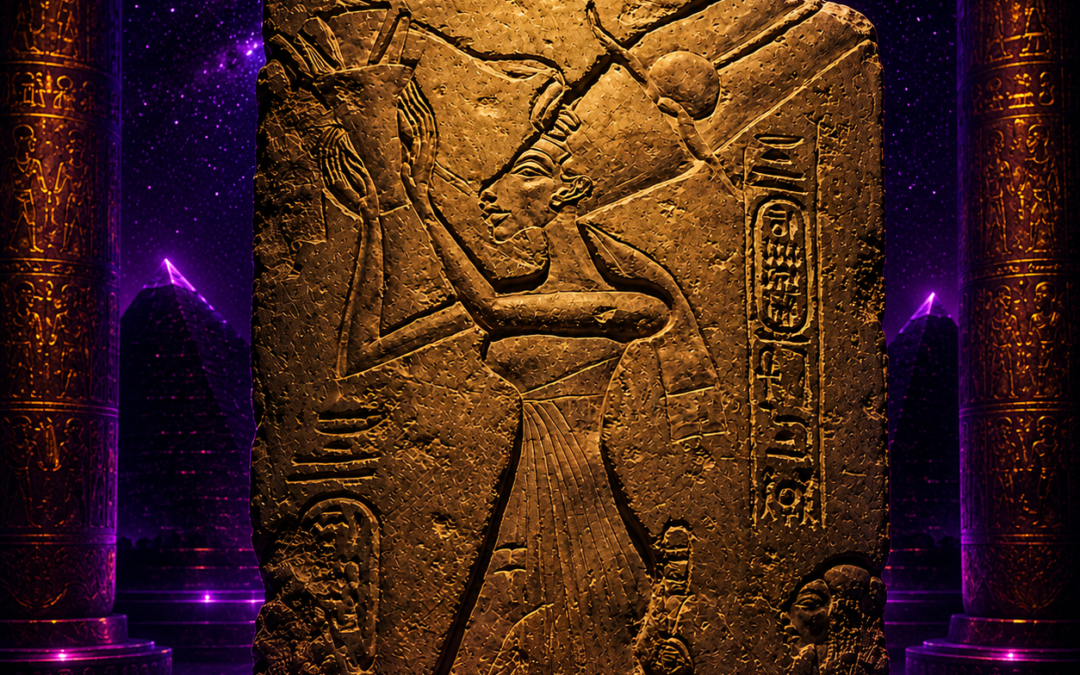
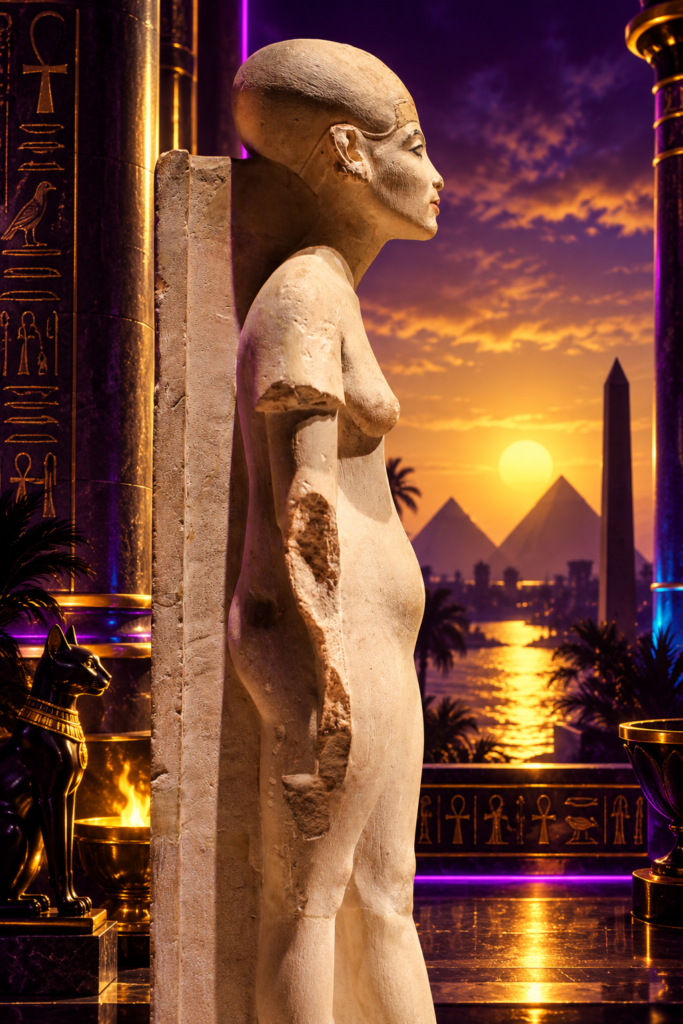
Egyptian art frequently depicts the royal couple beneath the rays of the Aten. The rays often terminate in tiny hands, some holding the ankh, the ancient Egyptian symbol of life, toward the royal family's faces.
These scenes communicate an important theological message: the king and queen occupied a privileged position between the Aten and the people of Egypt.
Nefertiti was therefore not simply standing beside Akhenaten.
She was an essential participant in the religious ideology of the Amarna court.
The Rise of Akhetaten
Akhenaten eventually established a new royal capital called Akhetaten, meaning approximately "Horizon of the Aten."
Today, the archaeological site is known as Amarna.
The city represented an extraordinary break from established royal traditions. Temples, palaces, administrative buildings, residences and workshops emerged in a landscape selected for the new religious center.
Nefertiti's presence appears throughout the surviving artistic program of this city.
She participated in ceremonies and offerings and was repeatedly represented with Akhenaten and their daughters beneath the Aten.
These images provide an unusually intimate glimpse into an ancient Egyptian royal household.
Nefertiti Was More Than a Queen Consort
One of the most fascinating aspects of Nefertiti's legacy is the exceptional power expressed through her imagery.
Ancient Egyptian royal art was highly symbolic. The size, clothing, crowns and actions of figures could communicate political and religious authority.
Nefertiti appears in contexts traditionally associated with kingship.
Most dramatically, surviving imagery depicts her smiting an enemy, a pose deeply connected with pharaonic power and the king's role in defeating disorder and preserving Ma'at, the principle of cosmic and social order.
For a queen to assume such imagery was significant.
Nefertiti was also represented performing offerings to the Aten and wearing an impressive variety of crowns and royal regalia.
Her visual presence suggests that her position within Akhenaten's new religious order exceeded the conventional image of a royal wife.
Exactly how much formal political authority she possessed remains debated, but the surviving evidence makes one conclusion difficult to ignore:
Nefertiti was one of the most visibly powerful royal women of ancient Egypt.
Nefertiti and the Aten
The religious changes of Akhenaten's reign are sometimes described as the world's first monotheistic revolution.
The historical reality is more complicated.
Akhenaten's religious program placed unprecedented emphasis on the Aten, while traditional cults—most famously that of Amun—were severely diminished. Whether Atenism should be classified as strict monotheism, monolatry or another form of exclusive royal worship continues to be debated.
What is certain is that the Aten became overwhelmingly dominant within official royal ideology.
Nefertiti played a central role in that system.
Representations of the royal family suggest that access to the Aten's divine power was closely associated with Akhenaten and Nefertiti themselves.
This gave the queen an extraordinary religious significance.
The Children of Nefertiti
Nefertiti and Akhenaten are generally understood to have had six daughters:
Meritaten
Meketaten
Ankhesenpaaten
Neferneferuaten Tasherit
Neferneferure
Setepenre
Their daughters frequently appear in Amarna artwork with their parents.
These depictions are remarkable because they often show affectionate interactions uncommon in earlier formal Egyptian royal art.
One famous scene portrays Akhenaten and Nefertiti seated with their daughters beneath the Aten. The children sit on their parents' laps while the rays of the solar disk extend toward the family.
Whether these scenes represent ordinary family life or primarily communicate religious symbolism, they give Amarna art a distinctive sense of intimacy.
One daughter, Ankhesenpaaten, would later become better known as Ankhesenamun, the wife of Pharaoh Tutankhamun.
The Famous Bust of Nefertiti
No discussion of Queen Nefertiti is complete without the extraordinary bust that transformed her into a global icon.
The painted limestone bust was discovered in 1912 at Amarna by a German archaeological expedition led by Ludwig Borchardt. It was found in the workshop associated with the sculptor Thutmose.
The sculpture presents Nefertiti wearing her distinctive tall blue crown.
Its symmetry, elegant proportions, preserved pigments and refined craftsmanship helped make it one of the world's most famous surviving works of ancient Egyptian art.
Today, the bust is housed in the Neues Museum in Berlin.
Its fame has strongly shaped modern perceptions of Nefertiti. Yet concentrating solely on her beauty risks obscuring the most compelling aspect of her story.
Nefertiti was not important because she was beautiful.
She was important because she stood near the center of one of the greatest religious and political transformations in ancient Egyptian history.
The Mystery of Nefertiti's Disappearance
One of the greatest mysteries surrounding Nefertiti concerns what happened during the final years of Akhenaten's reign and its immediate aftermath.
Older interpretations often suggested that Nefertiti suddenly disappeared from the historical record and may have died around the middle of Akhenaten's reign.
Later archaeological and inscriptional evidence complicated that picture.
An inscription dated to Year 16 of Akhenaten's reign refers to Nefertiti as the king's Great Royal Wife, demonstrating that she remained alive and retained her title considerably later than some earlier theories proposed.
But what happened afterward remains uncertain.
Her eventual fate has generated several competing theories.
Did Nefertiti Become Pharaoh?
This is one of the most intriguing questions in Egyptology.
Following Akhenaten, the succession is difficult to reconstruct. Royal figures including Smenkhkare and Neferneferuaten appear in the evidence surrounding the end of the Amarna Period.
Some scholars have proposed that Nefertiti adopted the name Neferneferuaten and ruled as a co-regent or pharaoh.
There are reasons the theory remains compelling.
Nefertiti had already been represented with unusual royal authority. She possessed enormous religious prominence, and a female ruler named Neferneferuaten appears in evidence associated with the succession.
But identifying this ruler conclusively as Nefertiti remains difficult.
Other interpretations have connected Neferneferuaten with different members of the royal family.
Therefore, statements that Nefertiti definitely became pharaoh go beyond what surviving evidence can currently establish.
A more historically responsible conclusion is:
Nefertiti may have exercised pharaonic authority late in the Amarna Period, but whether she formally ruled Egypt as pharaoh remains an unresolved scholarly debate.
That uncertainty is part of what makes her story so fascinating.
Nefertiti and King Tutankhamun
Nefertiti's story is also intertwined with that of Tutankhamun.
Tutankhamun was born during the Amarna Period and originally bore the name Tutankhaten, meaning "Living Image of Aten."
His exact maternal relationship to Nefertiti has been the subject of considerable discussion, but current genetic and archaeological interpretations generally do not identify Nefertiti securely as his mother.
Tutankhamun nevertheless became connected to Nefertiti's family through his marriage to her daughter Ankhesenpaaten.
After Akhenaten's death, Egypt gradually moved away from Aten-centered royal religion.
Tutankhaten became Tutankhamun, signaling the restoration of Amun's prominence.
The royal court eventually abandoned Akhetaten, and traditional temples and religious institutions were restored.
The revolutionary world in which Nefertiti had held such extraordinary prominence was being dismantled.
The Amarna Artistic Revolution
Nefertiti's reign also coincided with one of the most recognizable artistic periods in Egyptian history.
Amarna art frequently departed from the idealized conventions familiar from other periods.
Akhenaten could be depicted with an elongated face, narrow chest, prominent abdomen and broad hips. Members of the royal family sometimes appear with elongated skulls and highly stylized features.
Scholars have debated the meaning of these unusual representations for generations.
Some earlier interpretations attempted to diagnose Akhenaten with medical conditions based on the artwork. Such conclusions are highly uncertain because Egyptian royal art was symbolic and ideological rather than straightforward portrait photography.
The artistic changes may instead reflect the distinctive theology and ideology of Akhenaten's court.
Nefertiti herself appears in multiple artistic forms—from highly refined idealized portraits to more stylized Amarna representations.
Her famous bust demonstrates the exceptional sophistication of royal artistic workshops during this era.
What Happened to Nefertiti's Tomb?
Another major mystery remains unresolved:
Where was Queen Nefertiti buried?
No tomb universally accepted as Nefertiti's final burial place has been identified.
Because members of Akhenaten's royal family were associated with the Royal Tomb at Amarna, it is possible that plans existed for her burial there.
But the abandonment of Akhetaten and the political upheaval following Akhenaten's death make reconstructing events extremely difficult.
Researchers have also investigated theories that Nefertiti might have been buried elsewhere, including controversial proposals involving hidden spaces near Tutankhamun's tomb in the Valley of the Kings.
To date, no discovery has conclusively revealed Nefertiti's burial place or securely identified her mummy.
Her missing tomb remains one of ancient Egypt's most captivating archaeological mysteries.
The Fall of the Amarna Revolution
The religious revolution associated with Akhenaten and Nefertiti did not survive for long after their era.
Traditional Egyptian religious institutions returned to prominence, especially the cult of Amun.
Akhetaten was largely abandoned.
Later rulers also attempted to distance themselves from the Amarna kings. Akhenaten's monuments were dismantled, and his name and images were attacked or omitted from later royal records.
This deliberate suppression makes reconstructing the period particularly difficult.
Ironically, attempts to erase the Amarna royal family helped create one of archaeology's greatest historical puzzles.
Thousands of years later, Akhenaten, Nefertiti and Tutankhamun are among the most recognizable figures from ancient Egypt.
Nefertiti's Legacy
Nefertiti's legacy extends far beyond her celebrated portrait.
She represents a remarkable moment when religious authority, royal power, artistic experimentation and political transformation converged.
She was a Great Royal Wife, a prominent participant in Aten worship, the mother of royal daughters and possibly an even more powerful political figure during the final years of the Amarna Period.
Her story also reminds us of an important principle when exploring ancient history:
absence of evidence does not automatically provide evidence for a dramatic conclusion.
There are things we know about Nefertiti.
There are things scholars can reasonably infer.
And there are mysteries that ancient Egypt has not yet surrendered.
That distinction makes the real Nefertiti even more compelling than legend.
Why Queen Nefertiti Still Fascinates the World
More than three thousand years after she lived, Nefertiti remains instantly recognizable.
Part of that fascination comes from the beauty of her famous bust, but the deeper attraction lies in the unanswered questions surrounding her life.
Who were her parents?
How much political authority did she possess?
What happened after the final years of Akhenaten?
Was she the female ruler Neferneferuaten?
Where is her tomb?
And could archaeological discoveries still be waiting to rewrite her story?
Every inscription and artifact recovered from the Amarna Period has the potential to alter our understanding of one of ancient Egypt's most enigmatic royal figures.
Nefertiti stands at the intersection of power, religion, art, family and mystery.
She was not merely the beautiful queen beside Akhenaten.
She was one of the defining figures of the Amarna revolution and possibly one of the most powerful women ever to occupy Egypt's royal court.
Queen Nefertiti: Beauty, Power and an Unfinished Story
Nefertiti's famous face has survived the centuries, but much of her story remains hidden.
She witnessed, and helped represent, a radical transformation of Egyptian religion. She appeared in imagery displaying exceptional royal authority. Her daughters became part of Egypt's dynastic succession, and her family stood at the center of events that reshaped the New Kingdom.
Then the historical trail becomes frustratingly incomplete.
Perhaps future discoveries will reveal Nefertiti's tomb, identify her remains or finally establish whether she ruled Egypt after Akhenaten.
Until then, Queen Nefertiti remains one of ancient Egypt's greatest mysteries, a royal woman whose extraordinary power may have been every bit as remarkable as the beauty that made her immortal.
Thousands of years before the rise of many celebrated physicians, architects, and scholars of the classical world, Imhotep of ancient Egypt emerged as one of history’s most extraordinary intellectual figures.
Living during Egypt’s Third Dynasty, around the 27th century BCE, Imhotep served under Pharaoh Djoser and became associated with architecture, royal administration, scholarship, and healing. His reputation became so great that generations of Egyptians continued to honor him long after his death. Eventually, he was revered as a divine patron connected with medicine and healing.
Today, Imhotep is widely remembered as the brilliant mind associated with the Step Pyramid of Djoser at Saqqara, one of the earliest monumental stone structures in the world.
But Imhotep’s story extends far beyond a single pyramid.
His legacy provides a remarkable window into the intellectual achievements of ancient Kemet, demonstrating the sophisticated knowledge that flourished along the Nile thousands of years ago.
Who Was Imhotep?
Imhotep was an ancient Egyptian official who lived during the reign of Pharaoh Djoser, traditionally dated to approximately 2630–2611 BCE.
His Egyptian name is commonly interpreted as meaning “He Who Comes in Peace.”
Unlike Egypt's kings and queens, Imhotep was not born into the royal line, at least according to surviving evidence. Yet he rose to an extraordinarily influential position within Djoser’s administration.
One of the most important pieces of evidence for the historical Imhotep comes from the base of a statue of Djoser discovered at Saqqara. The inscription identifies Imhotep with several prestigious titles, including roles associated with royal authority and craftsmanship.
This inscription is particularly important because it demonstrates that Imhotep was a historical person rather than merely a legendary figure.
His extraordinary reputation, however, would grow dramatically over the centuries.
Imhotep and Pharaoh Djoser
Imhotep's name is inseparable from Pharaoh Djoser, one of the most important rulers of Egypt's Third Dynasty.
Djoser's reign represented an important period in the development of Egyptian royal architecture. During this era, Egypt possessed an organized central government capable of mobilizing skilled craftspeople, administrators, laborers, engineers, and enormous quantities of resources.
Imhotep occupied a high position within this system.
He is traditionally credited with overseeing the revolutionary funerary complex constructed for Djoser at Saqqara.
At the heart of this complex stood a monument that would transform architecture forever:
the Step Pyramid.
Imhotep and the Step Pyramid of Djoser
The Step Pyramid of Djoser is one of the great landmarks of world architecture.
Before the Step Pyramid, elite Egyptian tombs were commonly constructed in a rectangular form known today as a mastaba.
Djoser's monument dramatically expanded this concept.
The pyramid ultimately consisted of six progressively smaller levels, creating the distinctive stepped structure that still dominates the Saqqara landscape.
Rising roughly 60 meters (197 feet), the monument became the centerpiece of an enormous ceremonial complex.
What made the project especially revolutionary was its extensive use of cut stone on a monumental scale.
The surrounding complex contained courtyards, ceremonial structures, shrines, passages, columns, walls, and underground chambers. Together they demonstrated a remarkable level of architectural planning and craftsmanship.
Imhotep's association with this project helped establish his enduring reputation as one of history's earliest named architectural figures.
The Step Pyramid also became an important predecessor to the later pyramid-building traditions that produced the monumental pyramids of Egypt's Old Kingdom.
Was Imhotep Really the World's First Architect?
Imhotep is frequently described as the world's first recorded architect.
That description requires some nuance.
People had obviously designed and constructed sophisticated buildings long before Imhotep. What makes him exceptional is that his name survived in association with a monumental architectural project from an extraordinarily early period of recorded history.
For this reason, he occupies a unique position in architectural history.
His legacy reminds us that architecture in ancient Egypt involved far more than physical labor. Monumental projects required geometry, organization, material knowledge, logistics, surveying, craftsmanship, administration, and long-term planning.
The Step Pyramid complex stands as enduring evidence of this sophisticated intellectual and technical environment.
Dr. Imhotep: Was Imhotep the First Doctor?
Imhotep is also popularly called “Dr. Imhotep” and is frequently described as the first physician in recorded history.
The historical reality is more complicated, and even more interesting.
There is strong evidence that Imhotep became closely associated with medicine and healing in later Egyptian tradition. However, surviving contemporary evidence from Djoser's reign does not directly document him practicing medicine.
His reputation as a healer developed particularly strongly centuries after his lifetime.
Eventually, Egyptians revered Imhotep as a divine patron of healing, and people sought his assistance in matters of illness and health.
Therefore, it is more historically accurate to say that Imhotep became one of the earliest named historical figures strongly associated with medicine, rather than claiming with certainty that surviving evidence proves he personally practiced medicine as a physician during Djoser's reign.
That distinction does not diminish his importance.
In fact, the transformation of a historical official into a revered figure of healing demonstrates just how extraordinary his reputation became.
Medicine in Ancient Egypt
The civilization in which Imhotep lived developed a sophisticated tradition of medicine.
Ancient Egyptian medical practitioners observed injuries, diagnosed illnesses, prepared medicines, performed treatments, and recorded medical knowledge.
Several surviving Egyptian medical papyri reveal this advanced tradition.
Among the most famous is the Edwin Smith Papyrus, a medical document containing descriptions of injuries and methods of examination, diagnosis, treatment, and prognosis.
Although the surviving manuscript dates much later than Imhotep's lifetime, portions of its medical knowledge may derive from considerably older traditions.
The text is especially notable because many of its cases demonstrate careful physical observation.
Another important document, the Ebers Papyrus, preserves hundreds of remedies and discussions concerning illnesses and treatments.
These documents reveal a medical tradition that could combine empirical observation with religious and magical understandings of illness, approaches that were not considered mutually exclusive within ancient Egyptian culture.
Did Imhotep Write the Edwin Smith Papyrus?
A popular claim sometimes attributes the Edwin Smith Papyrus directly to Imhotep.
There is currently no conclusive evidence proving that he wrote it.
The surviving manuscript dates to approximately the 17th century BCE, more than a thousand years after Imhotep lived.
Scholars believe parts of the material may preserve traditions originating much earlier, but identifying Imhotep as the original author goes beyond what the surviving evidence can establish.
This is an important distinction because Imhotep's documented achievements and later reputation are remarkable enough without turning uncertain traditions into historical facts.
Understanding ancient Kemet requires separating evidence from later legend while appreciating both.
Imhotep as a Scholar and Royal Official
Imhotep was much more than an architect in later Egyptian memory.
He became associated with wisdom, writing, scholarship, and learning.
As a high-ranking official serving Djoser, he would have operated within Egypt's educated administrative elite.
Ancient Egyptian government depended heavily upon scribes.
Writing allowed officials to manage taxation, agricultural production, construction projects, religious institutions, royal decrees, inventories, and the distribution of resources.
Literacy was therefore closely connected with administrative power and intellectual prestige.
Later generations remembered Imhotep as an idealized sage, a person whose wisdom represented the highest traditions of Egyptian learning.
Imhotep's Connection to Ptah
Imhotep's later religious importance was closely associated with Ptah, the great creator deity and patron of craftspeople centered at Memphis.
In later tradition, Imhotep was regarded as the son of Ptah, strengthening his connections with craftsmanship, creation, knowledge, and intellectual ability.
This association was particularly meaningful because Memphis was an enormously important political and religious center.
Ptah was closely connected with craftspeople and creative power. Linking Imhotep with Ptah therefore elevated the famous architect and sage into a sacred intellectual lineage.
Imhotep was no longer remembered merely as a government official.
He became a symbol of divinely inspired wisdom.
How Imhotep Became a God
One of the most fascinating aspects of Imhotep's story is what happened after his death.
Most officials of ancient Egypt disappeared from popular memory over the centuries.
Imhotep did not.
His reputation continued to grow.
Approximately two thousand years after his lifetime, he received full divine worship and was increasingly revered as a god of medicine and healing.
People appealed to him for cures and divine assistance.
Temples and sacred spaces associated with his worship attracted individuals seeking healing, and offerings were dedicated in his honor.
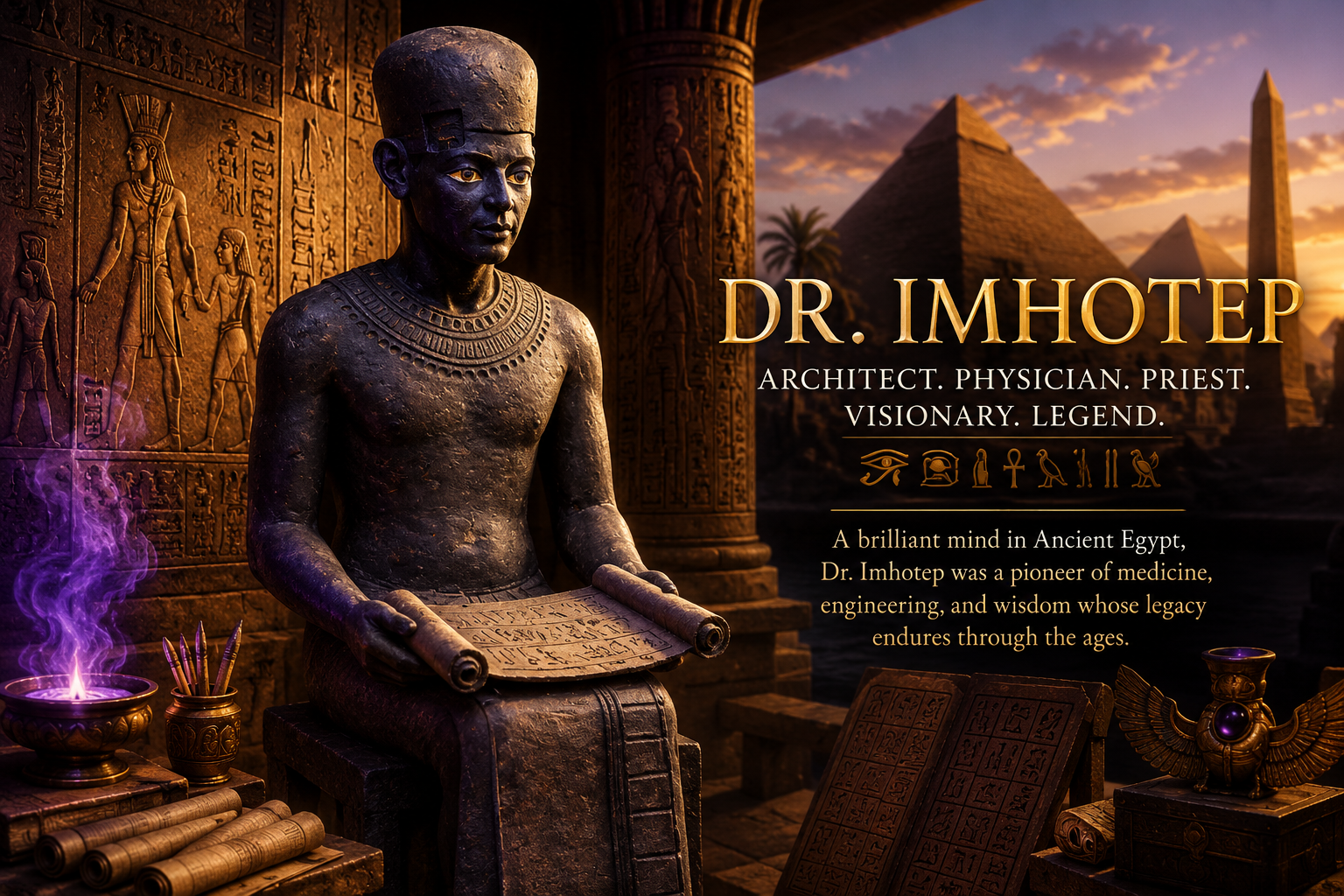
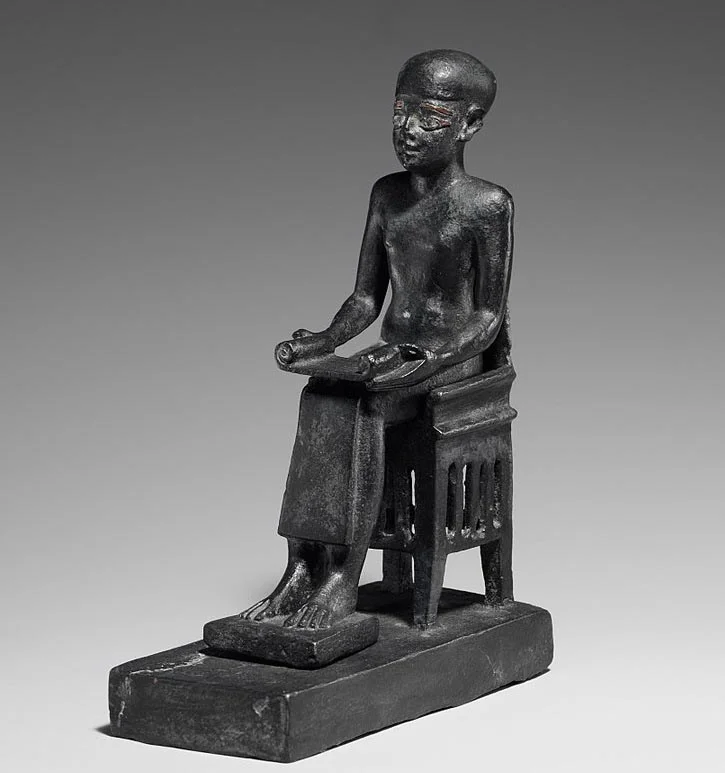
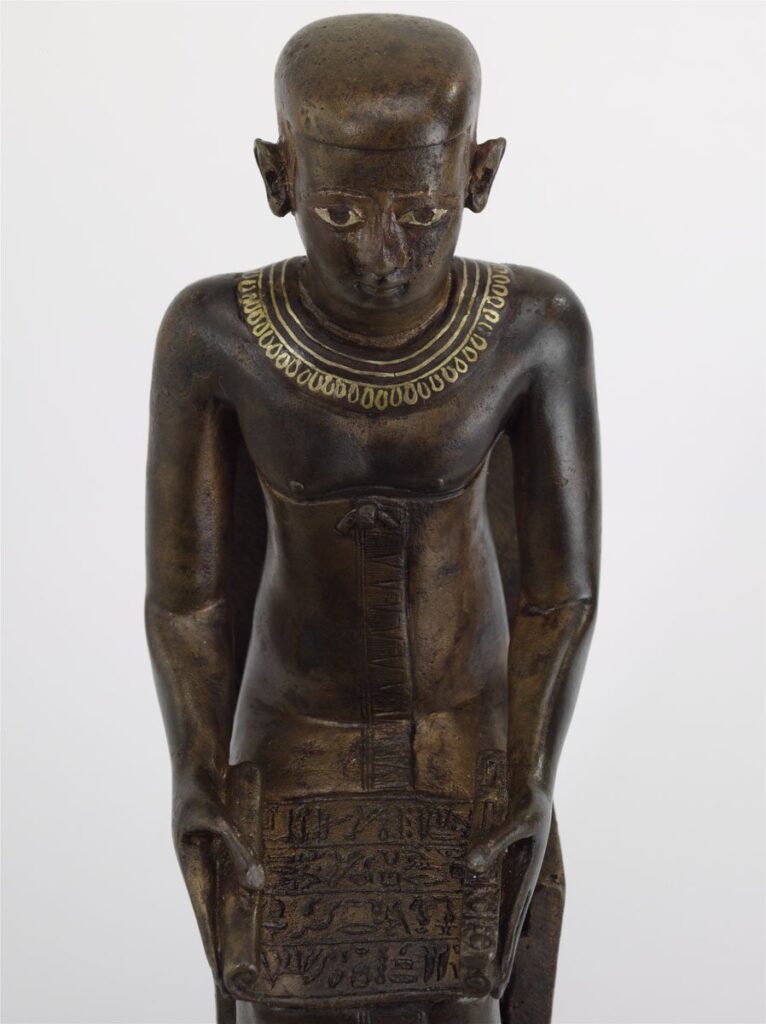
Small bronze statuettes frequently depicted Imhotep seated with a papyrus scroll across his lap—an image emphasizing his identity as a scholar and source of wisdom.
Few individuals in Egyptian history experienced such an extraordinary transformation from historical person to deity.
Imhotep and Asclepius
When Greek culture became increasingly influential in Egypt, particularly during the Ptolemaic period, Greeks identified Imhotep with their healing deity Asclepius.
Both figures were strongly associated with medicine and healing.
This comparison demonstrates how far Imhotep's reputation had spread.
A man who had served an Egyptian king during the third millennium BCE remained culturally significant more than two thousand years later.
His identity had evolved from royal official and architect to legendary sage, healer, and ultimately divine figure.
Was Imhotep African?
Yes.
Imhotep lived in ancient Egypt, in northeastern Africa, and was a product of the civilization that developed along the African Nile Valley.
This geographic reality matters when discussing the history of ancient Egypt.
Egypt was deeply connected with neighboring African regions through migration, trade, diplomacy, cultural exchange, warfare, religion, and movement along the Nile.
Imhotep therefore belongs within the history of ancient Africa as well as the broader history of world civilization.
Recognizing ancient Egypt's African geography does not require simplifying the complex identities of people who lived there thousands of years ago. Instead, it places Egyptian civilization within its proper geographic and historical environment.
What Did Imhotep Look Like?
No securely identified portrait created during Imhotep's lifetime is known to survive.
Most familiar representations of him were produced many centuries after his death.
Later Egyptian statues commonly depict Imhotep as a seated man wearing a close-fitting cap and holding an open papyrus scroll.
These images were religious representations rather than verified portraits of his physical appearance.
Therefore, modern artistic reconstructions of Imhotep, including paintings, sculptures, films, and digital artwork—should be understood as interpretations rather than confirmed likenesses.
Where Is Imhotep Buried?
One of ancient Egypt's great archaeological mysteries is the location of Imhotep's tomb.
Despite his enormous historical importance, his burial place has never been conclusively identified.
Because of his association with Djoser and Saqqara, archaeologists have long suspected that Imhotep may have been buried somewhere within the wider Saqqara necropolis.
Numerous archaeological investigations have attempted to uncover evidence connected with his burial.
Yet no tomb has been definitively proven to belong to him.
Finding Imhotep's burial place would be an extraordinary archaeological discovery and could potentially reveal new information about one of ancient Egypt's most celebrated individuals.
Imhotep: A Genius of Ancient Kemet
More than 4,500 years after his lifetime, Imhotep remains one of the most fascinating figures of ancient Egypt.
He began as a royal official serving Pharaoh Djoser, became forever associated with one of history's most revolutionary architectural monuments, and ultimately entered Egyptian religious tradition as a divine patron of wisdom and healing.
His story occupies the fascinating boundary between history, archaeology, medicine, architecture, religion, and legend.
The Step Pyramid still rises above Saqqara.
Statues created centuries after his death still portray him studying a papyrus.
His name is still spoken around the world.
That extraordinary survival may be Imhotep's greatest monument of all.
More than four thousand years later, the genius of Imhotep continues to echo from ancient Kemet into the modern world.