
More than 5,000 years ago, along the fertile banks of the Nile, a ruler emerged whose reign became closely associated with one of the most important transformations in ancient Egyptian history: the political consolidation of Upper and Lower Egypt.
His name was Narmer.
King Narmer is one of the earliest rulers known from ancient Egypt and is traditionally placed near the beginning of the First Dynasty, around 3100 BCE. His name appears on some of the most significant artifacts surviving from Egypt's formative period, including the extraordinary Narmer Palette.
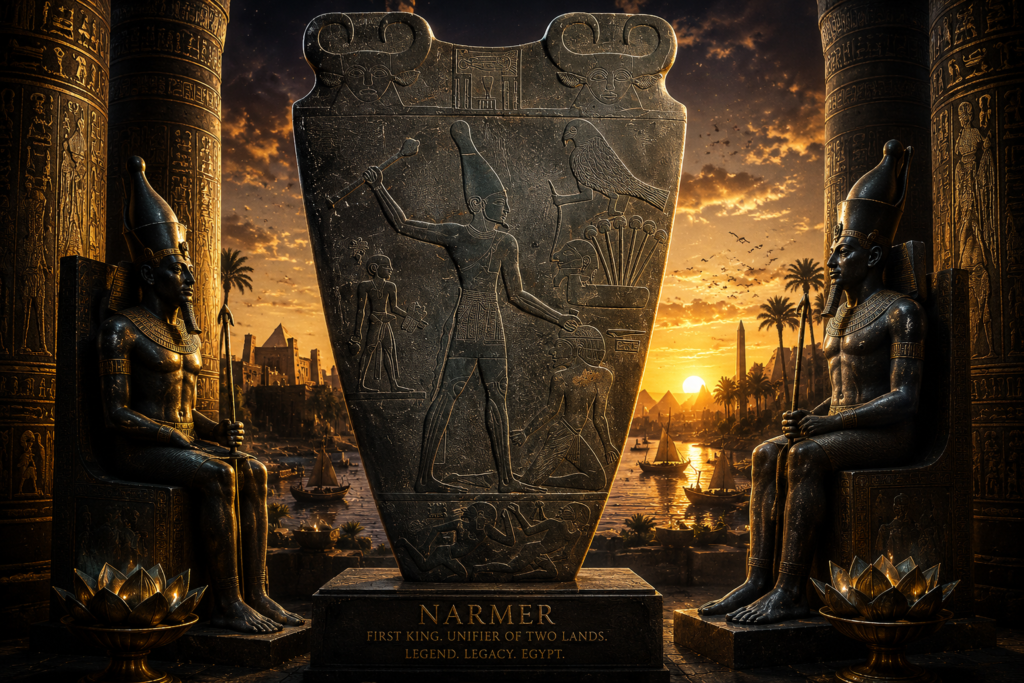
For generations, Narmer has been associated with the unification of Egypt and the establishment of the centralized kingship that would define ancient Egyptian civilization for thousands of years.
But who exactly was King Narmer? Did he truly unite Upper and Lower Egypt? Was Narmer the legendary Menes described by later Egyptian traditions? And what can archaeology actually tell us about this mysterious ruler?
The story of Narmer takes us back to the very beginning of dynastic Egypt.
Who Was King Narmer?
King Narmer was an early Egyptian ruler who lived around the transition between the Predynastic Period and Egypt's First Dynasty, approximately 3100 BCE.
He ruled during a period when communities throughout the Nile Valley were becoming increasingly interconnected and politically organized.
Before Egypt developed into the centralized kingdom familiar from later periods, the Nile Valley contained different settlements and regional centers of power. Over generations, increasingly powerful rulers based in southern Egypt expanded their influence northward.
Narmer appears near the culmination of this process.
His reign is therefore frequently associated with the emergence of the Egyptian state and the beginning of what historians call the Early Dynastic Period.
Narmer's name has been discovered at several archaeological sites, demonstrating that his authority or influence extended across a considerable geographic area.
Yet the most famous evidence connected to him comes from a ceremonial object discovered at Hierakonpolis, known today as the Narmer Palette.
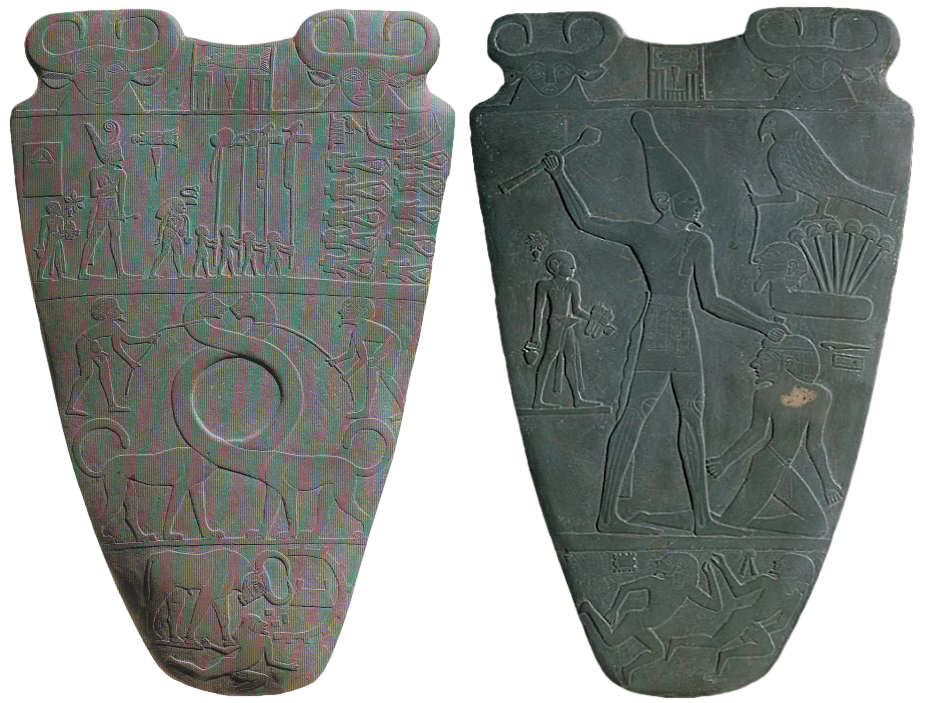
The Narmer Palette: An Extraordinary Window Into Early Egypt
Few ancient Egyptian artifacts are as important to our understanding of early kingship as the Narmer Palette.
Discovered in the late nineteenth century at Hierakonpolis in Upper Egypt, the ceremonial stone palette dates to around 3100 BCE.
Both sides contain intricately carved scenes centered on King Narmer.
On one side, Narmer appears wearing the White Crown, traditionally associated with Upper Egypt. He raises a mace over a kneeling captive while the falcon god Horus appears nearby.
On the opposite side, Narmer is depicted wearing the Red Crown, traditionally associated with Lower Egypt.
This combination is one of the primary reasons the palette has long been interpreted as evidence of Narmer's connection with the unification of Upper and Lower Egypt.
The imagery also reveals something profound about early Egyptian kingship.
Narmer is depicted much larger than the people surrounding him, a visual convention known as hierarchical scale. His enormous size communicates his elevated political and sacred status.
This artistic convention would remain a recognizable feature of Egyptian royal art for thousands of years.
Did King Narmer Unite Upper and Lower Egypt?
Narmer is commonly described as the ruler who unified Upper and Lower Egypt, creating one of the world's earliest centralized territorial states.
The traditional interpretation is compelling.
Narmer appears wearing the crowns associated with both regions on the Narmer Palette. The artifact also contains scenes of military victory and royal authority.
However, historians today generally treat Egyptian unification as more complicated than a single dramatic conquest.
Archaeological evidence suggests that political consolidation developed over generations. Rulers preceding Narmer, including kings associated with the late Predynastic period, were already expanding political and economic networks throughout the Nile Valley.
Narmer may therefore have completed, strengthened, or symbolized a process that had already been underway.
Rather than imagining Egypt becoming unified on a single day, it may be more accurate to see Narmer as one of the pivotal rulers in a long transformation that produced the dynastic Egyptian state.
Upper Egypt and Lower Egypt Explained
Understanding Narmer requires understanding one of the distinctive features of Egyptian geography.
Ancient Egypt was traditionally divided into two regions.
Upper Egypt was located in the south, extending along the Nile Valley toward the First Cataract.
Lower Egypt was located in the north, particularly around the broad Nile Delta.
The terminology may initially seem reversed. Upper Egypt is geographically south because it lies upstream, while Lower Egypt lies downstream toward the Mediterranean coast.
These two regions became central to Egyptian royal ideology.
Later pharaohs regularly presented themselves as rulers of the Two Lands, emphasizing the unity of Upper and Lower Egypt under one monarch.
Narmer's imagery appears at the beginning of this enduring political tradition.
Narmer and the Meaning of the Two Crowns
The crowns worn by Narmer on his famous palette carried powerful political symbolism.
The White Crown, or Hedjet, became associated with Upper Egypt.
The Red Crown, or Deshret, became associated with Lower Egypt.
Eventually, the two crowns were combined into the Double Crown, symbolizing royal authority over the unified Two Lands.
The presence of Narmer wearing both regional crowns on the same ceremonial object is therefore particularly significant.
Whether the scenes represent a literal historical battle, ceremonial symbolism, or a combination of both remains debated. Nevertheless, the imagery clearly presents Narmer as a ruler whose authority encompassed, or claimed to encompass, both regions.
Was Narmer the Same Person as Menes?
One of the great historical questions surrounding Narmer concerns another mysterious figure: Menes.
Later Egyptian tradition remembered Menes as the first king of unified Egypt.
Ancient writers such as Manetho, an Egyptian priest who lived thousands of years after the beginning of the First Dynasty, placed Menes at the beginning of Egypt's dynastic history.
The difficulty is that contemporary archaeological evidence has not produced a king whose Horus name was simply "Menes."
This has led scholars to several possibilities.
Narmer may have been the historical ruler remembered later as Menes.
Alternatively, Menes may have referred to Narmer's successor, Hor-Aha.
Another possibility is that the later Menes tradition compressed memories of Egypt's complex unification process into the story of a single founding ruler.
The exact relationship remains uncertain.
For this reason, it is safer to describe Narmer as one of the strongest historical candidates behind the later tradition of Menes rather than stating definitively that the two names represented the same individual.
The Meaning of Narmer's Name
Narmer's royal name appears inside a serekh, an early rectangular royal emblem representing the façade of a palace and topped by the falcon god Horus.
The hieroglyphic signs associated with his name include a catfish and a chisel-like object.
Because of this, Narmer's name has sometimes been popularly translated using expressions connected with the catfish symbol, although the precise linguistic interpretation remains debated.
More important historically is the way his name was displayed.
The serekh became an important feature of early Egyptian kingship, associating the ruler with Horus, one of the most significant divine figures connected with royal authority.
Narmer therefore belonged to a developing ideological system in which political leadership, divine legitimacy, symbolism, and royal identity were deeply interconnected.
Horus and the Divine Authority of Narmer
The falcon god Horus occupies a prominent position on the Narmer Palette.
In one scene, a falcon representing Horus stands above a group of papyrus plants while controlling a human figure.
Papyrus was strongly associated with the marshlands of northern Egypt, causing many scholars to interpret the imagery as a symbolic representation of Narmer's domination over territories in Lower Egypt.
The scene demonstrates how religion and kingship were already becoming intertwined at the dawn of dynastic Egypt.
Egyptian kings were not simply political administrators.
Their authority existed within a sacred worldview.
The king maintained order, defended the land, honored the gods, and stood at the center of the relationship between the divine and earthly worlds.
These concepts would later become fundamental to pharaonic ideology.
Narmer and the Birth of Pharaonic Kingship
Narmer lived centuries before the Great Pyramid of Giza, Tutankhamun, Hatshepsut, Akhenaten, or Ramesses II.
Yet many features commonly associated with later Egyptian kingship were already emerging during his era.
Royal imagery emphasized enormous authority.
The king was closely connected with Horus.
Egypt was conceived as the union of two complementary lands.
Military victory could represent the triumph of order over enemies.
Royal regalia communicated political and sacred authority.
These ideas became increasingly sophisticated over subsequent dynasties, but their early development can be seen in objects associated with Narmer.
That makes his reign important not merely because of territorial politics but because it stands near the beginning of a distinctive Egyptian conception of kingship that survived for millennia.
Where Was King Narmer Buried?
Narmer's tomb is generally identified at Umm el-Qa'ab in Abydos, one of ancient Egypt's most important early royal burial grounds.
His burial consisted of relatively modest mud-brick chambers compared with the enormous pyramids constructed by later rulers.
This difference reveals how dramatically Egyptian royal architecture evolved.
Narmer lived roughly four centuries before the Great Pyramid of Khufu.
The monumental stone pyramid complexes associated with the Old Kingdom had not yet developed.
Nevertheless, Abydos was already becoming a major center of royal burial and sacred tradition.
Several of Egypt's earliest kings were buried there, and the area later became closely associated with Osiris, god of the afterlife and regeneration.
Archaeological Evidence for Narmer Beyond Egypt
One fascinating aspect of Narmer's reign is the geographic distribution of objects bearing his name.
Artifacts connected with Narmer have been discovered beyond the heartland of the Nile Valley, including areas of the southern Levant.
These discoveries demonstrate that early Egypt participated in broader systems of exchange and interaction.
Egypt was not an isolated civilization suddenly appearing along the Nile.
Its early rulers existed within networks connecting northeastern Africa and neighboring regions of western Asia.
Goods, materials, technologies, and cultural influences traveled through these networks long before Egypt's famous pyramids were constructed.
Narmer's era therefore provides evidence not only for the formation of the Egyptian state but also for Egypt's participation in an interconnected ancient world.
Was Narmer Really the First Pharaoh?
Calling Narmer the "first pharaoh" is common, but it requires some clarification.
Egypt had rulers before Narmer.
Archaeological evidence from Predynastic Egypt identifies earlier kings, particularly those associated with powerful centers in Upper Egypt.
Furthermore, the Egyptian royal title translated today as pharaoh developed much later. The ancient Egyptian term per-aa, meaning "Great House," originally referred to the royal palace before eventually becoming a designation for the king.
So Narmer would not have called himself "Pharaoh Narmer" in the way the expression is commonly used today.
Nevertheless, in popular historical language, he is frequently described as one of Egypt's earliest pharaohs because he stood near the beginning of the dynastic monarchy that later produced Egypt's famous royal tradition.
What Egypt Was Like During Narmer's Lifetime
Narmer's Egypt looked dramatically different from the Egypt of the pyramid builders.
There were no massive pyramids dominating the horizon at Giza.
The temples of Karnak had not yet been constructed.
The Valley of the Kings did not exist.
Instead, settlements stretched along the Nile, surrounded by agricultural land supported by the river's annual cycles.
Communities produced pottery, stone vessels, tools, textiles, jewelry, and increasingly sophisticated works of art.
Trade networks connected different regions, while political authority became more centralized.
Writing was also developing.
Some of Egypt's earliest hieroglyphic inscriptions date to the centuries surrounding Narmer's reign, reflecting the growth of administrative systems and royal institutions.
Narmer therefore lived during one of the most transformative periods in Egyptian history.
The Nile and the Rise of the Egyptian State
No discussion of early Egypt is complete without the Nile River.
The Nile provided water, fertile agricultural land, transportation, fish, reeds, and a natural corridor connecting communities across northeastern Africa.
Its geography also helped make political integration possible.
Instead of being separated by enormous mountain ranges, communities along much of the Egyptian Nile Valley were connected by the river.
Boats could transport people, goods, officials, and military forces over considerable distances.
As powerful rulers expanded their influence, the Nile became the central artery of the emerging Egyptian state.
Narmer inherited, and helped shape, a civilization whose political organization was inseparable from this extraordinary African river.
Why King Narmer Matters
Narmer's importance extends far beyond the details of his individual reign.
He represents a turning point between Predynastic Egypt and dynastic Egyptian civilization.
During this transformation, increasingly complex communities became incorporated into a centralized kingdom capable of administering territory stretching along hundreds of miles of the Nile.
The state that emerged would eventually build enormous monuments, develop sophisticated religious traditions, produce remarkable art and literature, and influence surrounding regions for thousands of years.
Narmer stands remarkably close to the beginning of that story.
The surviving evidence from his reign provides a rare glimpse into the moment when many of the symbols later associated with ancient Egyptian civilization were still taking shape.
The Enduring Legacy of King Narmer
More than five millennia after Narmer lived, his image remains immediately recognizable.
A king wearing an ancient crown raises his mace above a defeated enemy.
Horus watches over the scene.
Royal standards move through ceremonial processions.
The imagery communicates power, sacred authority, victory, and political order without requiring a lengthy written explanation.
That visual language would become one of ancient Egypt's greatest cultural achievements.
Narmer's historical importance therefore lies not only in the question of whether he personally "unified Egypt."
His reign represents the emergence of an extraordinary political and cultural system.
From the early rulers of Abydos to the pyramid builders of the Old Kingdom and the powerful monarchs of the New Kingdom, the institution of Egyptian kingship continued to evolve while preserving ideas whose roots stretched back to Narmer's world.
King Narmer and the Dawn of Ancient Egypt
King Narmer remains one of the most fascinating figures in ancient Egyptian history precisely because so much about him exists at the boundary between archaeology, royal symbolism, and later tradition.
The evidence strongly establishes him as a major ruler at the beginning of Egypt's First Dynasty and connects his reign with the political consolidation of Upper and Lower Egypt.
Whether Narmer alone united the Two Lands, completed a process begun by earlier rulers, or later became remembered through the legendary figure Menes remains debated.
What is clear is his extraordinary historical position.
Narmer stood at the threshold of dynastic Egypt.
The kingdom that emerged from this formative era would endure, transform, and influence the ancient world for approximately three thousand years.
More than 5,000 years later, the Narmer Palette still preserves the image of a ruler standing at the dawn of one of Africa's most extraordinary civilizations.
Frequently Asked Questions About King Narmer
Who was King Narmer?
King Narmer was an early Egyptian ruler who reigned around 3100 BCE and is generally associated with the beginning of Egypt's First Dynasty and the political consolidation of Upper and Lower Egypt.
What is King Narmer famous for?
Narmer is best known for his association with the unification of ancient Egypt and for the Narmer Palette, one of the most important surviving artifacts from early dynastic Egypt.
Did Narmer unite Upper and Lower Egypt?
Narmer has traditionally been credited with unifying Upper and Lower Egypt. Modern archaeology suggests unification was probably a gradual process involving several rulers, with Narmer playing a major role near its culmination.
Was Narmer the first pharaoh of Egypt?
Narmer is frequently called Egypt's first pharaoh in popular history, although rulers existed before him and the actual title translated as "pharaoh" came into use much later.
Are Narmer and Menes the same person?
Possibly, but the identification remains debated. Some scholars have associated Menes with Narmer, while others have proposed Narmer's successor Hor-Aha or interpret Menes as a later traditional representation of Egypt's founding ruler.
Where is the Narmer Palette today?
The Narmer Palette is preserved in the Egyptian Museum in Cairo and remains one of the most important artifacts from the formative period of the Egyptian state.
Where was King Narmer buried?
Narmer's tomb is generally identified at Umm el-Qa'ab in Abydos, an important royal cemetery used by Egypt's earliest dynastic rulers.