Across the sacred landscape of ancient Egypt, few divine images are as breathtaking as Nut, the great Egyptian goddess of the sky. Her enormous, star-covered body was imagined stretching across the heavens, her hands and feet touching the horizons while the world existed beneath her celestial embrace.
To the ancient Egyptians, the sky was not simply empty space overhead. It was part of a living, sacred cosmos filled with divine forces. Nut embodied that celestial realm.
She was associated with the sky, stars, cosmic renewal, the dead, and rebirth. Ancient Egyptian religious texts and funerary art also connected her to one of nature's most powerful cycles: the disappearance of the sun in the west and its return in the east.
This made Nut far more than a goddess looking down from heaven. She became a divine expression of the eternal cycle between life, death, and renewal.
Who Was Nut in Ancient Egypt?
Nut, whose name is commonly rendered as Nwt in modern Egyptological transliteration, was the ancient Egyptian personification and goddess of the sky.
She belonged to one of the most important divine families in Egyptian religion.
According to the theological traditions associated with Heliopolis, Nut was the daughter of Shu, the god associated with air, and Tefnut, associated with moisture. She was also the sister and consort of Geb, the earth god.
Nut and Geb became parents of several of ancient Egypt's most significant deities:
- Osiris
- Isis
- Seth
- Nephthys
Some traditions also connect Horus the Elder with this divine family.
Together, these gods formed part of the Great Ennead of Heliopolis, a divine grouping used by ancient Egyptians to explain aspects of creation and the structure of the cosmos.
Nut therefore occupied an extraordinary position: she was both the heavens themselves and an ancestor of gods who became central to Egyptian beliefs about kingship, death, resurrection, and the afterlife.
What Did the Goddess Nut Look Like?
Nut has one of the most recognizable forms in all of ancient Egyptian art.
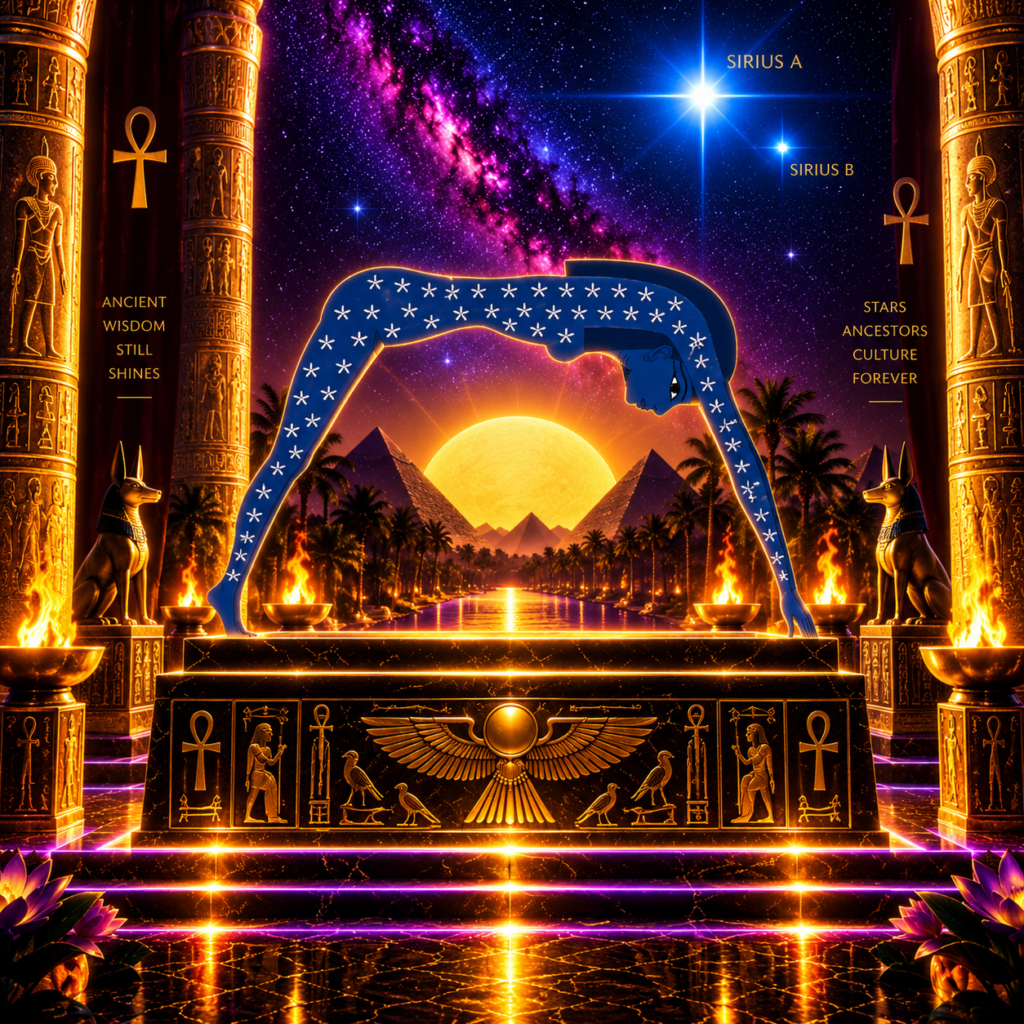
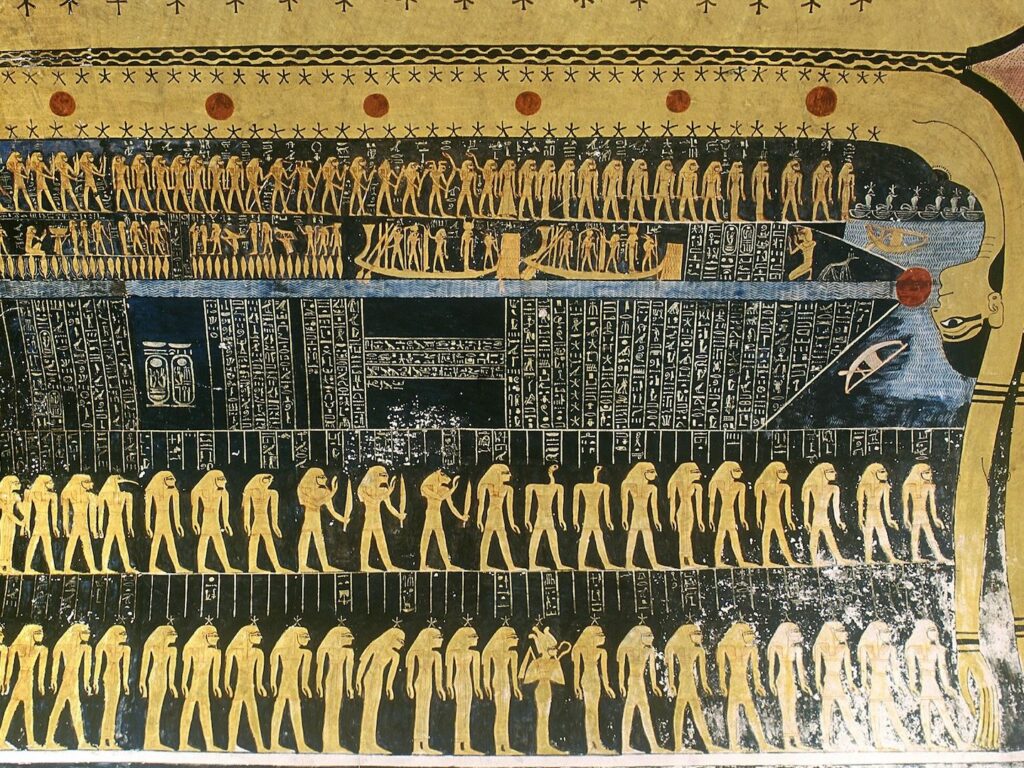
She was frequently portrayed as a woman arching over the earth, with her body extending from one horizon to the other. Stars could cover her body, emphasizing her identity as the celestial sky.
Below her often lies Geb, representing the earth.
Between Nut and Geb may stand Shu, whose raised arms separate the sky from the earth.
The scene is more than beautiful religious artwork.
It represents the organization of the Egyptian cosmos.
In one conception of creation, Nut and Geb were originally joined together until Shu separated them, creating the space in which the ordered world could exist.
Nut became the heavens above.
Geb became the earth below.
Shu occupied the space between them.
For the ancient Egyptians, this divine imagery transformed the structure of the natural world into a sacred story.
Why Was Nut Covered With Stars?
Nut's association with the stars was fundamental to her celestial identity.
Imagine standing beside the Nile thousands of years ago.
There are no modern city lights illuminating the horizon. Above you stretches an enormous night sky filled with countless stars.
For ancient Egyptians carefully observing the heavens, these celestial movements were intertwined with concepts of divine order, time, death, and renewal.
Nut could therefore be portrayed with stars spread across her body.
In some representations, the sun travels in relation to her celestial form as part of its daily cycle.
The heavens were alive—and Nut embodied them.
Did Nut Really Swallow the Sun?
One of the most fascinating aspects of Nut's mythology concerns the daily journey of the sun.
Egyptian religious traditions could describe Nut as receiving or swallowing the sun in the evening. During the night, the solar deity traveled through the mysterious realm beyond ordinary human sight.
At dawn, the sun emerged again.
This cosmic cycle repeated every day:
Sunset → Night → Renewal → Sunrise
The disappearance of the sun was therefore not necessarily understood as a permanent ending.
It was part of a cycle.
Night led toward morning.
Death could lead toward renewed existence.
And Nut stood at the center of this celestial transformation.
Nut and the Birth of the Sun
Nut's mythology demonstrates something essential about ancient Egyptian religion: divine identities and cosmic explanations were not always limited to one rigid story.
Different religious texts, temples, periods, and theological traditions could express the cosmos in different ways.
Nut could be envisioned as the celestial mother through whom the sun was renewed.
The solar deity's nightly passage and morning reappearance transformed the sky into something resembling a cosmic womb.
Every sunrise became another victory of renewal.
This imagery also helps explain why Nut became so important in Egyptian funerary religion.
The same celestial power that renewed the sun could symbolize renewed existence for the deceased.
Nut, Death, and Rebirth
Nut's role extended deeply into ancient Egyptian beliefs about death and the afterlife.
This may initially seem surprising.
Why would a sky goddess appear so prominently in funerary contexts?
The answer lies in renewal.
If Nut could receive the sun and participate in its reappearance, she could also represent the possibility that death was a transition rather than an absolute end.
Ancient Egyptians developed elaborate funerary traditions intended to help the deceased successfully enter and continue existence in the afterlife.
Nut became associated with this protective and regenerative journey.
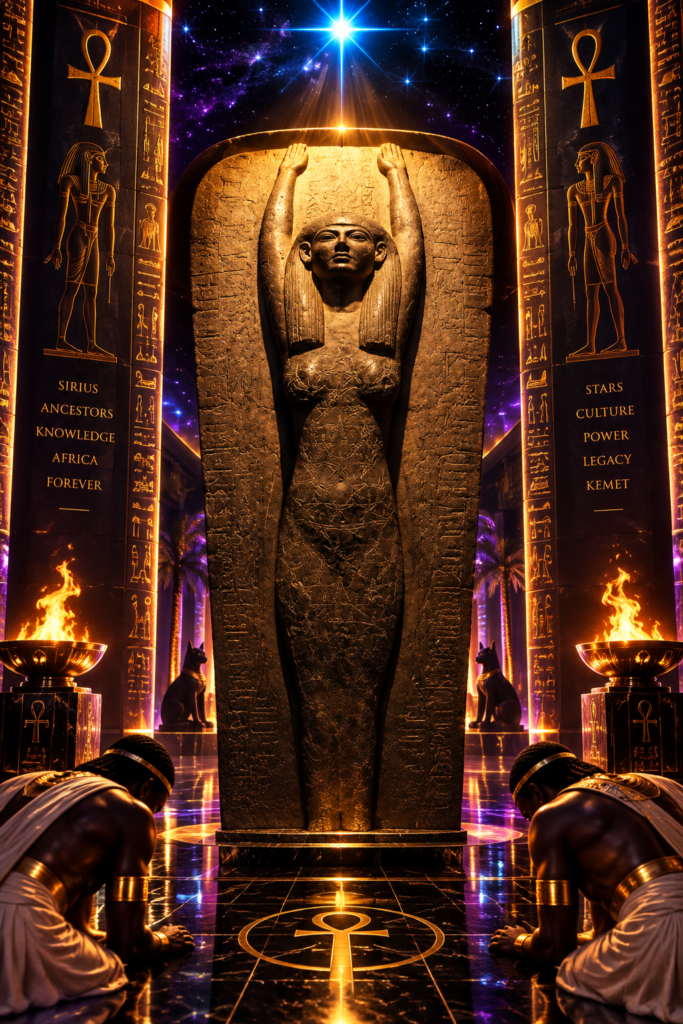
Her image and words invoking her could appear on coffins, sarcophagi, tombs, and funerary objects.
The deceased could symbolically enter her celestial realm and participate in the same pattern of regeneration visible in the heavens.
Why Nut Appears Inside Egyptian Coffins
One of the most meaningful places to encounter Nut is inside ancient Egyptian funerary equipment.
Her image was sometimes painted on the interior of coffin lids.
This placement carried profound symbolism.
When the coffin closed, the deceased could symbolically lie beneath—or within—the celestial goddess.
Nut surrounded the dead just as the sky surrounded the living world.
Her presence expressed protection, celestial transformation, and rebirth.
This relationship became so important that Nut could be invoked as a divine mother receiving the deceased into the heavens.
A coffin, therefore, was not merely a container for a body.
Within Egyptian funerary belief, it could become part of a sacred environment designed for transformation and eternal existence.
The Goddess Nut and the Pharaohs
Nut's celestial role also appears in royal funerary traditions.
The Pyramid Texts, among the oldest extensive bodies of ancient Egyptian religious writings, preserve spells associated with the afterlife of Egyptian kings.
Within these traditions, Nut is repeatedly connected with the deceased king and his ascent or integration into the celestial realm.
Her role as a divine mother and heavenly protector made her particularly significant.
The dead ruler could be connected with the gods and stars, entering an eternal cosmic existence rather than simply disappearing from the world.
This gives Nut an important place in understanding ancient Egyptian concepts of royal immortality.
Nut and the Five Additional Days of the Egyptian Year
A later famous story involving Nut concerns the birth of her children and the structure of the Egyptian calendar.
In a version preserved by the Greek writer Plutarch, the sun god placed a restriction preventing Nut from giving birth on any day of the existing year.
The god Thoth then obtained additional portions of light and created extra days outside the original calendar.
Nut could give birth during these added days.
The story became associated with the five epagomenal days added to the 360-day calendar, producing a civil year of 365 days.
These days became associated with the births of major gods.
It is important, however, to distinguish later literary retellings from evidence originating directly in much earlier Egyptian periods. Ancient Egyptian religion developed over thousands of years, and surviving versions of myths do not always come from the same era.
Nut and Geb: The Sky and Earth
The relationship between Nut and Geb is among the most visually powerful expressions of ancient Egyptian cosmology.
Interestingly, Egyptian mythology reverses a pattern found in several other ancient traditions.
Here, the sky is female and the earth is male.
Nut stretches above as the sky.
Geb rests beneath as the earth.
Their separation establishes the space occupied by creation.
Yet visually, Nut still appears to surround Geb.
Her fingers reach toward one horizon while her toes touch the other, creating a celestial arch over the earth.
The entire inhabited world exists within this divine cosmic structure.
Nut and Ma'at: Understanding Cosmic Order
Nut should also be understood within the broader Egyptian concept of Ma'at, truth, balance, justice, proper order, and cosmic stability.
Nut was not simply a character in isolated mythology.
The movements of celestial bodies, the rising and setting of the sun, the annual rhythms of nature, divine kingship, temple ritual, and the afterlife all existed within a worldview concerned with maintaining order against disorder.
Every sunrise demonstrated continuity.
The stars moved according to celestial patterns.
The Nile followed seasonal rhythms, even though its inundations naturally varied.
The universe appeared governed by recurring cycles.
Nut visually embodied part of this ordered cosmos.
The Book of Nut and Ancient Egyptian Astronomy
Nut is especially fascinating because studying her can bring religion and ancient Egyptian astronomy together.
A group of astronomical and religious compositions conventionally known today as the Book of Nut describes aspects of the sky and celestial phenomena through the body of the goddess.
Versions and related material survive from Egyptian monuments and later manuscripts.
These compositions demonstrate how closely Egyptian observations of celestial cycles could intertwine with religious cosmology.
Stars were not merely decorative dots painted around Nut.
Their movements mattered.
The Egyptians observed celestial bodies for practical and religious purposes, including calendrical and timekeeping systems.
The sky was simultaneously something to observe, measure, interpret, and worship.
Was Nut the Egyptian Goddess of the Milky Way?
Modern discussions sometimes claim that Nut specifically represented the Milky Way.
This idea should be treated carefully.
Nut unquestionably represented the sky and was strongly associated with celestial bodies and stars. Scholars have explored possible relationships between Egyptian depictions of Nut and visible features of the night sky.
However, it is safer not to reduce Nut to simply "the goddess of the Milky Way."
Her documented religious significance was much broader.
She represented the celestial sky itself and played major roles in Egyptian concepts of solar renewal, the stars, death, protection, and rebirth.
Nut Was More Than a Sky Goddess
Calling Nut the Egyptian goddess of the sky is accurate, but it barely captures the scale of her importance.
Her body could represent the boundary of the visible cosmos.
She was a mother of gods.
She received the dead.
She was associated with stars.
She participated symbolically in the daily renewal of the sun.
She stretched across the world itself.
Through Nut, the ancient Egyptians transformed the sky into a divine expression of one of their civilization's most enduring ideas:
existence moves through cycles.
Day becomes night.
The sun disappears and returns.
Life leads to death.
And within Egyptian religious thought, death could lead toward transformation and renewed existence.
Why the Goddess Nut Still Fascinates Us
Thousands of years later, images of Nut remain among the most unforgettable works inherited from ancient Egypt.
Part of their power comes from their scale.
The ancient Egyptians looked upward and imagined the entire sky as the body of a goddess.
Every star existed within her celestial domain.
Every sunset participated in a divine cycle.
Every sunrise represented renewal.
And for those preparing for the journey beyond death, Nut offered the possibility of being welcomed into that cosmic cycle.
Her mythology reminds us that ancient Egyptian religion was not simply a collection of gods with individual powers. It was an intricate attempt to understand creation, nature, time, mortality, and humanity's place within an ordered universe.
Nut stood above it all—quite literally.
Her star-filled body stretched from horizon to horizon, embracing the world below while the eternal celestial cycles continued.
And perhaps that is the most powerful legacy of Nut, the ancient Egyptian goddess of the sky:
She transformed the heavens into a symbol of eternal renewal.
Frequently Asked Questions About Nut
Who is Nut in ancient Egyptian mythology?
Nut was the ancient Egyptian goddess and personification of the sky. She was associated with the heavens, stars, solar renewal, protection of the dead, and rebirth.
What was Nut the goddess of?
Nut was primarily the goddess of the sky. Her religious roles also connected her with stars, the sun's celestial cycle, funerary protection, and regeneration.
Who were Nut's parents?
In the Heliopolitan tradition, Nut was the daughter of Shu and Tefnut.
Who was Nut's husband?
Nut's consort was Geb, the ancient Egyptian god associated with the earth. They were also siblings within the Heliopolitan genealogy.
Who were the children of Nut?
Nut was the mother of Osiris, Isis, Seth, and Nephthys. Some traditions also include Horus the Elder in the group associated with the five additional days of the Egyptian year.
Why does Nut have stars on her body?
The stars emphasize Nut's identity as the personification of the celestial sky. Her arched, star-covered body became one of ancient Egypt's most recognizable representations of the cosmos.
Why was Nut painted on coffins?
Nut's funerary imagery represented celestial protection, regeneration, and rebirth. Her placement within coffins symbolically connected the deceased with the heavens and the continuing cycles of existence.
What is Nut's symbol?
Nut does not have only one universal symbol. She is most famously represented as an arched woman covered with stars, although she can also appear in other forms and celestial imagery.