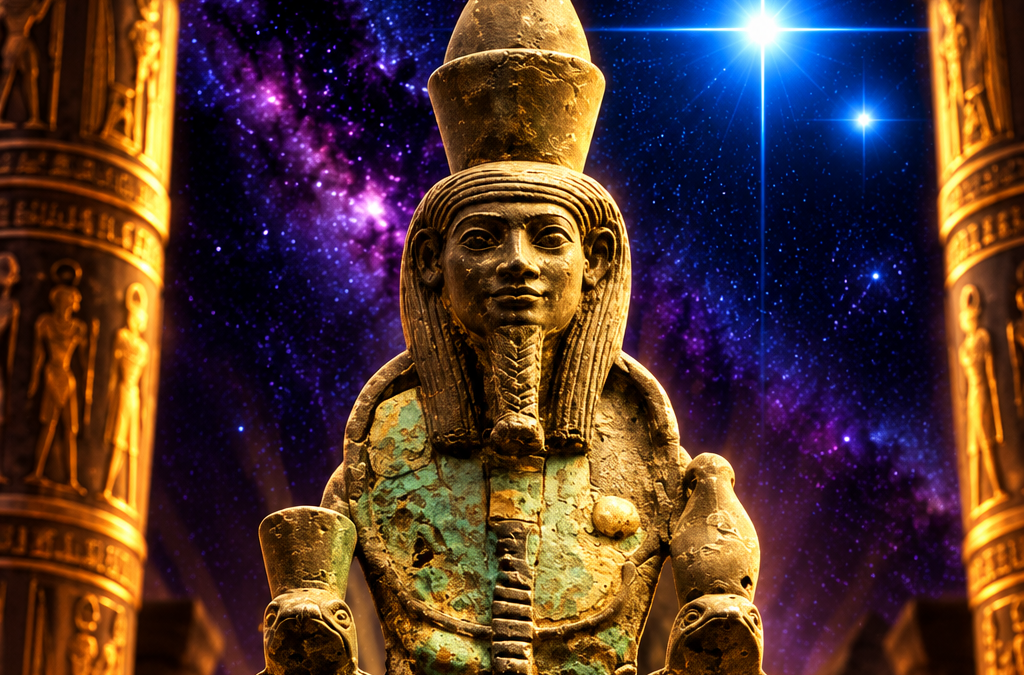
Atum was one of the most important creator deities of ancient Egypt. Appearing prominently in some of the oldest surviving Egyptian religious writings, he represented the creative power through which an ordered universe could emerge from the primordial state that existed before creation.
Ancient Egyptian traditions described Atum as self-generated. Before the familiar world of earth, sky, people, and living beings had taken form, Atum existed within or emerged from the primordial waters known as Nun.
From Atum came the first divine pair, Shu and Tefnut. Their descendants included Geb and Nut, followed by Osiris, Isis, Seth, and Nephthys. Through this divine genealogy, Egyptian religious thought connected Atum with the development of the natural world and some of ancient Egypt's most important deities.
Atum was also associated with the sun, especially its evening phase, and became closely linked with Ra. His influence extended into Egyptian ideas about kingship, creation, death, regeneration, and the continuing cycles of existence.
But who exactly was Atum, and what did this ancient Egyptian creator represent?
Who Was Atum in Ancient Egypt?
Atum was an ancient Egyptian creator and solar deity associated with the origin and completion of creation.
His name is commonly written Atum in English and transliterated from ancient Egyptian as jtm or jtmw. Scholars connect the name with the Egyptian verb tm, which carries meanings associated with completion or finishing.
This concept is central to understanding Atum.
He was not simply imagined as a craftsman constructing a universe from materials already around him. In an important Egyptian conception of creation, Atum contained within himself the potential from which other parts of existence could emerge.
The creator was initially one.
Creation transformed that unity into multiplicity.
This concept gave Atum an extraordinary position in ancient Egyptian religion: he could represent both the source of creation and its completeness.
The Ancient Origins of Atum
Determining exactly when Egyptians first conceived of Atum is difficult because Egypt's religious traditions developed long before many surviving texts were written.
What can be stated with confidence is that Atum was already an important deity by the Old Kingdom.
His prominence is demonstrated by the Pyramid Texts, the great collection of religious utterances first preserved extensively in royal pyramids beginning late in the Fifth Dynasty.
These inscriptions contain some of the oldest surviving written evidence concerning Egyptian religious beliefs.
Atum appears repeatedly within them.
This matters because much of what is popularly called "Egyptian mythology" today was written down or reconstructed from sources separated by enormous spans of time. The Pyramid Texts bring us much closer to early Egyptian religious thought.
They show that Atum's roles as creator, divine ancestor, and powerful figure connected with Egyptian kingship were already well established thousands of years ago.
Atum Before Creation: The Primordial Waters of Nun
Ancient Egyptians developed sophisticated ideas about what existed before the ordered world.
One important concept was Nun, the primordial watery state associated with existence before the familiar structure of the cosmos had emerged.
Nun was not simply the Nile or an ordinary body of water.
It represented a primordial condition from which creation could develop.
Atum was associated with emerging from this state at the beginning of creation.
The image of life and land emerging from water would have carried particular meaning in the Nile Valley. Egyptian civilization depended upon the Nile and its agricultural cycles, and Egyptians repeatedly witnessed the relationship between water, fertile earth, vegetation, and life.
Their religious ideas transformed such observations into cosmic concepts.
Creation was an emergence.
Atum represented the divine creative force at the heart of that transformation.
Atum and the First Land of Creation
Atum was also connected with the appearance of the primeval mound, representing the first stable land to emerge from the primordial waters.
This concept became important in ancient Egyptian creation symbolism.
For people living within the Nile Valley, the imagery would have been immediately understandable. Floodwaters could cover the landscape, followed by the reappearance of land as waters withdrew.
At the cosmic level, the first emerging land represented the beginning of an ordered and inhabitable world.
Atum's association with this moment placed him at the threshold between the primordial state and creation.
The first land also became associated with Egyptian solar symbolism and the Benben, a sacred symbol of emergence and creation.
Atum therefore represented not merely existence, but the beginning of ordered existence.
How Did Atum Create Shu and Tefnut?
Atum's creation of Shu and Tefnut is among the most distinctive episodes preserved in ancient Egyptian religious literature.
Because Atum initially existed alone, the first divine generation had to emerge from the creator himself.
The Pyramid Texts preserve bodily and sexual imagery describing this act of creation. Certain passages associate Atum's hand with the generative act, while other Egyptian traditions describe Shu and Tefnut as being brought forth through actions involving the mouth.
These descriptions should be understood within their ancient Egyptian religious context rather than through modern assumptions.
The underlying theological concept is more important than the physical imagery:
Atum possessed within himself the power required to generate life.
There was no preexisting divine couple necessary for the first act of generation.
Atum himself contained the creative potential.
Recent Egyptian scholarship examining the Pyramid Texts and archaeological evidence has drawn particular attention to the symbolism of Atum's hand as a life-bestowing instrument in this act of creation.
From the original creator came the first divine pair.
Shu and Tefnut: The First Divine Generation
From Atum came Shu and Tefnut.
Shu was strongly associated with air and atmospheric space.
Tefnut was associated particularly with moisture and related aspects of the natural world.
Their appearance represented a crucial development in creation.
Where Atum had initially existed as one, creation was now becoming differentiated.
Shu and Tefnut subsequently became the parents of:
Through these divine generations, Egyptian religious thought described the development of an increasingly structured cosmos.
Earth and sky became distinct.
Space existed between them.
The ordered world was taking shape.
Atum as Ancestor of a Powerful Divine Family
Atum's role as creator also made him the ancestor of one of ancient Egypt's most influential divine families.
The genealogy traditionally included:
Atum → Shu and Tefnut → Geb and Nut → Osiris, Isis, Seth, and Nephthys.
These nine deities are often collectively called the Ennead, from a modern term derived through Greek. More importantly for understanding the Egyptian concept, they represented an interconnected divine family beginning with Atum.
This genealogy connected the creation of the natural world with deities who later became central to Egyptian beliefs about kingship, protection, death, inheritance, regeneration, and the afterlife.
Atum therefore stood at the beginning of far more than a family tree.
Through his descendants, he became an ancestral source within a religious system that connected the structure of the universe with divine and royal order.
Atum in the Pyramid Texts
The Pyramid Texts provide some of the most important surviving evidence concerning Atum.
The earliest known substantial collection appears inside the pyramid of King Unas near the end of the Fifth Dynasty, with the tradition continuing in subsequent royal pyramids.
Atum appears throughout these texts in different religious contexts.
Some passages concern creation.
Others connect Atum with the deceased Egyptian king.
This relationship between Atum and kingship is significant.
The king's death was not understood simply as an ending. Egyptian royal funerary religion concerned transformation, continued existence, ascent, and association with divine powers.
Atum—the god connected with the beginning of creation—could therefore also participate in religious ideas concerning renewed existence after death.
Creation and regeneration were not entirely separate concepts.
Both involved the emergence or continuation of life and order.
Atum's Powers and Divine Roles
Atum's identity developed over ancient Egypt's long history, but several major roles remained especially important.
Creator
Atum represented the creative source from which the first divine generation emerged.
Divine Ancestor
Through Shu and Tefnut and their descendants, Atum became the ancestral head of an important Egyptian divine genealogy.
Solar Deity
Atum developed strong connections with the sun and particularly its evening phase.
Symbol of Completion
His name and theological character connected him with completeness and the completion of cycles.
Royal Deity
His imagery and appearances in royal religious literature associated him with divine authority and kingship.
Deity of Regeneration
His involvement in funerary religion and the recurring solar cycle connected him with transformation and continued existence.
These overlapping roles explain why Atum remained important across different periods of Egyptian history.
Atum and the Setting Sun
Atum became particularly associated with the setting sun.
Ancient Egyptians did not understand sunset merely as the disappearance of the sun.
The sun followed a recurring cosmic cycle.
It appeared in the east, traveled across the visible sky, descended in the west, passed through the night, and returned again.
Different Egyptian deities and divine manifestations could express different aspects of this solar journey.
Atum was strongly associated with its evening stage.
This made theological sense.
The setting sun had completed its daytime journey, echoing the concept of completion embedded in Atum's identity.
Yet completion did not necessarily mean permanent destruction.
The sun would return.
Atum's solar character therefore joined two important Egyptian ideas:
completion and renewal.
Atum and Ra
Atum became closely associated with the great Egyptian solar deity Ra.
The two could appear together as Ra-Atum or Atum-Ra, an association already found in Old Kingdom religious texts.
Ancient Egyptian religion frequently allowed deities to be joined in combined forms without permanently eliminating their individual identities.
This is important when understanding Atum.
Atum did not simply "turn into" Ra and disappear.
Instead, their creative and solar qualities allowed Egyptian religious thought to connect them.
Ra's immense importance as a solar deity complemented Atum's identity as a primordial creator and his association with the evening sun.
Together, these ideas strengthened Atum's connection with both creation and the recurring solar cycle.
What Did Atum Look Like?
Ancient Egyptian artists could represent Atum in several forms.
His most recognizable human representation depicts him as a male deity wearing the Double Crown of Upper and Lower Egypt.
He may hold divine symbols such as the was-scepter, associated with power and dominion, and the ankh, associated with life.
The Double Crown was especially significant.
By depicting Atum with royal regalia, Egyptian artists visually connected the creator with sovereignty and universal authority.
Atum was therefore not portrayed simply as an abstract cosmic force.
He could appear as a divine ruler.
Atum's Animal Forms and Symbols
Ancient Egyptian deities were not restricted to a single appearance.
Different forms could communicate different qualities of the same divine being.
Atum could be represented or symbolically associated with several animals, including the serpent.
Surviving Egyptian objects also preserve unusual manifestations connected with Atum, demonstrating how complex his visual identity could become.
These representations should not be interpreted as evidence that Egyptians believed Atum physically "looked" like only one creature.
Egyptian religious imagery operated symbolically.
Human, animal, and composite forms allowed artists and priests to communicate different characteristics of divine power.
Atum in Serpent Form
Atum's serpent form has particular importance because it appears in Egyptian ideas concerning the distant end of the ordered world.
Ancient Egyptian religious literature could imagine creation eventually returning toward a primordial watery state.
In one remarkable funerary tradition, Atum declares that what he created will ultimately return to the condition of Nun, while he assumes the form of a serpent.
This produces a striking theological symmetry.
Atum is associated with the beginning.
Atum is associated with completion.
And Atum remains connected with existence when the structured cosmos returns toward its primordial condition.
The creator therefore stands conceptually at both ends of the cosmic cycle.
Atum, Kingship, and the Double Crown
Atum's connection with Egyptian kingship deserves particular attention.
When depicted in human form, he commonly wears the Double Crown, combining symbols of Upper and Lower Egypt.
The imagery communicated authority over the unified Egyptian state.
Ancient Egyptian kingship was deeply connected with religious concepts of cosmic order.
The ruler was expected to uphold maat—a fundamental Egyptian principle encompassing truth, justice, balance, proper order, and rightness.
Creation itself involved the establishment of order.
Atum's position as creator and his royal appearance therefore made him especially appropriate within Egyptian ideas connecting divine authority, cosmic stability, and kingship.
Where Was Atum Worshipped?
Atum's most important cult center was Iunu, an ancient Egyptian city in the area of modern Cairo.
The city became one of Egypt's major centers of solar religion and religious learning.
It was only much later called Heliopolis by the Greeks.
Atum's importance, however, extended beyond a single location.
Evidence from Egyptian religious texts, funerary objects, and monuments demonstrates that knowledge and worship of Atum spread across different regions and periods.
His presence in royal Pyramid Texts, later funerary traditions, temple contexts, and surviving stelae demonstrates the longevity of his religious importance.
Atum Across Ancient Egyptian History
Atum's significance did not remain frozen in the Old Kingdom.
Egyptian religion continually developed.
Deities gained new associations, interacted with other gods, acquired additional titles, and could become more or less prominent depending upon historical circumstances.
Atum's connection with Ra became particularly important.
His creator role remained embedded within Egyptian religious tradition, while his solar identity allowed him to participate in broader ideas concerning the sun's daily transformation.
Later Egyptian funerary evidence continued to depict and invoke Atum.
Surviving stelae, for example, show worshippers adoring Atum and solar forms associated with him centuries after the Pyramid Texts were first inscribed.
Atum therefore remained part of Egyptian religious life across an extraordinary span of time.
Was Atum the Only Creator God in Ancient Egypt?
No.
This is one of the most important points for understanding ancient Egyptian religion accurately.
Egypt existed for thousands of years and developed multiple traditions concerning creation.
Atum was one of ancient Egypt's great creator deities, but he was not the only Egyptian god credited with creative power.
Other traditions emphasized deities such as Ptah, Khnum, Amun, Ra, and primordial divine forces.
These traditions did not always function as competing religions in the modern sense.
Egyptian theology could combine divine identities and accommodate different explanations of creation.
Atum's importance should therefore not be exaggerated into the claim that every ancient Egyptian everywhere believed Atum alone created the universe.
His documented significance is impressive without making that claim.
Atum and Khnum: Different Egyptian Ideas About Creation
Atum provides an especially interesting comparison with Khnum, another major Egyptian creator deity.
Their creative roles were not identical.
Atum's creation traditions emphasize self-generation and the emergence of the first divine beings from himself.
Khnum became famous for a different form of creative imagery: fashioning life on a potter's wheel.
These differences demonstrate the richness of ancient Egyptian religious thought.
Egyptians could express creation through several concepts—generation, emergence, divine speech, craftsmanship, solar power, and other forms of creative action.
Rather than forcing these traditions into a single uniform story, examining their differences helps us better understand the complexity of ancient Egyptian religion.
What Atum Reveals About Ancient Egyptian Thought
Atum's significance reaches beyond the question of who Egyptians believed created the universe.
His traditions preserve profound Egyptian ideas concerning the relationship between unity and multiplicity.
At the beginning, Atum exists as one.
From Atum emerge Shu and Tefnut.
From them come Geb and Nut.
Additional divine generations follow.
The original unity has unfolded into a complex cosmos.
Atum's story therefore provided ancient Egyptians with a way of explaining how the many components of existence could emerge from an original creative source.
Air, moisture, earth, sky, divine beings, kingship, solar cycles, death, and regeneration could all become interconnected within an ordered universe.
Atum Within the African History of Ancient Egypt
Atum belonged to the religious world developed within ancient Egypt in northeastern Africa.
That geographic and cultural reality matters.
Egyptian religion developed within the environmental, political, linguistic, and cultural history of the Nile Valley and interacted across long periods with other African regions, particularly to Egypt's south and west.
African scholars such as Cheikh Anta Diop challenged older approaches that isolated ancient Egypt from the rest of Africa and encouraged generations of researchers to examine Egypt within a broader African historical framework.
At the same time, understanding Atum accurately requires beginning with the surviving Egyptian evidence itself: Egyptian religious texts, inscriptions, archaeological remains, artistic representations, and the historical development of Egyptian religion.
The strongest picture emerges when ancient Egypt is neither detached from Africa nor reduced to assumptions that the surviving Egyptian evidence cannot support.
Atum is an important example of the intellectual and religious complexity that developed in the ancient Nile Valley.
Why Atum Remains Important Today
Atum provides an extraordinary window into how ancient Egyptians thought about existence.
His religious traditions addressed fundamental questions:
How did an ordered world emerge?
How could many forms of existence develop from a single source?
What connected creation with the sun?
How were divine authority and kingship related?
Why did cycles of disappearance and renewal matter?
What happened when the created world reached its completion?
Ancient Egyptians developed sophisticated theological answers to these questions over many centuries.
Atum stood at the center of some of those answers.
The Enduring Legacy of Atum
Atum was one of ancient Egypt's most significant creator gods.
The Pyramid Texts preserve his importance deep within the Old Kingdom, while later Egyptian texts, objects, and religious traditions demonstrate that his influence endured for centuries.
He was the self-generated creator from whom Shu and Tefnut emerged.
He was an ancestral deity connected with a powerful divine family.
He was associated with the primordial waters of Nun and the emergence of creation.
He was linked with Ra and the sun.
He represented the completion of the solar journey.
He appeared with the royal Double Crown and became associated with divine authority.
And in remarkable Egyptian traditions concerning the distant end of the cosmos, Atum remained connected with the return of creation toward its primordial state.
Atum therefore represents much more than a character from an ancient "myth."
He provides surviving evidence of how people in ancient Egypt contemplated creation, nature, divine power, kingship, life, death, regeneration, and the structure of the universe.
More than four thousand years after his name was inscribed within Egyptian royal pyramids, Atum remains one of the most powerful surviving examples of the intellectual and religious traditions created in the ancient African Nile Valley.
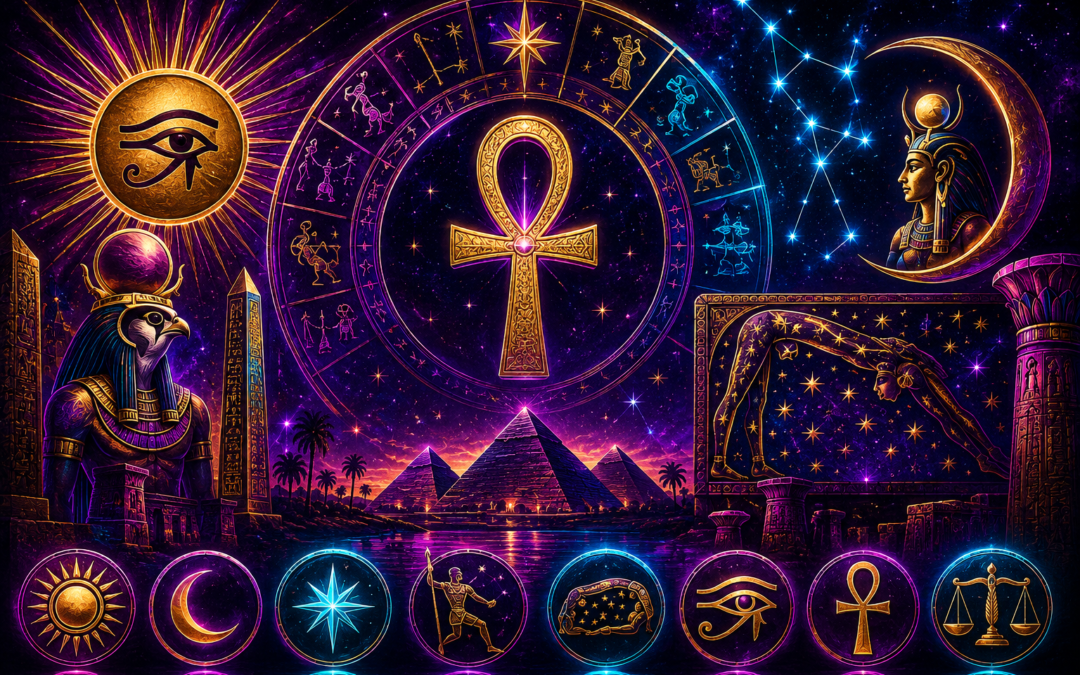
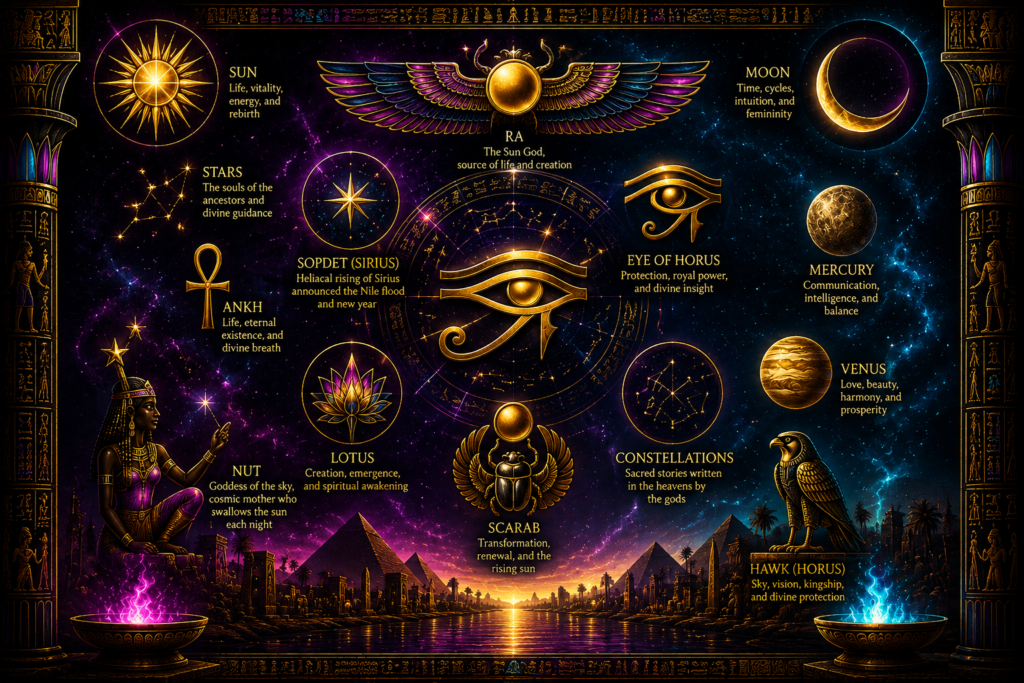
For thousands of years, the people of ancient Egypt carefully observed the Sun, Moon, stars, planets, and recurring movements of the night sky. These observations were connected to far more than curiosity about the heavens. Celestial cycles helped ancient Egyptians measure time, organize calendars, express religious ideas, understand cycles of renewal, and represent the structure of the cosmos.
Ancient Egyptian celestial symbols therefore carried layers of meaning. The Sun could represent divine power and regeneration. Stars could be associated with eternity and the afterlife. Sopdet, identified with Sirius, became connected with an important seasonal transition. Nut embodied the sky itself, while groups of stars now called decans were incorporated into systems for measuring the passage of the night.
These traditions belonged to an ancient African civilization whose astronomical knowledge developed over many centuries.
It is important, however, to distinguish this Egyptian celestial tradition from the popular idea of modern astrology. The evidence from ancient Egypt is strongest for astronomical observation, calendars, timekeeping, religious symbolism, funerary traditions, and cosmology. The familiar twelve-sign zodiac became prominent in Egypt much later.
To understand ancient Egyptian celestial symbols accurately, we must begin with the Egyptians' own sky.
The Sun: Divine Power, Life, and Renewal
Few celestial objects were as important to ancient Egyptian culture as the Sun.
Its daily journey across the sky provided a visible cycle of appearance, disappearance, and return. Egyptian religious traditions transformed this recurring natural phenomenon into a powerful expression of cosmic regeneration.
Ra, one of ancient Egypt's major solar deities, became closely associated with the Sun, creation, kingship, life, and the maintenance of cosmic order.
Egyptian religious compositions described the solar deity traveling through the visible sky during the day and through the hidden regions of the cosmos during the night. Dawn represented the successful renewal of this journey.
The Sun therefore carried meanings extending far beyond light itself. It could symbolize:
Life
Divine authority
Kingship
Creation
Regeneration
Cosmic continuity
Solar disks appear throughout Egyptian religious imagery and could be associated with several deities.
During the reign of Akhenaten, the Aten—the visible solar disk—became the center of an extraordinary transformation of royal religion. Artistic representations famously show rays descending from the disk, some terminating in hands offering life to members of the royal family.
Although Akhenaten's religious program was exceptional, reverence for solar power was deeply rooted in Egyptian culture long before his reign.
The Moon: Time, Cycles, and Renewal
The Moon also occupied an important place within ancient Egyptian understandings of the sky.
Unlike the Sun's daily rhythm, the Moon visibly changes throughout its monthly cycle. Its recurring phases provided ancient observers with another celestial means of recognizing the passage of time.
Several Egyptian deities possessed lunar associations.
Khonsu, whose major cult became especially important at Waset, modern Luxor, was strongly associated with the Moon. Thoth, the deity of writing, knowledge, reckoning, and wisdom, also acquired significant lunar connections.
Within Egyptian religious thought, the Moon could consequently become associated with ideas involving:
Time
Measurement
Cycles
Restoration
Renewal
The Egyptian Moon was therefore part of a much larger system in which observation of the natural world and religious meaning could intersect.
Stars and the Promise of Eternity
Stars possessed profound significance in ancient Egyptian religion, particularly in ideas concerning death and continued existence.
Some of Egypt's earliest surviving royal funerary writings, the Pyramid Texts, contain passages describing the deceased king ascending into the heavens and becoming associated with celestial beings and stars.
Of particular importance were stars in the northern sky that appeared never to set.
From the Egyptian observer's perspective, these stars possessed an enduring quality. Because they continually circled the northern celestial region rather than disappearing for long periods below the horizon, they became powerful images of permanence.
This made the stars particularly appropriate symbols for concepts involving:
Eternity
Immortality
Royal transformation
The celestial afterlife
Continuity beyond death
For ancient Egyptians looking upward at night, the sky could therefore represent both a physical environment and a sacred landscape.
Sopdet: Sirius and the Egyptian Year
Among all the stars known to ancient Egyptians, Sopdet held exceptional importance.
Sopdet is identified with the star we now call Sirius, the brightest star in Earth's night sky.
Ancient Egyptian observers paid particular attention to its heliacal rising—its reappearance in the eastern sky shortly before sunrise after a period during which it had not been visible.
This appearance became associated with an important seasonal transition and the beginning of the Egyptian year.
The annual inundation of the Nile was essential to Egypt's agricultural system. It replenished agricultural lands with water and fertile sediment and profoundly shaped the rhythm of life along the Nile Valley.
Sopdet's reappearance became culturally associated with this season of renewal.
However, an important distinction is necessary: Sirius and the Nile flood should not be described as remaining perfectly synchronized throughout all periods of Egyptian history.
Egypt's 365-day civil calendar lacked the extra quarter-day of the solar year, causing calendar dates to gradually shift in relation to the seasons.
The importance of Sopdet therefore demonstrates not fortune-telling, but something historically more significant: Egyptian observers recognized recurring celestial phenomena and incorporated them into systems of time, religion, and seasonal understanding.
Sah: The Celestial Figure Associated With Orion
Another prominent celestial figure was Sah.
Sah is commonly associated with the region of the sky we identify today with Orion, although ancient Egyptian constellations should not automatically be assumed to correspond perfectly to modern constellation boundaries.
Sah became closely connected with Osiris, one of the most important deities associated with death, regeneration, kingship, and the afterlife.
Egyptian astronomical representations sometimes place Sah and Sopdet within the same broader celestial environment.
Their importance illustrates how Egyptians mapped religious meaning onto the observable sky without separating astronomy, religion, and cosmology into the strict modern categories familiar today.
The stars were observable celestial bodies, but they could simultaneously participate in a sacred understanding of existence.
The Decans: Egypt's Celestial Timekeepers
Among the strongest evidence for ancient Egyptian astronomical knowledge are the star groups conventionally known today as decans.
Egyptian astronomical traditions organized decanal stars or star groups into systems connected with ten-day periods and the measurement of nighttime.
One of the most remarkable surviving forms of this knowledge appears in diagonal star tables, particularly those preserved on Middle Kingdom coffins.
These tables arranged sequences of stars across grids. Their successive appearances were used to represent the passage of the hours of the night.
A traditional Egyptian system ultimately involved 36 ten-day divisions within the 360-day portion of the year, followed by five additional days completing the 365-day civil calendar.
The decanal system should not be imagined as completely unchanged throughout Egyptian history. Star lists, astronomical representations, and methods evolved over time.
What remains clear is that ancient Egyptians developed sophisticated systems connecting observation of stars with the measurement and organization of time.
This is one of the clearest examples of practical astronomy preserved from ancient Egypt.
Star Clocks and Astronomical Ceilings
Egyptian celestial knowledge survives not only in written texts but also in spectacular visual representations.
Astronomical ceilings have been discovered in tombs and temples, where stars, planets, deities, calendars, and constellations could be represented together.
A famous example comes from the tomb of Senenmut, an important official during the reign of Hatshepsut.
Its astronomical ceiling contains representations of celestial figures alongside stars, planets, decans, and calendrical information.
Such monuments demonstrate that Egyptians did not simply observe individual stars in isolation. They developed organized ways of representing the structure and movement of the sky.
Other Egyptian astronomical sources include:
Diagonal star tables
Astronomical ceilings
Water clocks
Shadow clocks and sundials
Calendrical texts
Religious compositions concerning the heavens
Together, these surviving sources provide direct archaeological and textual evidence for Egyptian celestial knowledge.
Nut: The Sky Embodied
Few images capture ancient Egyptian cosmology more dramatically than Nut, the goddess of the sky.
Nut was often depicted as a woman arching over the Earth, sometimes with stars covering her elongated body.
Rather than simply living somewhere in the heavens, Nut could embody the sky itself.
Her body created a visual representation of the celestial realm stretching over the world below.
Egyptian religious traditions also connected Nut with the solar cycle. The Sun could be described as entering her body in the evening and emerging again with the dawn.
Nut consequently became associated with:
The sky
Stars
The solar cycle
Birth and rebirth
Protection
Regeneration
The afterlife
One of the most important Egyptian astronomical compositions known today as the Book of Nut describes aspects of the behavior of the Sun and stars within this cosmological framework.
Nut demonstrates how ancient Egyptians could transform careful observation of celestial cycles into a powerful visual and religious understanding of the universe.
The Wedjat Eye: Restoration and Celestial Meaning
The Wedjat Eye, commonly called the Eye of Horus, is one of ancient Egypt's most recognizable symbols.
Its principal meanings concerned protection, healing, restoration, and wholeness.
Egyptian religious traditions describe the eye of Horus being damaged during conflict with Seth and subsequently restored. This restoration made the Wedjat a potent symbol of completeness and recovery.
The eyes of divine figures could also acquire solar and lunar associations in Egyptian religious thought.
However, the Wedjat should not simply be labeled an "astrology symbol."
Its historical meaning was considerably broader.
The Wedjat belonged to Egyptian religious and protective symbolism and appears extensively in amulets and funerary contexts. Any celestial interpretation should therefore remain part of that larger Egyptian religious framework.
The Ankh: The Symbol of Life
The ankh is among the most recognizable symbols surviving from ancient Egypt.
Its fundamental meaning was life.
Egyptian artworks frequently depict deities holding an ankh or extending it toward the king. In these scenes, the symbol communicates the divine granting or sustaining of life.
The ankh was not an astrological sign.
Its relevance to Egyptian celestial symbolism comes from the wider Egyptian understanding of the cosmos as a divinely ordered environment in which life, nature, kingship, and divine forces were interconnected.
Understanding this distinction prevents modern spiritual interpretations from replacing the meanings supported by ancient Egyptian evidence.
Ma'at: Cosmic Order and Balance
To understand how Egyptians viewed the heavens, we must also understand Ma'at.
Ma'at encompassed interconnected concepts of truth, justice, balance, right order, and cosmic stability.
The Egyptians experienced a world filled with recurring patterns.
Day followed night.
The Sun disappeared and returned.
Stars moved across the heavens.
Seasons changed.
The Nile followed recurring environmental rhythms.
Against this background, the predictable behavior of the heavens could be understood as part of a larger ordered cosmos.
Egyptian kingship itself was deeply connected with maintaining Ma'at. The king was expected to preserve proper order against destructive disorder.
Celestial cycles therefore belonged to something larger than astronomy. They existed within an Egyptian worldview concerned with maintaining the balance necessary for life and society.
Egyptian Cosmology in Its African Setting
Ancient Egypt developed in northeastern Africa, with the Nile connecting communities across Egypt and regions farther south.
Understanding Egyptian celestial traditions within this African geography is essential.
African scholars have long argued that ancient Egypt should be studied within African history rather than isolated from the continent. Senegalese scholar Cheikh Anta Diop, in particular, challenged approaches that separated Egyptian civilization from its African setting and emphasized the importance of examining Egyptian religion, philosophy, language, and culture within African historical study.
Modern scholarship continues to debate many questions concerning cultural relationships across ancient Africa, and individual historical claims must be evaluated according to archaeological, linguistic, textual, and biological evidence.
Yet the geographical foundation is unmistakable: ancient Egyptian civilization developed on the African continent, within a Nile Valley environment that connected Egypt with neighboring African regions.
Celestial observation was therefore one expression of an African civilization's sustained effort to understand nature, time, life, death, and the structure of the universe.
Did Ancient Egyptians Practice Astrology?
This question requires careful terminology.
Ancient Egyptians unquestionably observed the heavens.
They tracked celestial cycles, created calendars, developed stellar timekeeping systems, represented constellations and planets, incorporated celestial phenomena into religious traditions, and produced astronomical diagrams.
That does not mean that the familiar modern system of twelve zodiac personality signs existed throughout pharaonic Egyptian history.
It did not.
The twelve-sign zodiac familiar from later astrology entered Egyptian visual and intellectual culture much later, after zodiac traditions developed elsewhere and circulated throughout the ancient Mediterranean and Near Eastern worlds.
Late Egyptian monuments such as the famous zodiac at Dendera demonstrate this later interaction.
For an article focused on ancient Egyptian celestial symbolism, however, this later development should not overshadow Egypt's much older indigenous traditions.
Long before zodiac imagery appeared in Egypt, Egyptians were observing Sopdet, Sah, decanal stars, the Sun, Moon, planets, and northern stars and integrating celestial cycles into their understanding of time and the cosmos.
Did Celestial Symbols Predict Individual Fate?
Claims that ancient Egyptians routinely used celestial symbols to determine everyone's personality or individual destiny should be approached cautiously.
Evidence from pharaonic Egypt strongly supports the use of celestial observation in:
Calendars
Nighttime measurement
Religious ritual
Temple and funerary symbolism
Seasonal organization
Royal ideology
Cosmology
Concepts of death and regeneration
That evidence does not justify transforming every Egyptian deity or sacred symbol into a zodiac personality sign.
Modern systems sometimes assign Egyptian gods to birthdays, personality traits, or zodiac signs, but these should not automatically be presented as traditions originating in the earliest periods of ancient Egypt.
The historically documented Egyptian relationship with the heavens is compelling without adding unsupported claims.
What Ancient Egyptian Celestial Symbols Really Tell Us
Ancient Egyptian celestial symbols reveal a civilization paying extraordinarily close attention to recurring patterns in nature.
The Sun demonstrated renewal and divine power.
The Moon provided visible cycles connected with time and restoration.
Sopdet marked an important celestial and seasonal transition.
Sah linked a recognizable region of the night sky with Egyptian religious traditions concerning Osiris.
The decanal stars helped organize nighttime.
Nut transformed the entire sky into divine imagery.
The Wedjat represented restoration and protection while acquiring celestial associations.
The ankh expressed life.
And Ma'at provided a broader concept through which cosmic stability, social order, and proper balance could be understood.
These symbols were not isolated mystical icons.
Together, they belonged to a sophisticated Egyptian way of observing and representing the universe.
The Enduring Legacy of Ancient Egypt's Celestial Symbols
Ancient Egyptians left behind one of Africa's most extraordinary records of sustained engagement with the heavens.
Coffins preserve star tables. Tombs contain astronomical ceilings. Religious texts describe celestial journeys. Temples preserve images of sky deities, solar cycles, stars, and planets. Surviving timekeeping instruments demonstrate attempts to measure the passage of hours.
The evidence reveals a civilization in which the observable sky, sacred tradition, time, kingship, death, regeneration, and cosmic order could exist within an interconnected worldview.
Ancient Egyptian celestial symbols should therefore be understood first within the civilization that created them.
Doing so moves us beyond the popular image of a mysterious "Egyptian zodiac" and toward something supported far more strongly by the surviving evidence: an ancient African civilization that carefully observed the heavens and transformed those observations into systems of timekeeping, religious expression, and powerful ideas about humanity's place within an ordered cosmos.
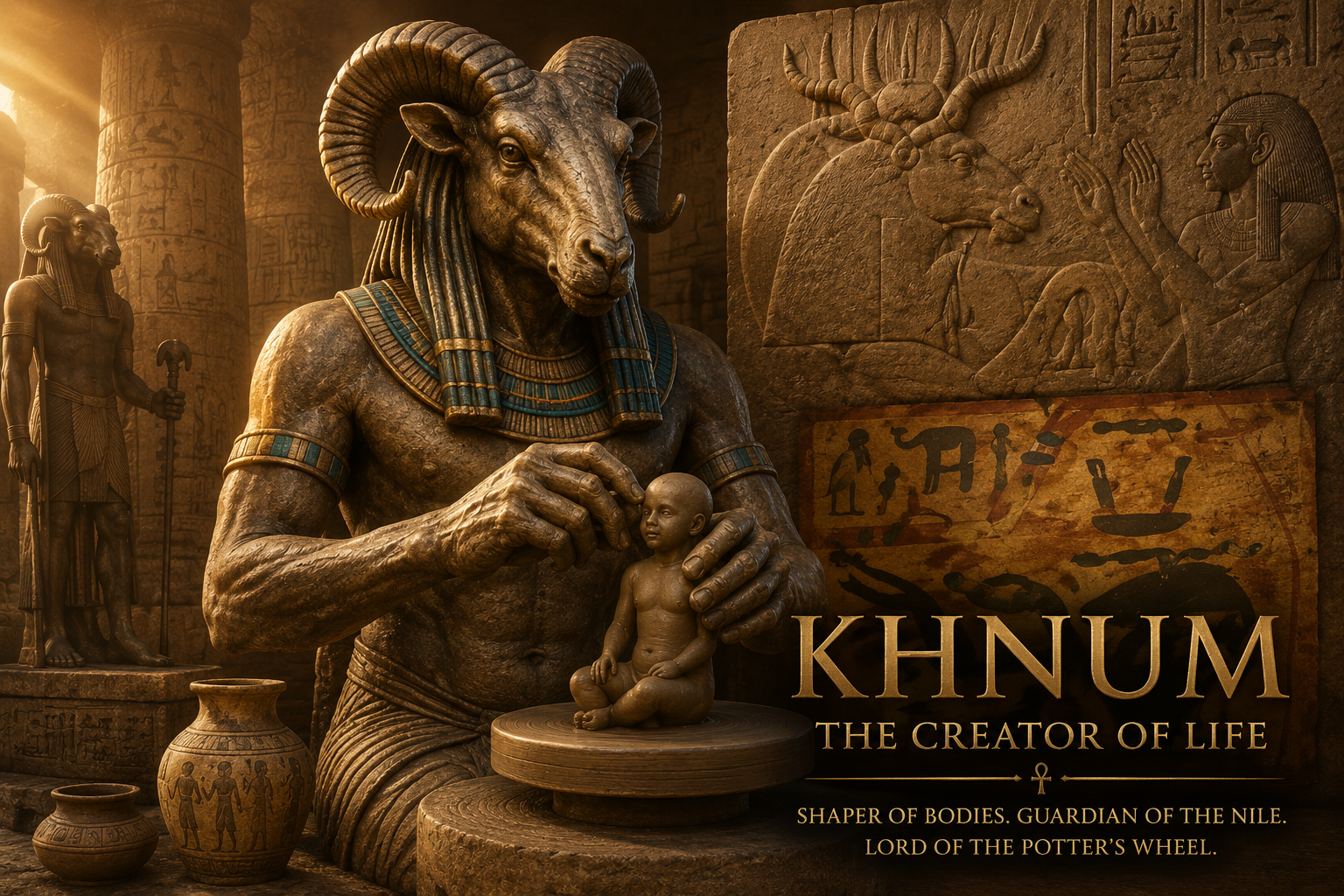
Among the many deities worshipped across ancient Egypt, few embodied the mystery of creation as vividly as Khnum, the ram-headed god associated with the Nile, fertility, craftsmanship, and the creation of life.
Ancient Egyptian religious traditions described Khnum as a divine craftsman who formed living beings upon a potter’s wheel. In some traditions, he shaped the bodies of people and even their vital essence or ka, from clay before life entered the world.
Yet Khnum's importance extended far beyond creation. His worship was deeply connected to the Nile River, particularly around Elephantine Island near modern Aswan, where the river's annual inundation was essential to agriculture and survival.
From sacred temples to remarkable reliefs depicting a god at his potter's wheel, Khnum represents one of ancient Egypt's most compelling ideas: life itself could be understood as an act of divine craftsmanship.
Who Was Khnum in Ancient Egypt?
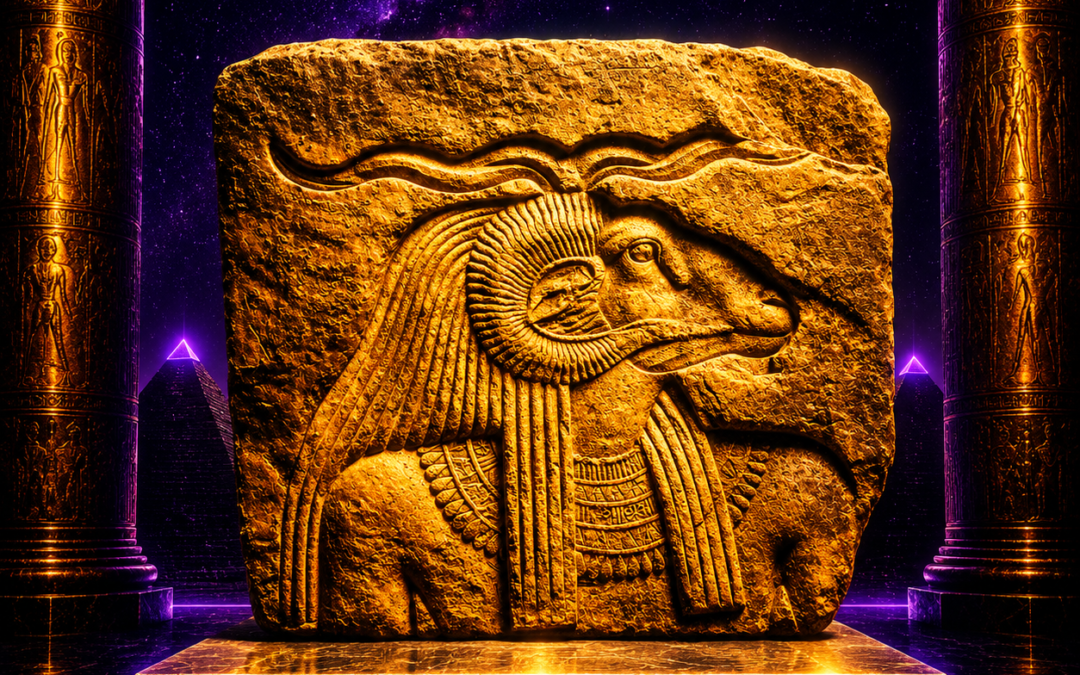
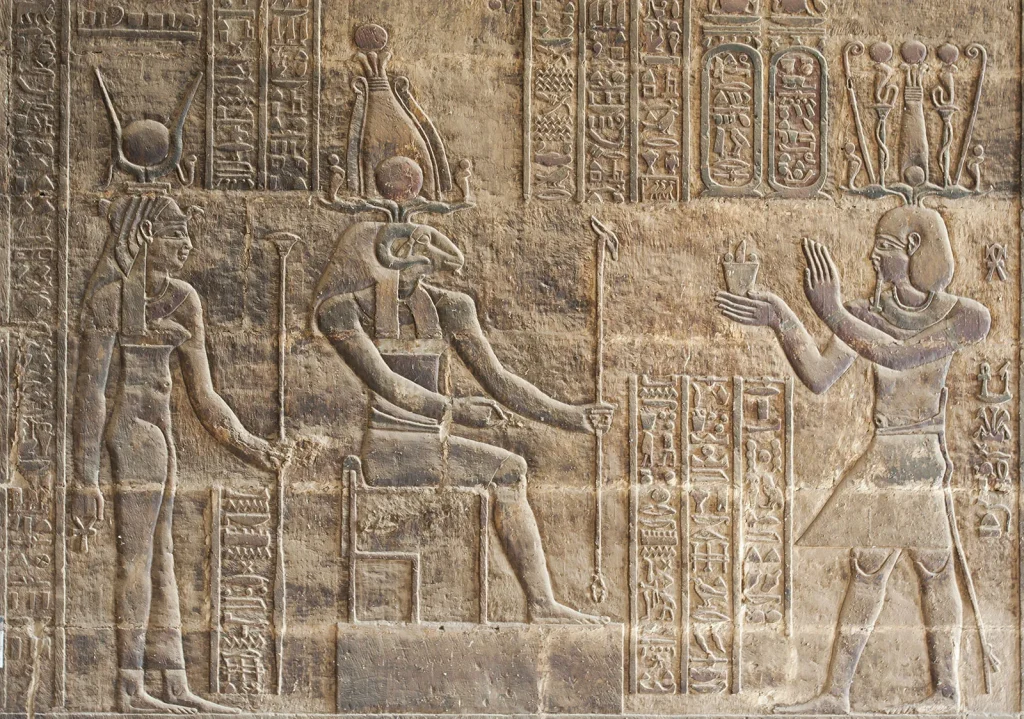
Khnum was an ancient Egyptian deity typically represented as a man with the head of a ram, particularly a ram with horizontally extending or curling horns.
His Egyptian name is commonly transliterated as Khnum, Khnemu, or Khnumu. The name has been associated with the idea of joining, creating, or fashioning, an appropriate concept for a deity renowned as a divine craftsman.
Khnum's religious identity developed over Egypt's long history, and beliefs about him were not necessarily identical in every region or period. Ancient Egyptian religion contained multiple creation traditions rather than a single universal account of how existence began.
Within traditions centered on Khnum, however, he could occupy an extraordinarily powerful position as a creator and fashioner of life.
Khnum and the Divine Potter's Wheel
Perhaps the most famous image associated with Khnum shows him seated before a potter's wheel.
This was far more than an artistic symbol.
Pottery was an important craft in ancient Egypt. Clay could be gathered, shaped, transformed, and made into something entirely new. The potter therefore provided an especially powerful metaphor for divine creation.
Khnum was envisioned as the ultimate craftsman.
In temple scenes, he could be depicted fashioning a person, or the royal child upon his wheel. Some representations show Khnum forming both the physical body and a second figure associated with the individual's ka, an important aspect of ancient Egyptian conceptions of personhood and vitality.
The symbolism is profound:
Human existence was not merely born. It was fashioned.
The image of Khnum at his wheel transformed creation into an intentional act requiring knowledge, skill, and divine power.
Did Khnum Create People From Clay?
Khnum is frequently described today as the Egyptian god who created people from Nile clay.
That description captures the general symbolism of his role, but the surviving Egyptian traditions are more complex.
Texts and temple imagery portray Khnum as a divine potter who fashions bodies on his wheel, while later interpretations strongly connect his creative material with the fertile earth and clay associated with the Nile.
For ancient communities whose survival depended upon the river, the symbolism would have been particularly meaningful.
The Nile nourished the soil.
The soil produced crops.
The crops sustained life.
And Khnum, associated with the river and its creative forces, became a divine craftsman capable of transforming the material of the earth into living form.
Khnum and the Nile River
Khnum was closely associated with the Nile, particularly with the First Cataract region in southern Egypt.
His principal cult center was Elephantine Island, located near present-day Aswan.
Ancient Egyptians regarded this region as profoundly important to the Nile's inundation. Before the construction of modern dams transformed the river, the annual flood deposited fertile silt across agricultural lands and helped sustain Egyptian civilization.
The precise natural source of the Nile lay far beyond ancient Egypt, but religious geography could give sacred explanations to the river's behavior.
Khnum became associated with the waters flowing into Egypt and with the forces governing the inundation.
This relationship made him more than a creator of individual life.
He could also be understood as a sustainer of Egypt itself.
Elephantine: The Sacred Home of Khnum
Elephantine Island was one of the most important religious centers in southern ancient Egypt.
Located at Egypt's southern frontier near the First Cataract, Elephantine had strategic, commercial, and religious importance stretching across thousands of years.
Khnum became the principal male deity of an important divine grouping worshipped there.
The Elephantine Triad consisted of:
Khnum — creator and deity associated with the Nile
Satet (Satis) — goddess connected with the inundation and the southern frontier
Anuket (Anukis) — goddess associated with the Nile and cataract region
Together, these deities embodied aspects of the river and the sacred landscape surrounding Elephantine.
Temples dedicated to Khnum existed on the island, and successive Egyptian rulers expanded, restored, or rebuilt religious structures there.
Khnum as a God of Fertility and Rebirth
Khnum's association with creation naturally connected him with fertility.
The Nile itself was a symbol of renewal.
Each agricultural cycle transformed the landscape. Floodwaters arrived, fields were replenished, crops emerged, and life continued.
Khnum therefore stood at the intersection of several interconnected ideas:
water, fertility, creation, birth, renewal, and divine craftsmanship.
These concepts made his religious role especially powerful because they linked cosmic creation with ordinary existence.
The same divine force capable of shaping a person could also sustain the land upon which that person depended.
Why Was Khnum Depicted With a Ram's Head?
Khnum was commonly portrayed as a ram-headed man.
Rams carried powerful religious symbolism in ancient Egypt and could represent fertility, strength, virility, and divine potency.
However, not every ram-associated Egyptian deity was identical.
His ram imagery reinforced his associations with generative power and fertility, while the potter's wheel communicated his role as a craftsman and creator.
Together, these symbols produced one of the most recognizable divine images in ancient Egyptian religion.
Khnum and the Birth of Pharaohs
Khnum's creative powers were not limited to ordinary people.
Egyptian temple imagery could place him directly within narratives concerning the divine birth of kings.
One celebrated example appears in the mortuary temple of Hatshepsut at Deir el-Bahri.
Scenes within the divine-birth cycle present the queen's conception and birth as part of a sacred plan. Khnum participates by fashioning the future ruler and her ka upon his potter's wheel.
The imagery carried enormous ideological significance.
The ruler was not presented merely as the product of an earthly royal family. The pharaoh's existence could be framed as something deliberately fashioned and sanctioned by the gods.
Khnum's craftsmanship therefore helped express the sacred legitimacy of kingship.
The Temple of Khnum at Esna
Another major center of Khnum's worship was Esna, ancient Latopolis, south of Luxor.
The surviving temple structure at Esna is especially famous for its monumental hypostyle hall, enormous decorated columns, astronomical imagery, religious inscriptions, and representations of Egyptian deities.
Much of the visible structure dates from the Ptolemaic and Roman periods, demonstrating that the worship of Khnum remained important long after the age of the great pyramid builders and New Kingdom pharaohs.
At Esna, Khnum's theology could take on strongly cosmic dimensions.
He was not simply a local river god.
He could be celebrated as a primordial creator whose power helped bring the ordered universe into existence.
This demonstrates one of the fascinating characteristics of ancient Egyptian religion: a deity's identity could expand and acquire new theological dimensions across different temples, regions, and historical periods.
Khnum Was Part of a Much Larger Creation Tradition
Modern descriptions sometimes call Khnum "the Egyptian creator god," but this can be misleading if taken to mean that ancient Egyptians recognized only one creator deity.
They did not.
Different religious centers developed distinct yet sometimes overlapping explanations of creation.
Atum played a central creative role in traditions associated with Heliopolis.
Ptah occupied a major position in Memphite theology.
Amun acquired enormous creator and cosmic significance, particularly during later periods.
The Ogdoad represented primordial forces in traditions associated with Hermopolis.
And Khnum could be celebrated as the divine craftsman who fashioned life.
These traditions did not necessarily function as mutually exclusive religions competing to produce one definitive creation story.
Ancient Egyptian theology could accommodate multiple divine explanations simultaneously.
That flexibility is essential to understanding Khnum accurately.
Khnum, Ptah, and the Power of Divine Craftsmanship
Khnum's identity becomes even more fascinating when compared with Ptah, another Egyptian deity strongly connected with creation and craftsmanship.
Ptah was particularly associated with Memphis and artisans. In Memphite theological traditions, creation could be expressed through divine thought and speech.
Khnum's creative imagery was more tactile.
He fashioned.
He molded.
He formed.
His potter's wheel presented the universe of living things as the product of skilled divine hands.
The comparison reveals how Egyptian religious thought could use familiar activities, speech, craftsmanship, fertility, kingship, and natural cycles, to explore questions about the origin of existence.
What Did Khnum Symbolize?
Khnum's symbolism reaches beyond any single myth.
He represented the belief that creation possesses order, intention, and craftsmanship.
The potter begins with material that appears formless.
Through knowledge and skill, that material acquires shape.
The result becomes something new.
For ancient Egyptians, this was an extraordinarily powerful metaphor for existence itself.
Khnum could therefore symbolize:
Creation — the formation of living beings.
Fertility — the generative forces necessary for life.
The Nile — the waters sustaining Egypt.
Craftsmanship — creation through divine skill.
Birth — particularly in religious representations of royal birth.
Renewal — the recurring restoration of life associated with the river.
Divine order — the transformation of unformed material into purposeful existence.
The Enduring Legacy of Khnum
For the ancient Egyptians who worshipped Khnum, creation could be imagined not as an accidental event but as divine craftsmanship, the deliberate shaping of life itself.
His connection with the Nile strengthened that message.
The river transformed dry land into fertile earth. Khnum transformed raw material into living form. Both expressed the same profound cycle of creation, fertility, renewal, and life.
From Elephantine Island to the monumental temple at Esna, Khnum's worship endured through centuries of Egyptian history.
Today, the ram-headed creator still offers us a remarkable window into the ways ancient Egyptians contemplated one of humanity's oldest questions:
Where does life come from?
For Khnum's worshippers, the answer could be found in the waters of the Nile, the fertile earth,, and the hands of the divine potter.