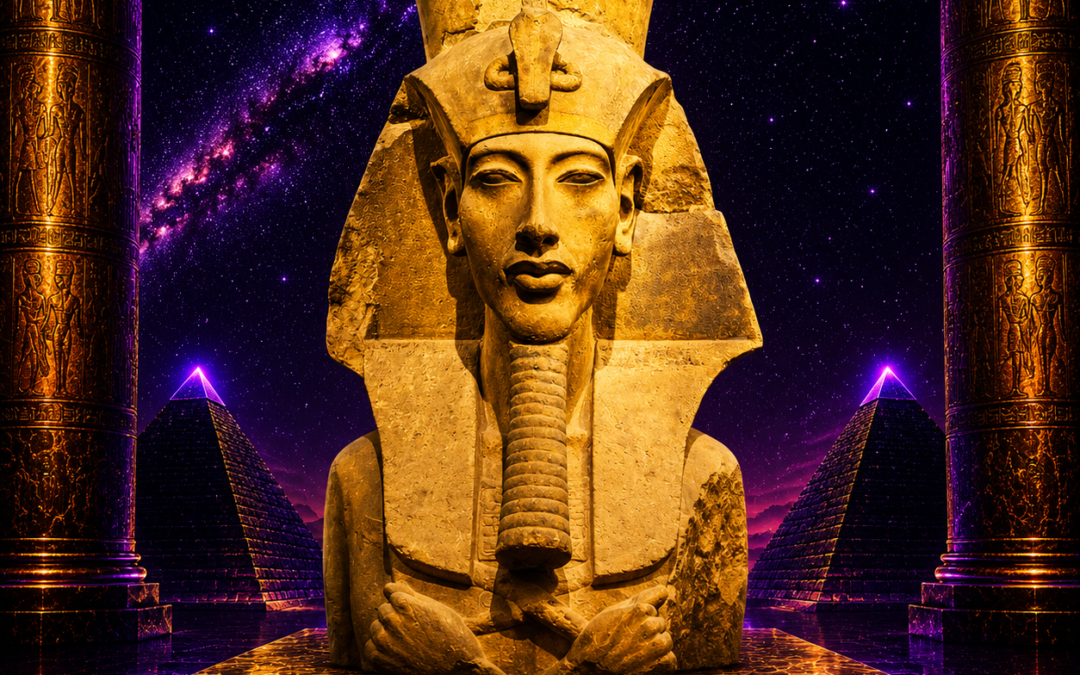
Akhenaten: The Revolutionary Pharaoh Who Changed Ancient Egypt Forever
Few rulers in the history of ancient Egypt have inspired as much fascination, controversy, and debate as Pharaoh Akhenaten. During the 18th Dynasty of Egypt’s New Kingdom, Akhenaten launched sweeping changes that challenged long-established religious traditions, transformed Egyptian art, and created an entirely new royal capital.
Originally known as Amenhotep IV, the pharaoh elevated the solar deity Aten to an extraordinary position within Egyptian religion. He changed his own name, abandoned the traditional royal center at Thebes, established the city of Akhetaten, modern-day Amarna, and promoted a radically different vision of kingship and divine worship.
His revolution did not survive him.
After Akhenaten's death, Egypt's traditional religious institutions returned, his new capital was largely abandoned, and later rulers attempted to erase his legacy. Yet more than 3,000 years later, Akhenaten remains one of the most recognizable and mysterious pharaohs of ancient Egypt.
Who was Akhenaten, and why did his reign change Egypt so dramatically?
Who Was Pharaoh Akhenaten?
Akhenaten was an ancient Egyptian pharaoh of the 18th Dynasty, ruling during the New Kingdom in the 14th century BCE. He was the son of Pharaoh Amenhotep III and Queen Tiye, one of the most influential royal women of her era.
Akhenaten came to the throne as Amenhotep IV.
The name Amenhotep can be understood as meaning “Amun is satisfied” or “Amun is content,” connecting the king directly with Amun, whose cult had become immensely powerful during the New Kingdom.
But Amenhotep IV would eventually break dramatically with that religious tradition.
Around the fifth year of his reign, the king changed his name to Akhenaten, generally translated along the lines of “Effective for the Aten” or “Beneficial to the Aten.”
The change represented far more than a new royal name. It symbolized the extraordinary religious transformation taking place throughout Egypt.
Akhenaten and the Rise of Aten
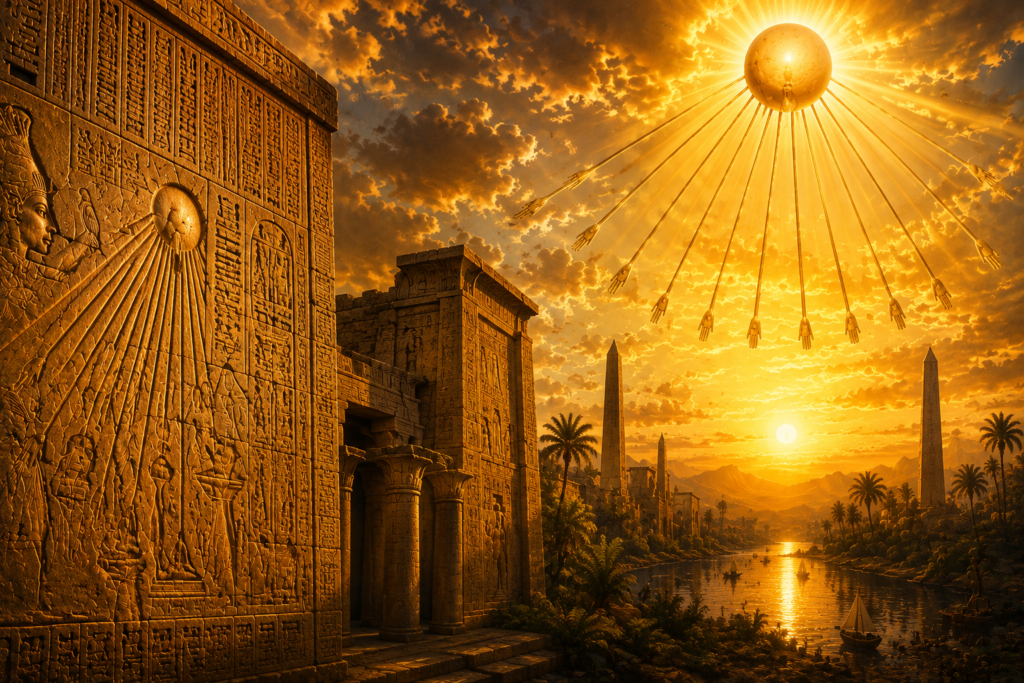
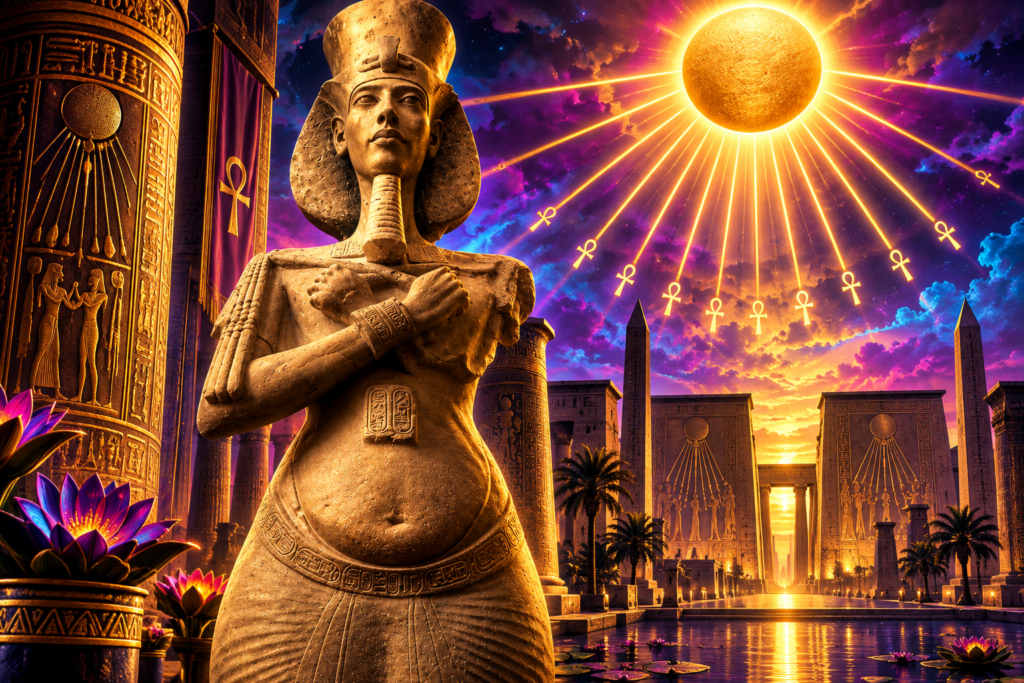
The Aten was represented as the visible disk of the sun. Depictions from Akhenaten's reign commonly show rays extending downward from the solar disk, with small hands at their ends.
Some of these hands present the ankh, the ancient Egyptian symbol of life, toward Akhenaten and members of the royal family.
Solar worship was not invented by Akhenaten. The sun had occupied a central place in Egyptian religion for centuries, and Aten itself existed before his reign.
What changed under Akhenaten was the Aten's position.
As his reign progressed, Akhenaten increasingly elevated Aten while restricting or suppressing the worship of other traditional gods, particularly Amun.
Names and images of Amun were removed or damaged in various places, while the Aten became the overwhelming focus of the state religion.
This was one of the most dramatic religious transformations ever attempted by an Egyptian pharaoh.
Did Akhenaten Invent Monotheism?
Akhenaten is frequently described as the world's first monotheist, but the reality is more complicated.
His religious reforms unquestionably concentrated royal and state worship around Aten to an extraordinary degree. Other gods were marginalized, and traditional cults suffered under his reforms.
However, scholars continue to debate whether Akhenaten's religion should be classified as true monotheism belief that only one god exists, or something closer to monolatry, in which one deity receives exclusive or supreme worship without necessarily denying every other divine being.
This distinction is important.
Akhenaten's religious system also placed the pharaoh and his family between Aten and the Egyptian population. Rather than simply creating a religion in which everyone independently worshipped a universal god, Akhenaten remained central to the relationship between humanity and Aten.
For this reason, calling him the “first monotheist” can oversimplify a complex religious revolution.
What can be said with confidence is that Akhenaten attempted one of the most radical reorganizations of religion known from ancient Egypt.
Akhetaten: The New City of the Aten
Akhenaten's revolution required more than temples and theology.
It required a new city.
The pharaoh established a royal capital called Akhetaten, meaning approximately “Horizon of the Aten.” Today, its archaeological remains are known as Amarna.
The location was significant because Akhenaten presented the site as territory belonging specifically to Aten rather than one already dominated by Egypt's established religious institutions.
Boundary stelae carved into cliffs surrounding the region recorded the king's dedication of the city.
Akhetaten became the center of Akhenaten's new religious order.
Palaces, administrative buildings, residences, temples, workshops, and other structures were constructed there, creating a functioning royal city within a relatively short period.
The city's temples were also suited to Aten worship. Because Aten was represented through the sun's disk and rays, worship emphasized open spaces where sunlight could reach offerings directly.
The city became the physical embodiment of Akhenaten's revolution.
Akhenaten and Queen Nefertiti

No discussion of Akhenaten is complete without Queen Nefertiti.
Nefertiti was Akhenaten's Great Royal Wife and one of the most famous women of ancient Egypt. During the Amarna Period, she appears prominently in religious and royal imagery.
Her visibility is remarkable.
Nefertiti is shown participating alongside Akhenaten in ceremonies, presenting offerings to Aten, and appearing with their children beneath the life-giving rays of the solar disk.
In some scenes, she assumes positions and gestures associated with royal power.
This prominence has led to extensive debate about her political and religious authority.
Some scholars have proposed that Nefertiti eventually served as Akhenaten's co-regent or even ruled independently after his death under another royal name. The exact sequence of rulers at the end of the Amarna Period remains one of Egyptology's most complicated questions.
What is clear is that Nefertiti occupied an unusually visible position in Akhenaten's new royal and religious order.
The Famous Amarna Art Revolution
Akhenaten's reign transformed more than religion.
Egyptian royal art changed dramatically.
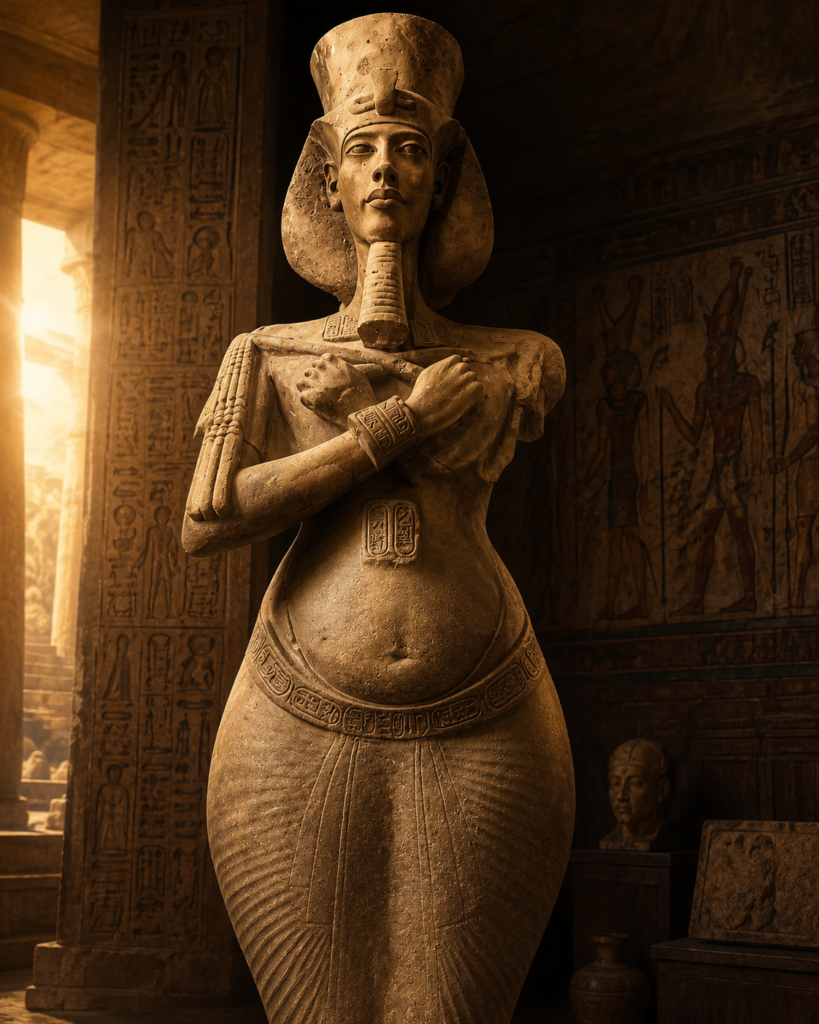
Earlier representations of pharaohs generally emphasized idealized strength, symmetry, youth, and divine perfection. During the Amarna Period, royal figures were portrayed with strikingly different characteristics.
Akhenaten was depicted with:
- An elongated face and skull
- Narrow eyes
- Full lips
- A long neck
- A prominent abdomen
- Broad hips and thighs
- Slender arms and legs
These images are among the most recognizable works of ancient Egyptian art.
The reasons for Akhenaten's unusual appearance remain debated.
Older theories attempted to diagnose the pharaoh with various medical or genetic conditions based primarily on artistic representations. Such interpretations are speculative and should be treated cautiously. Art created during Akhenaten's reign was highly stylized, and the unusual body proportions may have communicated religious or ideological concepts rather than recording his literal physical appearance.
Amarna art also introduced unusually intimate royal scenes.
Akhenaten and Nefertiti can be seen interacting affectionately with their daughters beneath Aten's rays. These images provide a striking contrast to the more formal royal imagery associated with many other periods of Egyptian history.
The Great Hymn to the Aten
One of the most famous religious texts associated with the Amarna Period is the Great Hymn to the Aten.
The hymn survives in the tomb of Ay at Amarna and praises Aten as a life-giving solar power whose light sustains creation.
It describes the world awakening when the sun rises and becoming dark and inactive when the sun disappears. People, animals, plants, and distant lands all depend upon the Aten's light.
The text is important because it provides insight into the theology promoted during Akhenaten's reign.
The Aten was not presented merely as a local deity. The solar power was portrayed as sustaining life across different peoples and lands.
This universal quality has contributed greatly to modern fascination with Akhenaten's religion.
Is the Hymn to Aten Connected to Psalm 104?
A particularly fascinating debate involves similarities between the Great Hymn to the Aten and Psalm 104 in the Hebrew Bible.
Both compositions contain imagery involving sunlight, darkness, animals, creation, ships, and the ordering or sustaining of life.
These parallels have prompted some writers to suggest that the Aten hymn may have influenced later Hebrew religious literature.
However, similarity does not establish direct borrowing.
The chronology, transmission mechanisms, and broader traditions of ancient Near Eastern religious poetry make the relationship difficult to prove. Scholars therefore debate how much significance should be attached to the parallels.
It is more accurate to say that the two texts contain noteworthy thematic similarities than to claim as established fact that one was copied from the other.
Akhenaten, Moses, and the Monotheism Theory
Akhenaten's religious revolution has also inspired theories connecting him with Moses and the development of biblical monotheism.
Perhaps the most famous modern thinker to explore this connection was Sigmund Freud, who proposed in Moses and Monotheism that Moses may have been influenced by Akhenaten's Aten religion.
Other writers have gone much further, sometimes arguing that Akhenaten and Moses were actually the same person.
There is no accepted historical or archaeological evidence establishing that Akhenaten was Moses.
These ideas remain speculative.
Nevertheless, the comparison persists because Akhenaten's reign raises an extraordinary historical question: how did such a radical concentration of worship around a single deity emerge in Egypt during the second millennium BCE?
The question is legitimate even when sensational conclusions are not.
What Happened to Egypt During Akhenaten's Reign?
While Akhenaten concentrated enormous attention on religious transformation, Egypt still faced the political realities of an international empire.
One of the most valuable sources for this period is the collection known as the Amarna Letters.
These clay tablets preserve diplomatic correspondence involving Egypt and rulers or officials throughout the ancient Near East.
They reveal a complicated international world of alliances, marriages, gifts, disputes, territorial competition, and requests for Egyptian assistance.
Some of Egypt's vassals appealed to the pharaoh for military support as political conditions changed in the region.
Akhenaten has consequently been portrayed by some accounts as a ruler so consumed with religion that he neglected Egypt's empire.
That interpretation should be approached cautiously.
The Amarna Letters demonstrate serious geopolitical pressures, but reconstructing precisely how Akhenaten responded, and how much territory was actually lost because of his policies, is more difficult than the popular image of a completely disengaged pharaoh suggests.

Akhenaten's Family
Akhenaten and Nefertiti are shown with several daughters in Amarna-period inscriptions and artwork.
Among them were:
Meritaten, Meketaten, Ankhesenpaaten, Neferneferuaten Tasherit, Neferneferure, and Setepenre.
Ankhesenpaaten would later become particularly important.
Following the restoration of Egypt's traditional religion, her name was changed to Ankhesenamun, reflecting the renewed importance of Amun.
She became the wife of one of the most famous pharaohs in history:
Tutankhamun.
Was Tutankhamun Akhenaten's Son?
Evidence strongly supports a close family relationship between Tutankhamun and Akhenaten, and genetic research on royal mummies has been interpreted as identifying Tutankhamun's father with the male buried in tomb KV55.
Many Egyptologists identify the KV55 individual as Akhenaten, although aspects of the identification and reconstruction of the Amarna royal family have generated scholarly debate.
Tutankhamun's original name was Tutankhaten, meaning approximately “Living Image of Aten.”
That name alone demonstrates how closely his early life was connected to the religious world created by Akhenaten.
But that world was about to disappear.
The Death of Akhenaten and the Collapse of His Revolution
Akhenaten died after approximately 17 years of rule.
What happened immediately afterward remains complicated because the succession at the end of the Amarna Period is not completely understood.
Names such as Smenkhkare and Neferneferuaten appear in the surviving evidence, and historians continue to debate their identities, relationships, and precise order of rule.
Eventually, the young Tutankhaten came to the throne.
During his reign, the religious revolution of Akhenaten was reversed.
Traditional gods and temples were restored. Amun regained prominence. Tutankhaten changed his name to Tutankhamun, publicly signaling the restoration.
The royal court also abandoned Akhetaten.
Akhenaten's dream city began to empty.
The Attempt to Erase Akhenaten From History
The backlash did not end with the abandonment of Amarna.
Later rulers worked to dismantle Akhenaten's legacy.
His monuments were taken apart. Blocks from his buildings were reused in later construction. His name and images were attacked, and he was excluded from some later king lists.
In later records, Akhenaten could be referred to indirectly as the “enemy” or “criminal” of Akhetaten.
This was effectively a form of damnatio memoriae, the destruction or suppression of a person's public memory, although that term itself comes from Roman historical practice.
For ancient Egyptians, the consequences had profound religious significance.
A person's continued existence after death was closely associated with the preservation and remembrance of the name. Destroying a ruler's name and image therefore carried implications far beyond ordinary political criticism.
Akhenaten was not simply being rejected.
His revolution was being systematically dismantled.
Why Did Akhenaten's Revolution Fail?
Several factors probably contributed.
His religious reforms were deeply connected to the authority and personality of the king himself. They disrupted institutions that had existed for centuries and challenged powerful temple establishments.
Amun's priesthood and traditional cults were deeply embedded within Egyptian society.
Akhenaten's new system also concentrated religious access around the king and royal family.
Once Akhenaten was gone, there may have been little institutional foundation capable of preserving the revolution against supporters of Egypt's traditional religious order.
Within a relatively short period, the old gods returned.
Akhetaten was abandoned.
And Aten ceased to dominate Egyptian state religion.
Was Akhenaten a Visionary or a Heretic?
That depends greatly on perspective.
To modern observers, Akhenaten can appear remarkably innovative, a ruler willing to challenge centuries of tradition and reconstruct Egyptian religion, art, architecture, and royal ideology.
From the perspective of those committed to traditional Egyptian religion, however, his policies may have represented a dangerous disruption of Ma'at, the principle of cosmic and social order.
The Egyptians depended upon the gods, and the pharaoh was responsible for maintaining proper relations between the divine and earthly worlds.
Suppressing established gods and their temples could therefore be understood not simply as religious reform but as a threat to the order sustaining Egypt itself.
That helps explain the intensity of the reaction after his death.
The Enduring Mystery of Pharaoh Akhenaten
Akhenaten's experiment lasted less than two decades.
Yet few pharaohs have generated more discussion.
He challenged one of the world's oldest religious systems.
He elevated Aten above Egypt's traditional gods.
He created a new capital.
He transformed royal art.
He placed Nefertiti and the royal family at the center of a new visual and religious ideology.
And after his death, much of what he created was deliberately dismantled.
Ironically, the attempt to erase Akhenaten helped make his rediscovery even more compelling.
Modern archaeology at Amarna, surviving sculptures, inscriptions, diplomatic tablets, and reconstructed monuments have allowed researchers to piece together the extraordinary story of a pharaoh whom later Egyptian rulers wanted history to forget.
Akhenaten's Legacy in Ancient Egypt
Akhenaten's greatest historical significance may not be that his revolution succeeded.
It is that he attempted it at all.
Ancient Egyptian civilization was remarkably capable of absorbing political changes while preserving religious traditions stretching across centuries. Akhenaten interrupted that continuity in a dramatic way.
His reign forces us to reconsider the idea that ancient Egypt was culturally static.
It wasn't.
Egyptian civilization contained periods of innovation, conflict, experimentation, restoration, and transformation.
Akhenaten represents one of the most dramatic examples.
He remains simultaneously a pharaoh, religious reformer, political ruler, husband of Nefertiti, father within the Amarna royal family, patron of revolutionary art, and one of ancient Egypt's greatest historical mysteries.
More than three millennia after his death, the questions surrounding him remain powerful:
Did Akhenaten believe he was restoring a forgotten divine truth? Was his revolution driven by faith, politics, royal authority, or all three?
The surviving evidence cannot answer every question.
But one thing is certain:
Akhenaten changed ancient Egypt, and Egypt spent generations trying to undo what he had begun.