The Egyptian Zodiac: Discover the 12 Signs and the Powerful Truth Behind Ancient Egyptian Astrology
Search for the Egyptian zodiac today and you will often encounter twelve signs associated with Egyptian deities and sacred figures such as Amun-Ra, Mut, Geb, Osiris, Aset (Isis), Djehuty (Thoth), Horus, Anpu (Anubis), Set, Bastet, and Sekhmet.
These signs are commonly assigned birth dates and personality traits, creating what is often called the 12 signs of the Egyptian zodiac.
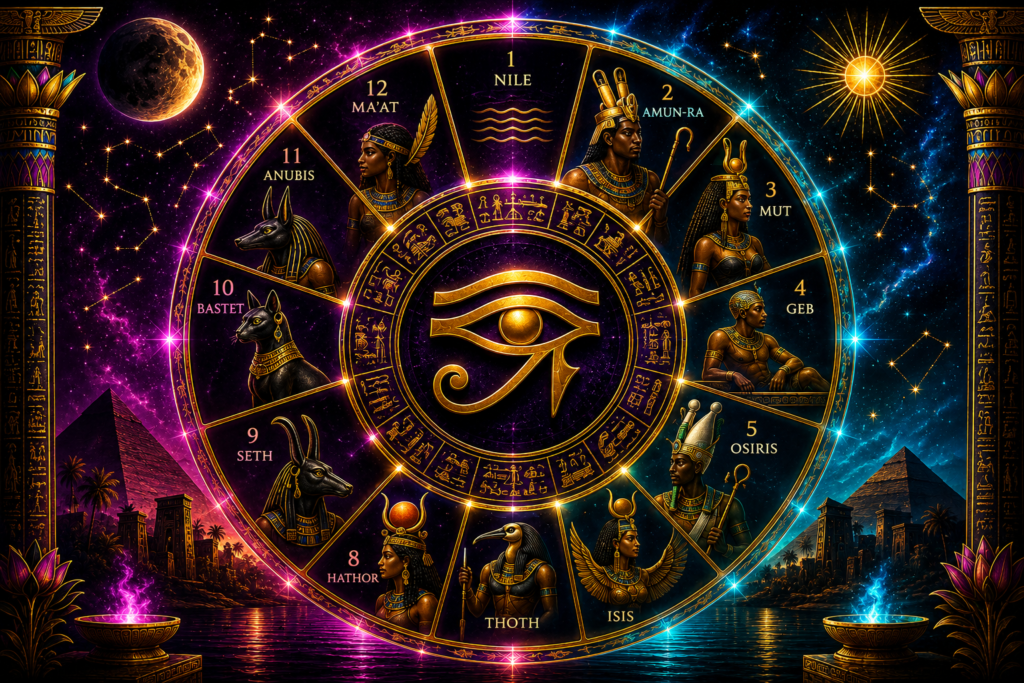
There is one important historical distinction, however: this popular twelve-deity birth-sign system is not known from surviving ancient Egyptian texts as an original pharaonic zodiac.
Ancient Egyptians absolutely possessed sophisticated traditions for observing the sky, measuring time, organizing calendars, tracking stars, and connecting celestial phenomena with religion. But the evidence they left behind reveals something considerably more complex than the modern Egyptian zodiac found online.
To understand the Egyptian zodiac accurately, we therefore need to separate two subjects:
the popular modern Egyptian zodiac inspired by Egyptian deities, and the documented astronomical and celestial traditions of ancient Kemet.
Let's explore both.
What Is the Egyptian Zodiac?
The term Egyptian zodiac is commonly used today for a twelve-sign astrological system in which different periods of the year are assigned to Egyptian gods, goddesses, or sacred concepts.
The twelve commonly presented signs are:
- The Nile
- Amun-Ra
- Mut
- Geb
- Osiris
- Aset (Isis)
- Djehuty (Thoth)
- Horus
- Anpu (Anubis)
- Set
- Bastet
- Sekhmet
You'll frequently find these signs accompanied by birth dates and descriptions of supposed personality characteristics.
These associations can provide an interesting modern spiritual or astrological way of exploring Egyptian deities, but they should not be confused with a documented system used by Egyptians during the pharaonic periods.
No surviving ancient Egyptian source currently establishes this exact collection of twelve deities as birth signs with the modern date ranges and personality profiles commonly reproduced today.
That doesn't mean Egypt lacked celestial systems.
Quite the opposite.
Ancient Egyptian astronomical traditions were extensive, and the surviving evidence allows us to explore what Egyptians actually recorded about the heavens.
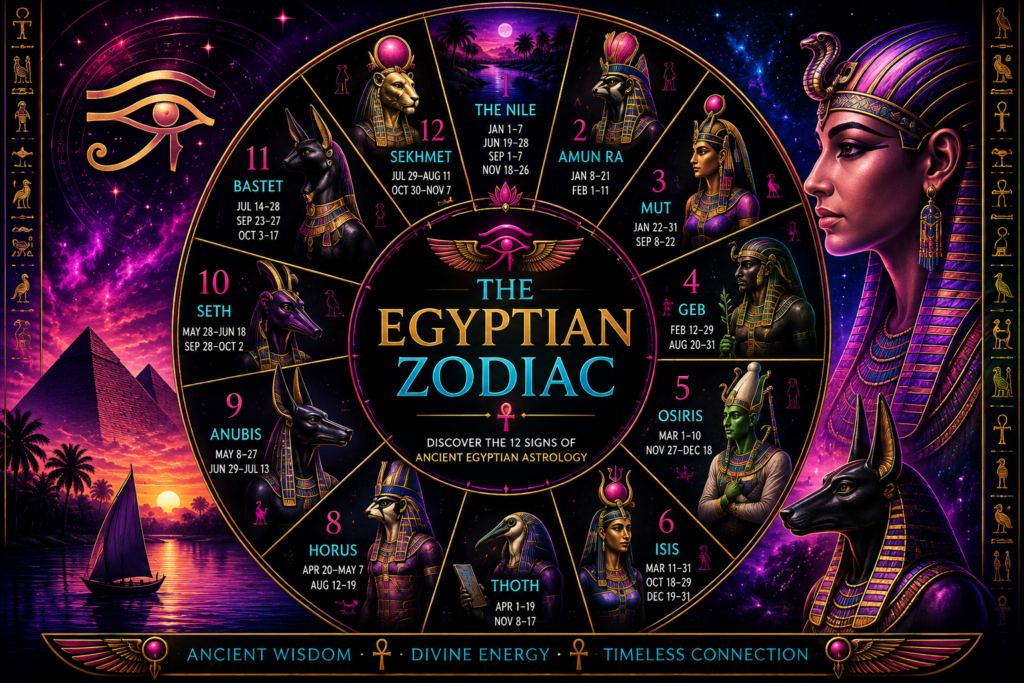
The 12 Popular Egyptian Zodiac Signs
The following are the twelve signs most commonly encountered in the modern Egyptian zodiac.
The personality descriptions associated with them belong to modern astrological interpretation rather than documented ancient Egyptian teachings.
1. The Nile
The Nile is commonly presented as the first Egyptian zodiac sign.
Modern interpretations associate this sign with peacefulness, adaptability, intuition, and wisdom.
Historically, however, the Nile was far more than an astrological symbol. Its cycles shaped agriculture, settlement, transportation, religious practice, and the economic foundations of Egyptian civilization.
Modern associations: Adaptability, intuition, peacefulness and awareness.
2. Amun-Ra
Amun-Ra combines Amun, an enormously important deity whose prominence increased dramatically during the New Kingdom, with Ra, one of Egypt's major solar deities.
Modern Egyptian zodiac traditions associate Amun-Ra with leadership, confidence, ambition, and optimism.
These personality characteristics should be understood as modern zodiac interpretations, not personality descriptions assigned to people born under Amun-Ra in surviving pharaonic texts.
Modern associations: Leadership, confidence, ambition and determination.
3. Mut
Mut was an important Egyptian goddess whose name is closely connected with the concept of mother.
She became particularly prominent at Waset, modern Luxor, where she was associated with Amun and Khonsu.
In modern Egyptian zodiac systems, Mut is associated with loyalty, protection, patience, and nurturing qualities.
Modern associations: Protection, loyalty, patience and compassion.
4. Geb
Geb was an Egyptian deity associated with the earth and an important figure within Egyptian creation traditions.
He was connected genealogically with Shu and Tefnut and with the sky goddess Nut.
Modern Egyptian zodiac interpretations describe people associated with Geb as dependable, sensitive, practical, and grounded.
Modern associations: Stability, sensitivity, reliability and connection with nature.
5. Osiris
Osiris, whose Egyptian name is conventionally rendered Wesir or Wsir, became one of the most important deities in Egyptian religious history.
He was profoundly associated with death, regeneration, legitimate kingship and the afterlife.
Modern zodiac traditions associate the Osiris sign with independence, resilience, passion, and personal transformation.
Modern associations: Resilience, independence, determination and transformation.
6. Aset (Isis)
Aset, better known internationally by the later name Isis, was among the most influential goddesses of ancient Egypt.
Her roles encompassed motherhood, protection, kingship, healing and powerful divine magic. She was the wife of Osiris and mother of Horus within one of Egypt's most enduring religious traditions.
Modern Egyptian zodiac systems associate Aset with compassion, loyalty, protection, confidence, and devotion.
Modern associations: Compassion, protection, loyalty and determination.
7. Djehuty (Thoth)
Djehuty, commonly known by the later name Thoth, was closely associated with writing, knowledge, calculation, wisdom and the moon.
He occupied an extraordinary intellectual role within Egyptian religion and appears repeatedly in religious and funerary texts.
Modern zodiac interpretations associate Djehuty with intelligence, curiosity, communication, creativity, and analytical thinking.
Modern associations: Intelligence, curiosity, communication and creativity.
8. Horus
Horus was one of ancient Egypt's most enduring divine figures.
Usually represented as a falcon or falcon-headed deity, Horus was intimately connected with kingship, royal legitimacy, protection and the sky.
Living Egyptian kings could be identified with Horus through royal ideology.
Modern Egyptian zodiac systems consequently associate Horus with leadership, courage, ambition and confidence.
Modern associations: Courage, leadership, protection and ambition.
9. Anpu (Anubis)
Anpu, commonly known today as Anubis, was closely associated with cemeteries, embalming, funerary rituals and protection of the deceased.
His recognizable jackal or jackal-headed imagery became one of the most famous visual traditions of ancient Egypt.
Modern Egyptian zodiac interpretations associate Anpu with independence, introspection, observation, mystery and emotional depth.
Modern associations: Independence, observation, introspection and determination.
10. Set
Set was a complicated and powerful Egyptian deity.
His roles changed considerably across Egyptian history. He could be associated with the desert, storms, strength, disorder and conflict, yet Egyptian religious tradition cannot accurately be reduced to the idea that Set was simply an embodiment of “evil.”
Modern zodiac systems associate Set with boldness, independence, competitiveness and adventurousness.
Modern associations: Boldness, independence, strength and determination.
11. Bastet
Bastet was an important Egyptian goddess whose character and iconography developed significantly over Egypt's long history.
She became particularly associated with protection, domestic life, fertility, women, music and feline imagery.
Modern Egyptian zodiac interpretations associate Bastet with intuition, independence, charm and protection.
Modern associations: Intuition, independence, protection and harmony.
12. Sekhmet
Sekhmet was the formidable lioness goddess whose powers could encompass destruction, warfare, royal protection, disease and healing.
This combination of destructive and restorative power illustrates how Egyptian deities could embody forces that modern categories sometimes struggle to capture.
Modern Egyptian zodiac traditions associate Sekhmet with discipline, strength, courage and intensity.
Modern associations: Strength, discipline, courage and passion.
Did Ancient Egyptians Actually Have a Zodiac?
This question requires a careful answer.
Ancient Egyptians developed extensive astronomical, calendrical and celestial traditions, but the popular twelve-deity Egyptian zodiac described above is not currently documented as a pharaonic birth-sign system.
The evidence instead reveals Egyptians observing the movement of stars, organizing time through celestial phenomena and incorporating the sky into religious understandings of the cosmos.
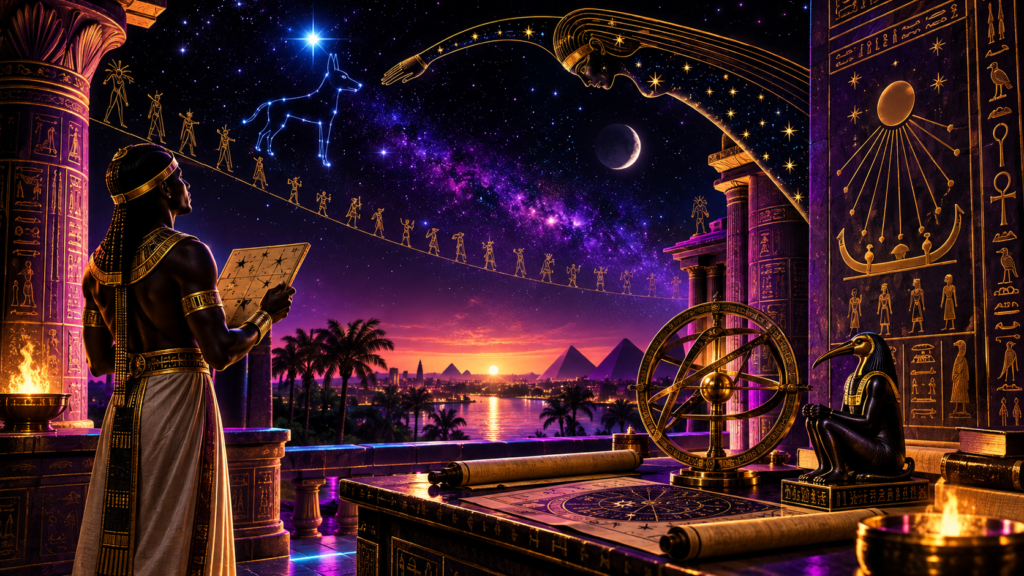
One of the most important components of this tradition involved star groups now commonly called decans.
The Decans: A Genuine Ancient Egyptian Celestial System
Long before the famous circular zodiac at Dendera was created, Egyptians were recording groups of stars used in systems for tracking the night.
Modern Egyptology commonly refers to these star groups as decans.
Sequences of these celestial groups appear in some of ancient Egypt's remarkable diagonal star tables, including examples preserved on Middle Kingdom coffins.
The star groups appeared at regular intervals through the year and could be used to mark portions of the night.
This is an essential distinction for anyone researching ancient Egyptian astrology and astronomy.
The decans are supported by actual Egyptian archaeological and textual evidence. The popular twelve deity-based personality signs are not documented in the same way.
Egyptian Star Clocks and the Measurement of Night
Ancient Egyptian interest in the sky was practical, religious and intellectual.
Diagonal star tables arranged celestial information in a systematic fashion. Sequences of stars could help identify the progression of nighttime hours.
Later astronomical ceilings provide additional evidence.
One particularly important example survives from the tomb of Senenmut, a high official during the reign of Hatshepsut in the Eighteenth Dynasty.
Its astronomical ceiling depicts celestial figures and contains information concerning stars, planets, decans, months and divisions of time.
These surviving records demonstrate something far more substantial than a generalized claim that Egyptians “believed in astrology.”
They demonstrate systematic observation and organization of celestial phenomena within an Egyptian cultural and religious framework.
Sopdet: One of Ancient Egypt's Most Important Stars
Few stars were as culturally significant in Egypt as Sopdet, the brilliant star known today as Sirius.
The reappearance of Sopdet in the predawn sky after a period of invisibility became associated with Egyptian calendrical traditions and the approach of the Nile's inundation.
The Nile flood itself ultimately depended upon seasonal rainfall far to Egypt's south in the African interior, particularly the Ethiopian highlands.
This relationship connected Egyptian civilization to a much larger African environmental system.
Sopdet also possessed religious significance and became closely associated with Aset.
Rather than simply assigning a personality type to someone born beneath a zodiac sign, Egyptian celestial traditions integrated time, environment, kingship, religion, agriculture and the cosmos.
The Ancient Egyptian Calendar and the Heavens
Egyptian civilization developed a civil calendar of 365 days.
It consisted of twelve months containing thirty days each, producing 360 days, followed by five additional days.
The year was also organized around three major seasons:
Akhet — associated with inundation
Peret — associated with emergence and growing
Shemu — associated with harvest and the dry season
The Egyptian calendar demonstrates how observations of nature and the heavens became incorporated into systems that organized society and ritual life.
Egyptian celestial knowledge was therefore not an isolated practice.
It was part of the way Egyptians understood time itself.
Nut and the Egyptian Vision of the Sky
The heavens also possessed profound religious meaning.
Nut, the Egyptian sky goddess, could be depicted arching across the world, her body filled with stars.
Egyptian religious texts describe celestial cycles involving the sun and stars moving through the cosmic realm.
This imagery illustrates an important feature of Egyptian thought: astronomy and religion were not necessarily separated into the modern categories we use today.
Observation of celestial cycles existed within a worldview in which the universe itself possessed sacred order and meaning.
What About the Dendera Zodiac?
No discussion of the Egyptian zodiac would be complete without the famous Dendera Zodiac.
The circular relief comes from the Temple of Hathor complex at Dendera in Upper Egypt and is now preserved at the Louvre.
It includes representations of zodiac figures, constellations, decans and Egyptian divine imagery.
However, its date is crucial.
The surviving circular zodiac is generally dated to approximately 50 BCE, during the Ptolemaic period, thousands of years after the beginnings of Egyptian civilization.
By this period Egypt had experienced centuries of interaction with neighboring cultures.
The Dendera Zodiac therefore provides extraordinary evidence for late Egyptian celestial traditions and the adaptation of zodiac imagery within an Egyptian religious environment.
It should not be projected backward thousands of years as evidence that Old Kingdom or Middle Kingdom Egyptians practiced the same twelve-sign zodiac system.
That distinction is essential.
Egyptian Astronomy Was Part of an African Intellectual Tradition
Ancient Egypt developed within northeastern Africa, and its astronomical achievements belong within the history of African knowledge and civilization.
This context deserves particular attention.
Senegalese scholar Cheikh Anta Diop repeatedly argued for recognizing ancient Egypt as fundamental to understanding African history and intellectual development. His work addressed Egyptian mathematics, astronomy, calendrical knowledge, cultural history and Egypt's relationship with the wider African continent.
Individual chronological reconstructions proposed by Diop, like those proposed by other scholars, remain subjects for scholarly examination rather than facts that should simply be repeated without qualification.
But his broader insistence that ancient Egyptian science be examined within African history rather than detached from Africa remains important to the way Kemet Hive approaches the subject.
Egypt's astronomical traditions should therefore be understood simultaneously as Egyptian achievements and as part of the extraordinarily deep history of intellectual activity on the African continent.
Egyptian Zodiac vs. Ancient Egyptian Astronomy
Understanding the distinction between the two actually makes ancient Egypt more interesting.
The modern Egyptian zodiac provides twelve deity-inspired signs associated with birth dates and personality characteristics.
Documented ancient Egyptian celestial traditions provide something different:
star clocks, decans, astronomical ceilings, calendars, observations of Sopdet, celestial deities, religious texts and systems for organizing the passage of time.
The latter are supported directly by surviving artifacts and inscriptions.
The former is better understood as a modern astrological tradition inspired by Egyptian religion.
Both can be discussed, but they should not be presented as the same thing.
So What Is Your Egyptian Zodiac Sign?
Readers interested in modern Egyptian astrology can still explore the twelve popular signs and discover which deity is traditionally assigned to their birth period.
But instead of stopping with a personality description, use that sign as an invitation to investigate the actual Egyptian deity behind the modern association.
If your modern sign is Aset, learn about Aset's historical role in Egyptian religion.
If it is Djehuty, explore Egyptian writing, wisdom and lunar traditions.
If it is Anpu, investigate Egyptian embalming and funerary practices.
If it is Sekhmet, examine her complex relationship with protection, healing and destructive divine power.
That approach transforms a modern zodiac curiosity into an opportunity to discover authentic Egyptian history.
The Powerful Truth Behind the Egyptian Zodiac
Ancient Egyptians did not need the modern twelve-deity zodiac to demonstrate an extraordinary understanding of the heavens.
Their surviving monuments and texts reveal generations of observation.
They watched stars rise and disappear. They organized nighttime through celestial movements. They developed calendars. They connected Sopdet with cycles of the year. They recorded star groups on coffins and astronomical information on tomb ceilings. They incorporated celestial bodies into some of their most profound ideas about existence, death, regeneration and cosmic order.
The popular 12 signs of the Egyptian zodiac can therefore serve as an accessible introduction to Egyptian symbolism, but they should never replace the documented history.
The authentic story is richer.
Ancient Kemet possessed a sophisticated celestial tradition rooted in observation, religion, timekeeping, the Nile environment and an African understanding of humanity's relationship with the cosmos.
And thousands of years later, the surviving evidence continues to reveal just how closely ancient Egyptians watched the sky.