Discover the fascinating history of the Eye of Horus, its connection to Heru, its role in ancient Egyptian protection and restoration, and what the archaeological evidence reveals about one of Kemet's most recognizable sacred symbols.
What Is the Eye of Horus?
The Eye of Horus, known in ancient Egyptian tradition as the Wedjat Eye, is one of the most enduring religious symbols of ancient Kemet (Egypt). Associated with the falcon god Heru (Horus), the eye represented protection, restoration, wholeness, and the renewal of life.
For thousands of years, ancient Egyptians incorporated the Wedjat Eye into jewelry, amulets, funerary objects, religious imagery, and ritual practices. Its significance extended beyond decoration. It expressed an important religious idea: that what had been damaged or disrupted could be restored to completeness.
The ancient Egyptian term wḏꜣt, commonly rendered as wedjat or udjat, is associated with being sound, intact, or whole. This meaning reflects the mythology of the injured eye of Heru, which was healed and restored.
Although the symbol is frequently described today as the Eye of Horus, understanding its original Egyptian name and religious context provides a deeper appreciation of its place in ancient African civilization.
The Ancient Egyptian Name and Meaning of the Wedjat Eye
The word Wedjat comes from the ancient Egyptian language and expresses the condition of being restored, healthy, or intact.
This meaning was central to the symbol's religious importance.
In ancient Egyptian thought, wholeness was not simply a physical condition. Restoration could also carry religious significance, particularly in relation to divine order, healing, kingship, and the continuation of life after death.
The Wedjat Eye therefore represented several interconnected concepts:
- Protection: Safeguarding the living and deceased against harmful forces.
- Restoration: The recovery of something damaged or lost.
- Wholeness: The return to an intact and complete condition.
- Regeneration: The renewal of life and vitality.
- Divine well-being: The preservation of health and sacred order.
These meanings emerged from Egyptian religious traditions and were reinforced through centuries of ritual practice.
The Myth of Heru and the Restoration of the Sacred Eye
The mythology of the Eye of Horus is closely connected to Heru, the falcon deity associated with kingship, the sky, and divine authority.
In Egyptian religious traditions, Heru became involved in a struggle with Set (Seth), a powerful deity associated with conflict, storms, and disruptive forces.
The conflict was connected to the murder of Wesir (Osiris), the father of Heru, and the struggle over rightful kingship.
During the contest, Heru suffered an injury to his eye.
Different Egyptian texts preserve variations of this episode. Some describe the eye being damaged, removed, or otherwise harmed. Its restoration became a major religious theme.
The god Djehuty (Thoth), associated with wisdom, writing, and sacred knowledge, plays an important role in healing or restoring the eye in several traditions.
Once restored, the eye became the Wedjat: the sound or complete eye.
Why the restoration mattered
The recovered eye was not simply a sign that Heru had survived an injury.
It became a powerful expression of the restoration of divine order after conflict.
In Egyptian funerary traditions, the restored eye could also be offered to Wesir, helping express his renewed vitality and the continuation of existence beyond death.
This connection explains why the Wedjat Eye became especially important in mortuary rituals.
The myth carried a message that resonated throughout Egyptian religion: damage, disorder, and loss could be overcome through restoration and renewal.
Eye of Horus vs. Eye of Ra: What Is the Difference?
The Eye of Horus and the Eye of Ra are frequently confused because both appear in Egyptian religious imagery and can share similar visual forms.
However, their mythological associations are not identical.
| Eye of Horus (Wedjat) | Eye of Ra |
|---|---|
| Associated particularly with Heru | Associated with the solar deity Ra |
| Famous for its injury and restoration | Often expresses solar power and divine authority |
| Represents protection, wholeness, and renewal | Frequently represents protective and potentially destructive divine force |
| Prominent in healing and funerary symbolism | Prominent in solar mythology and protective goddess traditions |
The distinction should not be treated as absolute. Ancient Egyptian religious symbolism was flexible, and the meanings of divine eyes sometimes overlapped.
In some traditions, the eyes of Heru were associated with the sun and moon, while the Eye of Ra could be personified through goddesses such as Sekhmet, Hathor, or Tefnut.
Both traditions demonstrate the importance of divine sight and protective power in Egyptian religion.
The Wedjat Eye has a distinctive appearance that makes it recognizable even when separated from other Egyptian religious imagery.
Its design generally includes a prominent eye, an eyebrow, a curved marking beneath the eye, and an extended line descending from its outer region.
These features are often interpreted in relation to the markings around the eyes of falcons, particularly birds associated with Heru.
The falcon was an important symbol of royal and divine authority in ancient Egypt.
The eye's design combined recognizable visual elements with religious symbolism, creating an image that could be reproduced across many materials and scales.
Ancient artisans fashioned Wedjat Eyes from faience, stone, precious metals, and other materials. The symbol also appeared in painted decoration and carved reliefs.
Its widespread use demonstrates that the Wedjat Eye was not restricted to royal settings. It became a recognizable protective emblem throughout different levels of Egyptian society.
How Ancient Egyptians Used the Eye of Horus for Protection
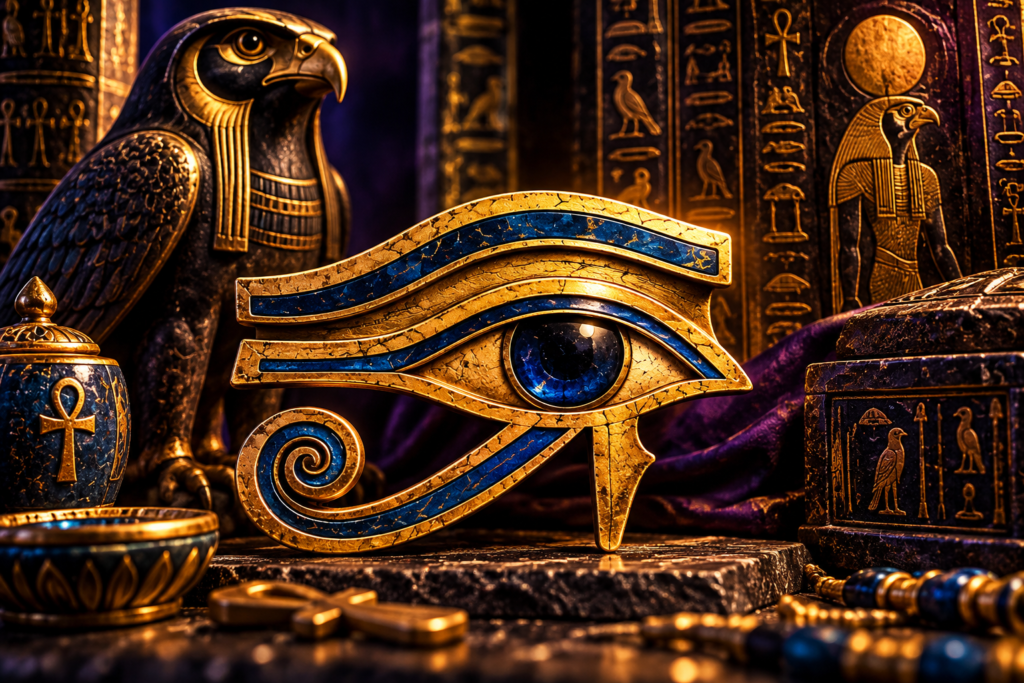
The Wedjat Eye was among the most common protective amulet designs in ancient Egypt.
Amulets were objects believed to provide benefits through their religious symbolism, materials, inscriptions, or ritual associations.
Wedjat amulets could be worn by the living and placed with the deceased.
Protection during everyday life
Ancient Egyptians wore protective amulets to seek divine safeguarding and well-being.
A Wedjat Eye pendant or small amulet could symbolize the protection associated with the restored eye of Heru.
The choice of materials and colors could add further religious significance.
Blue and green Egyptian faience, for example, were widely used in amulet production and could evoke renewal, fertility, and life.
Protection in the afterlife
The Wedjat Eye was also important in funerary contexts.
Examples have been recovered from burials, mummy wrappings, coffins, and other mortuary objects.
Within Egyptian funerary belief, the symbol was associated with the restoration and protection of the deceased.
Its connection to the renewed eye of Heru made it especially appropriate for religious practices concerned with overcoming death and achieving renewed existence.
The Eye of Horus in Ancient Egyptian Religious Texts
The Wedjat Eye appears in important ancient Egyptian religious compositions, including the Pyramid Texts, Coffin Texts, and Book of the Dead traditions.
These texts developed across different historical periods and preserve variations in Egyptian religious thought.
The Pyramid Texts
The Pyramid Texts, first preserved extensively in royal pyramids of the late Fifth and Sixth Dynasties, contain some of the earliest surviving substantial collections of Egyptian funerary spells.
They include references to the Eye of Horus as an offering and as a means of restoring vitality.
In several passages, the eye is presented to the deceased king, expressing the renewal of strength and the continuation of divine existence.
The Coffin Texts
The Coffin Texts expanded the surviving written record of funerary religious practices, particularly during the Middle Kingdom.
References to the Eye of Horus continued to express protection, renewal, and ritual restoration.
The eye could function symbolically as a divine offering or as a source of restored well-being.
The Book of the Dead
During the New Kingdom and later periods, compositions now commonly grouped under the Book of the Dead continued to incorporate the protective and regenerative symbolism of divine eyes.
The Wedjat Eye also appeared independently on funerary objects associated with the deceased person's journey into the afterlife.
Together, these sources demonstrate that the symbol's religious importance was not based on a single myth or one historical period.
Its meanings developed within a long and varied Egyptian religious tradition.
The Eye of Horus and Ancient Egyptian Fractions
One of the most interesting associations of the Eye of Horus concerns a system of fractional values.
In modern discussions of Egyptian mathematics, individual elements of the Wedjat Eye are frequently connected with fractions used in measuring grain and other commodities.
The familiar sequence is:
| Fraction | Decimal value |
|---|---|
| 1/2 | 0.5 |
| 1/4 | 0.25 |
| 1/8 | 0.125 |
| 1/16 | 0.0625 |
| 1/32 | 0.03125 |
| 1/64 | 0.015625 |
These six fractions add up to 63/64.
Egyptian mathematical sources establish the use of these fractional values in systems of measurement, particularly the heqat, a unit of capacity.
However, the popular diagram assigning each fraction to a particular anatomical feature of the Wedjat Eye should be treated carefully.
Although it is commonly repeated as an ancient Egyptian teaching, the full correspondence between the six drawn parts of the eye and the six fractions is not securely established by surviving ancient mathematical documents.
The historical use of the fractions is better documented than the familiar modern illustration.
This distinction matters because ancient Egyptian mathematics deserves recognition for its actual achievements rather than interpretations that cannot be fully verified.
The Eye of Horus, the Pineal Gland, and the Third Eye
In contemporary spiritual discussions, the Eye of Horus is sometimes associated with the pineal gland, the human brain, and the concept of a third eye.
The pineal gland is a small endocrine structure located within the brain. Its established biological functions include producing melatonin, a hormone involved in regulating sleep and circadian rhythms.
Modern illustrations sometimes compare the appearance of the Wedjat Eye with structures visible in a sagittal section of the human brain.
These comparisons have encouraged claims that the Eye of Horus was deliberately designed as an anatomical representation of the pineal gland or that ancient Egyptians used the symbol to encode knowledge of a spiritual third eye.
What does the historical evidence actually show?
Ancient Egyptians possessed meaningful anatomical knowledge, particularly through medical observation, injury treatment, and embalming practices.
The Edwin Smith Surgical Papyrus, for example, contains descriptions of head injuries and observations relating to the brain.
However, surviving Egyptian religious and medical texts do not establish that the Wedjat Eye was intended to represent the pineal gland.
Nor do they demonstrate that Egyptian priests understood the pineal gland as the biological location of spiritual enlightenment.
The familiar connection between the Eye of Horus and the third eye belongs primarily to modern symbolic and esoteric interpretation.
It should not be presented as a verified ancient Egyptian doctrine.
Can the Eye of Horus still carry a modern spiritual meaning?
Yes. People today may interpret the Wedjat Eye as a symbol of awareness, insight, balance, or spiritual reflection.
Such interpretations can hold personal or cultural significance.
The important distinction is between modern spiritual meaning and what ancient Egyptian evidence actually documents.
For Kemet Hive, recognizing that difference helps preserve the original African historical context while allowing readers to understand why the symbol continues to inspire contemporary spiritual thought.
Archaeological Evidence of the Wedjat Eye
The archaeological record provides substantial evidence of the Wedjat Eye's importance across ancient Egyptian history.
Objects bearing the symbol have been recovered from temples, settlements, tombs, and burial assemblages.
These include small faience amulets, jewelry, decorated coffins, funerary equipment, and religious offerings.
Wedjat Eye amulets
Small Wedjat Eye amulets are among the most recognizable surviving Egyptian protective objects.
Many were produced in Egyptian faience, a glazed material commonly associated with blue and green coloring.
Others were fashioned from stones, metals, and other materials.
Their sizes and forms varied considerably, indicating different practical and ritual uses.
Coffins and funerary equipment
Eye motifs were also incorporated into Egyptian coffin decoration.
On some coffins, painted eyes symbolically allowed the deceased to look outward toward the world of the living and receive offerings.
Not every coffin-eye motif is identical to a freestanding Wedjat amulet, but these traditions share the broader Egyptian religious importance of sight, protection, and continued existence.
Museum collections and surviving artifacts
Today, major Egyptian and international museum collections preserve numerous examples of Wedjat Eye objects.
The Egyptian Museum in Cairo, the National Museum of Egyptian Civilization, and other Egyptian institutions provide important contexts for studying Egyptian religious material culture.
International collections, including those of the Metropolitan Museum of Art and British Museum, also preserve documented examples.
Together, surviving artifacts demonstrate the symbol's extensive history and changing artistic forms.
The Eye of Horus and Ma'at: Restoration of Divine Order
The Eye of Horus can also be understood in relation to the broader Egyptian concept of Ma'at.
Ma'at represented truth, justice, proper order, and the balanced functioning of the cosmos and society.
The restoration of Heru's damaged eye expresses a religious concern closely related to these ideas: the overcoming of disruption and the return to a sound condition.
However, the Wedjat Eye and Ma'at were not interchangeable symbols.
The Wedjat specifically developed from traditions involving divine eyes, protection, offerings, and restoration.
Ma'at represented a much broader principle of cosmic and social order.
Their relationship is therefore best understood as a thematic connection within Egyptian religious thought rather than as two names for the same religious concept.
Why the Eye of Horus Still Matters Today
The Eye of Horus remains one of the most internationally recognized symbols associated with ancient Egypt.
Its enduring popularity reflects both its distinctive design and the powerful religious ideas attached to it.
For the people of ancient Kemet, the Wedjat Eye was not merely a decorative emblem or a mysterious illustration.
It represented a meaningful relationship between divine protection, injury, restoration, and renewed life.
The symbol also reveals the sophistication of Egyptian religious thought.
Its meanings were expressed through mythology, ritual, language, artistic production, and funerary practices, demonstrating how closely these aspects of Egyptian civilization were connected.
Modern interpretations continue to evolve, but the historical Wedjat Eye deserves to be understood first within the African civilization that created and sustained its traditions.
Frequently Asked Questions About the Eye of Horus
What does the Eye of Horus symbolize?
The Eye of Horus primarily symbolizes protection, restoration, wholeness, and renewal. Its meaning is closely connected to the mythological injury and healing of the eye of Heru.
What is the original Egyptian name for the Eye of Horus?
The ancient Egyptian name is Wedjat, also written Udjat, derived from terminology associated with being sound, healthy, or whole.
Is the Eye of Horus the same as the Eye of Ra?
No. They have overlapping protective meanings but different mythological associations. The Wedjat Eye is especially associated with the restoration of Heru's injured eye, while the Eye of Ra is closely connected with solar power and divine authority.
Did ancient Egyptians believe the Eye of Horus was the pineal gland?
There is no established historical evidence that ancient Egyptians designed the Wedjat Eye as a representation of the pineal gland. This association is primarily a modern interpretation.
Was the Eye of Horus used for protection?
Yes. Archaeological evidence demonstrates that Wedjat Eye amulets were used in ancient Egypt, including in personal adornment and funerary contexts, where they carried protective religious significance.
Is the Eye of Horus connected to mathematics?
The symbol is frequently associated with a series of Egyptian fractions, but the popular diagram connecting individual eye markings with specific fractional values is not securely documented in surviving ancient mathematical texts.
Conclusion: The Enduring Power of the Wedjat Eye
The Eye of Horus is one of ancient Kemet's most significant and enduring sacred symbols.
Its history reveals a religious tradition deeply concerned with protection, wholeness, restoration, and the renewal of life.
From the mythology of Heru and Set to the protective amulets recovered from Egyptian archaeological sites, the Wedjat Eye occupied an important place in Egyptian spiritual and cultural life.
Although modern interpretations sometimes associate it with the pineal gland, hidden consciousness, or the third eye, its original meanings are firmly rooted in ancient Egyptian mythology, religious texts, and material culture.
Understanding the Wedjat Eye within its historical African context allows us to appreciate the extraordinary intellectual, artistic, and religious heritage of ancient Kemet.
For Kemet Hive, preserving that historical foundation is essential to exploring the meaning and enduring legacy of Egyptian civilization.