Ancient Egyptian celestial symbols offer a fascinating look at how people in ancient Egypt understood the sky, time, divine power, and the natural world. The Sun, Moon, stars, planets, constellations, and sacred images were far more than decorative symbols. Many were connected to religious beliefs, calendars, royal ideology, temple rituals, and ideas about life, death, and the divine order of the universe.
However, ancient Egyptian astronomy should not be treated as identical to modern Western astrology. Egyptian celestial traditions developed over thousands of years, while the familiar zodiac system of twelve signs became especially prominent in Egypt during the later Ptolemaic and Roman periods under Greek and broader Mediterranean influence.
Understanding this distinction reveals something even more fascinating: ancient Egypt had its own sophisticated relationship with the heavens long before zodiac imagery appeared on Egyptian temple ceilings.
The Sun and the Power of Ra
The Sun was one of the most important celestial symbols in ancient Egyptian religion.
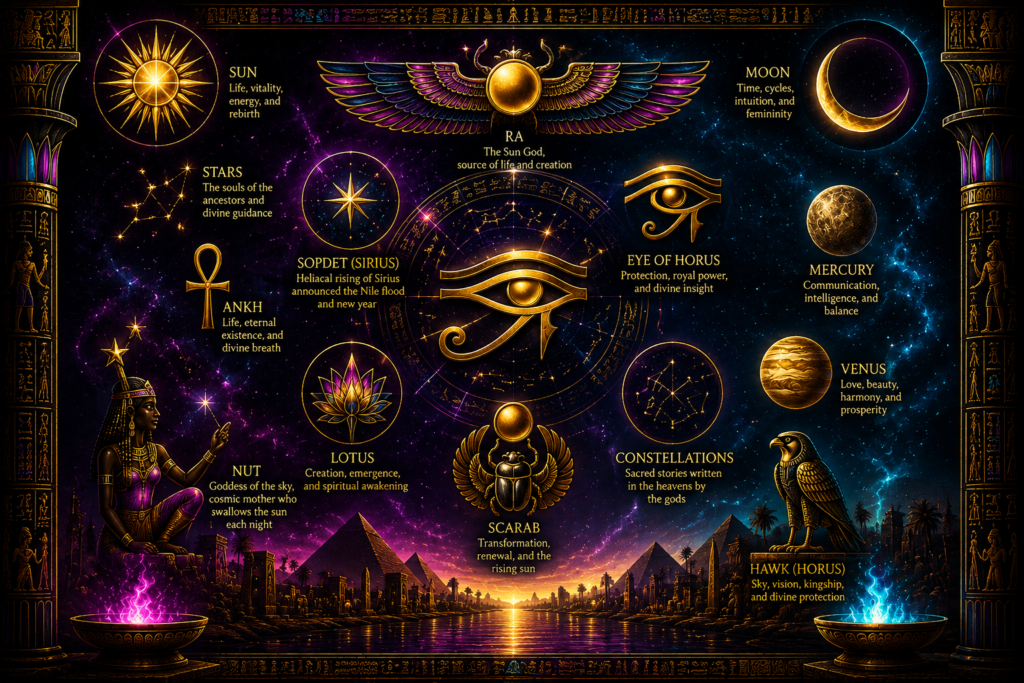
The solar deity Ra represented the Sun and was closely associated with creation, kingship, life, light, and cosmic renewal. Egyptian religious traditions described the Sun moving across the sky during the day and traveling through the underworld at night before being reborn at dawn.
This daily cycle became a powerful symbol of death, regeneration, and eternal renewal.
The solar disk appears frequently throughout ancient Egyptian art. It can be seen above deities such as Ra and Hathor and became especially important during the reign of Akhenaten, when the Aten, represented as a solar disk with rays extending toward the royal family, became the focus of state religion.
The Moon and Cycles of Time
The Moon also played an important role in ancient Egyptian religion and timekeeping.
Its changing phases provided a visible celestial cycle that could be observed and incorporated into systems for measuring time. Lunar associations were connected with several Egyptian deities, including Khonsu and Thoth.
Khonsu became an important lunar deity, particularly at Thebes. Thoth, the god associated with wisdom, writing, knowledge, and calculation, also possessed lunar connections.
Because the Moon changes predictably throughout the month, it became associated with cycles, measurement, renewal, and the passage of time.
Stars and the Egyptian Afterlife
Stars held profound religious significance in ancient Egypt.
Some of the earliest surviving Egyptian funerary texts connect the deceased king with the stars. The Pyramid Texts, inscribed inside royal pyramids beginning in the Old Kingdom, contain references to the king ascending into the sky and joining divine or imperishable stars.
The northern circumpolar stars were particularly significant because they appeared to remain continuously present in the northern sky. Their enduring presence made them powerful symbols of eternity and immortality.
The night sky therefore represented more than an astronomical landscape. It was also connected with ancient Egyptian ideas about the afterlife and the eternal existence of the deceased.
Sirius and the Coming of the Nile
One of the most important stars observed by the ancient Egyptians was Sirius, known in Egyptian tradition as Sopdet.
Its heliacal rising, when Sirius became visible shortly before sunrise after a period of invisibility, occurred around the season associated with the annual Nile inundation.
Because the Nile flood was essential to ancient Egyptian agriculture, Sirius became closely connected with renewal, fertility, seasonal change, and the Egyptian calendar.
Sopdet was represented as a goddess and was associated with the celestial and agricultural cycles that shaped Egyptian life.
Rather than suggesting that Egyptians used Sirius to predict individual fortunes, the evidence demonstrates something more concrete: careful observation of the heavens helped ancient Egyptians recognize and organize important cycles of time.
Orion and Osiris
The constellation we know as Orion also had important ancient Egyptian associations.
Ancient Egyptian texts connect Sah, a celestial figure associated with Orion, with Osiris, the god of death, resurrection, and the afterlife.
This relationship reinforced the connection between the night sky and Egyptian beliefs surrounding regeneration and eternal existence.
Together, the associations involving Orion and Sirius demonstrate how astronomical observations could become intertwined with mythology. The sky was understood through stories about gods, creation, death, and rebirth.
The Decans: Ancient Egyptian Star Groups
One of ancient Egypt's most distinctive contributions to celestial observation was the use of decans.
The decans were 36 groups of stars or celestial markers whose successive appearances were used in systems for dividing the night and organizing the calendar. Lists and representations of decans appeared on coffins, astronomical ceilings, and other religious monuments.
During certain periods, their successive risings helped ancient Egyptians measure the hours of the night.
The decans are particularly important because they demonstrate that ancient Egyptian celestial knowledge had practical applications alongside its religious significance. Observation of the stars could help organize time, ritual activity, calendars, and religious concepts of the heavens.
Nut: Goddess of the Sky
One of the most recognizable representations of the Egyptian cosmos is Nut, goddess of the sky.
Nut was frequently depicted as a woman arching her enormous body over the Earth. Stars could be shown covering her body, transforming the goddess herself into an image of the celestial realm.
According to ancient Egyptian cosmological traditions, Nut was associated with the daily cycle of the Sun. The Sun could enter her body in the evening and emerge again in the morning.
Her imagery therefore represented the sky, cosmic cycles, protection, rebirth, and the continuous renewal of creation.
The Eye of Horus and Celestial Symbolism
The Eye of Horus, or Wedjat Eye, is one of the most famous symbols from ancient Egypt.
Its primary meanings included healing, protection, restoration, and wholeness. The symbol originates from mythological traditions involving Horus and his struggle with Seth, during which Horus's eye was injured and later restored.
The eyes of Horus could also acquire celestial associations with the Sun and Moon in Egyptian religious thought.
For this reason, the Wedjat Eye should not simply be described as an ancient Egyptian astrology symbol. Its meaning was much broader and deeply rooted in ancient Egyptian mythology, protection, royal power, and restoration.
The Ankh and the Gift of Life
The ankh is another symbol frequently associated today with Egyptian spirituality.
In ancient Egyptian art, however, its meaning is much clearer: the ankh represented life.
Gods are often depicted holding the ankh or presenting it toward a king, symbolizing the divine granting of life.
Although the ankh was not specifically an astrological symbol, it belongs to the larger symbolic language through which ancient Egyptians represented relationships among life, the gods, nature, kingship, and cosmic order.
Ma'at and the Order of the Universe
To understand ancient Egyptian interpretations of the cosmos, it is also important to understand Ma'at.
Ma'at represented concepts including truth, justice, balance, order, and proper cosmic arrangement. Egyptian religion imagined the universe as something that required order to be maintained against the forces of disorder.
The predictable movements of celestial bodies fit naturally within this worldview. The Sun rose and set, stars followed recognizable patterns, seasons returned, and the Nile followed recurring environmental cycles.
Celestial order could therefore reflect the broader ancient Egyptian understanding of an ordered universe.
Did Ancient Egyptians Practice Astrology?
The answer requires an important distinction.
Ancient Egyptians certainly practiced sophisticated astronomical observation and connected celestial phenomena with gods, religious rituals, calendars, kingship, and the afterlife.
However, the popular idea of an ancient Egyptian zodiac consisting of twelve personality signs directly inherited from Egypt's earliest periods is misleading.
The twelve sign zodiac familiar today developed from earlier Babylonian traditions and was transmitted and transformed through the Hellenistic world. Zodiac imagery became prominent in Egypt particularly during the Greco Roman period, especially under the Ptolemies.
One of the most famous surviving examples is the Dendera Zodiac, originally located in the Temple of Hathor at Dendera. Its imagery combines Egyptian religious figures with zodiac constellations and other celestial representations.
By this later period, Egypt had become an extraordinary meeting place where Egyptian, Greek, Babylonian, and other astronomical and astrological traditions interacted.
Were the Stars Used to Interpret the Will of the Gods?
Celestial phenomena were understood within a religious universe populated by divine forces. The movements of the Sun, Moon, stars, and planets could carry religious significance, while celestial observation was connected with temple culture and systems of timekeeping.
However, claims that ancient Egyptians throughout all periods routinely used astrology to predict every individual's destiny should be treated carefully.
The strongest historical evidence reveals a civilization deeply interested in astronomy, calendars, celestial cycles, divine symbolism, funerary religion, and cosmic order. More recognizable forms of horoscope astrology became increasingly important in Egypt during the Greco Roman era.
This distinction makes ancient Egyptian celestial knowledge more compelling, not less. Ancient Egyptians developed complex ways of observing and representing the heavens long before later astrological traditions flourished in the country.
The Enduring Meaning of Egyptian Celestial Symbols
Ancient Egyptian celestial symbols reveal a worldview in which the heavens, religion, nature, and existence were closely connected.
The Sun represented renewal and divine power. The Moon reflected cycles and time. Sirius marked an important seasonal transition. Stars represented eternity and the celestial afterlife. Nut embodied the sky, while astronomical systems such as the decans helped Egyptians measure the night.
These symbols were not simply mysterious signs used to predict the future. They formed part of a much larger Egyptian understanding of a living and ordered cosmos.
Thousands of years later, ancient Egyptian celestial imagery continues to fascinate people because it reflects one of the oldest questions people have asked while looking toward the heavens:
What can the sky tell us about our place in the universe?