Long before modern observatories and mechanical clocks, the people of ancient Egypt watched the sky with remarkable attention.
The rising and setting of the sun, the changing phases of the moon, and the recurring appearances of particular stars created patterns that could be observed across days, seasons, and generations. These celestial cycles became intertwined with Egyptian systems of timekeeping, calendars, religious observance, agriculture, kingship, and ideas about cosmic order.
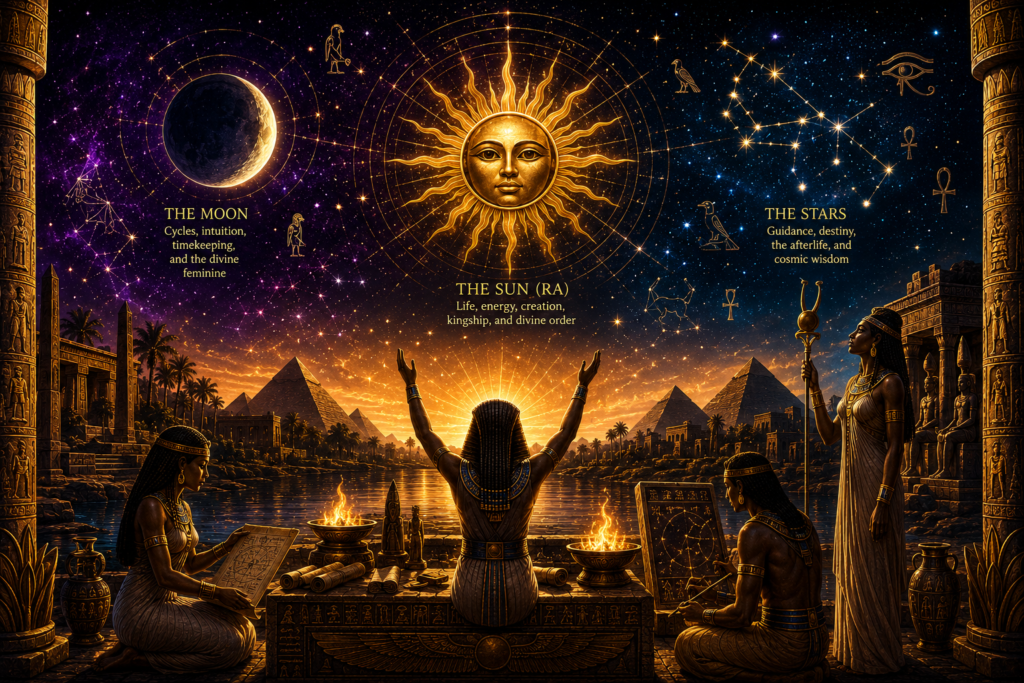
For the ancient Egyptians, however, the sky was not simply a scientific object separate from religion. Celestial observation existed within a worldview in which the natural and divine worlds were closely connected.
The heavens could function simultaneously as a clock, a calendar, a sacred landscape, and a visible expression of order.
Why the Sky Mattered in Ancient Egypt
Ancient Egyptian civilization depended on understanding recurring cycles.
Day followed night. The moon changed through recognizable phases. Stars disappeared and returned at predictable times of the year. The Nile rose and fell seasonally. Agricultural activity likewise followed patterns of growth, harvest, and renewal.
Egyptians observed these rhythms and incorporated them into methods of organizing time.
Their 365-day civil calendar contained 12 months of 30 days, followed by five additional days. The year was divided into three seasons traditionally known as Akhet, Peret, and Shemu, broadly connected with inundation, agricultural growth, and harvest.
Celestial observation also helped Egyptians measure shorter periods of time, especially during the night.
Yet astronomy was not isolated from Egyptian religion. The recurring order visible in the heavens fit naturally within an Egyptian worldview that placed enormous importance on Ma'at—truth, balance, proper order, justice, and the maintenance of harmony in the cosmos and society.
The predictable return of celestial phenomena made the sky one of the most powerful visible examples of recurring cosmic order.
The Sun: Life, Kingship, and Daily Renewal
No celestial body was more immediately important than the sun.
Its daily appearance brought light and warmth to the Nile Valley, while its regular disappearance and return offered a powerful natural image of continuity and regeneration.
Ancient Egyptian religion developed several important solar traditions. Ra became one of Egypt's major solar deities, while other gods could acquire solar characteristics or become closely associated with the sun.
The sun's journey was understood through different divine manifestations and religious traditions rather than through one unchanging explanation across all periods of Egyptian history.
Sunrise carried particularly strong associations with renewal and emergence.
The scarab beetle, associated with Khepri, became an important symbol of the rising sun and renewed existence. Ra represented the sun in other aspects of its power and celestial journey, while Atum could be associated with the setting sun and completion.
These relationships demonstrate how Egyptians interpreted the daily solar cycle as something far more significant than the movement of a bright object across the sky.
The sun embodied continuity.
Every sunset was followed by another dawn.
The Night Journey of the Sun
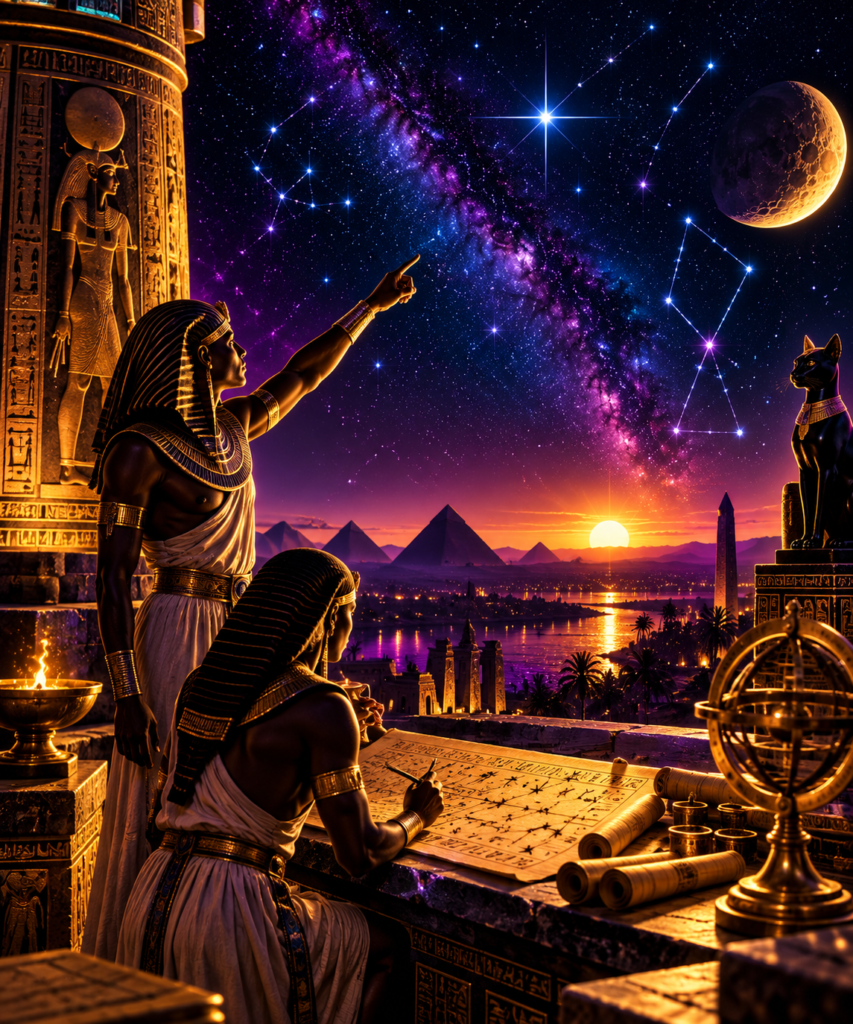
Ancient Egyptian funerary texts developed elaborate descriptions of what happened after sunset.
In several traditions, the solar deity traveled through the Duat, a realm connected with the night, the gods, transformation, and the dead.
The journey was not simply a story about darkness.
It explained how the sun could disappear in the west and nevertheless emerge renewed in the east each morning. Texts and images found in royal tombs describe stages of this nocturnal journey and the divine forces encountered along the way.
The daily cycle of disappearance, transformation, and reappearance became closely connected with Egyptian ideas about death and renewed existence.
For the Egyptians, the sky therefore presented a cosmic pattern that was repeated every day.
The Moon: A Celestial Measure of Change
The moon offered a different type of cycle.
Unlike the sun's daily rhythm, the moon visibly changed its appearance over a longer period. Its phases provided an observable way of tracking time and were important within Egyptian religious calendars.
Evidence indicates that lunar reckoning continued alongside Egypt's civil calendar, particularly for determining the timing of certain religious observances and festivals.
The moon also had connections with several Egyptian deities.
Khonsu became one of the best-known lunar gods, particularly at Waset, modern Luxor. His name is commonly understood in relation to movement or traveling, making his celestial identity especially appropriate for an object that visibly moves through the night sky.
Thoth, the deity of writing, knowledge, calculation, and wisdom, also possessed important lunar associations.
The moon's repeated waxing, fullness, waning, disappearance, and return made it another powerful expression of celestial renewal.
Sopdet: One of Ancient Egypt's Most Important Stars
Among all the stars visible from Egypt, Sopdet held exceptional significance.
Today, the star is commonly called Sirius.
Sopdet is the brightest star in the night sky, and its annual heliacal rising—its reappearance shortly before sunrise after a period of invisibility—became an important event in Egyptian timekeeping and religious thought.
Its appearance occurred approximately around the period when the first signs of the Nile's annual inundation traditionally became important in Egypt.
This relationship gave Sopdet strong associations with the Egyptian New Year, renewal, and the seasonal transformation of the Nile Valley.
But an important distinction is necessary.
Sopdet should not be described simply as a magical device Egyptians used to predict the exact arrival of the Nile flood every year.
Egypt's civil calendar contained 365 days, slightly shorter than the true solar year. As a result, the civil calendar gradually shifted relative to the astronomical and agricultural seasons.
The relationship between Sopdet, New Year, and the inundation was therefore historically significant but more complex than the common claim that Sirius functioned as a perfectly fixed annual flood alarm.
That distinction gives us a more accurate understanding of Egyptian astronomical knowledge.
Sopdet as Both Star and Divine Presence
Ancient Egyptians did not necessarily separate a celestial body from religious meaning in the way modern scientific culture often does.
Sopdet could be understood astronomically while also being personified as a goddess.
She became associated with renewal and the arrival of the new year and was eventually closely linked with Isis.
This illustrates an important principle when studying Egyptian astronomy:
Observation and religion were not competing explanations of the sky.
The Egyptians could recognize recurring astronomical behavior while simultaneously understanding that celestial phenomenon within their religious worldview.
Sah and the Celestial Realm of Osiris
Another important celestial figure was Sah, traditionally associated by modern scholars with the region of the sky corresponding broadly to Orion.
Sah became closely connected with Osiris, one of ancient Egypt's most important deities of death, regeneration, and renewed existence.
The association between Sopdet and Sah also acquired religious importance through their connections with Isis and Osiris.
It is better, however, to begin with the Egyptian figures Sopdet and Sah rather than imposing modern constellation boundaries directly onto Egyptian astronomy.
The Egyptians organized and interpreted the sky according to their own celestial traditions.
Their sky was Egyptian.
Stars and Eternal Life
Stars also played an important role in Egyptian ideas about death and immortality.
This is especially evident in some of the oldest surviving Egyptian religious writings: the Pyramid Texts.
These inscriptions, first preserved inside royal pyramids during the Old Kingdom, contain passages describing the deceased king ascending into the heavens and existing among divine and celestial beings.
Particularly important were stars in the northern region of the sky that appeared not to disappear beneath the horizon.
To Egyptian observers, these seemingly enduring stars provided a compelling image of permanence.
The deceased king could therefore be imagined as joining a celestial realm that appeared eternal.
This connection between the dead and the stars became one of the most remarkable features of ancient Egyptian royal funerary religion.
Decans: Turning the Night Sky Into a Clock
One of the clearest demonstrations of Egyptian astronomical observation is the system of star groups now conventionally called decans.
Egyptians tracked groups of stars whose appearances changed systematically throughout the year.
These stellar patterns could be used to divide and measure the night.
Evidence for this practice survives in remarkable diagonal star tables, particularly from the Middle Kingdom. Some were painted inside coffin lids, where rows and columns recorded sequences of celestial groups associated with different portions of the night and year.
Thirty-six principal decanal groups corresponded with successive ten-day periods.
As particular stars appeared in sequence during the night, their positions provided a means of estimating the passage of nighttime hours.
This was an extraordinary achievement.
Instead of relying on a mechanical clock, Egyptian observers could look toward the heavens and use the changing stellar environment as a system of timekeeping.
Egyptian Astronomical Ceilings
Ancient Egyptian astronomical knowledge also survives visually.
Tombs and temples preserve elaborate representations of the heavens containing stars, celestial deities, planets, decans, constellations, and other astronomical imagery.
One important example survives in the tomb complex associated with Senenmut, a high official during the reign of Hatshepsut in the 18th Dynasty.
Its astronomical ceiling contains celestial representations that provide valuable evidence for how Egyptians organized parts of the visible sky.
Later monuments preserve increasingly elaborate celestial imagery.
These ceilings should not be viewed simply as decorative star maps in the modern sense. They combined astronomical information with Egyptian religious and cosmological ideas.
The sky was simultaneously observed, organized, represented, and made sacred.
How Egyptians Measured Day and Night
Stars were not the only way Egyptians measured time.
During daylight, Egyptians could use the movement of the sun and shadows. Archaeological evidence includes shadow clocks and sundials, while water clocks provided another method of measuring hours.
At night, stellar observations offered an additional system.
Egyptian timekeeping therefore developed through several complementary technologies and observational practices rather than through one single invention.
These systems reveal a society deeply interested in structuring time.
That was important for administration and daily life, but it also mattered greatly for temples.
Rituals had to occur at appropriate times. Festivals belonged within calendrical cycles. Priestly responsibilities could be organized according to portions of the day or night.
Measuring time could therefore serve both practical and sacred purposes.
Did Egyptians Use the Stars to Predict the Future?
This question requires careful treatment.
Ancient Egyptians clearly believed that the cosmos, divine powers, the natural world, and events in human life were interconnected. They also practiced forms of divination and consulted religious texts and signs.
But this does not mean that the astronomy of pharaonic Egypt should automatically be described as the same kind of horoscope-based astrology familiar today.
The strongest evidence from much of pharaonic Egyptian history shows celestial observation being used for purposes such as:
- measuring time
- organizing calendars
- scheduling religious observances
- understanding seasonal cycles
- representing cosmic order
- supporting religious and funerary traditions
- orienting certain sacred and monumental structures
Systems involving zodiacal signs and personal horoscope traditions became much more prominent in Egypt during later periods when Egyptian culture interacted with other Mediterranean and Near Eastern astronomical traditions.
Those later developments should not be projected backward onto thousands of years of earlier Egyptian history.
Were Egyptian Monuments Aligned With the Heavens?
Some were.
Egyptian builders demonstrated an extraordinary ability to establish cardinal directions and orient major structures with considerable precision.
Solar and stellar phenomena appear to have played roles in the orientation of certain temples, pyramids, and sacred landscapes.
However, another distinction is important.
There was no single celestial alignment that explains every Egyptian monument.
Different structures were built in different locations, periods, and religious contexts. Local geography, the Nile, cardinal directions, solar events, particular cult traditions, and possibly selected stellar observations could all influence orientation.
Claims that every pyramid secretly points toward one particular star or that all Egyptian monuments reproduce a single celestial map go beyond what archaeological evidence can securely demonstrate.
The real Egyptian achievement is impressive enough without exaggeration.
Celestial Observation and Ma'at
The importance of the heavens becomes even clearer when considered through Ma'at.
Ma'at represented the proper order that sustained the universe and Egyptian society.
The sun returned.
Stars followed recurring paths.
The moon passed through its phases.
The Nile followed its seasonal rhythm, even though the exact scale and timing of inundation could vary.
For Egyptian religious thought, these recurring patterns existed within an ordered cosmos that had to be maintained against disorder.
The king was expected to uphold Ma'at on Earth.
The gods maintained cosmic processes.
Human religious activity participated in that relationship through temples, offerings, festivals, ritual, and proper conduct.
The heavens therefore provided more than information.
They provided a visible demonstration of continuity and cosmic order.
Astronomy, Agriculture, and the Nile
Agriculture was the foundation of Egyptian economic life, making seasonal knowledge extremely important.
The Nile's annual inundation deposited water and fertile sediment across agricultural lands. As floodwaters withdrew, fields could be prepared and planted before crops were eventually harvested.
Egyptians organized their year around this environment.
Celestial cycles contributed to the broader framework through which time and seasons were understood, particularly through the historical relationship between Sopdet and the beginning of the year.
Yet Egyptian farmers did not simply stare at the stars and receive exact instructions about what would happen next.
Their knowledge came from generations of experience with the Nile, seasons, landscape, weather, calendars, and celestial cycles together.
That distinction replaces romanticized claims with something even more significant: a civilization that accumulated and transmitted environmental knowledge over thousands of years.
The Egyptian Sky Was Both Observed and Sacred
One of the biggest mistakes we can make when studying ancient Egypt is forcing a modern division between astronomy and religion onto Egyptian civilization.
Modern astronomy is a scientific discipline concerned with the physical universe.
Ancient Egyptians did not approach the heavens through precisely the same categories.
A star could be carefully observed and simultaneously possess religious meaning.
The sun could measure the day while also manifesting divine power.
The appearance of Sopdet could provide calendrical information while also representing a goddess.
Stars could measure nighttime while simultaneously appearing in funerary traditions concerned with eternal existence.
These ideas were not contradictions within the Egyptian worldview.
They were parts of an interconnected understanding of the cosmos.
What Ancient Egyptian Astronomy Reveals Today
Ancient Egyptian celestial knowledge survives through archaeological objects, inscriptions, funerary texts, temple and tomb ceilings, calendars, water clocks, shadow clocks, and star tables.
Together, they demonstrate sustained observation of the heavens across many centuries.
The Egyptians recognized recurring celestial patterns and transformed those observations into systems for organizing time and understanding their environment.
But they also did something more.
They incorporated the heavens into their understanding of life, death, kingship, renewal, nature, and cosmic order.
The sun was not merely a source of light.
The moon was not merely an object passing through phases.
Sopdet was not merely the brightest star.
And the night sky was not simply empty darkness scattered with distant lights.
For the people of ancient Egypt, the heavens formed part of an ordered living cosmos—one whose recurring movements helped structure both earthly life and humanity's relationship with the divine.
That is the true influence of celestial bodies in ancient Egypt.
Suggested Internal Links for Kemet Hive
Where naturally relevant within the article, link to your existing Kemet Hive content on Sirius B and the Dogon tradition, The Egyptian Zodiac, Ancient Egyptian Celestial Symbols and Meanings, Atum, Nut, and other articles covering Egyptian astronomy and celestial beliefs.
For the Sirius B/Dogon article in particular, I would link it as a separate African astronomical tradition rather than suggesting that the Dogon interpretation is evidence for ancient Egyptian knowledge of Sirius B. This keeps both articles distinctive and historically responsible.
Kemet Hive SEO Package
SEO Title: Celestial Bodies in Ancient Egypt: Powerful Secrets of the Sun, Moon & Stars
Primary Focus Keyword: celestial bodies in ancient Egypt
Meta Description: Discover how celestial bodies influenced ancient Egypt as the sun, moon, Sopdet, stars, and celestial cycles shaped timekeeping, religion, calendars, seasons, and cosmic order.
Secondary Keywords: ancient Egyptian astronomy, celestial bodies ancient Egypt, stars in ancient Egypt, sun and moon ancient Egypt, Sopdet ancient Egypt, Sirius ancient Egypt, ancient Egyptian stars, Egyptian astronomy, Egyptian celestial beliefs, decans ancient Egypt, ancient Egyptian calendar, astronomy and religion ancient Egypt, Ma'at cosmic order, ancient Egyptian timekeeping
Suggested URL Slug: celestial-bodies-ancient-egypt
Excerpt: Explore how ancient Egyptians observed the sun, moon, Sopdet, and stars to measure time, organize calendars, guide religious observances, understand seasonal cycles, and express their powerful vision of cosmic order.
Primary Category: Ancient Egyptian Astronomy
Suggested Tags: Ancient Egyptian Astronomy, Celestial Bodies, Ancient Egypt, Sopdet, Sirius, Egyptian Stars, Egyptian Calendar, Decans, Ra, Khonsu, Ma'at, Egyptian Cosmology, Sun and Moon, Ancient Egyptian Religion, Egyptian Timekeeping
Featured Image File Name: celestial-bodies-ancient-egypt-sun-moon-stars.jpg
Featured Image Title: Celestial Bodies in Ancient Egypt – Sun, Moon and Stars
Featured Image Alt Text: Ancient Egyptian pyramids beneath a celestial sky filled with stars, a golden moon, and cosmic light representing astronomy in ancient Egypt.
Featured Image Caption: The sun, moon, stars, and recurring celestial cycles played important roles in ancient Egyptian timekeeping, religion, calendars, and concepts of cosmic order.
This version makes the article distinct from your Egyptian Zodiac and Sirius B articles. Its central subject is how Egyptians observed and used celestial cycles, rather than turning into another general astrology article. It also deliberately leads with Sopdet and Sah, with Sirius and Orion used for modern reader recognition rather than as the framework for Egyptian celestial thought.
For fact-checking, I relied especially on the Metropolitan Museum's treatment of Egyptian timekeeping and Sopdet, the Ancient Egyptian Astronomy Database, current Museo Egizio research into diagonal star tables, and specialist scholarship on Egyptian astronomical representations. These support the distinctions made above concerning the 365-day calendar, Sopdet's heliacal rising, decans, stellar timekeeping, and Egyptian astronomical imagery. (Museo Egizio)